For Threatened High School “Sweeney,” Lessons In The Woods

April 3rd, 2014 § 1 comment § permalink

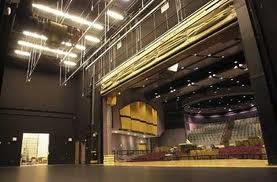
Timberlane High Performing Arts Center

Timberlane High Performing Arts Center

I have just returned from a trip to Plaistow, New Hampshire, where I went to support students, parents, alumni and members of the community who wanted to speak out against the cancelation of a production of Sweeney Todd at Timberlane High School, announced for production a year ago, but scheduled for 2015. In the wake of the response to the cancelation, the school scheduled an open forum to hear from the community on the issue. This was an important and rare step, since each and every decision of school administrators cannot possibly be opened to organized public discussion, with the media present as well.

But in creating the opportunity, the administrators of Timberlane opened the door to two-and-a-half hours of speaker after speaker extolling the caliber of the show, the importance of theatre in their lives, and how deeply connected they are to the school’s arts program.  Despite the opportunity, no one spoke up against the show. Even though some apparently made their feelings known privately to the administration, or in letters to local papers and on blogs, none would stand to say so in front of their peers in a public setting.

Because I don’t like to give speeches except when I’m invited to do so, I spoke at the session off the cuff, based on what I’d learned about the issue and the community in the days and hours leading up to the event in the high school cafeteria, attempting to address concerns specific to Timberlane. I want to share my remarks with you, with all of the imperfections of impromptu speech. I hope I spoke some sense and maybe even some truth.

The superintendent indicated he would render his decision very shortly, and as I write, a community awaits, as do I.

*   *   *

Into the woods – you have to grope
But that’s the way you learn to cope
Into the woods to find there’s hope
Of getting through the journey.
Into the woods, each time you go
There’s more to learn of what you know…

Those are the words of Stephen Sondheim. Stephen Sondheim is the greatest composer of musical theatre in the past 50 years and possibly in the history of the American musical theatre. His work deserves to be seen and while his work has never been known to as somebody to easily please audiences, the challenge that he presents to every audience is a special challenge for students.

I’ve come up from New York to represent to you that there are people far beyond this community who care about each and every student who wants a great experience in the arts. I don’t do it because I believe that every student in every drama club will go on and become a professional artist. Indeed, I suspect most of them won’t. I come here because I want better audiences for the arts and by being involved in the most challenging work at this stage in their lives, those who take part in his work, those who see this work, become better audiences so that we can have better arts.

You have an extraordinary performing arts center – I’m still in awe of that turntable, I’ve never seen anything like it – and with a facility like that you should be able to use it to its fullest.

No, you can’t please everyone all of the time. I’m amazed to find the number of performances that you have here. In the case of this show, it will not please everyone, it never has. But it is a masterwork of musical theatre. The original cast recording was just announced to be inducted into the Library of Congress today.

People like to focus on the more lurid aspects of Sweeney Todd. But Sweeney Todd is not about its actions; Sweeney Todd is about morality, about justice, about the lengths people will go to and the lengths they’re driven to when they face injustice.

No, I would not bring a seven year old to Sweeney Todd. But I believe and I am told that there are many other opportunities in this community for people of all ages at different times to have different experiences. This is not – and I do know this script, I know this script particularly well – that you are not proposing to do the original script. Stephen Sondheim has authorized a school edition of Sweeney Todd which removes some of the material which would be difficult for high schools to endorse or for students to perform. It’s not neutered but it is toned down. Countless high schools do this show every year across the country. The students here should be able to have the opportunities that their peers, who they will be facing when they go on to college, had at their schools.

There are many stories of school shows which are canceled at the last minute. This is by no means the case – you have a year. You have a year to place the show in context, to inform not just in the students in the drama club, but all of the students, all of the parents, all of this community, through a range of educational activities that can be put into place. Other schools have done it. I pledge myself as a resource to help you find what’s been done elsewhere, what’s been successful and even people who can come in and help with those programs. Nobody would walk into this show and be surprised by what is happening. Frankly, given what has surrounded this in the past week, I think we’re past that.

Fundamentally, I believe student theatre is first and foremost for the students who make it and then if there is there is the opportunity for people beyond their family members to come and see it, that’s fantastic. But the experience is for the students. That’s what school is for.

I truly hope that a year from now, I will be driving back up from the city to see Sweeney Todd.

Stephen Sondheim is a vastly smarter man than I am, so I will finish again with his words.

Careful with what you say,

Children will listen.
Careful you do it too.
Children will see.
And learn.
Guide them but step away,
And children will glisten.
Tamper with what is true,
And children will turn,
If just to be free.
The more you protect them,
The more they reject you.
The more you reflect them,
The more they respect you.

Thank you very much.

*   *   *

Update, April 10: I am delighted to report that late this afternoon, Dr. Earl Metzler of the Timberlane School District reversed the decision to cancel Sweeney Todd and the show is now back on the Timberlane High schedule for 2015. The decision came about thanks to the respectful yet passionate efforts of the students and parents of Timberlane and members of the greater Plaistow community. I look forward to seeing them once again, and my favorite musical, a year from now.

Call To Action: Support “Sweeney” At Timberlane High

March 31st, 2014 § 1 comment § permalink

timberlane owls 2Sweeney Todd at Timberland High in Plaistow NH seems to have a lot in common with the threatened but ultimately triumphant production of Rent this past weekend in Trumbull CT. A musical is announced months in advance and, after some time has passed, the administration, citing both a failure to follow a previously unknown approvals process and concerns over inappropriate content, cancels the production. In Trumbull, it was just weeks before auditions were to begin; in Plaistow it’s over a show in the next school year.

sweeney toddIf you look beyond the decision itself, politics at the school board level, in each case, seem to coincide with the dispute. In Trumbull, the school board suddenly ruled that only town residents would be permitted to speak at meetings, for the first time; in Plaistow, there was a declaration, currently being challenged on constitutional grounds, that once a decision is made by the school board, all members have to support it publicly.

A mature-themed school musical is once again at the center of a local controversy, but the pattern is a national one. While I urge you to read about the Plaistow situation in its entirety, as well as a sharply worded local editorial about the free speech issues regarding the school board, here’s the gist of what’s transpired, as reported by Alex Lippa of the Eagle-Tribune.

Timberlane Regional High School officials have canceled next year’s production of the musical “Sweeney Todd,” citing concerns over the nature of the script.

“I want an all-inclusive performance that the community can enjoy,” Superintendent Earl Metzler said yesterday. “We were uncomfortable with the script and agreed that this was not the right time or place for the performance.”

“Sweeney Todd” tells the story of a barber who murders his victims. His landlady then bakes them into pies and sells them.

The decision has caused a stir in the Timberlane community and efforts are being made through social media to convince the administration to reverse the decision.

“In the past, we have done shows with a wide range of difficult material and none of them have ever been opposed until now,” Timberlane senior Alexis Bolduc said. “And the only people who seem to disapprove of this show are the ones in charge.”

I have made the argument that high school theatre should be, first and foremost, for the students. I have made the argument that school theatre should challenge students so they can grow and learn. There’s little point in recounting those.

However it does appear that Dr. Metzler, the superintendent, is giving some manner of weight to missives he’s begun receiving from outside the community, triggered by social media and websites carrying the Timberlane tale of Sweeney Todd to the larger world. That’s where you come in.

If you are a student, parent, teacher or administrator who has had the experience of Sweeney Todd at your high school, recently or in past years, take a moment to write the Timberlane leadership and tell them about how the show was received and what it meant. If you are a theatre professional who cares about our next generation of theatre artists and the next generation of audiences, write and tell them why you think students should – perhaps even must ­– take on work like Sweeney Todd. If you are an audience member, a theatre aficionado, who believes in the value of Sweeney Todd, write about that and why students should be able to explore it in the Sondheim-approved, judiciously pruned school edition. Let’s demonstrate the level of commitment that exists among those who believe in the arts, and that we care not only what happens in the big cities, but in each and every community where theatre and the arts as a whole can be nurtured, not just in your own backyard.

The auditorium of Plaistow High

The auditorium of Timberlane High

Worth keeping in mind? Timberlane has already done The Laramie Project. Twice. That says something about the people in the Timberlane district, although there have been some subsequent leadership changes and the show was confined to the smaller studio space on the Timberlane campus. Let me also note that Dr. Metzler will be leading an open conversation with the community this coming Wednesday, April 2, so an iron wall has not necessarily gone up, despite the announced cancelation. The distinct possibility for constructive dialogue remains, so I urge you to refrain from sarcasm, from rash generalizations, from anger, and instead focus on your stories, your experiences, your thoughts and how they can apply to the students in Plaistow.

Let’s operate under the genuine assumption that everyone wants the best for the students and just have differing perceptions of what that is. I’ve been strident in some of my past writing, but the Trumbull students proved you get more with judicious diplomacy than with unbridled passion, valuable as that can be at certain times.

You can share your thoughts and experiences with:

Dr. Earl Metzler, Superintendent, Timberlane Regional School District, 30 Greenough Road, Plaistow NH 03865

Mr. Donald Woodworth, Principal, Timberlane Regional High School, 36 Greenough Road, Plaistow, NH 03865

And while you’re at it, would you copy me as well?  I’m driving to New Hampshire on Wednesday and I’d like to be able to print out and share a sheaf of thoughtful, supportive and constructive messages with those those in attendance at the forum.

Sweeney Todd is, at its core, about how insidious miscarriages of justice can be in a society, driving some to heinous acts in retaliation – ultimately for nought. That’s a valuable lesson, especially when told by an artist as skilled and respected as Stephen Sondheim. Let’s hope it can still be sung at Timberlane High next school year.


How You Can Save Arts Journalism Starting Right Now

March 26th, 2014 § 8 comments § permalink

clickingI am going to take it for granted that, since you’ve opted to read this article, you care about the arts. I’m also going to save time and typing by assuming that you appreciate media coverage of the arts and that you realize that without the attention of the media, it will be ever harder for the arts to share their news, their work and their value locally, nationally and internationally.

Since we are agreed, I will proceed directly to my point.

If you want to see intelligent, comprehensive coverage of the arts – features and reviews alike – then you’ve got to start clicking. Journalism is well on its way to being a numbers game for most outlets. How many people clicked on a story or video, how many times was it liked or shared, how much time was spent looking at it? We are already seeing journalism sites paying writers base salaries with bumps or bonuses based on online metrics; outlets say they are dropping certain types of coverage because it’s simply not generating enough traffic. It’s not enough to be happy that arts coverage exists, you have to actually engage with it to insure its survival and the job survival of those who create it.

Clicks mean eyes and eyes mean advertisers. As print becomes an ever-harder sell, online advertising grows ever more important to outlets. Even back in the days pre-internet, I encountered cuts in arts coverage because the arts didn’t generate enough advertising revenue (whereas advertisers loved sports sections and we get regular features about new cars because auto dealers buy big ads). Even now, arts spending online is a small sliver of online advertising, so our best means of supporting arts coverage is by actually reading it.

Let’s face it: anyone with a WordPress blog knows how many people read each piece they post (yes, I’m watching you). But that’s amateur hour compared to the realtime and cumulative algorithms and analytics applied at big media outlets. There are teams of people looking at clicks, links and likes for every story, and media empires are being built on click-bait methodology (why, hello BuzzFeed). It’s running the show in many places and it can’t be ignored.

FB shareSo here’s what I propose. Every morning, when you get online, go to the arts section of your local media outlets, seek out their arts and entertainment stories, and click of them. Don’t click on each in rapid succession, but spend 30 to 45 seconds on each one (remember your multiple browser windows). You have to wait a bit because one analytic is stickiness or hang-time or whatever it’s called now, namely whether people are really engaging with coverage. A click on and immediate click off looks like you got there by mistake. And needless to say, it certainly won’t hurt in the least if you actually read a story or watch a video while you’re at it.

I should also note that just liking or retweeting a story isn’t enough: you actually have to look at it. Sometimes you’re just liking a friend posting about a story, not the story or video itself, and that’s an important difference. There have been studies that show that many people retweet items without ever actually reading them, and anecdotally I know that to be true: I often see my own tweets with embedded links that have more retweets than clicks. You’ve got to stop and look. That said, on Facebook likes and shares feed into an algorithm that’s sure more people might see the post featured in their feed, and retweets do the same, so be liberal with those too.

tw retweetYou need to share this idea with your staffs, your audience, your donors. This can’t be an effort by a couple of thousand core die-hards; this has to be a movement and it has to be sustained. I do my part every day in curating the articles I share on my twitter feed. You don’t need to be as exhaustive as I am, but whether you seek out a story or if it comes across your social media feed, click on it (often click on opera and symphony stories even though I rarely attend them). If the arts generate eyes, if they generate numbers, you’re going to have a direct impact on how the arts are viewed by the media decision makers. Clicking on the occasional ad next to an arts story matters too.

I’d like to give this idea some snappy name that the field can adopt, but I’m only coming up with corny and possibly inexplicable ideas like “Click 10 For The Arts,” which in my mind is shorthand for remind you to click on 10 arts stories daily. I hope that if people buy into this idea, someone will come up with something clever.

But unlike the world of journalism 25 years ago, where outlets only knew how many papers they sold, it’s now exceedingly easy to know what gets traffic and what doesn’t. No need for audience surveys when our every move online is recorded. If we don’t actively work to pump up the stats for arts coverage, it’ll continue to erode.

Screen Shot 2014-03-26 at 10.56.12 AMTo quote Joni Mitchell, “you don’t know what you’ve got ‘til its gone,” and we’ve lost too much already. So next time you want to take a quiz about what Shakespeare villain or what Sondheim character you are, at least spend the equivalent amount of time reading articles about Shakespeare plays or Sondheim shows. Because while the former may be fun, it’s the latter that will actually sustain arts journalism and sustain the arts.

P.S. Thanks for clicking on this story. Now would you be so kind to like it, favorite it, share it, retweet it and so on? And yes, I’ll know if you did.


Obscuring The Better Angel of High School Theatre

March 11th, 2014 § 3 comments § permalink

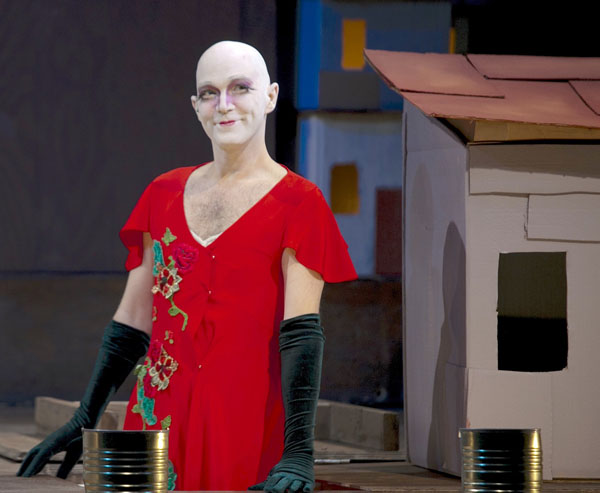
Taylor Mac as Shen Te in The Good Person of Szechwan

Taylor Mac as Shen Te in The Good Person of Szechwan

Last year, the actor Taylor Mac played the title role in the Foundry Theatre’s acclaimed production of Brecht’s The Good Person of Szechwan. This tale of a downtrodden woman who secures power in ancient China by cross-dressing as a man gained in depth and complexity from having the male Mac portray the female character Shen Te, only to transform into the male Shui Ta. Gender identity layered upon a story of gender discrimination enhanced the play, which managed to deliver numerous messages about society’s prejudices and ills in the context of a highly inventive staging.

I fear that next week, when a female high school teen plays the male drag queen Angel in a Long Island school production of Jonathan Larson’s Rent, depth will be intentionally lost, in service of obscuring the homosexuality that is essential to the character.

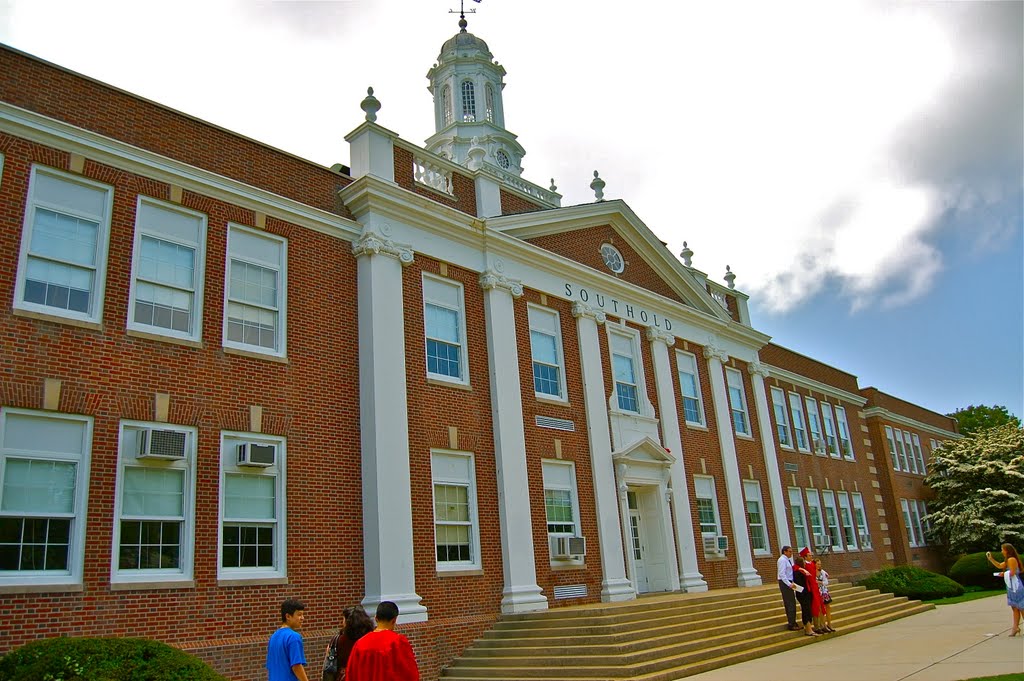
I first learned of this plan back in December and wrote about it at the time, deeply troubled by the language Southold High’s superintendent used in an article in The Suffolk Times. Amid comments about a committee to “adjust” the script in an effort to make it “fitting for the community,” the possibility of a young woman playing Angel was not ruled out. I subsequently heard from anonymous sources that this had come to pass, and I’ve kept tabs on the local paper for updates. Confirmation of the cross-gender casting came only yesterday, via The Suffolk Times, ten days before the production begins its single four-performance weekend.

In explaining the casting decision, comments from the school authorities are inconsistent.

“The gender of the character can’t be changed, but any student can play that character,” production co-director Casey Rooney is quoted as saying. “A girl that we have cast in this part is the best person for the role.”

Wilson Jermaine Heredia as Angel in Rent

Wilson Jermaine Heredia as Angel in Rent

This has been rationalized with the claim that the young woman cast will be playing Angel as a male. As an advocate of non-traditional, inclusive, race-blind and gender-blind casting under most circumstances, I normally applaud opening up male roles to women. So if the school had an ongoing practice of gender-neutral casting, I’d accept that statement at face value. But there’s no evidence that this has ever occurred before at Southold, and the superintendent’s December statements strongly suggest another motivation, namely fear of the gay character of Angel, truthfully portrayed, on a public school stage.

The new article continues:

“Although the script calls for a male actor in this part, Mr. Rooney said the school has the discretion to change the gender.
 Ms. Baumann [the musical director] said this arrangement isn’t uncommon.

‘With some schools, maybe there are drama clubs that have two guys and 20 girls,’ she said. ‘So, you do have to make adjustments’.”

It’s worth noting that in explaining the decision, Ms. Baumann cites other unnamed schools, not Southold itself. An extreme scenario is proffered that may well exist at “some schools,” but since there are 48 students in Rent at Southold, are we to understand that there are only five “guys” in the cast?

Superintendent David Gamberg weighs in as well. “Rent-School Edition is about a group of young people trying to discover who they are, what they stand for and who they can trust,” Mr. Gamberg said. “Rent-School Edition is not about homosexuality. It is not about AIDS and it is not about drug use.”

rent logoI agree with Mr. Gamberg’s first sentence, about young people discovering themselves, and perhaps it’s not entirely wrong to say that Rent – school edition or original script – isn’t about homosexuality, AIDS or drug use. But those three elements are essential to the story and the characters. Even in the toned-down high school script, they are far from absent or diminished in the lives of Jonathan Larson’s characters. Explicitly downplaying those topics is a disservice to the show and to the students in it, and reads as spin control.

Rent is an opportunity for students to explore our complex world, gaining knowledge and sensitivity along the way. For those at the school who are gay (out or not) or have friends or family members who are gay, for those dealing with substance abuse issues in their lives, for those who don’t realize that AIDS remains a major world health concern, Rent is an extraordinary prism on aspects of daily life that surely exist in Southold, NY, albeit in different clothes and homes than those in the show.

The excuse that the role of Angel has been cast with a girl playing a boy who dresses as a girl has been sufficient to satisfy the licensing house and the Larson estate; I am far from sanguine about it. Rent is not a Shakespeare comedy. I believe that even with the words in the script rigorously adhered to, the audience, both student and adult, will see a romance between a flamboyant girl and her male partner, made safe a la Tootsie. Whatever the talents of the young woman cast as Angel may be, I strongly doubt, given her age and presumably limited experience, she is capable of embodying a male character fully, in the way that Linda Hunt managed on film in The Year of Living Dangerously, given the intentional inversion of gender iconography that is inherent in drag.

I can infer a variety of motivations – perhaps at worst homophobia on the part of the administration, at best maybe the unwillingness of any capable boy at the school to play a drag queen. Yet the sheer fact that the school superintendent is discussing the casting decisions of a high school play suggests that there’s an awareness of something amiss here that must be carefully handled, something risky, something fraught with danger. However, I should acknowledge that, so far as any public reporting has indicated, the lesbian characters in the Southold production are played by women, and they are not merely BFFs.

Southold (NY) High School

Southold (NY) High School

As for the original discussion of being “sensitive to the community as a whole,” I’m also troubled that, to my knowledge, no one in the community has openly and vigorously opposed the approach the school is taking, only posting dissenting comments on the article in The Suffolk Times. Without someone – or a better still, a group of students and their parents – standing up for an accurate, honest and accepting portrayal of a gay character, I’m just an outside voice shouting over a distant fence, an online nuisance, an easily ignored agitator. It’s worth noting that while The Suffolk Times reported on an upcoming public meeting to discuss Rent, there does not appear to be a report on the content of the meeting itself, which would have been instructive.

The cancelled production of Rent in Trumbull CT was restored with help from a range of outside voices, but the success fundamentally belonged to the people of Trumbull, because they wanted to see the right thing done in their high school.  In the midst of the Trumbull fracas, I questioned whether, in 2014, high school students needed to be educated about homosexuality, AIDS and drug use, as the superintendent there suggested in arriving at a solution. I believed that these issues were prevalent enough in people’s lives and in the media that they would be redundant. Well, the adults at Southold High have proven me wrong – perhaps they need those lessons.

Disturbed as I am over the situation in Southold, I can’t quite bring myself to advocate for the cancellation of a high school show at this late date, to the disappointment of some five dozens students working on it. But I sincerely wish that the students, the community and perhaps most importantly the educators could get an education about the world we live in and how they’re undercutting a great work and a great learning experience. Sadly, all they’re teaching now is how to figuratively Photoshop that which they don’t like. If they’re not willing to both learn and teach, I hope they won’t attempt another show that is meant to grapple with real world issues again, until such time as they’re ready and able to deal with the challenges and complexity of real life on stage. At the same time, that would be an even greater loss for their students.


When A Theatre Review Condescends

March 3rd, 2014 § 34 comments § permalink

Fact: America’s newspapers are locked in a struggle for survival, fighting for financial stability and relevance at a time when money and attention increasingly focuses on online and video outlets.

Fact: Philadelphia’s newspapers are locked in a singularly ugly battle for survival, because after several instances of ownership turnover in recent years, the Inquirer and Daily News are now owned by a partnership in which the partners are suing one another over control of the business.

Fact: While newsroom cuts are the norm at papers across the country, and arts positions are being lost everywhere, Philadelphia is the largest city in the country which does not have a full-time theatre critic on staff at its daily newspapers, despite an array of professional theatre production in the city and surrounding area.

I lay these items out as preface for consideration of a single theatre review (which I hope you’ll read in its entirety), Toby Zinman’s Inquirer critique of the Arden Theatre Company’s production of Water By The Spoonful by Quiara Alegría Hudes, the play which received the 2012 Pulitzer Prize for Drama. This review has been the subject of a great deal of online comment as a result of a blog post on a site called “Who Criticizes The Critic?” The essay itself is “Critical Case Study #1: A Brutal Lack of Investment,” written by a pseudonymous author identified only as “criticcrusader.”

Armando Batista and Amia Desanti in Water BY The Spoonful at Arden Theatre Company

Armando Batista & Maia Desanti in Water By The Spoonful at Arden Theatre Company (Photo: Mark Garvin)

As the blog post circulated on Twitter and Facebook this past week – though it and the review are from late January – I saw a range of responses, from many who applauded the critique and from some who took issue with its legitimacy because of the anonymity of the author. I initially chose not to share it on social media because I’m troubled by criticism, let alone attacks, by unnamed voices on the internet. But I kept returning to the original review, and the critique of it, repeatedly. Then, by coincidence, I saw Hudes’ The Happiest Song Plays Last over the weekend at Second Stage, which brought the review to mind yet again; Song is the final piece in a trilogy of which Spoonful is part two.

I feel compelled to weigh in on Zinman’s review not because I make a habit of critiquing critics, but because I think her piece repeatedly crosses professional boundaries, in terms of what theatre, and all of the arts, should hope for from those who are paid to critique them, especially by major media outlets, even wounded ones. I know I’m echoing “Critical Case Study #1,” but I hope a bit more dispassionately. Those who discount “criticcrusader” for writing under an alias can make no such charge at me.

For transparency: though I went to college in Philly, I haven’t worked professionally in the city in 30 years, save for moderating some talks at the Philadelphia Theatre Company and doing some site visits for The Pew Center for Arts & Heritage. I do not know Toby Zinman or her editor Rebecca Klock. I have never attended the Arden Theatre and so I did not see this production. I cannot recall having ever spoken with the company’s leaders, though it’s possible I did at some point in the past.

And so.

It seems that the least we can hope for from a critic, whether staff or freelance, whether well-compensated or paid the pittance that is the shameful norm for most freelancers, is an informed opinion. Since Spoonful has received one of the highest awards given in theatre, it is not unreasonable to expect a critic to have a basic knowledge of that pre-existing work before attending it. Zinman has a Ph.D. in theatre and has written several books on the subject; she also teaches English at Philadelphia’s School of the Arts. She is far from a novice. Yet of Water By The Spoonful, Zinman writes:

“I imagined it might be about the global water crisis:

Consider the recent chemical tainting of residential water in West Virginia. Consider the drought and raging wild fires in California. Consider that more than 1.2 billion people on earth now live without a reliable source of fresh water.”

Why is this in a review? Even if Zinman elected to remain wholly ignorant of the work, what is the relevance of her musings on the title? Our water crisis is a perfectly legitimate concern, but it has nothing to do with the play. Print space is limited in any paper, so why use precious column inches on an irrelevant topic? Her aside accounts for more than 10% of the word total of the review.

“This play is about a bunch of crack addicts who do awful things and are, with the exception of Hudes’ recurring character Elliot, utterly boring and unsympathetic characters.”

In only the second paragraph of the review, Zinman has dismissed several drug-addicted characters as unsympathetic, without making any effort to explain why. Are struggling drug addicts, in fiction or in life, merely to be written off for their failings? As a central element of the story, this deserves as least as much space as the world’s water problems.

“Presumably, part of the script’s interest for Philadelphia audiences would be the local place-references, but mentioning Jefferson Hospital doesn’t redeem the play for me.”

Sure, audience members at the Arden might experience the odd frisson over hearing the name of a place they know mentioned, but given the productions the play has received in other cities, its locale seems hardly central to its existence or any production. To suggest it is only produced in Philadelphia because of its Philadelphia ties is callously dismissive.

“Yazmin (Maia Desanti) is the sanctimonious rich white girl who is, in ways I couldn’t follow, Elliot’s cousin/romantic interest/best friend.”

Yazmin is very clearly a Latina character. Zinman’s definition of her as “white” involves judging her based solely on the skin tone of the actress playing the role, ignoring any context within the play. Does Zinman doubt that individuals of differing skin colors can be related?

As with any critic, Zinman has every right to dislike the play. She has every right to dislike the production. But the reader has the right to expect some level of rationale for each, or for that matter a distinction between the two. From the review, it is impossible to know the source of Zinman’s poor opinion, save for her calling out of two lines which we can infer she finds wanting, and her mention of a slow pace. She neglects any mention of the physical production. Reading the review gives me the impression that Zinman was annoyed by the whole experience of seeing this play, and made no effort to engage with the play on its own terms.

The Philadelphia theatre scene has increased enormously since my days as a Penn student, filled with theatres and options that didn’t exist 30 years ago. While I will be the first to say that critics have zero responsibility for promoting or selling work for theatres, I think, and I hope most critics would agree, that theatres are deserving of reviews and critiques that adhere to professional standards, regardless of the hardships of the professional outlets that publish them. In my estimation, this review by Zinman fails, but the failing is not hers alone. Did her editor ask her for clarification of her points or suggest excising the extraneous? While presumably copy editors aren’t acting as fact checkers, the erroneous assertion about a character’s race could have been easily clarified by numerous online sources, let alone the readily available script.

As a blogger, I have no editor, no copy editor, no fact checker. I am solely responsible for the accuracy of what I write, and my integrity rests on that. At a professional newspaper, there are ostensibly more checks and balances, but – in my opinion – they failed in this case, in a way that no mere correction can erase or excuse. It calls into serious question the accuracy and validity of this critic’s voice in this case; I do not believe that this is emblematic of the state of theatre criticism nationally, which I value as an arts professional. But The Arden and its production, as well as Hudes’s play, deserve better than they got in terms of fair consideration of their work, regardless of whether the show was liked or not.

On a final note: this review follows on the heels of a very thoughtful piece on the role of a theatre critic by another freelance Inquirer critic, Wendy Rosenfield, writing for the Broad Street Review, in which she speaks of her support for “Theater that widens and deepens the scope of our regional scene.” I applaud that sentiment, but would like to paraphrase it, because Philadelphia – and all communities – deserve journalism that widens and deepens the scope of the city’s arts scene too. The two go hand in hand.

Update March 4, 11:30 am: As this post has circulated online, Jason Zinoman of The New York Times expressed his feelings that if I claim to be someone who believes in mutual respect between arts organizations and arts critics, I had failed to demonstrate it in this piece, by not sufficiently disavowing the tone, language and certain sentiments employed by the anonymous “criticcrusader.” It was my intention that the tone and content of my piece represented my approach to such dialogue, but I was indeed not explicit. Should anyone doubt my commitment to mutually respectful dialogue, let me make clear that the piece by “criticcrusader” was harsh, hyperbolic and unnecessarily personal, hardly the tone to be adopted when attempting to lobby for more considered and accurate writing; the anonymity is counterproductive as well. The thoughts in my piece, which may overlap with the earlier essay, are my own and I stand by them; however, to have not acknowledged what prompted me to write would have been dishonest.


The Stage: “Would You Like A Play With Your Food, Sir?”

February 27th, 2014 § 0 comments § permalink

When theatre professionals turn catty about work they’ve seen and disliked, they arrogantly and foolishly compare it to the work of amdram troupes (who are deserving of appreciation, not derision). But when they really want to draw a condescending laugh out of their peers, they invoke the institution of dinner theatre, imagining diners noisily chewing their way through shows. Who remembers the parody in the film Soapdish, which had Kevin Kline performing Death of a Salesman amid clattering tableware?

While dinner theatre may never garner respect under that name, the genuine merging of food and theatre is making inroads in the US at scales both grand and intimate. And in doing so, it fulfills two popular concepts that are much discussed in the arts these days – engagement and immersion.

In the past few weeks, I’ve experienced the spectrum of theatrical dining: a homely table laden with both store-bought and homemade desserts to accompany the faux village ceremony at the heart of Dog and Pony Theatre Company’s Beertown (a Washington DC import at NYC’s 59 E 59 Theatre). Then there was a Russian sampler at Natasha, Pierre and The Great Comet (at a tent in Times Square’s theatre district). At Queen of the Night (in the long-empty subterranean Diamond Horseshoe nightclub) there was a complete banquet with speciality cocktails and heaping platters of lobsters and beef. In each case, the food was completely integral to the show, rather than adjunct; this wasn’t just a quick bite during a lunchtime play or, God forbid, meatloaf juxtaposed with Miller.

What could be more immersive than eating? How can one possibly remain at a detached distance while sharing a table with other audience members, or when you’re exhorted to pile up a plate of goodies before taking your seat? Communal dining breaks down one’s reserve – even more so when alcohol is part of the repast. At Great Comet, selling drinks is not only a part of the experience, it’s part of the economic structure of the production; while a drunk audience might get out of hand at the sensual Queen. There’s even a theatre company named Three-Day Hangover that specialises in producing Shakespeare in bars, not simply in rooms above the pub, and encourages consumption via drinking games, just the thing for the much-desired “next generation of theatregoers,” provided they’re not abstainers.

Considering that “dinner and a show” is part of the lexicon for many arts attendees, it shouldn’t be a surprise that the two might be wrapped up in a single experience – and ticket. Going back to the 1980s, Tamara The Living Movie, a long-running hit in Los Angeles (with a briefer New York stay) fed audiences members rather lavishly at intermission, a respite from chasing actors playing out multiple storylines across myriad rooms years before Punchdrunk. Today, Sleep No More may not have fully integrated drinking and dining with its mashup of Hitchcock and Shakespeare, but bars and a restaurant echoing the design of the show share space at the retrofitted McKittrick Hotel in Manhattan’s Chelsea neighbourhood.

This is not to suggest that every show can be made immersive by adding a meal. The much-discussed clafoutis in God of Carnage would prove a messy distraction if passed out to each and every audience member, and it’s quite possible that a good show could be brought down by mediocre food. Even theatres that have dining rooms wholly separate from their performances have learned the pitfalls of becoming restaurateurs, as the art and business requires a different skill set from that needed for the stage.

It shouldn’t come as a surprise that of the examples here, none have been produced in spaces purpose-built as theatres; finding such spaces in New York or London places an added production challenge on any show.

We seek to lure audiences away from their satellite TV, their Netflix subscription and their video games, on ever-larger TVs, all of which they can enjoy over take-out food or with sustenance they prepare. Perhaps looking at theatre as a package deal rather than an a la carte offering can make sense, engaging not only minds but mouths.

Dramatists Legal Defense Fund To Honor Trumbull High’s Thespian Student Leader

February 13th, 2014 § 1 comment § permalink

I’m not given to posting press releases here and this isn’t the start of a trend, but I’m making an exception to insure this good news gets around. There’s nothing for me to say beyond what this press release from The Dramatists Guild already says so well.

*   *   *

First Annual “DLDF Defender Award” Goes to Connecticut High School Student

The Dramatists Legal Defense Fund will present the first ever “DLDF Defender Award” to Larissa Mark, a high school senior from Trumbull, CT who successfully organized her community in opposition to her school’s sudden cancellation of their upcoming production of Rent, ultimately forcing the production’s reinstatement.  This new award from the DLDF honors Ms. Mark’s work in support of free expression in the dramatic arts.

——————————————-

DG logoOn February 24, 2014, the Dramatists Guild of America, Inc. will hold its annual Awards Night at the Lamb’s Club in New York City and among the other honors given that night, an award from the recently created Dramatists Legal Defense Fund will be presented to Trumbull high school student Larissa Mark.  This first “DLDF Defender Award” honors Ms. Mark’s work in support of free expression in the dramatic arts.

Larissa Mark is the current president of Trumbull High School’s Thespian Society, which had planned to stage Jonathan Larson’s musical “Rent” in March, 2014.  However, Principal Marc Guarino put the production on “indefinite hold” in November due to the musical’s content, which he viewed as too controversial despite the fact that the students were going to present the show’s “school edition”.  This version of the show was created for high school audiences (edited with the approval of the Larson estate) and has been produced for years all around the country without incident, including in neighboring Connecticut towns like Greenwich, Woodbridge, and Fairfield.

The cancellation inspired a “Rentbellion” amongst the Trumbull student body, expressed within the school’s halls and on social media.  However, the president of the Thespian Society, Larissa Mark, took a different tact.  She started petitions, put up a website, spoke to the media, and focused community resistance in a remarkably effective way.  The story of Trumbull’s cancellation of “Rent” eventually attained national press, via The Washington Post and NPR’s Weekend Edition, among others.

At this point, the Dramatists Guild got involved. At the behest of the DLDF and Guild president Stephen Schwartz, and with the advice of the National Coalition Against Censorship, the Guild’s executive director of business affairs, Ralph Sevush, wrote directly to Principal Guarino to offer the Guild’s resources to assist in preparing Trumbull for the show’s subject matter with the kind of public discussions and events that the Principal had stated were necessary in order to reschedule the show. Receiving no response from the school, the Guild copied the letter to Trumbull parents, the school superintendent, the media, and to Ms. Mark.

rent school edSoon thereafter, the school eventually agreed to reinstate the production on its original March schedule (with no community events scheduled to date).  And because playwrights everywhere had a vested interest in Ms. Mark’s campaign to ensure that the production of “Rent” went forward at Trumbull High School, the Dramatists Legal Defense Fund wished to honor her contribution to free expression in the dramatic arts with its first annual “DLDF Defender Award.”

According to DLDF president John Weidman (librettist of Assassins, Pacific Overtures, and Contact): “When a provocative piece of theater is cancelled anywhere, it has a chilling effect on the production of provocative theater pieces everywhere.  In this instance, it was Larissa Mark’s effort, commitment, and leadership that ensured Jonathan Larson’s right to be heard.”

After being notified of the award, Ms. Mark said in response:

Thank you so much for this tremendous honor… I would be incredibly remiss not to mention how much The Guild’s letter struck Mr. Guarino and aided our cause. The day after he received it I had a meeting with him where he mentioned the letter, and how much it affected him. Our entire community is so glad that we will be moving forward with the show, because theater is a place we are allowed to talk about “taboo” topics and express ourselves. Jonathan Larson and so many other playwrights have created marvelous pieces to tackle issues society faces, and the Thespians at Trumbull High felt it was very important to bring Larson’s work to Trumbull. I am so thankful towards everyone who helped work to bring back this show to our school. I am so thankful towards The Guild for this honor, and humbled by being recognized from such a prestigious group.”

The Dramatists Guild of America was established a century ago and is the professional trade association for playwrights, composers, lyricists, and librettists writing for the stage. The Guild has over 7,100 members nationwide and around the world, from beginning writers to the most prominent authors represented on Broadway. The current officers of the Guild are Stephen Schwartz (president), Doug Wright (vice-president), Peter Parnell (secretary), and Theresa Rebeck (treasurer).

The Dramatists Legal Defense Fund is a non-profit organization created by the Guild to advocate for free expression in the dramatic arts and a vibrant public domain for all, and to educate the public about the industry standards surrounding theatrical production and about the protections afforded dramatists under copyright law.


For Randy, As He Heals

January 27th, 2014 § 9 comments § permalink

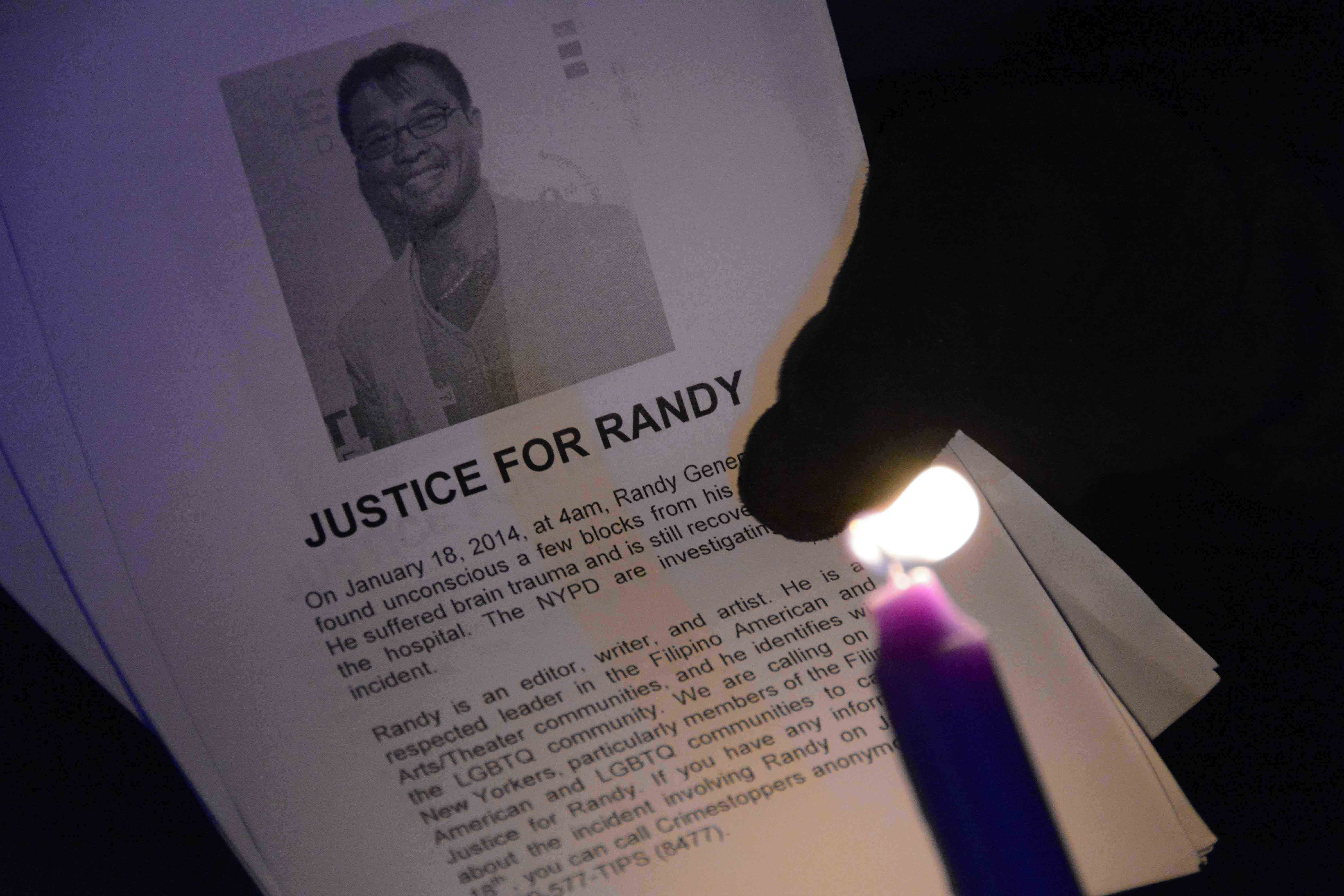
There’s nothing I can say. This inexplicable attack leaves me, and no doubt others, inarticulate. Hold Randy Gener in your heart as he recovers. Do what you can to support him in that recovery. Speak out against violence and hate whenever you’re able. Look at the handful of photos below as an insufficient record of a public expression of love for Randy, on behalf of all who were there and all who wish they could have been.

From WCBS 2 News, “Cops Investigate Beating Of Journalist Randy Gener As Possible Hate Crime” (condensed):

As WCBS 880′s Monica Miller reported, Randy Gener — an award-winning arts journalist who has worked for the New York Daily News, The New York Times, the Village Voice and NPR — was on his way home from a party near West 54th Street and Seventh Avenue in the early hours of Jan. 17 when he was attacked and left in a pool of his own blood. Gener, 45, has undergone brain surgery at St. Luke’s Hospital since the attack and is scheduled to have another. Gener had attended a performance on Broadway that evening and was only a short walk from his home his spouse Stephen Nisbet explained. “Three more minutes he would have been in his own bed,” Nisbet said. The NYPD said it is looking at the attack as a possible bias crime. Anyone with information is asked to call 800-577-TIPS.

From the Facebook page, “Candlelight Vigil in Support of Randy Gener”:

Randy Gener is an editor, writer, and artist, who has made a significant impact in the Filipino American and arts/theater community in New York and worldwide. On January 17, 2014, he was brutally attacked in Manhattan, a few blocks from his home. He suffered brain trauma and is currently still in the hospital. We, as New Yorkers, demand an end to hate violence in our city. We as LGBTQ folks, Filipino Americans, people of color, and allies want to feel safe on our streets again. Join us for a candlelight vigil to show your support to Randy and to proclaim to the world that hate violence will not be tolerated. Sunday, 1/26/14 at 6pm. Bring your own candles, bundle up, and be prepared to march a few blocks.

Randy reportedly had no medical insurance does have medical insurance, but he faces a long and challenging recovery process, the cost of which is expected to exceed the coverage. To lend your support, please make a donation. edit RG justice RG group camera RG flag RG candlelight editRG deli corner edit RG ipad


Update, January 28, from The New York Times, “Midtown Attack Investigated as Hate Crime.”

Ten days after being attacked, Randy Gener can talk again. He also now recognizes his husband and his sister, seated at his hospital bedside. But Mr. Gener, an openly gay Filipino journalist, remembers little of how he ended up there…

On Monday he was awake, alert and eager to talk about his work, writing freelance articles on theater and gay rights issues for a number of publications that have included The New York Times and The Miami Herald. “I’m not trying to push his memory, but we’re just focusing on the basics — where you are, why are you here,” said his sister, Jessica Blair-Driessler. “I’m trying to get him to talk to me about that day.”

The Complete Reduced Shakespeare Controversy (abridged)

January 26th, 2014 § 5 comments § permalink

rsc bible 1This post has been updated, and a story that began as an account of censorship has become one of, dare I say it, resurrection. Here’s the tale.

Three days ago, the town council of Newtownabbey in Northern Ireland shut down a planned engagement of the Reduced Shakespeare Company’s The Bible: The Complete Word of God (abridged) on the grounds that it was sacrilegious and anti-Christian. In doing so, they overrode the prior decision by the town’s Artistic Council to allow the show to go forward in a town-financed facility. I abhor this action in no uncertain terms, and anything I write would simply be variations on that theme. So rather than embroider my own thoughts, I offer you – consistent with the practices of my friends at Reduced – a relatively brief compendium of what has occurred since the first announcement, all via local coverage from Ireland (links to each complete story are contained in the name of each press outlet), as well as select comments from Reduced’s chief twit Austin Tichenor. I trust you’ll see this for what it is, censorship, pure and simple.

Screen Shot 2014-01-26 at 7.36.48 AM

Screen Shot 2014-01-26 at 7.36.37 AM

From the Newtownabbey Times, “Artistic board axes controversial theatre show”:

Newtownabbey Council’s Artistic Board has cancelled a comedy show due to take place at Theatre at The Mill next week, following complaints that the production would be offensive to the borough’s Christian community.

The move to pull ‘The Bible: The Complete Word of God (abridged)’ comes after councillors and officers received correspondence from individuals and church leaders calling for the “blasphemous” show to be axed.

At Monday night’s Development Committee meeting, several councillors voiced their objection to the Reduced Shakespeare Company production taking place at the council-run venue. And there was significant support for a proposal from DUP councillor Audrey Ball calling for it to be cancelled.

Other members argued against “political censorship” of productions and a decision on the issue was deferred to allow council officers time to look at potential contractual and financial implications arising from stopping the show just days before the scheduled start of its two-night run.

Screen Shot 2014-01-26 at 7.34.27 AM

Screen Shot 2014-01-26 at 7.34.40 AM

From UTV, “Bible theatre show cancelled after row”:

The party’s Robert Hill told UTV on Thursday that members of the public had approached representatives asking them to “get it stopped” on the grounds that it was offensive.

He said the council was “willing to take a moral stand” and hit back at those who have criticised the decision by claiming it amounts to censorship of the arts.

“Every film in the theatre is censored – that’s why there are age limits on what can be seen and what can’t. And where do you stop? There has to be a limit somewhere,” Mr Hill said.

UUP Mayor Fraser Agnew also told UTV that he felt the right decision had been made regarding the controversial play, adding that a professional facilitator had been brought in to resolve the issue.

“There were a lot of people concerned about the nature of this play, that it was anti-Christian – and we have established indeed it was anti-Christian,” he said.

Screen Shot 2014-01-26 at 7.34.10 AM

From the Belfast Telegraph, “Bible spoof play ban makes Northern Ireland a laughing stock”:

Belfast Telegraph Jan 24The decision by Newtownabbey Borough Council to cancel the Reduced Shakespeare Company’s light-hearted revue of the Bible gives religion a bad name.

It also underlines the backwoods narrow-mindedness of some people in Northern Ireland as it begins to show a more multi-cultural face to the world.

We must ask ourselves where else would this happen, except among the Taliban in Afghanistan?

Surely God must have a sense of humour – how else could he put up with the numpties of Newtownabbey?

From BBC News, “Comedian Jake O’Kane criticizes ‘zealots’ who cancelled play”:

Mr O’Kane said: “I haven’t seen the play, and unfortunately I’ll never be able to see the play because councillors have decided that we will not be allowed to see the play.

“It’s like getting in a time machine and they went back to before the Reformation and the Enlightenment.

“There was £7m spent on this theatre, it opened in 2010, and they may as well close the doors. If they are going to be the moral guardians of what we see and don’t see, that theatre is dead in the water.

“We already have laws, we have hate speech laws, that dictate what the arts can and cannot do. If it is hateful, if it is against minorities, the laws are already there to censor that.

“We don’t need a bunch of unionist councillors in Newtownabbey deciding what we can or cannot go to see.

“They call themselves moral guardians – they weren’t elected to be moral guardians. We elected them to empty our bins, make sure the leisure centres were open – that’s the powers they have.

From the Newtownabbey Times, “Council faces stinging criticism over decision to axe show”:

One Belfast newspaper claimed that the board’s decision had made Northern Ireland “a laughing stock”, while playwright Dan Gordon said it was “staggering that this type of censorship still appears to flourish in the UK.”

Alliance Alderman John Blair said that cancelling the show had “brought us back into the Dark Ages and turned us into a laughing stock”. But Alderman Billy Ball argued that the board had made “the right decision,” while Raymond Stewart, secretary of Reformation Ireland, welcomed the move to axe what he branded “an insult upon our Lord Jesus Christ and His gospel.”

From BBC News, “Banned play: Arts minister ‘saddened’ by council decision”:

rsc bible 2In a statement, the arts minister said: “I was disappointed to hear of the decision to cancel the production of The Bible: The complete Word of God (Abridged).

“I know that the play has travelled extensively and been performed on the international stage for the past 20 years.

Arts Minister Carál Ni Chuilín said audiences should be given the opportunity to “judge for themselves”

“I am saddened that audiences here will not be offered the opportunity to see the performance and judge for themselves the virtues of the show,” Ms Ni Chuilín added.

“I fully support the views of the Arts Council that the artist’s right to freedom of expression should always be defended and that the arts have a role in promoting discussion and allowing space for disagreement and debate.”

From the Irish Indpendent, “Cancellation of ‘blasphemous’ play interferes with freedom of speech: Amnesty International”:

Amnesty Northern Ireland director Patrick Corrigan said: “It is well-established in international human rights law that the right to freedom of expression, though not absolute, is a fundamental right which may only be restricted in certain limited circumstances to do with the advocacy of hatred.

“It is quite obvious that those circumstances are not met in the context of this work of comedy and, thus, that the cancelling of the play is utterly unjustified on human rights grounds.

From The Belfast Telegraph, “Bible play goes on in Newtownabbey… but only behind closed doors”:

The company behind the show, Newbury Productions and Reduced, have told this paper that they have already booked flights and accommodation and intend to come to Newtownabbey as planned.

They will take to the stage at the Theatre At The Mill for technical and dress rehearsals ahead of the rest of a UK tour, which takes in more than 40 venues in England, Scotland and Wales.

Last night a spokeswoman for Newtownabbey Borough Council confirmed the public would not be permitted access to watch the rehearsals.

“As is normal practice, dress rehearsals are not open to the public,” she added.

It has cost the council at least £2,000 to cancel the show.

Davey Naylor, general manager of Newbury Productions, told the Belfast Telegraph that tech and dress rehearsals will be taking place at Theatre At The Mill on January 29 and 30 as planned.

He said: “We will be there, we just won’t be able to perform for the public at the theatre.”

From The Irish News, “Comedy company considers other venues for Bible show”:

Last night the show’s producers – who revealed it was the first time in 20 years the production had been cancelled – said they would definitely consider returning at another date.

Davey Naylor said they believed the “good people of Northern Ireland should be free to come and see the show to make up their own minds”.

He added: “Sadly, at this late stage, I think another performance next week is remote, however, our tour goes on until April and there’s no reason we couldn’t come back at some point.”

Screen Shot 2014-01-26 at 7.30.05 AM

By sheer coincidence, the website Upworthy happened to feature a video by Monty Python member John Cleese, “On Creativity: Serious vs Solemn,” which seems particularly apt to this situation, billed by Upworthy as, “John Cleese Describes Why Nothing Is ‘Too Serious’ To Be Joked About”:

http://www.youtube.com/watch?v=gdWKQ36JkwE

I sincerely hope that the Reduced Shakespeare Company does return to play Newtownabbey. I suspect they need a good laugh there just about now.

Update, January 27 8:15 pm

beltel 28 janFrom The Belfast Telegraph, “Newtownabbey Borough Council has reversed the controversial decision to ban comedy play The Bible: The Complete Word Of God (Abridged).”

The Reduced Shakespeare Company production is expected to run as originally scheduled on Wednesday and Thursday this week. Anger had been growing since it was revealed the council’s artistic board – made up of councillors and independent members – had pulled the plug on the show at Newtownabbey’s Theatre At The Mill

DUP members had branded the pay blasphemous and an attack on Christianity, but the decision caused outrage and made international headlines. But on Monday night the artistic board announced it had reversed its decision – an announcement that was backed by the full council.

From the BBC, “Newtownabbey council reverses decision to cancel Bible play”

Austin Tichenor of the Reduced Shakespeare Company said: “I’m thrilled that the Newtownabbey community can now come see the show and decide for themselves what kind of a show it is. “My biggest fear is that they’ll come see the show and go ‘this is what all the fuss was about?’. I think people assume we’re coming from a place of hatred and mockery and we’re absolutely not. This is a celebration of the Bible and I think anybody who has seen the show, and many people of all faiths have seen the show, testify to that effect.”

Screen Shot 2014-01-27 at 8.19.12 PM And, I trust a good time will be had by all.

Update, January 30, 11 am:

reduced goofy triumph

Who Thinks It’s OK To ‘Improve’ Playwrights’ Work?

January 22nd, 2014 § 48 comments § permalink

Philadelphia, Here I Come at Asolo Repertory Theatre

Philadelphia, Here I Come! at Asolo Repertory Theatre

Asolo Repertory Theatre in Sarasota, Florida is back in rehearsal with their production of Brian Friel’s Philadelphia, Here I Come!, to restore the script as the fine Irish dramatist wrote it. Their production, which should have been in performance now, had eliminated characters and removed intermissions, among other “improvements.” Frankly, they’re lucky to even have a second shot at it. They could have lost the rights to the show altogether.

Jay Handelman in the Herald Tribune reported on the situation and reading his article in full, it comes clear that this isn’t some isolated incident for the Asolo.

[Producing Artistic Director Michael Donald] Edwards said Friel’s agent heard about the changes and was most concerned about the removal of the intermissions. “We asked if they would come down and see what Frank had done, which we thought was beautiful, but they decided not to.”

The theater has experimented with new approaches to older plays with some success in the past. Two years ago, for example, the theater played around with Leah Napolin’s play “Yentl,” keeping most of the script but adding in original songs by composer Jill Sobule, performed by actors doubling as musicians on stage.

Napolin had a “heads-up about what we were doing,” Edwards said. “But she didn’t know all of what we were doing. We got her down here and she could have said I don’t like this, but fortunately she loved it. She told me, ‘You have rescued my play’.”

If director Gordon Greenberg had gone to Napolin with every idea for changes or additions that came up during rehearsals “it would have killed the creative process. It would have made it a two-year process,” Edwards said.

Mr. Edwards appears to have a fundamental lack of understanding of (or respect for) the rights of authors and their estates. Copyright law and the licensing agreements signed by his theatre prevent him or any director working at his theatre from performing surgery on texts to suit the company’s own needs or interpretations. Why, Mr. Edwards, do you portray their spurning of your invitation as vaguely obstinate, when you’ve broken your word and the law? While some authors may allow leeway, it’s their prerogative, not the theatre’s, to do so. The fact that Leah Napolin was happy with Asolo’s alterations on her Yentl was a lucky break, but to take it as affirmation or precedent for this practice isn’t only foolhardy, it’s just plain wrong. [Please see clarifying update on Yentl at the end of this post.] I must confess, in the Philadelphia situation, I’m surprised by the actions of veteran director Frank Galati as well, though I should allow for the possibility that he was told approval had been given. On a related note: Wall Street Journal critic Terry Teachout was to have reviewed the Friel play, but was informed that performances were canceled – the Asolo never explained why.

Some might shrug the practices of Asolo as the anomalous act of a single theatre, but it’s only the most prominent recent example of a practice that, for obvious reasons, tries to fly under the radar. Last month, in writing about the efforts of a Long Island high school to perform a sex change on the character of Angel in Rent, I received numerous comments and e-mails telling me that this sort of manipulation happens all the time at not only at high schools but at colleges as well.  One correspondent, who teaches arts management at the university level, reported that the directing program at their school encourages directors to rework texts to make them their own, flouting licensing agreements for work that is given public performances.  While this is kosher for classic works out of copyright, it’s stunning to me that educational institutions are actively advocating such actions on copyrighted work. As a classroom experiment, it’s acceptable for learning purposes, but as soon as an audience walks in, this approach must go right out the window. Students must be taught the difference.

I know of many people who feel that copyrights extend for too long, not just during creators’ lifetimes but long past them, believing works should become available for free revision and reinterpretation much sooner than currently allowed. While I am all for creative reinterpretations of texts, that’s a separate legal discussion. But so long as copyright stands, it is not a matter for selective adherence, and that’s not simply my opinion, it’s a legal compact. Theatre is not the movies, where authors do not own their work and it can be altered and reworked by any number of writers to suit the needs or whims of a studio, a director or a marketing team.

When a situation arises like the one at Southold High, it’s hard not to draw a direct line to the example at the Asolo – after all, if professionals alter scripts without approval, it must be OK, right? If the practice is being encouraged at the college level, why wouldn’t it be filtering into both professional and amateur work? Many resent the restrictive vigilance of estates such as Samuel Beckett’s, and as a manager I once had to counsel an artistic director to veto a Godot design which would have likely drawn the ire of the estate had they become aware of it. Yes, I would have loved to see that jettisoned concept as a theatregoer, but as a manager, I wouldn’t support violating an agreement I’d signed, in addition to taking the risk that we might be found out, putting the organization in financial extremes. “Oh, who will know?” is neither a legal nor ethical defense.

It’s quite impossible to know how prevalent this is, because the vast majority of theatre in the U.S. isn’t scrutinized by authors or their representatives. It is simply impossible to do. So when cases come to light, they are largely because some astute audience member recognizes the manipulation and takes the initiative to contact the appropriate representatives, if they know how. Another way these incidents are revealed are likely when some member of the production recognizes that alteration is under way, and they choose to inform the right people, forcing them to become “informers” on their own employers. And, of course, critics may notice discrepancies with work they’ve seen or read before, and their reportage may bring alterations to the attention of authors and their representatives.

I can’t understand why some artists feel they have the right to unilaterally alter dramatic texts, especially when so many superb reinventions are done with the full cooperation of authors and estates; that said, I fully expect some of those who advocate for this right to take issue with my position as stated here. Although I feel as if I’ve heard it over and over again for decades, it seems that for so many, a basic thesis of the theatre isn’t being said and understood enough: theatre is first and foremost an author’s medium. If you can’t respect that, write the play you want to see instead – or go make movies.

Note: I serve on the advisory committee of Samuel French Inc., the company which licenses the work of Brian Friel. I have not consulted with anyone at French about the situation at the Asolo or this essay at any time.

Update 2:45 pm 1/22: Because, as I often do, I wrote and posted in haste, I neglected to include critics as a resource for bringing unauthorized alterations to light. When this was pointed out in the comment section below, I added a sentence to the penultimate paragraph to recognize their essential role.

Update 9:45 am 1/23: Gordon Greenberg, director of the Asolo production of Yentl, has written to advise me that he and the theatre had the author’s approval to interpolate Jill Sobule’s songs and make minor text changes to accommodate them. Additionally, Greenberg’s revised production of Working was done in collaboration with Stephen Schwartz. 

Update 5:45 pm 1/24: This post has prompted extensive response, in the comments here, as well as on my Facebook page and via Twitter. A number of people have taken exception to my statement that “theatre is first and foremost an author’s medium.” On reflection, the statement was too sweeping, and has apparently suggested to some a lack of respect on my part for directors, actors and the range of artists who collaborate to put a play on stage and are so essential in collectively exploring and realizing a playwright’s vision; that’s far from the truth. I also wrote from my experience, as I would hope is always evident in my writing, and respecting the author’s intent and rights is something I’ve been taught by theatre artists – not just authors – throughout my career and it is a point of view I embrace. That said, the majority of my theatergoing is American drama first and English writing second; the majority of productions I’ve seen were created in the U.S. regardless of authorship. I understand that in some countries and with some companies, a script may only be a framework that is elaborated upon in many different ways, and while that runs contrary to the majority of my theatergoing experiences, it was not my intention to denigrate it, provided the author is fully aware of the manner of production and agrees to it, according to their legal rights. For classical works where copyright has expired or never existed, I enthusiastically support artists’ free rein to rework and alter the text as they see fit. There are many ways to make theatre and my respect for every artist and their practice and tradition is unstinting. I regret my generalization, but in transparency, I leave it intact above, lest I be accused of rewriting myself surreptitiously.