Slate: ‘Homosexual Themes’ Get Pennsylvania School Production of ‘Spamalot’ Canned

August 26th, 2014 § 0 comments § permalink

“Just think,” says Sir Lancelot, of his nuptials to a young man named Herbert in Monty Python’s Spamalot, “In a thousand years time, this will still be controversial.” The administration of the South Williamsport, Pennsylvania, Junior/Senior High School seems determined to prove the gallant knight prescient, as it has canceled a planned 2015 production of the musical due to its “homosexual themes.”

When the cancellation was first reported in early July, the reporting was based primarily on charges by the school’s drama director, Dawn Burch, who spoke of an email she said she had received from the school’s principal, Jesse Smith, requiring a change of show. On advice of counsel, Burch did not provide the email to the press.

At the time, reports focused heavily on a statement attributed to Smith, about homosexuality not existing in South Williamsport—a statement that was quickly disavowed by all concerned and rescinded by its original source, a news report from television station WNEP. School board president John Engel and superintendent Dr. Mark Stamm appeared at a July 3 community event organized by Equality Central PA to debunk the statement, though they did not speak to the larger issue of whether gay content was the cause of the cancellation. In the press, Stamm also asserted thatSpamalot had never been approved for production according to school procedure. “School: ‘No way’ on play—but not due to gays,” read a headline in the Williamsport Sun-Gazette on July 3, in advance of the forum.

Last week, as a result of a release of emails requested through Pennsylvania’s Right-to-Know law, it became clear that the musical’s gay content was, in fact, singularly and explicitly the reason for its cancellation. In a June 27 e-mail from Smith to Burch, he wrote:

I am not comfortable with Spamalot and its homosexual themes for two main reasons:

1. Drama productions are supposed to be community events. They are supposed to be performances that families can attend. To me, this kind of material makes it very hard for this to take place. I don’t want families to be afraid of bringing small kids because of the content. I don’t want members of the community staying home because they feel the material is too risqué or controversial.

2. I think that choosing productions with this type of material or productions that may be deemed controversial put students in a tough spot. I don’t want students to have to choose between their own personal beliefs and whether or not to take part in a production.

When Burch appealed to the superintendent on June 30, he replied, in the only readable portions of a heavily redacted email:

[School Principal] Jesse [Smith] has given the drama program considerable time and attention this year. He has thoroughly explained his reasons regarding show selections to you and discussed them with me as well. His decision is sound.

As for Stamm’s assertion that the musical was never approved for production, the released documents include a $1,935 check from May 12, 2014, payable to Theatrical Rights Worldwide, the licensor of Spamalot, signed by Smith, as well as a check request and contract dated a week earlier, signed by Burch, for the rights to the play. While the check doesn’t specify that it is for Spamalot, it is unlikely that Smith would have assumed the check was payment in arrears for the school’s spring musical presented in March, as standard show licensing practice is for advance payment.

Following the release of the internal communications by the school in mailings dated Aug. 18, the contents were disclosed by the two parties that had filed a request for them: progressive advocacy organization Keystone Progress (via press release, including links to the complete document set) and me (via blog post) on Aug. 21. This yielded a half-dozen national news stories, but to date, no local or regional press outlet in central Pennsylvania has reported on the new disclosures, leaving the administration’s obfuscations intact. [Update, Aug. 26: The Williamsport Sun-Gazette informs me it is working on a story on the topic.] Stamm and Smith have not responded to my requests for comment, and Burch, when reached, declined to comment further.

Prior to the release of the materials, the school administration announced at an Aug. 4 board of education meeting that a “public performance policy” had been put in place. It says, in part:

Material that is generally considered offensive, suggestive, or demeaning based on race, religion, age, gender, or sexual orientation is not appropriate for school performances.

What the policy did not say is that material supporting inclusive representations of race, religion, age, gender, or sexual orientation would be encouraged. Currently in Pennsylvania, marriage equality is the law, however there is no equal rights protection for sexual orientation.

Students return to school in South Williamsport today with the false impression that their drama director provoked an unfounded controversy. What they don’t know is that their principal and superintendent assert that LGBTQ life is unsuitable for families to see, that their parents might be “afraid” of “small kids” seeing gay relationships even in a broadly comic setting, and that there are concerns about attendance at such a show because the material is “risqué.” The students also don’t know that their principal believes that LGBTQ representation might force some of them to make decisions about their personal beliefs, which is presumably part of education and maturation. There are important lessons still to be taught in South Williamsport, but only if the school administration and the community learn them first.

To see this article as it appeared on Slate, click here
Facts Emerge About School “Spamalot” Struck Out Over Gay Content

August 21st, 2014 § 10 comments § permalink

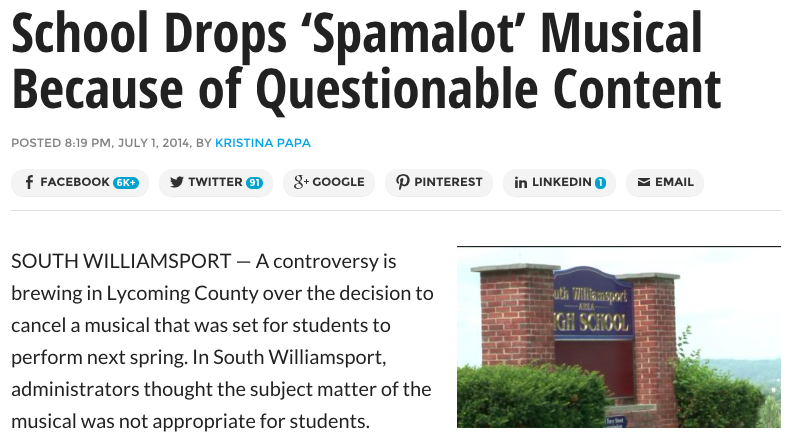
Once each year, the world turns its eyes to Williamsport and South Williamsport PA, as young athletes from around the globe compete in the Little League World Series. This year has garnered particular attention for the wunderkind pitcher Mo’ne Davis, whose story has united people across any manner of gender or racial lines, through the talent and grace of a single young woman. Less publicly and widely known, however, was that over this summer, the administration of the South Williamsport Area School District and the town’s Junior/Senior High School had been working against the very spirit of inclusion and diversity that is in abundant evidence on the town’s ball fields. (My previous reports were posted on July 2 and July 15.)

Screen Shot 2014-08-21 at 12.39.26 AMIt was first reported by the local television station WNEP on July 1 that the school principal had canceled plans for a production of the musical Spamalot, slated for the 2014-15 school year. The reason cited, according to drama director Dawn Burch, was the musical’s gay content, which includes a same sex wedding. While a particularly incendiary statement in that initial report, about homosexuality not existing in the community, was attributed to principal Jesse Smith, it was declared inaccurate by all parties, and excised as of July 3.

Screen Shot 2014-08-21 at 12.40.31 AMThe Sun Gazette of Williamsport, on July 3, reported that Dr. Mark Stamm, the district superintendent, denied Smith ever made the excised statement, though Stamm never spoke directly to the broader issue of the show being canceled over gay content. He also declared that the production had not been approved according to district policy.

Because Burch, acting on advice of counsel, would not release her communications with Stamm and Smith to corroborate her account, I became one of at least two parties to seek access to the school’s internal communications about the show under the State of Pennsylvania’s Right To Know Law. I received the materials in question yesterday, August 20; the metered postmark was August 18.

In brief, the materials make clear that Burch was telling the truth about Smith’s statements, namely that “homosexual themes” were the reason the show was being rejected, and that despite Stamm’s assertions as the story went public, it would seem Burch had very likely gone through the proper channels in seeking approval for the show or at the very least honestly and openly believed that approval had been given.

Cause of Cancelation

Regarding the assertion that Principal Smith had cited gay content as a cause for canceling the show, I quote first from an e-mail Smith sent to Burch on June 27, 2014 at 10:58 am. The first three paragraphs are redacted and only the following can be read:

“Finally, you told me late in the school year that you were looking to perform Spamalot for your spring 2015 musical. I have some concerns such as a guy sending another guy a message on girl’s underwear and a gay wedding to be performed. If you are still planning to perform this then we will need to talk.”

A cover letter to the materials provided to me by the school’s Open Records Officer – Dr. Stamm – states that six e-mails between Stamm, Smith and/or Burch on the dates June 27 through June 30 were withheld because they contained some combination of a) performance evaluation, b) written criticism of an employee and/or c) identifies child then aged 17 years or less.

Whatever was said in those e-mails aside, Smith sent an e-mail to Burch on June 30, 2014 at 7:27 am asking her to choose a different musical. He questioned the appropriateness of Spamalot as follows:

“I am not comfortable with Spamalot and its homosexual themes for two main reasons:

1. Drama productions are supposed to be community events. They are supposed to be performances that families can attend. To me, this kind of material makes it very hard for this to take place. I don’t want families to be afraid of bringing small kids because of the content. I don’t want members of the community staying home because they feel the material is too risqué or controversial.

2. I think that choosing productions with this type of material or productions that may be deemed controversial put students in a tough spot. I don’t want students to have to choose between their own personal beliefs and whether or not to take part in a production.”

So Mr. Smith feels that love is controversial, that homosexuality is risqué. He feels that people might be afraid of exposing children to it. To that I say: Mr. Smith, your statements condone the homophobic members of your community and seek to consign every gay resident to second-class status. Yet their love is not something to be feared or hidden any more than any romantic relationship of yours or Dr. Stamm’s or my own. You are coddling those who would seek to suppress and condemn, instead of setting an example of respect, equality and inclusion.

Yes, by statute Pennsylvania is inconsistent in its position on LGBT issues, in that marriage is legal for all, regardless of the genders of the couple, however the state doesn’t yet afford equal rights protection regardless of sexual orientation. But Smith is teaching lessons seemingly drawn from outdated textbooks. The law will catch up soon enough with society, either on the state or federal level, insuring equal rights for all. Stamm’s position that Smith’s decision regarding Spamalot “is sound” (e-mail from Stamm to Burch, June 30, 2014 at 1:12 PM) can be taken to mean that he condones the same discriminatory attitudes that would erase gay life, in any context, from the school’s stage. As an aside: the Motion Picture Association of America’s Ratings Board may share the school administration’s general view on representing homosexuality, according to critic Stephen Whitty of The Star-Ledger.

Approval of Spamalot

spamalot logoThe earliest materials provided to me by the school district are dated June 27. As quoted above, Smith acknowledges that he had a conversation during the school year with Burch about her intention to produce Spamalot, and expresses specific reservations. However, there is no correspondence indicating prior approval, leaving conflicting accounts by Burch and Stamm in the press.

This leads to the very last item in the materials I received: a check dated May 12, 2014 to Theatrical Rights Worldwide, the licensing house, for $1,935, with the note “For Spring Musical – Drama.” It is signed by Jesse Smith. In an statement to me as I began exploring this situation, a representative of Theatrical Rights confirmed to me that an executed license was in place between the company and the school for Spamalot. The school also provided a copy of the Spamalot contract, signed by Burch, dated May 7, along with the check request (which did not specify the show title, only “Spring Musical License/rental/materials).” So how did a check get signed by Smith and sent to the company for a show that ostensibly wasn’t approved? Would Burch submit a check request for a musical that hadn’t been approved for Smith’s signature?

Any school administrator who has any experience in licensing theatrical material is certainly aware that payment is made in advance, not following a production. A Facebook events post shows that the school’s 2014 musical, How To Succeed In Business Without Really Trying, was produced in March of this year. So it is exceedingly unlikely the check could have been construed to be payment for that production two months in arrears. The school provided me with check requests and check duplicates for perusal copies of other shows that Burch looked at, perhaps to suggest that there was confusion, but there’s only one contract, and the only check other than the one that corresponded to the Spamalot contract that over $100 was the license fee for this fall’s play production.

I can draw only two possible conclusions. The first is that Burch had secured the proper approval, albeit verbal, for the production of Spamalot, and Smith’s concerns only arose roughly six weeks after he signed a check for the rights. In that case, he was backtracking on his prior approval and Stamm’s comments reported on July 3 were either misinformed or willfully meant to obscure the events. It would be very interesting to know what prompted Smith’s change of heart, if that is the case. When did Smith discover content he objected to, and how?

The second possibility is that Smith signed a nearly $2,000 check to license a show he hadn’t approved. In my training and experience, anyone with financial responsibility is expected to know what they’re paying for. A common practice is for a check request, along with either an invoice or a contract (or both) is attached as backup to a check ready for signature. I cannot speak for the business practices of the South Williamsport School District, but if this is the truer of my two scenarios, then it appears Smith didn’t follow a fairly standard fiduciary protocol and review the license he was paying for, and now wants to distract from that oversight by blaming Burch, who appears to have been operating openly and in good faith.

Now What?

With Jesse Smith’s statements about suppressing the representation of homosexuality at the school now public, perhaps he will speak about the entire situation; he has not done so publicly to date. Both Smith and Stamm should repudiate their positions – and acknowledge the truth of Burch’s original assertions – or they must deal with being known as educators who appear to deny the truthful, honest lives and loves of many of their students past, present and future, as well as the LGBT community locally, statewide and even nationally.

Screen Shot 2014-07-15 at 12.51.01 PMFrom my perspective, I don’t understand why, once they knew they had to reveal their positions as a result of the Right-to-Know requests, Stamm and Smith didn’t own up to what had taken place and get out ahead of the story with an apology. Instead, they have left it up to me and others to reveal the truth, which will no doubt be picked up and explored by yet more who care deeply about equality in our society. They would do well to immediately consult with local LGBT groups about establishing a Gay-Straight Alliance at the school in the next few months, to demonstrate their commitment to the open acceptance of all of their students. They should also make clear that Burch may produce plays, musicals or both that include “homosexual themes.”

And where does this leave Dawn Burch, a drama director who couldn’t quietly accept the administration’s exclusionary position and spoke out? Well as this news was first breaking, on July 3, 2014 at 8:39 am, Dr. Stamm wrote to her that, “The feedback we received from the community, both local and national, is being given appropriate consideration. Whether or not you are able to return as the drama director, is a decision that you will have to make.” It is important to note that Burch is a contract employee, not a teacher; she has no tenure. I hope the school system stands by letting her decide her future and that she stays on to run the theatre program, for the benefit of all the students, not just those whose lives find favor with those in power. And no matter what shows she puts on – in correspondence disclosed, she did express a willingness to consider other shows for the coming year, but not without the source and the reason for the change in selection being known – I look forward to visiting South Williamsport to applaud her.

*   *   *

I e-mailed Dr. Stamm and Mr. Smith last evening at 6:43 pm, asking if they would speak with me on the record about the situation, setting a 9 am deadline. As of 9 am this morning, neither had responded. When I reached Burch by phone last evening, she declined to comment further on the situation. Should any of the parties contact me for an on-the-record conversation subsequent to the publication of this post, I will add to it here or write additional posts as warranted.

 

Why Are There So Few Long Running Plays On Broadway?

August 18th, 2014 § 0 comments § permalink

Screen Shot 2014-08-18 at 8.54.10 AMThere was a time, children, not so very long ago, when hit plays ran much longer than than 131 performances. Why 131? Because in the last ten complete Broadway seasons, that’s the average of how long a play – new or revival – ran. Yet, out of 313 plays in that decade, only 21 plays ran for 200 performances or more, and only seven ran for 300 performances or more. No play in the past decade topped 800 performances, as The 39 Steps stopped climbing at 794 performances and War Horse headed for the stables at 741.
Going back 40 years ago, specifically to the 1974-75 season, out of the 42 plays produced on Broadway that year alone, four plays ran over 200 performances, three ran over 400 performances, one ran a hair under 600 performances, and two ran well past 1,000 performances. Those last two plays, FYI, were Same Time Next Year and Equus.

For perspective, a year of performances, assuming 52 weeks at eight shows a week, is 416 performances. So that means in the past 10 years, only five shows ran for more than a year. In 1974-75 alone, four did. What happened?

Screen Shot 2014-08-18 at 8.53.06 AMWell, based on studying the past decade, and then looking at the prior 25 years at five year intervals, it seems the average length of runs for a play hasn’t changed much: from 146 then to 131 now, all of two weeks variance. As Ken Davenport pointed out, new plays run longer than revivals; on average, the difference between them over the past 10 years is about five weeks.

One key factor is that when you go back to the days when plays ran for a year or two or more, there were many more shows that ran only a handful of performances. It wasn’t uncommon for show to play two or three previews, open, and shutter almost instantly. The long-runners were balanced by the fast-closers. With extended preview periods now, the idea of a show that doesn’t manage to play for at least a month is unheard of; even Elling performed 29 times and The Performers exposed themselves 30 times.

Screen Shot 2014-08-18 at 8.52.29 AMToday, when the solid base of fixed runs at Roundabout, Lincoln Center and Manhattan Theatre Club accounts for a significant amount of the dramatic activity on Broadway, relatively short runs are more common. Place them alongside the now common star-driven limited runs of 13 to 17 weeks, and the 131 performance average makes perfect sense. The average run per season only varied significantly once in the past decade, in the 2007-08 season, thanks primarily to The 39 Steps and August: Osage County (666), with assists from Boeing Boeing (296) and November (238).

So as much as we might want to complain about the brevity of plays’ runs on Broadway, the minor difference in average runs suggests that things haven’t really changed all that much. Even when we go back into the 1970s, when it wasn’t uncommon to find 40 or more new plays in a season, the average held.

In an era where hit musicals run longer than ever, why are hit plays running shorter? People are quick to blame the short, star-driven runs of plays, where brief runs can gross more than $1 million a week and generate profits without overstaying their welcome – and that’s not untrue. But the long-runners nowadays are plays that are launched without stars – The 39 Steps, War Horse, August: Osage County, Peter and The Starcatcher. Only one significant long-runner in the past decade was star-driven – God of Carnage – and therein lies a big catch.

Screen Shot 2014-08-18 at 8.53.39 AMLong-running plays are those which either aren’t conceived as star vehicles or, even when star driven, take the leap and make cast changes, or even introduce entirely new casts. There were three casts for Carnage, and while the presence of James Gandolfini undoubtedly was key to launching the play, it proved (not unlike playwright Yasmina Reza’s Art) that a play could become a hit even without maintaining its original cast. In the case of August: Osage County, cast replacements were actually better known than those who originated the roles: Deanna Dunagan may have won a Tony, but even regular theatregoers were probably more familiar with her successors, Estelle Parsons and Phylicia Rashad.

It would appear that long-running plays have fallen victim to the conventional wisdom that only stars are stars, that plays can’t be stars. But even if we were to accept that as true, look at what Equus managed: Anthony Hopkins (who was far from a star in those days) was succeeded by, among others, Anthony Perkins, Leonard Nimoy and Richard Burton. Yes, that’s right – Burton was a replacement. Though not in the years I selected, let’s also remember that The Elephant Man originally starred the unknown Philip Anglim, who was followed by, among others, David Bowie. I would put it to casting directors to answer the question of whether stars are no longer willing to succeed others on Broadway, at a time when ostensibly there are more name actors than ever seeking the professional credibility that a Broadway stint can bring. Or is it that profit margins are so low that producers aren’t willing to risk installing a new star or new cast?

With the kind of money at risk on Broadway these days – a play will cost $3 million or more – there is an understandable desire to minimize risk. But in the process, plays have been minimized as well. The length of plays’ runs, and the size of the theatres they play in, certainly explain why 80% of Broadway attendees see musicals. But the data, both old and new, bears out that once a play succeeds, provided the success is based on something more than just the celebrity of a cast member, plays can still be coaxed into longer runs, allowing non-musical pieces to perhaps claw back a bit more of Broadway. Maybe we’ll never return to the days when “the play’s the thing” on Broadway, but perhaps they can be more of a thing than they’ve been lately.

*   *   *

Note: The years cited prior to the 2004-2005 season are a sampling of the period, not complete (I have neither sufficient time nor any staff to research as much as I’d like). The plays cited from that period are not necessarily the longest runners ever (Gemini (1,819) and Deathtrap (1,793) are among the plays that outran them), but simply happened to fall within the years selected during the defined span of time. Even longer running plays date back to the days of Tobacco Road (3,182 performances) and Life With Father (3,224), but the fundamental changes in Broadway since that time render any comparison uninstructive. There have been changes since the 70s as well, but it is not so far in the past as to be invalid for comparison’s sake.


Why I Saw A Musical I Knew Virtually Nothing About

August 11th, 2014 § 3 comments § permalink

ragnar logo01410 days ago, I was completely unaware that an Icelandic musical had established a beachhead in one of Off-Broadway’s larger theatres. To be honest, I’d never given much thought to Icelandic theatre, let alone their musicals. So when I spotted an online Village Voice story about the show’s musical score and gave it a skim, that alone was enough to make me want to see this rara avis. So I spent Saturday afternoon, a beautiful August afternoon, in the dark at the Minetta Lane. But there’s actually a slew of other reasons why I went.

RARITY As someone who prides himself on obscure knowledge and eccentric experiences, I am fairly (but not absolutely) certain that there have not been major productions of Icelandic musicals before in New York, or even the United States. I remember a Polish musical making it to Broadway, although I didn’t see Metro, and there was a Dutch musical of Cyrano, but I daresay a piece of Icelandic musical theatre making its world premiere in New York is most likely a first. Please contradict me if you’re able.

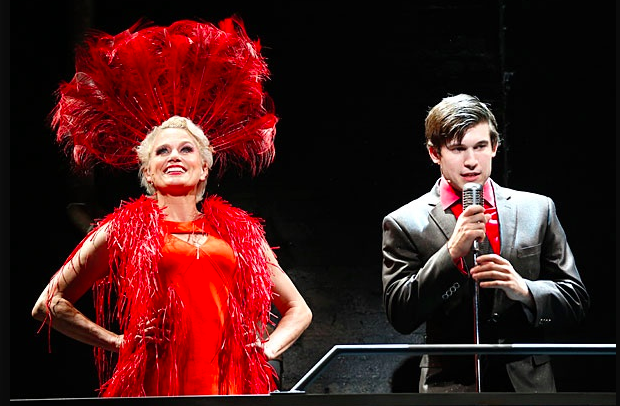
Cady Huffman & Marrick Smith in Ragnar Agnarsson (Carol Rosegg photo)

Cady Huffman & Marrick Smith in Ragnar Agnarsson (Carol Rosegg photo)

NAME Let’s face it, it’s pretty hard to resist a title like The Revolution in the Elbow of Ragnar Agnarsson Furniture Painter. At least it is for me. While it’s not as mellifluous as Oh Dad, Poor Dad, Mama’s Hung You In The Closet and I’m Feeling So Sad and doesn’t approach the monumental length of The Persecution and Assassination of Jean-Paul Marat as Performed by the Inmates of the Asylum of Charenton Under the Direction of the Marquis de Sade, I wanted to catch it before the musical buffs start calling it simply Ragnar or Elbow, shortened like How To Succeed or Forum. Just mentioning that I was going to it genuinely startled some people and I suspect the title will have that effect among the uninitiated for some time.

ICELAND I’ve actually been to Iceland. Not in a “quick stopover thanks to cheap flights via Icelandair on the way to Europe” way, but a two week stay. Mind you, I was 15 and it was a Boy Scout trip, but Iceland was the first foreign country I ever visited – I hadn’t even been to Canada when I went. I chose it precisely because I didn’t know anyone who had ever been there, passing up (if memory serves) alternate forays to Scotland and Jamaica. I went with so little preparation that I didn’t even know that the sun doesn’t set there in July. I climbed a (then dormant) volcano. It was all a discovery.

As a result, I’ve always followed news of the island country and thought it might give me an excuse to troop out some old knowledge. Without prompting, I explained to my wife, based solely on the title, that I knew the title character Ragnar’s father is named Agnar, given the patronymic naming that prevails in the country. Impressed? Incidentally, when I checked the website RagnarAgnarsson.com, I discovered that it belongs to a filmmaker, not to the show. For all I know, Ragnar Agnarsson could be the Icelandic equivalent of John Smith.

MUSIC I am well aware that there have been successful bands and performers out of Iceland, like Björk and Sigur Rós and The Sugarcubes, but to be honest, I’m not sure I’d recognize any of their music, only the swan dress, so perhaps this was a chance to acquaint myself with a certain rock style that had passed me by. Of course, I have no way of knowing whether the score by Ívar Páll Jónsson is representative of current tastes in Iceland or not. But now, it’s all I’ve got.

Kate Shindle & Cady Huffman in Ragnar Agnarsson (Carol Rosegg photo)

Kate Shindle & Cady Huffman in Ragnar Agnarsson (Carol Rosegg photo)

THEATRE Frame of reference, I realized as I watched, was something I lacked theatrically as well. While everyone I met in Iceland all those years ago spoke both English and Icelandic, that didn’t tell me a thing about what theatrical styles might be favored in this country of only 300,000 residents. Have they evolved their own aesthetic, do they lean toward America or England or Scandinavia or some other European region? Do they stage sagas? One show, I realized, wasn’t going to teach me that. But it was a reminder about how much of world theatre has passed me by, or that I have passed by.

It was interesting to note that the director Bergur Þór Ingólfsson directed the hit Icelandic production of Mary Poppins and producer Karl Pétur Jónsson was behind Icelandic productions of Hedwig and the Angry Inch and The Complete Works of William Shakespeare (abridged). So maybe the cultural chasm isn’t all that wide. Of course, since the show is premiering in New York and not Reykjavik, we don’t actually know what the Icelandic public thinks of Ragnar. It could be an outlier there. Interesting strategy.

CAST Cady Huffman. Kate Shindle. What’s not to like? Those were the only two names I recognized when I looked the show up in the Theatrical Index. But it’s also great to see actors I’m not familiar with too, in this case the rest of the cast.

PLOT What appealed to me most about the plot its utter opacity. I’ve reached the point where it’s pretty difficult for me to see a show without some sense of what I’m in for. Save for my experiment a year ago at the New York International Fringe Festival, where I let someone I still have never met choose my itinerary, I have some manner of preconceived notion, however slight, about everything I see. What a joy to approach a show as a completely blank slate. For all the shows I go to with anticipation about the cast, the author, the director and so on, or with a vague sense of dread, I rarely feel the excitement of the utter unknown. Even with the fringe, I did read show synopses once I was given my marching orders. Perhaps what I felt was akin to what the folks are trying to do at the Lyric Hammersmith’s Secret Theatre in London, though in some cases there, you may recognize the play as soon as it starts. In Elbow, everything was new.

*  *  *

Basically, I saw The Revolution in the Elbow of Ragnar Agnarsson Furniture Painter so that I could practice what I preach. Admittedly cost and time are usually part of our decision making, and legitimate factors at that, but we are forever self-selecting our entertainment. Once in a while, it’s refreshing to go to something completely in the dark. For those of us in the business of the arts, it’s a reminder of the faith audiences place in us when we convince them to come to an event that doesn’t have famous names or a familiar title. It takes us outside of the bubble of professional connections and journalism and gossip that inform our own decisions on what to see and, at least until we’ve spent a little time taking it in, enables (or forces) us to be completely open about a show because we know so little.

Obviously I’ve been very careful not to say what I thought of the show, and nothing herein should be extrapolated out to as either endorsement or indictment. It will open at the end of the week, and then it will be difficult to experience the show as unaware as I did, as others declare their opinions for your consumption. After that, you’ll have to look for, perhaps, an Estonian epic or a Uruguayan musical when it lands on our shores for your own tabula rasa experience in the theatre.

As for me, I can just say that I’ve plunged rather unknowingly into two Icelandic adventures in my life and – you should pardon the allusion – how cool is that?


High School Theatre Wickedness In The Eye Of The Beholder

August 5th, 2014 § 7 comments § permalink

Screen Shot 2014-08-05 at 10.47.28 AMYears from now, when the musical Wicked is eventually made available for school and amateur productions, will some high school administrator declare it inappropriate? After all, among its many plot strands is the story of (spoiler alert) the manipulative Madame Morrible, a school headmistress who schemes against those in Oz who don’t conform precisely to her standards, be they green girl or anthropomorphic animal. It’s a terrible portrait of pedagogy gone wrong and surely doesn’t foster the collaborative, supportive relationships that school leaders must seek with each successive generation of students, as well as with their faculty and staff. From that perspective, it’s seditious.

I’m reminded of this element of Stephen Schwartz and Winnie Holtzman’s massively popular musical as I consider the challenges to high school theatre that I’ve read about, heard about and involved myself in. Recently, I was engaged to deliver the opening keynote at the Educational Theatre Association’s (EdTA) annual conference for high school teachers. During the question and answer session that followed, one attendee asked the others how many had had shows turned down when they sought approval for them. Roughly a quarter of those in the room raised their hands. In follow-up, they were asked how many had wanted to do certain shows, but didn’t even try because they were sure they couldn’t get approval. Virtually every teacher raised their hand.

Because I don’t believe that these teachers had all been contemplating Oh! Calcutta!, I find myself wondering about their internal decision-making, their self-censorship. Surely they weren’t considering shows which would be blatantly inappropriate in a school setting, so what are those shows that they thought would be good for their students, but which they didn’t even dare raise as a possibility? That might make for an interesting survey in itself.

Screen Shot 2014-08-05 at 10.52.55 AMOf course, what’s acceptable to the powers that be at one school, in one town, may be considered problematic in another. Earlier this year in New Hampshire, Sweeney Todd was canceled at Timberlane High School (since reversed) even as another school just a few towns away readied their production of the same show. In 2012, Sonja Hansen lost her position directing shows at Loveland High in Ohio after her production of Legally Blonde was declared inappropriate, yet according to the EdTA’s annual survey, its was the fourth most popular musical in high schools nationally.

Screen Shot 2014-08-05 at 10.49.54 AMSo I’m very interested in the new “Public Performance Policy” that has been put into place at the Junior/Senior High in South Williamsport PA, where a production of Spamalot has been canceled by the principal for reasons that remain unclear. The drama director Dawn Burch asserts that Principal Jesse Smith stated, in an e-mail, that the show’s gay content was a factor. Smith himself has been silent since this story broke, and while the school administration has taken exception to one element of the first report about the issue (since corrected), it has yet to produce the e-mail in question to clear things up. Two “Right To Know” requests have been filed seeking that e-mail and related documents; one of those requests is mine.

The timing of the Public Performance Policy, revealed last night at a meeting for the school board, is certainly no coincidence, coming between the initial assertions of anti-gay bias and the release of clarifying materials. As read by the school superintendent, Dr. Mark Stamm, it states:

General Guidelines: Public performances serve as a capstone project for students to showcase their dedication, determination, and talents for their peers and for their families. Performances must be age appropriate for participating students and audiences. Material that is generally considered offensive, suggestive, or demeaning based on race, religion, age, gender, or sexual orientation is not appropriate for school performances.

The first sentence of the policy, describing “showcasing dedication, determination, and talents,” is nicely affirmative ­– until one notices that there’s no mention of learning or growth, which would seem essential in any school activity, even at South Williamsport, where the drama program is extracurricular, and the drama director an outside contractor, not a teacher. That said, any adult working with young people in a leadership position is a teacher, accredited or not.

However, it’s worth noting that there is a mission statement for the drama program on the school’s website which admirably speaks to deeper value. It reads:

Our mission is to provide students with the opportunity to better themselves through the Arts. Whether it is onstage or backstage, in the production crew or artistic departments, theater helps all people more deeply understand our place in our modern, multicultural, globalized world.

As an aside: finding the drama information on the school website isn’t entirely logical. While there’s a section for clubs, which includes “Yearbook,” “Chemistry,” “Student Council” and “Songwriters and Musicians,” it doesn’t include “Drama.” The Athletic Program has its own site, with its own URL separate from the school district’s. But “Drama” falls under “Departments,” along with “Guidance” and “Nurse,” to which it seems wholly unrelated. How very odd to set it apart in this way.

But returning to the Public Performance Policy, the second sentence isn’t particularly troublesome, so long as it is not used as a justification to infantilize students by feeding them dramatic pabulum. But it’s the third sentence sentence where things turn tricky. While the phrase about not demeaning any parties is admirable (although in their seeming haste, they neglected disability, among other concerns), the language which begins the sentence is limiting, yet vague. “Offensive” and “suggestive” are completely subjective, presumably to be determined according to Justice Stewart’s famous phrase about what constitutes obscenity: “I’ll know it when I see it.” But no two people probably agree about what is offensive, or what is suggestive.

Screen Shot 2014-08-05 at 10.50.32 AMIf this policy is meant to be general guidance for teachers (and contractors), shouldn’t it be constructed as such? Wouldn’t it be better to use affirmative language about supporting and advancing society through inclusive representations of race, religion, age, gender, or sexual orientation, instead of saying it simply won’t demean people on those grounds? As it is now, the policy seems more a declaration for the public, and a very general yardstick that teachers might be struck with should they violate its amorphous tenets. Since the school already has a practice of the principal approving the drama productions, it seems that process would presumably address content concerns, based upon reading the text and exploring productions and educational materials from other schools as aids, but in an open dialogue that would negate the need for future Right To Know inquiries. That said, I don’t favor shows going to any manner of public vote, and school boards shouldn’t decide play selection any more than they tell a coach what athletic plays to run.

Screen Shot 2014-08-05 at 10.49.15 AMI wonder, however, where the concerns were when the South Williamsport High School did Grease and Once Upon A Mattress? Certainly there are those who would find the plot points about pregnancy out of wedlock in those shows both offensive and suggestive. Grease, frankly, is rife with suggestiveness, at least as I construe it, but I don’t happen to find it offensive; but it was more than enough to cause a school in Missouri, following a 2006 production, to cancel the next show on the schedule: The Crucible. What about Urinetown, produced at the school in 2009? All that talk of toilets and body functions must have offended the sensibilities of some in South Williamsport. The world’s most famous teen suicide story, Romeo and Juliet, was staged, but I wonder whether the school provided educational programs and material to students and the public about the dangers of romanticizing exactly the sort of behavior Shakespeare depicted?

Was everyone sanguine with the following plot points, drawn from two synopses on the website of the licensing house Music Theatre International:

Soon after, attractive and seductive women appear and slowly surround him (“With You”). At first, Pippin is enjoying the romanticism, however, the mood quickly changes and the women bombard him. Pippin is pulled into numerous exotic orgies.

*  *  *

Audrey has forgotten her sweater, and Orin slaps her around for it…. Orin then pulls out a container of laughing gas, complete with a gas mask and puts it on himself to get high… Seymour feeds Orin’s body parts to the plant.

Screen Shot 2014-08-05 at 10.48.23 AMObviously they passed muster, because Pippin and Little Shop of Horrors were produced at the school before Dawn Burch was hired. With this new policy, could any of the aforementioned shows be done again? Indeed, since there are – sad to say and sad as it is – still people who find homosexuality offensive, would LGBT life in any play or musical be precluded from the South Williamsport stage in deference to their reactionary sensibilities?

At the EdTA conference, I repeatedly counseled teachers to cultivate open and honest communication about their work with their department heads, their principals, even their superintendents if possible. Support for sports seems a given at our schools, but support for all of the arts, and it seems theatre in particular, must be developed over time – and started anew each time a key leadership position changes personnel.

When cancelations emerge from behind school doors into the public consciousness, locally and nationally, genuine rifts inside school communities and even entire towns are always possible, with long-lasting and detrimental effects on drama programs. Some schools, such as in Everett MA, do away with drama altogether, deciding a fair and open discussion about dramatic value is simply a nuisance – and therefore the program is as well. Yet are sports shut down when a student is seriously injured, publicly? No. In the case of football, it remains celebrated, even as data on traumatic brain injury mounts, because athletic prowess and competition is honored. It is the thought and expression of theatre that seems to be the dangerous undertaking in so many instances.

Another question I now field with some regularity is whether it’s wise to speak up publicly about these conflicts, bringing them broader attention than they might otherwise receive. My response is that it does carry risk, but if people believe in the power of theatre to not only entertain but educate, in the best interest of the participating students first and foremost, staying silent only allows repression to flourish, and for students to be consigned to the blandest, safest, time-worn work possible. And doesn’t Wicked (among countless works of literature) teach us about the dangers of people working behind the scenes, censoring, excluding, supposedly in the best interest of the community at large?

Having cited Wicked twice, let me finish with a few lyrics that hark back to L. Frank Baum’s Oz stories. I think this pair of couplets, devised by master satirist Tom Lehrer almost 50 years ago, speak simply and directly to slippery words like “offensive” and “suggestive.”

When correctly viewed
Everything is lewd,
I could tell you things about Peter Pan
And the Wizard of Oz, there’s a dirty old man.
 

Movie Marketers Love Music, Not Musicals

August 3rd, 2014 § 1 comment § permalink

red riding hood edited

The arrival of a new movie trailer online is received with a level of excitement and scrutiny that once waited for the film itself; even photos get analyzed in depth, as the recent hubbub over the first image of Gal Gadot as Wonder Woman has proved. So it’s no surprise that the theatre fan community went into a frenzy over the first full trailer for Disney’s film of Stephen Sondheim and James Lapine’s Into The Woods; after all, superhero movies now arrive like clockwork, while movie musicals, though more common than in the 70s and 80s, are still infrequent events. That dearth caused a previous bit of alarm and umbrage over Into The Woods, when Mr. Sondheim suggested there might be some plot changes.

Almost as quickly as the Into The Woods trailer appeared, my social media feeds were filled with an anguished refrain: where are the songs? Yes, the core audience felt betrayed, even though I suspect every person who was moved to write already knows the score by heart.

What those of us who love theatre in general, musicals in particular, and Sondheim most of all have to remember is that, sadly, we are not representative of the majority of moviegoers, and movie marketers have to throw a wide net. Those of us who flock to watch the trailer of Into The Woods are already committed to seeing it, no matter how much we may want to grouse about it. The film studios are trying to reach a much wider crowd, for whom the sight of stars singing may be off-putting, strange as such a thought may be to those of us who are ready to belt out a show tune at the slighted prompting. It’s also possible that we’ll get a more representative trailer as the film draws closer.

Minimizing the musical theatre connection has certainly been true for movie musicals for some time. It’s almost as though marketers are trying to slip the fact that people sing past potential audiences. Unlike Into The Woods, which does seem more like a moody tour of the film’s production design than anything, music is prominently featured in countless trailers, even for non-musical films, and sometimes with music that isn’t ever heard in the film. But when it comes to seeing people sing, let’s keep that quiet, shall we? We can hear singing in trailers, and see people moving their lips, but not in sync. Take a look at the trailer for Hairspray as an example.

https://www.youtube.com/watch?v=iJ53mRO80c0

Dancing, apparently, isn’t so problematic. The Dancing with the Stars effect has probably only increased its appeal. Another example is Mamma Mia! which looked as if it was a romantic comedy with a bunch of Abba songs on the soundtrack, rather than a story told using Abba songs. One can understand why they wouldn’t have wanted anyone to see and hear Pierce Brosnan warbling, but the sight of master thespian Meryl Streep going to town on some Swedish pop might have added some appeal in its very incongruity.

Maybe Paramount knew the theatre purists were already on edge when they cut the trailer for Sweeney Todd, given the relative musical inexperience of the main cast (which many feel lived down to their expectations), which keeps vocals to a minimum. Despite that, more than most musical trailers, Sweeney actually gave us a real look at a bit of a song, “Epiphany,” spoke-sung by Johnny Depp (although we were halfway through the trailer before it was deployed). However that could easily be recognized as a fantasy sequence and seemingly not the style of the whole film. Overall the trailer hewed closer to the Hammer Films homage that director Tim Burton had appropriated for the Grand Guignol tale, and maybe a few Fangoria devotees were lured into a musical they’d have avoided otherwise.

It’s not that we don’t get a few glimpses of people singing in some trailers, but in the quick-cut style that brings them flash and energy, there is a certain “blink or you’ll miss it” quality, even when the making of music is central to the plot, as in the Dreamgirls trailer, where one would think performance footage of a superstar like Beyoncé would actually be a plus.

The incongruity of Eddie Murphy singing may be why we saw a bit of exactly that in Dreamgirls, and the same rationale may have applied to Depp in Sweeney, as well as Catherine Zeta-Jones and Renee Zellwger as the merry murderesses in the trailer of Chicago. For Zellweger, the singing was new; for Zeta-Jones it was part of her professional background, but before she became a star. Perhaps singing from people we least expect to sing has marketing value.

Mind you, this fear extends to movies that aren’t musicals but tell musical stories and in which the main characters are known to us precisely because they’re singers. The flash of the trailer for the just-released Get On Up, about James Brown, gives us glimpses of his energetic performances and we hear his music along with narration and dialogue, but lips actually moving along with the songs go largely unseen. Of course, given the subterfuge with which actual musicals are being marketed, I can’t help but wonder whether some audiences see this and think, “Uh, I dunno. I think they’re trying to slip one of those durned musicals by us.”

As much as we purists might be desperate to see musical scenes as quickly as possible, we can be fairly sure that the film itself will be a musical, even if it has been adapted and altered from its stage version. The example of Irma la Douce, one of the very few musicals to be adapted for the screen without the songs, is unlikely to recur.

So what about original musicals for the screen? To be fair, original live action film tuners are scarce, except for animation, where, since Disney’s The Little Mermaid, a mini-song score seems de rigeur. But is that a selling point? On the basis of the trailer for Frozen, which ultimately drilled Idinia Menzel’s “Let It Go” into the brains of millions of kids and their parents worldwide, even Disney wasn’t sure that the massively successful score was going to bring in the crowd. The film seemed to be the story of one girl, one boy and one talking snowman. However, to be fair, even though they hid it, the word got out about the exceptional songs.

The trailer for Les Miserables did show us Anne Hathaway as the doomed Fantine singing “I Dreamed A Dream,” in fact it’s all we hear as we watch that trailer – all of the other visuals that are laid over it could easily come from a non-musical. No warbling Wolverine here. Perhaps, to the handful of people in the world who have managed to escape any knowledge of the stage musical, this one song could be an isolated case. But this trailer more than any demonstrates the marketing tactic that prevails: don’t make it look too much like a musical in the hope of capturing some people who may not like musicals, and as for the core audience, we’ll throw ‘em a bone.

I wish I could recall which Twitter wit I read who compared movie trailers without songs to foreign film trailers without dialogue, since I would like to credit them for that very astute observation. But it’s worth noting that foreign films are financed and produced abroad, then picked up for distribution over here; the Hollywood studios shoulder vastly greater risk when they release musicals. While I’m fairly grouchy about the studios these days, with the endless remakes, sequels and films from dystopian young adult novels (thanks Mark Harris for that), I really am willing to give them a lot of leeway on musicals, to a degree on how they adapt them, but certainly on how they sell them. For perspective: if a musical sells 600,000 tickets in a year, it’s a smash; if a movie musical sells 600,000 tickets in its first week, it’s a disappointment. And after all, if a trailer whets our appetite for a movie musical, we can always fire up the iPod, or our Sondheim channel, and listen and sing along to our heart’s content until the movie comes out. After all, haven’t we been doing that already?

Incidentally, we’re getting two musicals this Christmas. In addition to Into The Woods, everybody’s favorite orphan is back, and on the basis of the trailer, while it’s hard to know what’s been done with the story and most of the score, at least we know it will still be a hard knock life tomorrow, though we may not be entirely sure of who’s singing.

https://www.youtube.com/watch?v=nrxc8rS2W2E


Pardon Me, Ira Glass: Shakespeare Doesn’t Suck (IMHO)

July 28th, 2014 § 4 comments § permalink

glassOne of the many achievements of Ira Glass’s This American Life is that it is a longform approach to storytelling, whether personal or reportorial. By not dumbing down, by not sound-biting, it has become one of the most acclaimed and honored radio programs of this generation, and has turned Glass himself into a well-recognized individual, both by voice and face. As a purveyor of subtlety, nuance, compassion and depth, Glass has connected with a significant community that is desirous of something greater than the clamor of most of what we consume in the media.

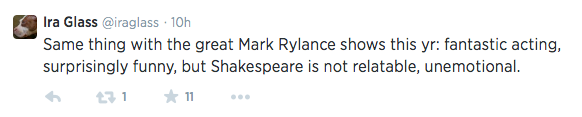
So I was very disappointed to discover these tweets this morning:

Screen Shot 2014-07-28 at 10.41.24 AM

Screen Shot 2014-07-28 at 10.41.15 AM

If there had been only a single tweet dissing Shakespeare, I might have let it pass. But the fact that Glass doubled down makes it worthy of comment. That holds true even if Glass isn’t particularly skilled at Twitter, and didn’t realize that his tweet to John Lithgow was a public message, instead of a private missive. But with his more than 83,000 Twitter followers, and his position as an influential figure in the media, it’s worth taking a moment to respond to what Glass wrote.

I hope that, had it not been 12:15 am, Glass might have realized that perhaps what he wanted to say was, “I, Ira Glass, don’t like Shakespeare. I don’t find his work relatable.” That’s a Twitter-friendly message, and while it’s one which might surprise me, it’s one with which I couldn’t quibble. He could have simply added “IMHO” (that’s “In My Humble Opinion” in social media speak).

I should share that, like many who go to the theatre a great deal, I have a level of Shakespeare fatigue, especially with the parade of Macbeths and Lears we’ve had in New York over the past few years. But, the fatigue for me is play by play; I don’t think anything would keep me from a reasonable diet of well-done Much Ados and Twelfth Nights, such is the pleasure I find in those plays.

Clarke Peters and John Lithgow in King Lear (photo: Joan Marcus)

Clarke Peters & John Lithgow in King Lear (photo: Joan Marcus)

I’ve never studied Shakespeare in any structured way, so it would be very difficult for me to make the intellectual and educational argument on behalf of the Bard. But there are literally thousands of books and professors and even autodidacts who would happily do so, and I have a strong suspicion that Glass is going to be hearing from them as today wears on.

I’ll just take a moment to suggest that, perhaps, Glass doesn’t fully understand, smart as he certainly is, the difference between a play and a production. Shakespeare provides the words of what he’s seen, but each interpretation varies. Perhaps he hasn’t seen Shakespeare productions that illuminate the words in ways that speak directly to him. Trust me, I know that there are plenty of those. That said, maybe he’ll never like any of the plays, no matter how they’re done. Never ever.

Mark Rylance as Richard III

Mark Rylance as Richard III

I haven’t seen Lithgow’s Lear yet (it just started performances last week, by the way) and to be honest, if it weren’t for John (and for Jessica Hecht), I doubt I’d be going. I liked The Globe Theatre’s Twelfth Night with Mark Rylance rather well, though I didn’t care for the Richard III. But the fact is, I’d really be perfectly content to not see Richard III ever again. I don’t care for the play, an opinion forged over many productions, but I certainly don’t dismiss it. I’d look very foolish if I did.

Don’t think I’m trying to make the case for Shakespeare all the time. Our theatres need much more variety, even if school curriculums insure steady group sales for Shakespeare productions, and even if the lack of royalty costs makes them slightly more economical (balanced to some degree by their cast size, though I’ve seen the plays done on occasion with casts as small as five). It’s just that this sweeping generalization from someone who seems such advocate of the arts – and of considered thought and messaging – strikes me unfortunate, since it reinforces the prejudices of others, and even justifies them.

Look I get it, we all don’t like the same things, and frankly, when we’re told it’s good for us, we’re probably even less inclined to like something. We might also be hype-averse, from being told something is the best ever, part of the common online lexicon these days, but also the opinion of many when it comes to Shakespeare. And no matter what the build-up, no matter how much exposure we do or don’t get, there are creative endeavors we each don’t like, for whatever reason. Irrevocably. And that’s O.K.

I will ceaselessly defend Ira Glass’s right to publicly and vocally dislike Shakespeare. But as someone whose voice is amplified and respected, I just wish he’d said that he was sharing his opinion, not declaring an absolute.

Addendum, July 28, 5:45 pm: I just learned that Ira Glass was asked by Entertainment Weekly whether he stands by last night’s anti-Shakespeare tweets. His response: “That was kind of an off-the-cuff thing to say that in the cold light of day, I’m not sure I can defend at all.” So why say anything at all, Ira? He has not, however, sent any further tweets at this point on the subject to suggest that he might have been off the mark.


Yet Another Life for a Times Square Cinema

July 17th, 2014 § 2 comments § permalink


visitor center central circle

visitor center tambourinePerhaps you knew it as a place to cool off, use the bathroom or grab some free wi-fi. You may have passed through it on your way to an office in the building known variously as 1560 Broadway, 165 West 46th Street, or the Equity Building, for which it has been a lobby while construction shut down the regular side street entrance. I’m referring to the Times Square Visitors Center, which closed its doors suddenly three weeks ago.

visitor center twins croppedIn recent years, it has hosted meetings and events, allowed tourists a close up look at one of the Waterford crystal New Year’s Eve balls, and had a small exhibition of Broadway memorabilia. But if you looked beyond that, you could see the vestiges of the intimate Embassy Theatre, a movie house which opened in the pre-sound era of 1925, a bit ahead of many of the grand movie palaces that were about to proliferate. Landmarked in 1987, it was the smallest of the more than 300 theatres designed by Arthur Lamb. Of particular note is that it was built as a high-end theatre for women, with an all-female staff.

visitor center pan fluteThroughout its days as the Visitors Center, from 1998 to 2014, its exquisite details remained intact, if you looked beyond the tourism information booth, the endlessly replayed newsreel highlights clips, the faux peep show and the glowing ball in the center of the space. Given its landmark status, these features should remain preserved, even as the space is converted, reportedly, into a retail opportunity of some kind. Just in case some of the features are protected but obscured in the space’s newest incarnation, here’s a small selection of photos from this lovely gem, taken just after it was closed to the general public and sat in semi-darkness, while those of us who worked above passed through it for a few more days.

visitors-center-light-fixture-from-below-small

visitor center mirror image

visitor center single fixture

visitors center whit corner

visitor center ceiling corner

visitor center exit 2

All photos copyright Howard Sherman


Trying To Find Out A Lot About A Canceled Spamalot

July 15th, 2014 § 16 comments § permalink

spamalot logoOn July 2, I wrote about a situation at South Williamsport, Pennsylvania’s Jr/Sr High School, where a production of Monty Python’s Spamalot, slated for 2015, was canceled, reportedly due to its gay content. A number of news items and opinion pieces were written about the cancelation, with particular attention paid to a statement that homosexuality doesn’t exist in the community. However, the television station which first reported the story subsequently repudiated that portion of its report, saying the statement had not been made. They stood by the rest of their account, which relied primarily on an interview with Dawn Burch, the school’s drama director.

So, nearly two weeks later, where do things stand?

As originally reported, Burch asserted that the principal’s cancelation was attributable to gay content in Spamalot, which he communicated to her in an e-mail. Burch sought legal counsel regarding her right to release that communication, and she has yet to share it, presumably on the advice of counsel. So the reported smoking gun that could prove or disprove anti-gay bias on the part of the South Williamsport district and/or the school administration has not been revealed.

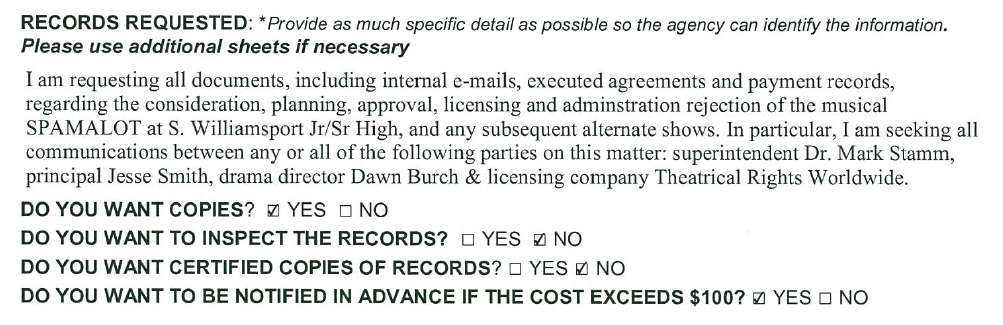
Screen Shot 2014-07-15 at 12.50.17 PMHowever, the state of Pennsylvania has very clear “right to know” laws, available to both state residents and non-residents alike. Consequently, this morning, I filed a request for all documents and communications regarding the musical, in particular any communications between Burch, superintendent Dr. Mark Stamm, principal Jesse Smith and the licensing house Theatrical Rights Worldwide. According to Pennsylvania law, upon receiving a request, an agency has five days in which to either accede to or deny a request, with subsequent appeals processes.

Screen Shot 2014-07-15 at 12.51.01 PMAs I was filing, I learned from a press report that another entity had filed the same type of request on July 10. While the source of the request was not identified, based upon their submission date, they should get an answer by tomorrow or at the latest Thursday, depending upon when exactly they submitted it. Without knowing who requested the material, it’s impossible to know whether they will make the response, successful or not, public. But at this point, I’m in the secondary position for an answer.

In the meantime, Equality Central PA had held a conference of support for gay rights on July 3 in Williamsport, which was attended by superintendent Stamm and school board president John Engel, as well as Dawn Burch. The event was by all accounts a positive one. But additional news reports included statements which suggested that Spamalot was only one play under consideration and had not in fact been selected and approved. Yet the superintendent said the play was canceled to avoid controversy, without specifying what he found to be controversial. While officials can’t even agree on whether the play was ever approved or was in fact canceled, the lack of approval claim is in direct contradiction of the statement I received from licensor Theatrical Rights Worldwide, that made clear that a license had been granted, which surely required both a contract and an advance payment (I don’t imagine any school enters into contracts for multiple shows while they wait to make a final decision). While Burch may have signed the agreement, surely someone from the district with authority signed the deposit check; it will be interesting to learn who approved that payment.

s williamsport high 2Last night, at a school board meeting in South Williamsport, the receipt of the first Right To Know request was acknowledged. However it appears the only public comment beyond that was that it had been referred to “the district’s solicitor.” As expected, they’ve lawyered up. For the record, my attorney received my e-mailed records request concurrently with the school district.

FYI: here’s an interesting tidbit. Under Pennsylvania’s Open Records Policy, every state and local agency must appoint an Open Records Officer. For the South Williamsport School district, that officer is Superintendent Stamm, not an outsider, ombudsman or impartial arbiter. I can’t help but suspect the documents won’t be quickly forthcoming.

And so, we wait, either for Dawn Burch to be assured that by releasing the e-mail she will not be putting herself at professional or personal risk or liability, or for the school system to release the e-mail, voluntarily or compelled to do so by law, the content of which they have not explicitly denied.

To be continued.

Addendum, July 19, 2014: When I got home last evening, I had mail from the South Williamsport Area School District, dated and postmarked on July 16. It acknowledged receipt of my request for records under the Right-to-Know Law and said that the request was under review. However, it was most specifically a “Notice of extension for time to respond to request,” citing the following reasons: 1) “Your request for access may require redaction of public records,” and 2) “A legal review is necessary to determine whether the requested record is a public record subject to access under the law.” The letter further states that, “The School District expects to provide a response to you on or before Monday, August 21, 2014. If the school district fails to provide you with a final decision within that time period, your written request is deemed denied.” It is signed, “Dr. Mark Stamm, Superintendent and Open Records Officer.”

And so, in accordance with the applicable Pennsylvania law, I must wait. If the request is denied, I have the right of appeal, at which point the Pennsylvania Office of Open Records becomes involved. As I wrote previously, I doubted I’d get an immediate, affirmative response to my request, so while this is frustrating, it is not surprising. I suspect that many people don’t have the patience to see freedom of information and open records requests through to the end. However, I am not one of those people.

Addendum, July 31, 2014: Equality Central PA has issued an update regarding their press conference from July 3 and their written offer to work collaboratively with the South Williamsport Area School District “in order to foster a more inclusive environment for all students.”  The update states, in part: “Dr. Stamm responded to the letter promptly, and Equality Central PA is now in discussions on how this new partnership will move forward together. As next steps are determined, details and updates will continued to be shared.” The update concludes with a note, stating, “It has been made known that two separate organizations have filed “Right-To-Know requests relating to the e-mails from Principal Smith to drama director Dawn Burch. Equality Central PA is not involved in those inquiries, but will share whatever information becomes available.”


Gay Denials Slam ‘Spamalot’ at Pennsylvania School

July 2nd, 2014 § 11 comments § permalink

lumberjack“I chop down trees, I wear high heels, suspenders and a bra.

I wish I’d been a girlie, just like my dear papa.”

My friends and I happily sang those Monty Python lyrics, at the drop of a hat, throughout our teen years, identifying with Michael Palin’s exuberant character, rather than the men who walked away from him in dismay. Yes, we’d seen men dress as women in comedy sketches, but those were burlesques, painted in broad, garish strokes. There had never been a declaration of donning women’s garb as a part of regular life, let alone by a macho character like a lumberjack.

In my little gang of friends, we didn’t necessarily know or talk much about homosexuality, which was decidedly less open in our suburban lives in the 70s (though one of our group later came out, to little surprise from any of us). We also hadn’t heard of terms like transvestitism or cross-dressing. Remarkable as it may seem, Monty Python may have played a key role in raising our consciousness, even more so when we learned, in the following decade, that Python’s Graham Chapman was gay, sadly lost too young to cancer.

spamalot logoSo it’s particularly galling, more than three decades later, to find that South Williamsport Junior/Senior High School in Pennsylvania has just shut down an intended production of Monty Python’s Spamalot reportedly because of its gay content. WNEP News paraphrases the school’s drama director, Dawn Burch, as saying, “school officials dropped the musical because of its homosexual themes, according to an email she says she received.” WNEP quotes the superintendent as saying, “We want our performances to be appropriate for the student performers and audiences so that anyone participating or watching can enjoy all aspects of the show.” There’s no indication of what he finds inappropriate or unenjoyable.

I have already reached out to Burch, as well as to the school’s superintendent, for comment; I’ve received no replies as I write a few hours later. I would very much like to read exactly what the e-mail that nixed the production said. The language needs to be brought out into the open. But if Burch’s characterization is accurate, it marks the first time I’ve encountered a school explicitly saying that gay content caused cancellation of a show; the language is usually veiled, with references to mature themes, difficult material or, as even the WNEP report is headlined, “questionable content.”

The WNEP piece continues, “In that email, Burch says the principal wrote that homosexuality does not exist in a conservative community such as South Williamsport.”

If the principal believes that, then he is standing with Iranian President Mahmoud Ahmedinajad who denied that homosexuality existed in his country during a 2007 speech at Columbia University. He is backing the rationale of Russia’s Vladimir Putin who has outlawed the “promotion” of homosexuality. That’s a very strange cast of characters for any high school principal to be aligned with, especially in such a conservative community.

While I’ll grant that there’s some language in Spamalot that a combined junior and senior high school might have some concerns about, they certainly could take those moments up with the licensing house, Theatrical Rights Worldwide. In fact, TRW already has an FAQ with suggested edits for schools right on its website (click here, then ‘Resources,’ then ‘FAQ for School Productions’).

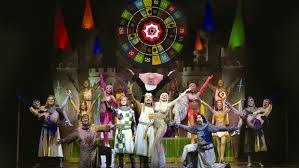
spamalot photoBut the marriage of the characters Herbert and Lancelot is non-negotiable. I asked Jim Hoare, director of licensing for TRW, whether they would ever entertain the excision of those nuptials, and his answer was blunt: “Absolutely not.” Hoare said that hundred of schools perform Spamalot annually.

This news is just breaking, and I’m writing with limited information at what I suspect and hope is the start of a story, not the end. One facet to be explored: Dawn Burch’s husband Samuel is on the district Board of Education, and both are active in community theatre as well, so there may well be support for the show above the level of superintendent.

Despite this coming to light just before a national holiday (gee, didn’t Trumbull High cancel their production of Rent right before Thanksgiving?), it must survive the weekend festivities, on a wave of deserved outrage. School may not be in session, but hopefully the students can organize, like students in Trumbull High School in Connecticut, like students at Timberlane High in New Hampshire, via social media, to increase pressure on the narrow-minded, retrograde administration.

That any educator or school administrator is still denying gay love and gay life in 2014, that a school would cancel a show in a move designed both implicitly and explicitly to shame and frighten any gay student, teacher or person, is simply ugly and wrong. It’s worth noting that in the very first news piece on this, reporter Kristina Papa quickly found people to counter the principal’s alleged, now retracted, assertion about gay life in South Williamsport, which must have really startled the blinkered administration.

It’s worth noting that gay marriage is legal in Pennsylvania. So it is ironic that, as they marry in Spamalot, Lancelot says to his spouse, “Just think, Herbert, in a thousand years time this will still be controversial.”

I guess Tim the Soothsayer had warned Lancelot about South Williamsport, PA. But maybe we can change history, if we raise our voices together.

I urge you to write Superintendent Dr. Mark Stamm (mstamm@swasd.org) and Principal Jesse Smith (jsmith@swasd.org) to voice your concerns (and please share your correspondence with me, if you’re willing, at howard [at] hesherman [dot] com. But I ask that you do so respectfully, even if the district doesn’t afford the same respect in its attitudes and actions.

Addendum, July 3, 5 pm: WNEP now reports that the principal did not make the statement about “homosexuality not existing.” I have left the material in place with the text and my rhetoric about it struck through, because I cannot deny having shared that original report or that I made statements resulting from it, but to show that they are also no longer supported by facts in evidence. Disclosure of the e-mail at the root of this controversy seems more essential than ever, and it should be noted that the school administration certainly has the legal right to disclose it should it wish to do so.

For those who do read the original WNEP story, it should be noted that the local resident and parent, Manny Tskitas, who makes several statements in support of the school administration’s position and questions the play choice, is also a staff member of the South Williamsport school district, as the librarian for grades K through 6. It would have been beneficial if WNEP had noted his affiliation.

Correction, July 5, 7:30: The original version of this post stated that Graham Chapman died of AIDS. That was an error and the text has been updated with accurate information.