October 22nd, 2013 § § permalink

Sesame Street music director Bill Sherman with Elmo and Zoe on the set. Sherman won a Tony Award for In the Heights in 2008 and has recruited Broadway peers to compose for the children’s show. (Photo: Howard Sherman)
You know how to get to Carnegie Hall: practice, practice, practice. But do you know how to get, how to get to Sesame Street?
Turns out there’s a shortcut from New York’s theater district — and it’s landed a number of Broadway’s top songwriting talents on the venerable children’s program.
The man to see is Bill Sherman, a 2008 Tony Award winner for his work on orchestrations for In the Heights. Sherman is in his fifth season as music director for Sesame Street. Back when he started the job, Broadway’s songwriters were an obvious go-to.
“I knew them,” he shrugs. “It was easy access. I was trusting songwriters I knew and loved.”
He’s since discovered that no matter whom he calls, Sesame Street meets with universal enthusiasm. “Everybody will stop some really important thing they should be doing and really focus on this.”
From A College Buddy To Strangers In The Biz
Sherman’s first call, five seasons back, was to Lin-Manuel Miranda, composer and lyricist of In the Heights. “Lin has been my best friend for 10 years,” Sherman says. “We went to college together, so asking him to write a song was very easy.”
Miranda was followed by other Heights alumni, Alex Lacamoire and Chris Jackson, and by composers Jason Robert Brown (Parade, The Last Five Years), Justin Paul (A Christmas Story) and Tom Kitt (Next To Normal). And while some of these artists typically write both music and lyrics, Sesame Street primarily taps into their composing skills.
“So much of what we do is curriculum-based that it has to go through many levels of approval,” Sherman explains. “So most of the lyrics come from the [Sesame Street] scriptwriters.”
Miranda, an adept lyricist, says being forced to focus solely on the music was “enormous fun.”
“It’s easier than usual, since lyrics take longer,” he says — though he’s quick to note that he confers with the show’s wordsmiths.
“The writer will say, ‘It’s very Harry Belafonte; it’s Ravel’s Bolero; it will build and build.’ You get a sense of what they were thinking, of the rhythm that’s in their heads.”
With “Elmo the Musical,” More Shots At The Spotlight
Sesame Street‘s musical universe expanded further when the show introduced its “Elmo the Musical” segments — stand-alone bits, eight to 10 minutes long, that take place entirely in the imagination of the childlike red fuzzball.
The Elmo the Musical segments are through-composed — musicalized from start to finish — “so each composer had their chance to really sink their teeth into the music,” Sherman says. “It became their episode, their thing. We tried to figure out a way to use the composers’ strengths for whatever particular episode it was.”
An installment called “Detective,” for instance, “asked for this complex, jazzy [sound], and Jason Robert Brown is known for that.”
Like all the composers, Brown — who’s never met Sherman — jumped at the opportunity.
“I had a 2-year-old who stared at Elmo all day long,” Brown says. “So there was nothing better than that.”
Then came the kicker: That episode’s script was to be written by John Weidman, a Sesame Street veteran and co-creator, with Stephen Sondheim, of iconic musicals like Assassins and Pacific Overtures.
“I called him and said, ‘So we’re finally writing a show together, only it’s for a furry red puppet,’ ” Brown says. “When I got the recording of Elmo, I could not have been more excited if it had been Frank Sinatra, if it had been Joni Mitchell.”
This fall, as puppeteer David Rudman laid down Cookie Monster’s vocal track on Tom Kitt’s “If Me Had a Magic Wand,” Kitt described the song using an old-school musical-theater term. It’s “a soaring, emotional ‘I want’ moment,” he said, a readily identifiable, recognizably Broadway kind of sound.
But as Sherman is quick to point out, the “Broadway sound” is very much in flux.
“I’ve been part of musical-theater situations that pushed boundaries, that brought new sounds to Broadway. Taking this job, like [working on] In the Heights, was an opportunity to put new sounds in kids’ ears. People assume musical theater is vaudevillian, epic ballads and tap-dance numbers. So to turn that on its head and bring in audiences that don’t go to Broadway shows is important to me.”
Is it a challenge for these sophisticated writers to gear their work for toddlers? “Sometimes,” says Sherman, “composers think that because it’s Sesame Street, they have to dumb it down. … [But] these days children have unbelievably sophisticated ears. I think dumbing it down is disrespectful to kids.”
“That’s Not What Cookie Monster Sounds Like”
When composers have kids of their own, they’ve got an in-house test panel. Brown did demos, complete with character voices, for his daughter.
“Her response was, ‘That’s not what Cookie Monster sounds like,’ ” he reports.
Sherman has met with greater success at home.
“If my 3-year-old hears something, and 15 to 20 minutes later she’s still singing it, then I know I did the right thing,” he says. “If the 1-year-old dances to it, then I know that it sounds right.”
There might well be more musical theater in Sesame Street‘s future; Sherman admits he’d like to work with Stephen Schwartz (Wicked, Pippin) and Marc Shaiman (Hairspray).
And there’s one more big fish he’d like to land — the whale of the business, really.
“We toyed a bit with going after Sondheim,” he said. “We haven’t gone that route yet, but to call up Stephen and see if he was down [for it], that’d be funny. Why not?”
* * *
View this post in its original form on NPR.org
September 19th, 2013 § § permalink

“Stanley? Is that you?”
A very good friend of mine began a successful tenure as the p.r. director of the Long Wharf Theatre in 1986, one year after I’d taken up the comparable position at Hartford Stage. He came blazing out of the gate with a barrage of stories and features in the first few months he was there. But as their third play approached, he called me for some peer-to-peer counseling. With a worried tone, he said, “Howard, my first show was All My Sons with Ralph Waite of The Waltons. My second show was Camille with Kathleen Turner. Now I’ve just got a new play by an unknown author without any stars in it. What do I do?”
My reply: “Welcome to regional theatre.”
Now as that anecdote makes clear, famous names are hardly new in regional theatre, though they’re somewhat infrequent in most cases. In my home state of Connecticut, Katharine Hepburn was a mainstay at the American Shakespeare Theatre in the 1950s, a now closed venue where I saw Christopher Walken as Hamlet in the early 80s. The venerable Westport Country Playhouse ran for many years with stars of Broadway and later TV coming through regularly; when I worked there in the 1984 and 1985 seasons, shows featured everyone from Geraldine Page and Sandy Dennis to David McCallum and Jeff Conaway. I went to town promoting Richard Thomas as Hamlet in 1987 at Hartford. The examples are endless.
So I should hardly be surprised when, in the past week, I have seen a barrage of coverage of Yale Repertory Theatre’s production of A Streetcar Named Desire with True Blood’s Joe Manganiello, or Joan Allen’s return to Steppenwolf, for the first time in two decades, in The Wheel. Indeed, I make the assumption, even the assertion, that they were cast because they were ideal for their roles, not out of any craven attempt to boost box office (Manganiello has even played the role on stage before, and of course Allen is a Steppenwolf veteran). I truly hope they both have great successes. But the stories are coming fast and furious (here’s an Associated Press piece on Allen and an “In Performance” video with Manganiello from The New York Times).
I have to admit, what once seemed a rare and wonderful opportunity to me as a youthful press agent gives me pause as a middle-aged surveyor of the arts scene. Perhaps it’s the proliferation of outlets that make these star appearances in regional theatre seem more heightened, with more attention when they happen. And that’s surely coupled with my ongoing fears about where regional arts coverage fits in today’s entertainment media priorities, which by any account are celebrity driven.
At a time when Broadway is portrayed as ever more star-laden (it has always been thus, but seems to have reached a point where a successful play without stars is the rarity), I worry that this same star-focus is trickling down. Certainly Off-Broadway is filled with “name” actors, so isn’t it reasonable that non-NYC companies would be desirous of the attention made possible by casting actors with the glow of fame? If Broadway maintains sales for plays by relying on stars, it’s not unreasonable for regional companies to want to compete in the same manner against the ongoing onslaught of electronic entertainment.
Again, I doubt any company is casting based solely by name, like some mercenary summer stock producer of bygone days, but one cannot help but worry about the opportunities for solid, working actors to play major leads when Diane Lane takes on Sweet Bird of Youth at The Goodman or Sam Rockwell plays Stanley Kowalski at Williamstown. Aren’t there veteran actors who deserve a shot at those roles? Yet why shouldn’t those stars, proven in other media, have the opportunity to work on stage, especially if it benefits nor-for-profit companies at the box office without compromising artistic integrity?
I’m talking out of both sides of my mouth here, and I know it. But I go back to the essence of my friend’s quandary back in 1986: what do regional theatres do when they don’t have stars? They go back to serving only their communities, which is their first and foremost priority, but they fall back off the radar of what remains of the national media that might allocate any space to stage work outside of New York. They have raised the expectations of their audiences, who love seeing famous folk in their town, on their stages, then can’t always meet them. Are theatres inadvertently contributing to a climate in which celebrity counts first and foremost? How then does the case get made for the perpetual value of the companies that either don’t – or never could – attract attention by working with big names.
Theatres play into this with their own marketing as well; it’s not solely a media issue. Even when they rigorously adhere to alphabetical company billing in programs and even ads, their graphics usually manage to feature famous faces (notably, Yale’s Streetcar does not). Though in some cases, even the billing barrier has fallen, acknowledging the foolishness in trying to pretend someone famous isn’t at the theatre, it grates a bit when regional theatres place actors “above the title” in ads or use the word “starring,” when ensemble was once the emphasis. When the season brochure comes out for the following season, or seasons, which actors seem to recur in photos, for years after their sole visit?
This past February, The New York Times placed a story about celebrity casting on its front page, as if it were something new, and ensuing reportage seemed to carry a whiff of condescension about the casting of stars in Broadway shows. Though when the Times‘ “The New Season” section came out two weeks ago, who was on the front page of it? James Bond – excuse me, Daniel Craig. Celebrity counted there as well. Because it sells.
In a week when Off-Broadway shows like The Old Friends, Mr. Burns and Fetch Clay, Make Man opened to very strong reviews, it’s worth noting that none featured big box office stars, and that as of yet, none have been announced for commercial transfers. Their quality is acknowledged, but perhaps quality alone is not enough to sustain the productions beyond their relatively small-sized venues. Time will tell. While that’s no failure, it suggests that theatre is evolving into two separate strata, unique from the commonly cited divisions of commercial/not-for-profit or Broadway/Off-Broadway/regional. Perhaps the new distinction for theatre has become “star” or “no-star.” And if that’s the case, I think it bodes ill for the health of not-for-profit companies, the vitality of audiences, and for anyone who seeks to spend their life acting, but may never get that TV show or movie that lifts them into the realm of recognition, or even higher, into fame.
Incidentally, can anyone say, quickly, who’s playing Blanche at Yale? Because, in case you forgot, the play is really about Blanche. Not the werewolf.
September 12th, 2013 § § permalink
Macbeth. Twelfth Night. Richard III. Romeo and Juliet. No Man’s Land. Waiting For Godot. Betrayal. The Winslow Boy.
The syllabus for a university survey course in drama? No. Instead, it’s the roster of eight of the 16 titles scheduled to open on Broadway between now and the end of 2013.
To be sure, British plays, artists and productions haven’t ever been strangers to Broadway, but this preponderance of works – featuring actors such as Jude Law, Mark Rylance, Rachel Weisz, Daniel Craig, Anne-Marie Duff, Stephen Fry, Orlando Bloom, Roger Rees, Ian McKellen and Patrick Stewart – in the 40 theatres that comprise Broadway, all at the same time, is an embarrassment of riches. Add in concurrent Off-Broadway productions of A Midsummer Night’s Dream with David Harewood and Kathryn Hunter (opening the new Theatre for a New Audience space in Brooklyn) and Michael Gambon and Eileen Atkins in All That Fall, and it appears that Anglophilia is running rampant in the playhouses of New York.
Much of this is coincidence, since it’s not as if producers conspire on themes. Indeed, from a marketing standpoint, it’s not necessarily even a good idea, since the theatregoers most drawn to this work may have to face some tough buying decisions unless they have unlimited resources and time. Cultural tourists won’t even be able to fit all of these terrific sounding shows in, should they fly to the city for merely a long weekend.
But whether the productions are transfers from the UK or newly minted in America, as is the case with No Man’s Land, Romeo and Juliet, and Betrayal, the British imprimatur seems as if it’s a requirement this year, even if only in part. UK director David Leveaux is staging Romeo and Juliet with a North American cast capped by Bloom. US director Julie Taymor tapped Harewood and Hunter for A Midsummer Night’s Dream, her first project since the highly-publicised and contentious Spiderman: Turn Off The Dark (a tell-all book by her collaborator Glen Berger will be released just as Midsummer performances begin). Even the US classic The Glass Menagerie is being helmed by John Doyle. Only Classic Stage Company’s Romeo and Juliet, with Elizabeth Olsen and TR Knight, is wholly comprised of American artists, though their Romeo is Japan-born.
The English theatre can certainly take pride in this abundance of talent exported to American shores, and I look forward to each and every one of these shows enthusiastically. Indeed, I’ll pass on my annual autumn trip to London since I’ll need only take the subway and not British Airways.
But it does beg the question of whether classical work can succeed on Broadway without a UK connection. Are producers giving up on our best American actors and directors taking on British and Irish pieces without at least some of that heritage in the shows’ DNA? To be sure, not-for-profit companies may lean American overall (LCT’s Macbeth is Ethan Hawke), but has public television conditioned us to desire the “genuine” article? Great American plays appear on British stages frequently, ranging from A View From The Bridge to Fences to Clybourne Park, without the perpetual need to import Americans, let alone the cream of American talent, to make them work. Yet the power of UK casting appears to be such that even multiple Macbeths are deemed economically viable, with Alan Cumming having played virtually all of the roles on Broadway only months ago and Kenneth Branagh due at the Park Avenue Armory in June 2014.
I don’t like calling attention to national divisions when it comes to art, but the fall theatre season in New York simply can’t be overlooked. Despite the luxury of all of the great theatre on tap, the timing sends the message to US actors, theatre students, critics and audiences that when it comes to staging foreign classics, the talent exchange flows more strongly from west to east than in the other direction.
But looking on the bright side, perhaps this means we’ll soon enjoy one more benefit of the English stage, and be able to buy ice cream at the interval.
September 11th, 2013 § § permalink
 This afternoon on Twitter, journalists were decrying the proliferation of the word “premiere” in theatres’ marketing and press materials, especially in cases where the usage is parsing a point rather finely or declaring an outright untruth. I feel for Jason Zinoman, Johnny Oleksinski, Charles McNulty, Diep Tran, Kelly Nestruck and their peers, because at times they may have editors wanting them to take note of important distinctions, but don’t necessarily have a complete production history in order to insure accuracy. Having previously explored the obfuscations of arts communication in Decoder and Decoder II (which remain inordinately popular), it falls to me to dissect this phenomenon.
How has “premiere” metastasized? World premiere. U.S. premiere. East coast premiere. West Coast premiere. Professional premiere. New York premiere. Broadway premiere. Regional premiere. Area premiere. Local premiere. World premiere production. Shared premiere. Simultaneous premiere. Rolling premiere. I’m sure I’ve missed some (feel free to add them in the comments section).
So what is this all about?
It’s a sign of prestige for a theatre to debut new work, so “world” and “U.S.” premieres have the most currency. This is the sort of thing that gets major donors and philanthropic organizations interested, the sort of thing that can distinguish a company on grant applications and on brochures. You would think it’s clear cut, but you’d be wrong.
If several theatres decide to do a brand new play all in the same season, whether separately or in concert with one another, they all want to grab the “premiere” banner. After all, it hadn’t been produced when they decided to do it, they can only fit it into a certain spot, and they can’t get it exclusively, but why shouldn’t they be able to claim glory (they think). Certainly they’re to be applauded for championing the play, and reciprocal acknowledgment is worthy of note.
But still I imagine: ‘Oh, there was a festival production, or one produced under the AEA showcase code? Well surely that shouldn’t count,’ I can hear some rationalizing. ‘We’re giving it more resources and a longer run. Besides, the authors have done a lot of work on it. Let’s just ignore that production with three weeks of paid audiences and reviews. We’re doing the premiere.’
Frankly, sophisticated funders and professional journalists aren’t fooled. But there are enough press release mills masquerading as arts news websites to insure that the phrase will get out to the public. If anyone asks, torturous explanations aimed at legitimizing the claims are offered. When we get down to “coastal,” “area,” “local” and the like, it’s pretty transparent that the phrase is being shoehorned in to tag onto frayed coattails, but at least those typically have the benefit of being honest in their microcosmic specificity. That said, if multiple theatres, separately or together, champion a new play, they’re to be applauded, and reciprocal acknowledgment is worthy of note.
In the 1980s, regional theatres were being accused of “premiere-itis,” namely that every company wanted to produce a genuine world premiere so that it might share in the author’s royalties on future productions, especially if it traveled on to commercial success. Also, there was funding specifically for brand new plays that was out of reach if you did the second or third production, fueling this dynamic. Many plays were done once and never seen again because of the single-minded pursuit of the virgin work. To give credit where it’s due, that seems less prevalent, even if it has done a great deal to make the word “premiere” immediately suspect. But funders and companies have realized the futility of taking a sink or swim attitude towards new work.
To give one example about how pernicious this was, I was working at a theatre which had legitimately produced the world premiere of a new musical, and the company had been duly credited as such on a handful of subsequent productions. But when the show was selected by a New York not-for-profit company, I was solicited to permit the credit to be changed to something less definitive – and moved away from the title page as is contractually common – lest people think this was the same production and grow ‘confused’. I didn’t relent, but it’s evidence of how theatres want to create the aura of origination.
I completely understand why journalists would be frustrated by this semantic gamesmanship, because they shouldn’t have to fact check press releases, but are being forced to do so. That creates a stressful relationship with press offices, and poor perception of marketing departments, when in some cases the language has been worked out in offices wholly separate from them. Have a little sympathy, folks.

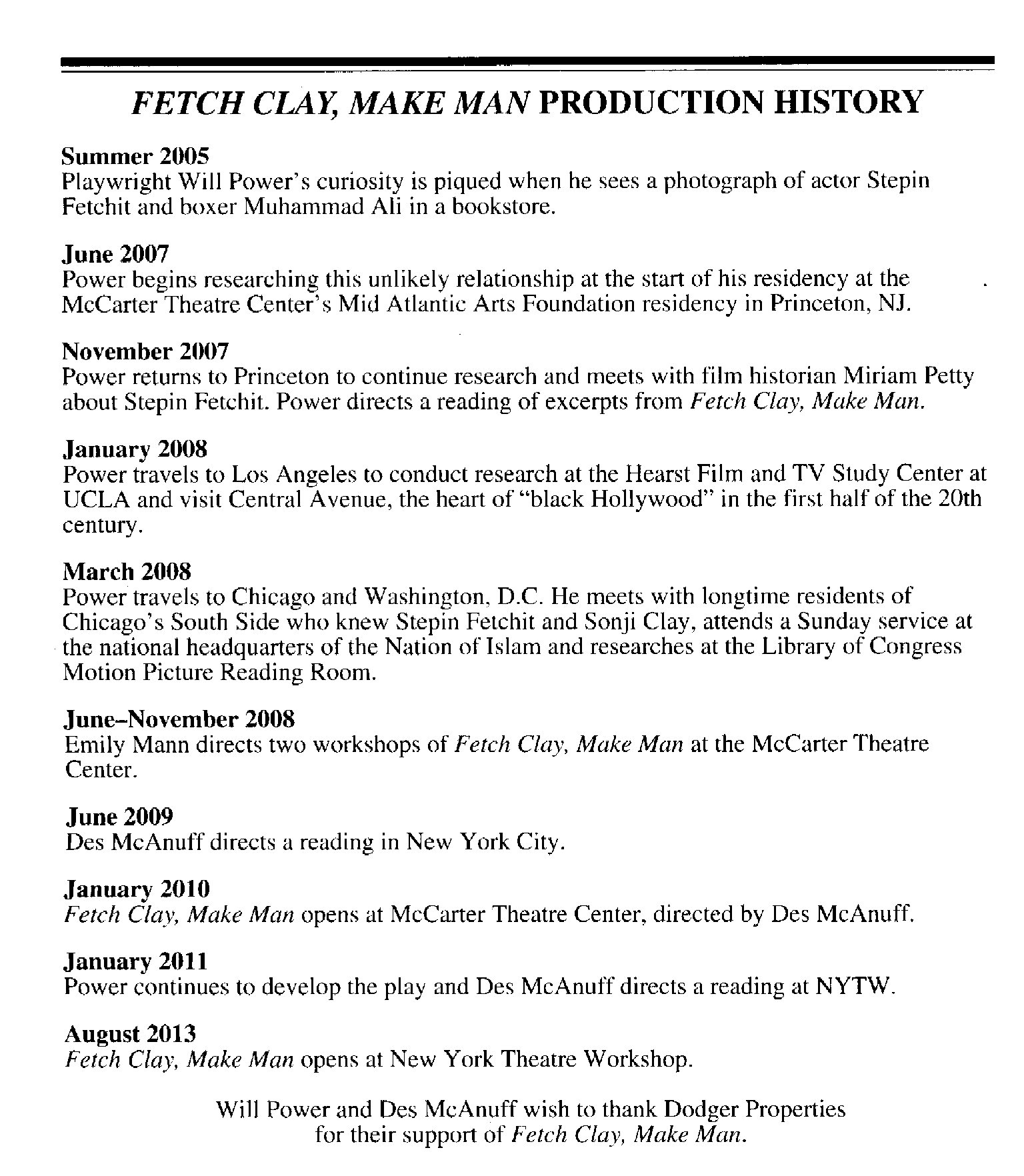
Production history of Will Power’s
Fetch Clay, Make Man
That said, at every level of an organization, truth and accuracy should be prized, not subverted. What’s happening at the contractual level insofar as sharing in revenues is concerned is completely separate than painting an accurate picture of a play’s life (the current New York Theater Workshop Playbill for Fetch Clay, Make Man provides a remarkably detailed and honest delineation of the play’s development and history, by way of example). Taking an Off-Broadway hit from 30 years ago may in fact be its “Broadway debut,” but “premiere” really doesn’t figure any longer, since there’s little that’s primal or primary about it. If you’re based in a small town with no other theatre around for miles, I suppose it’s not wrong to claim that your production of Venus In Fur is the “East Jibroo premiere,” but does anyone really care? It’s likely self-evident.
Let’s face it, any catchphrase that gets overused loses all meaning and even grows tiresome. If fetishizing “premiere” hasn’t yet jumped the shark quite yet, everyone ought to realize that there’s blood in the water.
P.S. Thank you for reading the world premiere of this post.
Thanks to Nella Vera and David Loehr for also participating in the Twitter conversation that prompted this post, which has been recapped via Storify by Jonathan Mandell, including some comments I’d not previously seen.
September 3rd, 2013 § § permalink
Let’s face it: railing against Broadway musicals adapted from movies is a useless exercise. As long as people keep buying tickets for them, and as long as enough of them turn out to be financial successes, they’re going to keep coming, some terrific, some blatantly and ineffectively mercenary. After all, the major Hollywood studios have now established theatrical divisions, looking to exploit their catalogues of stories and marketable titles and to them, theatrical budgets are tiny, so risk is minimal. If the pace ever slackens, I predict it’s going to be a long time coming, and likely due more to the blockbuster mentality that is overwhelming Hollywood being unable to translate to the stage. Pacific Rim, The Musical anyone?
The fact is, musicals from movies are hardly a new phenomenon. As far as I’m concerned (quoting myself from a blog post last summer), “There’s absolutely nothing wrong with musicals based on movies. When it is done with enough craft, with care and talent, no one begrudges a show its origins.”

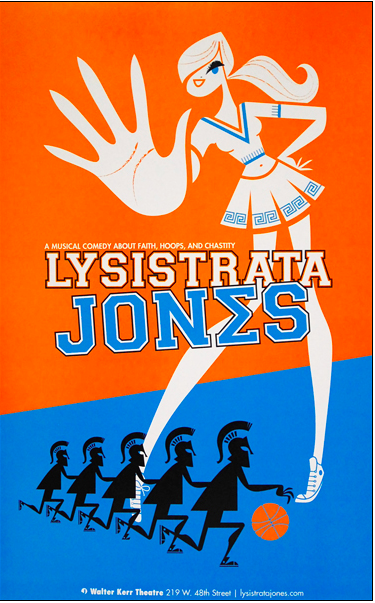
The new Aristophanes musical!
There’s no question that lovers of musicals harbor a deep-seated desire for the wholly original musical – a story not heard or seen before, a score not lifted from some era’s Top 40 hits. There’s a particular craft at play there that hopefully won’t be lost and don’t mistake anything in this post as not desiring more of that work. But adaptation has been around for almost as long as Broadway musicals themselves; the only change is in the source. What’s puzzling is why certain sources have largely been abandoned.
Quick what was the last memorable musical you can name that was adapted from a play? And, excluding those which first became movies, what was the last solid musical based on a book? Actually, let’s drop the question of success altogether and just look at origins.
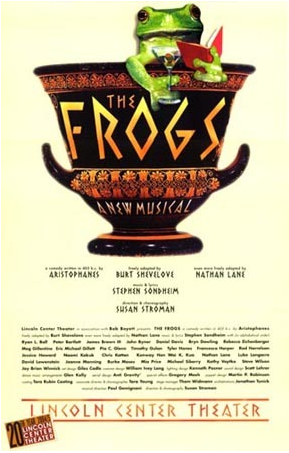
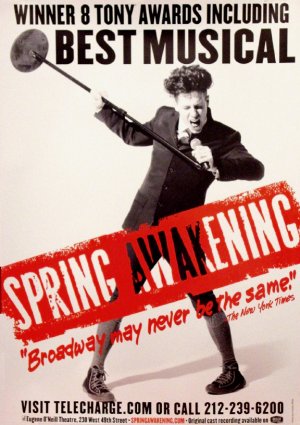
In the past decade on Broadway, only three musicals were adapted from plays: Lysistrata Jones, Spring Awakening and The Frogs (four if you include All Shook Up, exceedingly loosely based on Shakespeare). Only one musical was made from a book that hadn’t been previously filmed. Perhaps you’ve heard of it: Wicked. And I suppose you could make the argument that the Wizard of Oz tie-in gave that show a leg up as well, and it didn’t stand solely on its direct source.

Another Aristophanes toe-tapper!
It’s easy to think up reasons why literate sources have been, seemingly, all but abandoned. Sure, they don’t have the benefit of major Hollywood marketing pushes, but isn’t there some value to decades, if not centuries in the literary and theatrical canon? Hollywood quickly options countless literary properties, some of which never get made, but don’t those rights lapse at some point? Certainly there are numerous plays and books which never get bought as potential films. Those in the public domain shouldn’t be the only ones considered.
A quick reminder may be in order. The tradition of adaptation is as old as the fully integrated musical, since Oklahoma! itself was based on the Lynn Riggs play Green Grow The Lilacs. Among the many musicals adapted from plays: My Fair Lady (from Pygmalion), Hello, Dolly! (The Matchmaker), The Most Happy Fella (They Knew What They Wanted), Where’s Charley? (Charley’s Aunt), The Threepenny Opera (The Beggar’s Opera), Porgy and Bess (Porgy) and, more recently Merrily We Roll Along (from the play of the same title). As for books, think about Show Boat, Damn Yankees, The Pajama Game, How To Succeed In Business Without Really Trying, and Pippin (from Steinbeck’s The Short Reign of Pippin IV: A Fabrication). Don’t forget that musicals have even been assembled from short stories, perhaps most notably Guys And Dolls (Damon Runyon), Fiddler On The Roof (Sholom Aleichem), and Wonderful Town (Ruth McKenney).
To be sure, when it comes to plays, subjects and scale have changed; one might more easily envision the large-cast plays of the 20s and 30s translating into musicals than todays four-to-six character plays. I’m not remotely suggesting that every play (or book, or movie for that matter) is necessarily right for musicalization. But decades since “musical comedy” has ceded ground to “musical theatre” in the artistic vernacular, it would seem there’s a rich vein of material that has been left untapped.

Sing along with Wedekind!
Hollywood studios committing resources to developing musical properties may in fact be the best argument for returning to plays and books as musical sources. Now that the studios want to handle their own stage development, the window may be closing for independent producers who seek rights to movies and the same may hold true for artists who are self-generating ideas for movie into musical adaptations. All the more reason to look beyond the silver screen.
What plays do I think might work as musicals? Peter and the Starcatcher (a book that became a play) seems an obvious one from the recent crop of Broadway plays; frankly, it already feels like a musical to me in many ways. Prelude To A Kiss has always struck me as the basis for a romantic musical with deep feeling. I’ve gently begun nudging Alan Ayckbourn about his Comic Potential. Since Born Yesterday is already an American Pygmalion, it could work just fine. Some of August Wilson’s plays could conceivably translate into a musical blues idiom that’s already in place in his language. Remember, I’m not suggesting stereotypical musical comedy, but musical theatre. And while new plays on Broadway may be scarce, there are plenty Off-Broadway and in regional theatre.
As for books? Bel Canto by Ann Patchett, perhaps, as a musical/opera mix. Middlesex by Jeffrey Eugenides. Dave Eggers’ A Heartbreaking Work of Staggering Genius. Perhaps even a particular favorite of mine, the surreal but compelling Geek Love by Katherine Dunn, with the added element of extensive puppetry work from Handspring.
Broadway remains the predominant engine and the goal of new musicals, and my suggestions may not be obvious material with built-in marketing appeal; these may need to be developed and produced in the not-for-profit sector. But as plays become operas (Doubt, Angels in America) and books have long become movies and then musicals (From Here To Eternity is coming up soon in London), there seems to be a large swath of literature that can be told combining story and song, live on stage. We just need creative people, artists and producers alike, to look beyond the obvious and the easy, and to their own bookshelves, which are stacked with novels and plays, waiting to be told anew. Time to stop watching, and start reading, imaginatively.
July 11th, 2013 § § permalink
While the arts are often notoriously slow adopters of new technology, the rapid rise of social media would seem to dictate that commercial theatre jump on the bandwagon and hold on tight.
But social media may be best suited for use by subsidised companies, rather than the shows that populate the West End and Broadway.
Certainly, every show has the basics in place, a Facebook page, a Twitter feed and so on, in addition to the now de rigeur website. But producers and their marketing teams seem to view most social media as an extension of advertising or PR, feeding out casting announcements, special ticket offers and ‘exclusive’ photos and video all directed at driving sales.
The problem is that for most productions, especially early in their runs, there aren’t necessarily enough people who have followed or liked the show to read what’s on offer, and the content is often repurposed for other uses, diluting the impact that ‘exclusivity’ might still carry.
Shows appear drawn to the media portion of this new manner of communications, when it is the social aspect that is most innovative and compelling. Social platforms offer rapid and direct communications with individuals, but the fact is that people engage most with those who actually engage with, or entertain, them. It may take place on an overwhelming scale when it comes to major celebrities, but in the theatre, it’s quite easy for fans to strike up conversations with stars, writers, designers, directors and even critics – something virtually unimaginable a decade ago. So, if shows don’t actually engage with their audiences beyond tarted-up press announcements, they’re dropping the ball.
Of course, the challenge is how creative on an ongoing basis any one show can be, since they’re a relatively fixed offering (people, on the other hand, can have remarkably varied day-to-day lives) and how much they’re willing to invest to be socially rather than sales-oriented, focusing on the long game rather than immediate gain. Except for a very small portion of the audience, attendance at a commercial show is a one-off event, not an ongoing commitment, seemingly at odds with the basis of social media. The building of relationships afforded by social media can create a stronger bond for an ongoing company producing an array of works over months or years.
In 2009, when social media was still working its way into public consciousness, the Broadway production of Next to Normal garnered great attention and achieved a remarkable million followers through two initiatives. It offered one night “live-tweeting” the plot of the entire show for anyone who cared to follow. Shorn of songs and even most dialogue, they were serialising an outline in real time, but it was a distinctive effort that marked the show as creative and tantalised people with the framework of a show they might then choose to see in real life.
Next to Normal also ran a campaign in which Twitter followers were encouraged to make suggestions for a new song for the show, creating a connection directly with the authors, who did indeed write a song based on suggestions. While it wasn’t added to the finished work, fans could hear it online. It’s a shame that, since the account still has 946,000 following (though it is closed), it hasn’t tweeted since April of last year, leaving a huge untapped base of potential ticket buyers for other productions.
Despite the efforts and success of Next to Normal, social media still seems an afterthought for most Broadway shows. In a survey of Broadway theatres in early May, prompts to interact with the show through social media activity (primarily Facebook, Twitter and Instagram) were on display at 15 theatres – yet a nearly equal number (14) had no such reminders in their front of theatre or box office lobby displays (a number of theatres had no tenants at the time). A few showed real initiative in advocating social media use (a photo backdrop outside the Lunt-Fontanne for Motown; a ‘photo stop’ in the upper lobby of the Gershwin for Wicked).
Unfortunately, others simply displayed social platform logos without the specific names used by the shows in those arenas, so one would have to seek them out; it’s akin to posting ‘we have a website’ instead of giving a URL.
If productions don’t feel that social media gives them sufficient bang for their buck, perhaps they shouldn’t establish a presence only to give it short shrift. On the other hand, as some shows are demonstrating, with a little thought, a show can build its profile at a proportionately low cost, amplifying the power of the ever essential word of mouth, so long as they’re willing to commit to subtly promoting their presence by offering intriguing content and damping down the urge to shout “BUY NOW”.
June 27th, 2013 § § permalink
During the 2012/13 Broadway season, a total of nine new musicals appeared on Broadway (hitting the average annual level of recent years). Of those nine, only four are still running. As I write, there are seven new musicals playing Off-Broadway, with an eighth due in a few weeks; there may well be others. What does it tell us when 12 months of Broadway yields just about as much new musical material as we find Off-Broadway in only a couple of months?
To be fair, many of the Off-Broadway musicals are limited runs in the seasons of subsidised companies, and two are commercial transfers from such companies from earlier this year. Only one will play in a theatre which is comparable in size to Broadway venues, and in that case it’s under the auspices of Shakespeare in the Park; most are in spaces where one week of performances equals the capacity of one Broadway performance. A transferred Off-Broadway hit can easily become a Broadway casualty given the commercial demands of larger theatres and higher costs.
Certainly, hit Off-Broadway musicals are hardly new; one need only look to The Fantasticks, You’re A Good Man, Charlie Brown, Godspell and Little Shop of Horrors for precursors, and it’s unlikely the current new shows will ever attain the longevity of those icons. But in recent years, the standard model has tended much more towards the Off-Broadway to Broadway transfer for success, as evidenced by shows ranging from Rent to Avenue Q to The 25th Annual Putnam County Spelling Bee. Even shows that began in rudimentary stagings at the New York International Fringe Festival and the New York Musical Theatre Festival have fought their way to Broadway, including Urinetown and Next to Normal.
Surveying the variety of material, it would appear that the modest scale of Off-Broadway allows for a greater range of topics and styles than the Great White Way, from the sung through pop opera of Dave Malloy’s Natasha, Pierre and the Great Comet of 1812 (based on a portion of War and Peace, and performed in a tent) to David Byrne and Fatboy Slim’s Imelda Marcos disco bio Here Lies Love. There’s one musical that is drawn from a film (Far From Heaven) and two with their roots in Shakespeare (Venice, after Othello, and Love’s Labour’s Lost). Several adopt variations on an environmental, break-the-proscenium approach (Here Lies Love, Murder Ballad and Great Comet). None model themselves on the formula of the classic American musical.
I suspect that no one is getting rich off of these productions, while the backers of Kinky Boots, Matilda and Motown on Broadway will surely do quite well over time. For these Off- Broadway musicals to become true earners for all involved, they will either have to manage sustained runs under a commercial model, on Broadway or Off, or spawn productions across the country and abroad. But even if that doesn’t come to pass, what they are doing is providing a superb showcase for predominantly new talent and unexpected subjects; they are bolstering the musical repertory at a pace at least equal to Broadway and building the reputations of artists.
This shouldn’t suggest that musical success Off-Broadway is a breeze, and it’s worth noting that many of these shows are only mounted with significant donor underwriting or “enhancement” from producers who hope the property will turn out to be Broadway-worthy. But with different scale and different expectations, Off-Broadway musicals may well be supplanting Broadway in advancing the form.
Hindsight doesn’t benefit anyone, but it is hard to resist wondering whether the short-lived Hands on a Hardbody might have fared better at director Neil Pepe’s Atlantic Theatre Company instead of in a Broadway theatre. Ironically, that was the birthplace of Spring Awakening, a musical that had struggled through a number of developmental productions over the years only to find praise, first Off- Broadway, then on.
There’s an old saying that one can’t make a living on Broadway, but can make a killing. It’s not easy to make a living off of Off-Broadway musicals either, but you can build a career.
June 27th, 2013 § § permalink
Ever so quietly this week, the national arts scene became a bit more fragmented, a bit more stratified and a lot more invisible. The Associated Press has just spiked a chunk of its opera, dance and off-Broadway coverage. And in this case, no news is bad news.
In an email, AP chief theater writer Mark Kennedy described the decision to me:
“We sent out a survey before the Tonys to the members of our cooperative, asking about their use of our reviews,” he wrote. “While music, books, movies and TV came back positive, the results proved what we have long suspected: Members overwhelmingly are not using our opera, dance or off-Broadway reviews.”
“It’s more than that,” Kennedy continued. “In some cases, they actually resent [that coverage], thinking we can use our resources better. So while we of course will dip into the world of off-Broadway, whether for an occasional review or a story, we have to listen to the people who pay our bills.”
This may seem like an inside-baseball story, of interest only to theatrical publicists and producers. But the ramifications are a little greater.
Coverage in The New York Times has prestige and tradition, and speaks to the arts community; The Wall Street Journal reaches art organizations’ board members and corporate sponsors; USA Today has mass appeal. But the AP almost certainly has the widest reach of all: Its copy is available to hundreds of print and online outlets internationally, including the big three above.
Indeed, as news has increasingly shifted online, AP arts coverage is probably more accessible to more people than it has ever been. It appears directly on countless news websites — including NPR’s — without any human effort, as part of a continuous news feed, where it’s not subject to the day-to-day editorial priorities and space limitations that govern a print paper or radio show. Even when editors “don’t use” this coverage, it appears on their sites; in some cases, an AP item may prompt an outlet to do its own story on the same subject.
In my days as a publicist, pre-Internet, reportage by The Associated Press often resulted in a single story cropping up in the most unexpected places. It would get relayed back to me by other publicists in other cities — or, charmingly, by the parents of co-workers.
Further back, when I was a teen hungry to learn, AP coverage fed my arts interest with news of culture beyond that originated by my local paper.
What’s important to note is that this week’s news is not the callous edict of a commercially driven corporate behemoth, but rather a practical decision by a member-driven service organization that operates as a not-for-profit. Yet it represents how, in an ever more challenging environment for the news industry, the arts are drawing the short stick.
Some might think that coverage of these areas is essentially local news for Manhattanites. But the arts ecology is more complicated than that. Sure, many people may not be able to attend a New York opera in person, but both radio and TV broadcasts bring those performances to audiences across the country — and the AP’s stories may be the most accessible source of advance coverage for fans in a variety of markets.
Dance companies may well tour to those same locations, and since few can sustain themselves playing only in Manhattan, the AP’s coverage has a direct impact on the viability of those bookings as well.
As for off-Broadway? That’s the easiest to argue for. It’s home to a significant number of new works that may never reach Broadway, but which increase the body of theatrical literature — and which often go on to play numerous regional and amateur stages.
This is particularly important when it comes to plays (as opposed to musicals): Of the 45 works recognized by the Pulitzer for drama or the Tony for best play since 1984, only five originated on Broadway. Yet that is the arena on which the AP will now narrow its focus. Coverage of “regional” arts organizations — long hailed as a similarly deep well of creativity — has already been marginalized.
This is just the latest news in a dispiriting trend. Onetime show-business bible Variety has all but eliminated regional theater reviews, along with a significant amount of its off-Broadway coverage; there’s occasional opera coverage in its pages these days, and no dance coverage.
The Village Voice, home to off-Broadway’s Obie Awards, laid off drama critic Michael Feingold just weeks ago, after more than four decades of service, even as it broadened its coverage of food.
There are countless other examples: Arts coverage at outlets large and small has been narrowing in favor of the largest and most popular companies and offerings, just as arts funding sources have been shrinking, and often tilting in favor of the bigger players. That stratification will only be reinforced by the AP’s coverage reductions.
There’s an invisible cost here. When attempts to reduce or eliminate funding to the arts crop up — which they do with a depressing regularity — they gain traction in part because not enough people encounter the arts, or even regular coverage of the arts, on a daily basis. When a resource as mighty as The Associated Press can’t even offer material for consideration because of a professed lack of interest by other media gatekeepers, I worry it’ll only lend support to those who want to delegitimize the arts with a charge of elitism.
Because celebrity holds ever-increasing sway in all entertainment coverage, and because the performing arts are (to too many editors) the poor stepchild of entertainment, I have a sneaking suspicion that if Hugh Jackman ever ventures off-Broadway, when Renee Fleming sings something at the Met, wherever David Hallberg dances, The Associated Press will probably manage to tell us about it.
We’ll also still hear from the AP when an artistic leader is the victim of internecine violence in his own company, or when a tech mishap injures a performer. Bad news always trumps good.
But we will know infinitely less about all the fine work being done by those who aren’t already well known, or at companies where tragedies mercifully don’t happen, or among worthy troupes that could most benefit from national attention not found elsewhere.
And should The Associated Press’s decision prove to be a model for yet more media outlets, then entire swaths of the arts may be, as long feared, on the brink of popular irrelevancy. Because soon no one may know they’re there.
Here’s the post in its original form on NPR.org
June 12th, 2013 § § permalink
Jean-Michel Basquiat
For those complacent about the ongoing reduction and elimination of professional arts journalism, I would like to offer a small but concrete example of where this decline is leading us.
On Monday June 10, the website BroadwayWorld.com published the following item, credited only to “BWW News Desk.” In my experience, this usually means that it is, more or less, taken directly from a press release.
Eric LaJuan Summers and Felicia Finley to Star in BASQUIAT THE MUSICAL Reading, 6/24
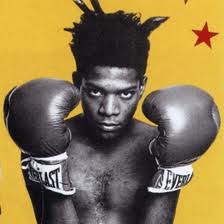
Basquiat, a new musical based on the life and times of 80’s art-star, Jean-Michel Basquiat will get a private reading on Monday June 24th.
Basquiat was a New York graffiti artist who shot to stardom in the early 80’s with his neo-expressionistic paintings and bad-boy image. He was a part of a cultural revolution that included fellow painters, Keith Haring and Fab 5 Freddy, New Wave bands Blondie and Talking Heads and Basquiat’s mentor, Andy Warhol. He was one of the most sought after painters in the 80’s until his untimely death in 1988 at only 27 years old. Written by Chris Blisset (music and lyrics), Matt Uremovich (lyrics) and Larry Tobias (book), Basquiat deals with the triumphs and failures of one of the art world’s most controversial figures.
The cast stars Eric Lajuan Summers (Motown) and Felicia Finley (Mamma Mia). Summers, who recently won an Astaire Award for Outstanding Male Dancer for Motown the Musical, will be reading the title role of Jean-Michel Basquiat.
Other performers include: Roger DeWitt, Chad Carstarphen (In the Heights), James Lambert, Justis Bolding (Woman in White) Frank Viveros, Jason Veasey (Lion King), Gabriel Mudd, Rubin Ortiz, and Eddie Varley.
Basquiat is conceived and directed by Paul Stancato.
Now this is a pretty straightforward announcement of something that happens constantly in New York, a reading of a new musical. But in our era of search engine optimization, curation, consolidation, aggregation and “reporting” based solely on something written elsewhere, stories begin to grow. On Tuesday June 11, The Huffington Post carried the following “story,” with no byline, which escalates some of the language around this one-day industry reading. It is, presumably, drawn from the same source as the Broadway World item, or extrapolated from the item itself.
‘Basquiat The Musical’ Is Reportedly Happening
Move over Matilda, there is a new unlikely Broadway star in town. According to Broadway World, “Basquiat The Musical” will get a private reading on June 24 with stars Eric LaJuan Summers and Felicia Finley.
That’s right, art star Jean-Michel Basquiat will have his meteoric life immortalized in song, thanks to writers Chris Blisset, Matt Uremovich and Larry Tobias, and director Paul Stancato (who is married to Felicia Finley).
Of course if any artist were to get a Broadway debut, we would assume it would be Jean-Michel. The neo-Expressionist bad boy’s iconic style, charismatic persona and tragic early death make for an extremely compelling story. He’s already been the subject of documentary and film, and a blockbuster auction at Christie’s, but the musical threshold has yet to be crossed…until now.
Summers, who previously starred in “Motown,” seems like a good fit to play the graffiti king, leaving us wondering who will play Basquiat’s mentor Andy Warhol and brief beau, Madonna.
What do you think of the prospect of a Basquiat-based musical? And which artist would you most like to see doing jazz hands on Broadway? Fingers crossed for Gerhard Richter…
On the very same day that a one-day reading is announced by Broadway World, The Huffington Post informs us that Basquiat is “reportedly happening” as a Broadway show and the actor taking the lead role in the reading has been elevated to having “previously starred in Motown.” Considering that Motown has only been running for a couple of months, the use of past tense seems unwarranted, and the actor in question is a member of the ensemble there, not playing a lead role (the Motown ensemble plays a wide variety of small roles). In addition, this as-yet unseen reading is apparently already generating buzz, as the unnamed reporter opines that this actor “seems like a good fit to play the graffiti king,” even though the reporter is unlikely to have read the script, heard the score or been able to extrapolate from the actor’s Motown performance how his talents would bear on that material. Incidentally, as I write, 133 people saw fit to share this story with others, 67 tweeted it out and 463 “liked” it.
Then, in turn, this morning, Complex.com does its own “reporting,” credited to Justin Ray (noting it is “via The Huffington Post,” but also citing Broadway World as a source) in which Basquiat is now a sure thing.
“Basquiat The Musical” Will Be Coming to Broadway
We have heard a slew of rappers refer to Jean-Michel Basquiat in song, however the influential artist’s involvement with music will be taken to the next level. Basquiat The Musical will be having a private reading on June 24 according to Broadway World.
Yes, the prolific art icon will now have a musical dedicated to his life starring Eric LaJuan Summers and Felicia Finley. The musical was written by Chris Blisset, Matt Uremovich, and Larry Tobias. It will be directed by director Paul Stancato. Although it is unexpected, we imagine it will be a pretty awesome story. It’s another thing he could have added to his hilarious resume.
Eric LaJuan Summers starred in the big musical Motown and is sure to play the part well. However details have not been released as to who will play Madonna or Andy Warhol. However we anticipate it will become popular, though it will be hard to outsell his works (which have gotten crazy amounts of dollars).
Yes, in less than 48 hours, Basquiat is not only “coming to Broadway” – all reference to a reading is gone in the headline – but Complex “anticipate[s] it will become popular” and the lead actor is “sure to play the part well.” The snowball effect is well underway, for a show that hasn’t even had its industry reading.
I don’t bring this up in order to cast any aspersions on the artists or creators of Basquiat; I genuinely wish them well. But these three items, taken together, demonstrate how quickly some simple facts about a show early in its development blow it up into a Broadway show based solely on the voracious appetite of news consolidators and headline fabricators. Have they done so wholly of their own accord, or were they easy prey for a wily publicist? Hard to say.
Since I was a child, I’ve known the phrase, “You can’t believe everything you read.” But nowadays, when it comes to news, when facts are elaborated upon and disseminated by multiple “news” sources, our skepticism needs to be greater than ever before. If this is the new standard for news, we shouldn’t be bemoaning the death of accuracy, even more than the anticipated death of print?
And as for arts coverage? Without reliable and verifiable reporting, whether in print or online, our descent into nothing but gossip draws ever closer.
* * *
Full disclosure: I periodically cross-post blog entries from this site to The Huffington Post as an arts blogger, for which I receive no compensation, and I have not communicated with anyone there in connection with this piece.
May 8th, 2013 § § permalink
 I keep expecting to get jaded. Even though the actuarial tables tell me that I’m more than halfway through my life, I can still be a teenaged drama club kid, over and over again, with only the slightest provocation. Yesterday was one of those days.
Like so many in “the business,” I started out as a performer in my high school shows, both plays and musicals. But as practical considerations like finances and family, as well as negligible talent, took hold, I shifted over to administration, allowing me to be close to what I loved, but without the vagaries of an artist’s life. I have never forgotten how much I enjoyed performing, but I moderated any dreams in that regard.
When I met high school acquaintances over the years who expressed surprise that I wasn’t still on stage, I’d preempt the conversation by saying I’d be happy just to sit in a jury box on an episode of Law And Order. I was as surprised as anyone when the universe – and one very generous person on Twitter – listened, and I landed a small speaking role on Law And Order: Special Victims Unit two years ago. I still can’t believe it.
As for standing on a Broadway stage, singing? I had moderated that to a lingering desire to one day write the liner notes for a cast recording, something more within my wheelhouse. (I came very close about nine years ago, for a Tony-winning show, but it was not to be.) I am, for reasons too mundane and absurd to mention, thanked in the liner notes of the reissue of The Golden Apple, but that doesn’t count.
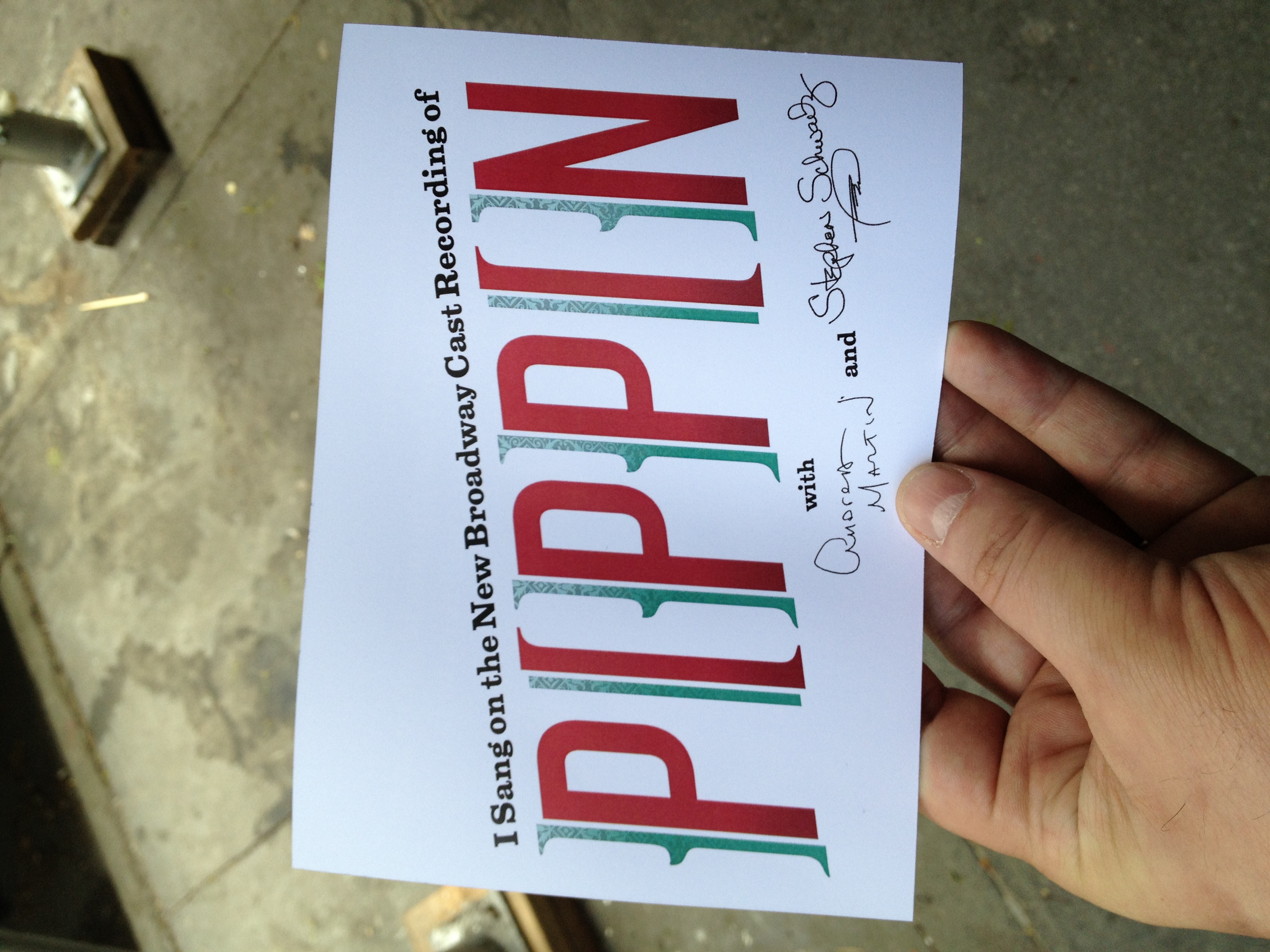
So when I read last week of a recording session that would include the public on a track on the cast album of the Pippin revival, my heart leapt. I filled out forms online; I placed a few calls to friends in the industry. My not-so-submerged fanboy, my long suppressed performer, went into overdrive. This was my chance to sing on a Broadway cast recording. I had to do it. It wasn’t quite being in a Broadway show, but it was the next best thing.
Mind you, I would be doing my vocalizing with some 250 strangers; I wouldn’t get my name on the recording; royalties or even payment wasn’t in the cards. Only those I told about it would even know I was there. But I would know.
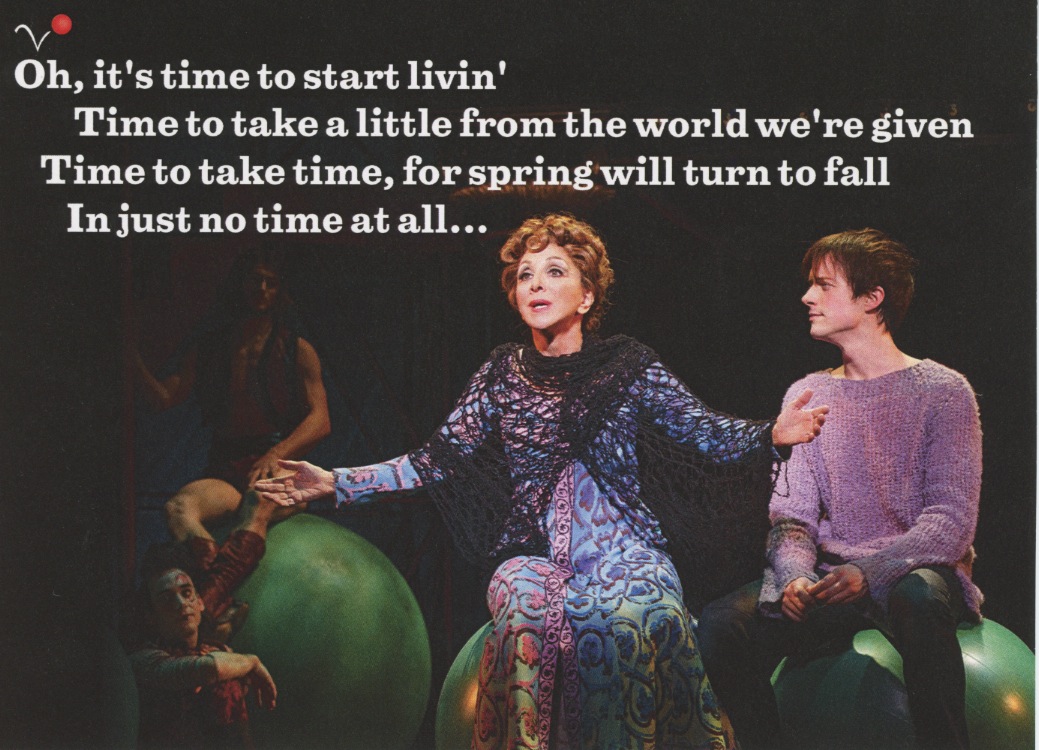
Whether it was fate or phoning, I got my e-mail notice, my golden ticket, that I was “in.” Yesterday, I lined up with what turned out to be more like 500 or 600 others to play the role of “audience” on the Pippin track “No Time At All.” As we filled the auditorium at the School for Ethical Culture on New York’s Upper West Side, I took note of the surroundings, which clearly are that of a church. I considered the phrase painted above the stage/altar: “The place where people meet to seek the highest is holy ground.” I found it rather apt, in my own secular interpretation, given the degree of devotion many have to musical theatre.
I was a mix of seasoned pro and giddy youth. I said hello to some of the journalists in attendance; I greeted a Twitter pal who had gotten in by volunteering to guard one of the microphone stands near an entryway; I chatted with Kurt Deutsch, whose Ghostlight Records will be releasing the cast album; I sat with my friend Bill Rosenfield, who during his days as head of A&R for RCA/BMG was responsible for countless cast recordings (and for filling out my CD collection with those discs). At one point, Kurt’s wife joined us in the pew where I was seated, so suddenly I was singing with the tremendously talented Sherie Rene Scott, only two people separating us. The radio host, author and accomplished musical director Seth Rudetsky was seated directly in front of me; I feared he might turn at any moment and cast me out as a poseur.
 But when the music team came out, I was just one voice in a big chorus, albeit one which knew the song before the first note was played. Imagine my surprise when, after being drilled on diction and rhythm, we were then taught harmony lines. I had not thought of myself as a “baritone” since high school chorus, nor had I attempted harmony in public in some 30 years. I was quickly reminded of my inability to remember anything but a melody line unless others around me are singing “my” line; scary flashbacks to my poor efforts at barbershop harmonizing ensued. Although we had been seated as we learned our parts, we were given the direction, “Let us stand,” as in worship and as in chorus rehearsals decades ago. I was surprised by the power of those three words.
Pippin’s composer/lyricist Stephen Schwartz was onstage for the session, and he was genuinely listening and tweaking what we did; Andrea Martin, although her vocal track had already been laid down in a studio, was there to egg us on. I was pleased to see them, but I know them both casually, so there wasn’t the sudden rush from being in the presence of celebrity. When Andrea first came out, she spied me and flashed a big grin and a tiny wave of recognition; I felt even more connected, more than just someone whose name got drawn along with so many others. Ah, a performer’s ego.
But the truest thrill was when every member of the assembled horde lifted their voices, including mine, in song. I had forgotten what it was like to sing in a group, in harmony, the magical mingling of one’s self with others in music, the unique vibration of the vocal cords and emotion that music can produce. Yes, a shotgun microphone was only a few feet away, but it was forgotten in the sheer happiness of being encouraged to sing full out, without embarrassment, on a tune that is undoubtedly one of the most effective and spirited earworms of the Broadway repertoire.
I’d still like to write some liner notes on day, but even if that doesn’t come to pass, I know that embedded in the Pippin cast recording is little old me, happily singing away for present and future generations of musical theatre fans. I am preposterously happy at the thought of being an indistinguishable footnote and at what is now already a memory of a magical hour.
I leave you with these random thoughts:
Thank you to every person at Pippin who made “my debut” possible.
I’ll be happy to sign your Pippin CD when it comes out (kidding, kidding).
Sing out Louise, whenever and wherever you can.