A Whispered Broadway Milestone No One’s Cheering

May 28th, 2014 § 21 comments § permalink

hundred dollar billIt’s a funny thing about milestones, the way certain thresholds get set in our minds. If you follow reporting on the movie industry, breaking the $100 million gross barrier is a major achievement (and for those of us in the arts, an astronomical figure), although its not always connected to the cost of the film under discussion. But that number has been a yardstick for years, once cause for double page ads in Variety whenever it was reached, regardless of whether the movie that achieved it was released in the 60s, 70s, 80s or today – despite inflation making the success happen a little faster with every passing year. To be sure, plenty of movies still don’t make it, but it’s a less rarified club than it was in the days of The Sound of Music or Star Wars.

Once upon a time, when people still spoke of the price of a loaf of bread as an economic indicator, gas prices crossed a big threshold when a gallon broke over the $1.00 price point. People under 40 may not even remember this being breached. This was a big deal in those non-digital days, when prices couldn’t simply be altered with a tiny bit typing; I happened to be in England a few years back when the price of a liter of petrol broke the £1 mark, resulting in some creative solutions to signage that never anticipated announcing such a sum.

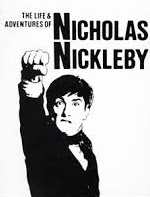
nickelby playbill cropIn theatre, in my lifetime, the big round number that sticks in my memory was the $100 ticket for The Life and Adventures of Nicholas Nickleby, though it could be explained away by the massive physical production, cast size and length. It seemed a one-off as opposed to a trend-setter. Miss Saigon had $100 tickets at the start of its run, but didn’t sustain them, dropping back to the then more typical $65. The $100 price cropped up again for the 1999 revival of The Iceman Cometh, which by virtue of its length, simply couldn’t give enough performances in a week to make economic sense otherwise. You may know of other isolated instances.

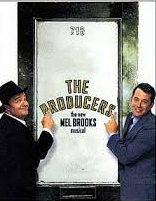
iceman playbill croppedWe didn’t truly reach the $100 asking price per ticket milestone until The Producers introduced the $100 ticket in the wake of rave reviews, also giving us the innovation of the VIP ticket at the extraordinary price of $480. This was in 2001, just 13 years ago. At the time, other hits were quick to match The Producers, with Mamma Mia! jumping to $100 per ticket just two months later.

But it should be noted that the $100 price was the theatre equivalent of a hotel’s “rack rate,” the stated top price for rooms which were in reality variable and negotiable. In theatre, through group sales, discount offers, the beloved TKTS booth and day of show lotteries you could still see a Broadway show for much less than that. As a result, over the past decade, while regular prices have risen, especially at the most successful shows, the average price paid on Broadway stayed under $100 per seat. That is, until last year, the just-completed 2013-14 Broadway season, when the average ticket was $103.92, up $5.50 over the year before.

So while articles may be trumpeting record revenues and record attendance, they’re either downplayingavoiding or ignoring the true breaking of the $100 threshold, preferring to lead with the allure of numbers in the millions (attendance) or billions (dollars). That’s a shame, because in terms of what matters to the average audience member, the average ticket price seems much more essential news. To me, that’s the headline.

the producers playbill croppedIt’s always important when discussing prices over time to acknowledge overall price changes in comparable fields or the economy as a whole. So let me point out that in the period since The Producers in 2001, the Consumer Price Index has risen from 177 to 233, an increase of 32%. The average movie ticket price nationally has gone from $5.65 to $8.13, a jump of 44%. But the Broadway jump from $58.72 to $103.92? That’s an increase of 77%.

I don’t have the resources to analyze all of the factors contributing to that jump, beyond the prevalence of premium or VIP seating, along with hit shows with higher prices that don’t need to discount (The Book of Mormon and Wicked) and superior supply and demand management (The Lion King). Maybe Nate Silver and his Five Thirty Eight team could work on this and tell us whether there’s a valid economic underpinning, or whether its just naked supply and demand having its day.

But surely if Broadway price hikes outstrip the economy and even other entertainment options, Broadway will eventually reach a tipping point that could have an impact on the already dicey economics of producing and running shows. Purchasing decisions based on price could put even more shows at risk for sustaining an economically viable run, whether in theory, as a Broadway engagement is contemplated, or even once it’s up and running.

So I want to call out this pricing milestone for all to see, and wonder where it will lead our commercial theatre yet a few more years down the line. If price resistance takes hold, if the Broadway price-value equation tips too far with the former outweighing the latter, will it be a place where shows can only be smash hits and utter flops, with no mid-level performers managing to run? If that happens, I hope it will prompt more people to sample institutional and independent theatre, here in New York and elsewhere. But on Broadway, and indeed at every level in the arts, ticket pricing is our global warming crisis, steadily rising year after year without raising true alarm and provoking meaningful action, until it threatens to swamp us all.


Hey Broadway, Have You Got The Time?

May 22nd, 2014 § 2 comments § permalink

“Saturday at 10? It’s a date!” Neil Patrick Harris in Hedwig and the Angry Inch

“Saturday at 10? It’s a date!”
Neil Patrick Harris in Hedwig and the Angry Inch

Imagine my surprise when I discovered that Broadway’s 7 pm curtain on Tuesdays was introduced more than 11 years ago. I thought it a somewhat more recent innovation, especially since I still regularly attend shows where audience members enter at about 7:50, usually far into the first act, looking embarrassed, angry or both.

Of course, this curtain time is no longer limited to Tuesdays, as many shows also play on Thursdays at 7, and shorter shows that can still give their company an appropriate break between matinee and evening even manage it on Wednesdays.

I remember the doomsayers when the Tuesday plan began: people wouldn’t be able to eat dinner, restaurant business in the theatre district would suffer, suburban patrons would be deterred from coming in for a show given the compressed travel time. That doesn’t seem to be the case, because while overall seasonal attendance has fluctuated between 11.5 and 12.5 million in the past 10 years on Broadway, there’s no evidence that the change in curtain times hurt business and it’s entirely possible that the adjustment helped to stave off declines by introducing flexibility.

Of course, that flexibility has gone far beyond the 7 or 8 pm curtain options. There are also shows with 7:30 weeknight performances, matinees variously at 1 pm, 2 pm, 2:30 pm, and 3 pm, and family oriented shows may well play two shows on Saturday and two on Sunday. (I remember the 1999 Broadway revival of You’re A Good Man, Charlie Brown experimenting with three show Saturdays, though that was short lived and, to my knowledge, never repeated.). At long last, the Thursday matinee (long seen in London) has been added. Right now, Hedwig and the Angry Inch, perhaps to retain a connection with its downtown roots, has 7 pm and 10 pm shows on Saturdays, a performance schedule that was once commonplace in the Off-Broadway of my younger days. I’m probably leaving a few options out.

I recount all these variants because I think it’s worth recognizing that Broadway producers and theatre owners, no doubt in collaboration with the theatrical unions, have proven that by being responsive to the changing needs of audiences, they can break out of habits for which the rationale may be long forgotten. For tourists, this means there are more possibilities of catching a show; for die-hard theatregoers, it means their binge weekends can be even more packed, in that eternal quest to see as many shows as possible in a limited number of days. For local audiences, it means they may have plenty of evening ahead of them post-show, or the opportunity to get to bed earlier on theatre nights.

I will say that this proliferation of performance times doesn’t surprise me in the least. Growing up in Connecticut, many theatres there had 4 pm Saturday matinees (followed by 8:30 or 9 pm evening shows) and the 4 pm shows were usually the fastest to sell out, no matter what was on stage. 4 pm shows also yielded the most geographically diverse audience, since the schedule allowed for day-trips with the greatest options of complementary activities – even plenty of time to sit by a pool or at the beach before heading to the theatre. And it was in 1985 that we surveyed our audience at Hartford Stage about their weeknight performance preferences, finding that by a 2 to 1 margin, they wanted 7:30 instead of 8 pm. It was implemented with nary a complaint.

All of this is merely a reminder that, as we search for ways to retain or develop audiences, the most simple tried and true elements of past patterns may not be something to cling to, just as abandoned practices may yet come into vogue once again. What may have been just fine five years ago may not hold today. We’ll only know for sure by experimenting – and by asking our audiences for their input whenever possible. We’re never going to be Netflix when it comes to entertainment on demand, but we might find there are some demands we can easily meet, if we’d just listen, and give things a try.


The Stage: Opera can help build a future for new musicals

May 22nd, 2014 § 0 comments § permalink

Note: I fear the headline that ran with this piece was misleading, since the column focused more on how companies not known for traditional musical theatre were making it a part of their producing mix. That said, if the resources expended on opera were allocated to new musicals then, well, wouldn’t it be loverly?

Bryn Terfel and Emma Thompson in Sweeney Todd. Nathan Lane reprising his career-making role in Guys and Dolls. Film actor Billy Zane and musical veteran Jenn Gambatese in The Sound of Music. Three intriguing stage productions with one common thread: none was produced by a theatre company.

Respectively, they were mounted by the New York Philharmonic, Carnegie Hall and Chicago Lyric Opera. They drew upon Broadway artists, but none were on Broadway.

It seems that when non-theatre companies want a sure thing they turn to musicals. While theatre companies, subsidized and commercial alike, seek to sustain audiences amid an array of entertainment options and ever-escalating price barriers, musicals are offered as budget balancers by symphonies and opera companies, with ever greater frequency. That’s on top of theatre companies which were once devoted solely to dramatic works having made an annual musical de rigeur. And when it comes to the big halls, it’s big names, both for titles and performers.

These events owe a great deal to the Encores! series at City Center, which has proven the significant audience for limited run versions of great musicals, some rarely seen. But they also attest to the broad appeal of musicals when companies step outside their own repertoire.

Thirty years ago, it was considered startling when the late New York City Opera embraced Sweeney Todd. Theatre only seems to attempt opera perhaps once every decade or so, notably with Baz Luhrman’s La Bohème and Peter Brook’s La Tragédie de Carmen. It seems that when it comes to producing across disciplines, for theatres it’s primarily a one-way street.

With the English National Opera’s announcement of plans to produce commercial musicals, it’s not quite the “unique” venture cited in their announcement. In their efforts to “embrace the new climate where audiences seem to enjoy the blurring of boundaries between opera, theatre and musicals,” one cannot help but wonder how the balance will play out if a West End berth, as stated, is a goal for these projects. Several years ago, the Metropolitan Opera announced a joint venture with its neighbor Lincoln Center Theater to develop works along such lines, but it has yielded little.

Given the budgets for major operas, or the musical richness of a full symphony, it’s easy to see why musical theatre artists would be eager to work outside their usual sphere. But so long as musicals are viewed as cash cows, economic pressure will dictate reliance on the tried and true, with the same repertoire being repeatedly mined by ever more groups. What musical theatre really needs is more resources and new models for sustaining new works beyond the hit or flop reality of Broadway and the West End. If only the symphonies and opera companies could help out there.


Drama School Clickbait from The Hollywood Reporter

May 19th, 2014 § 4 comments § permalink

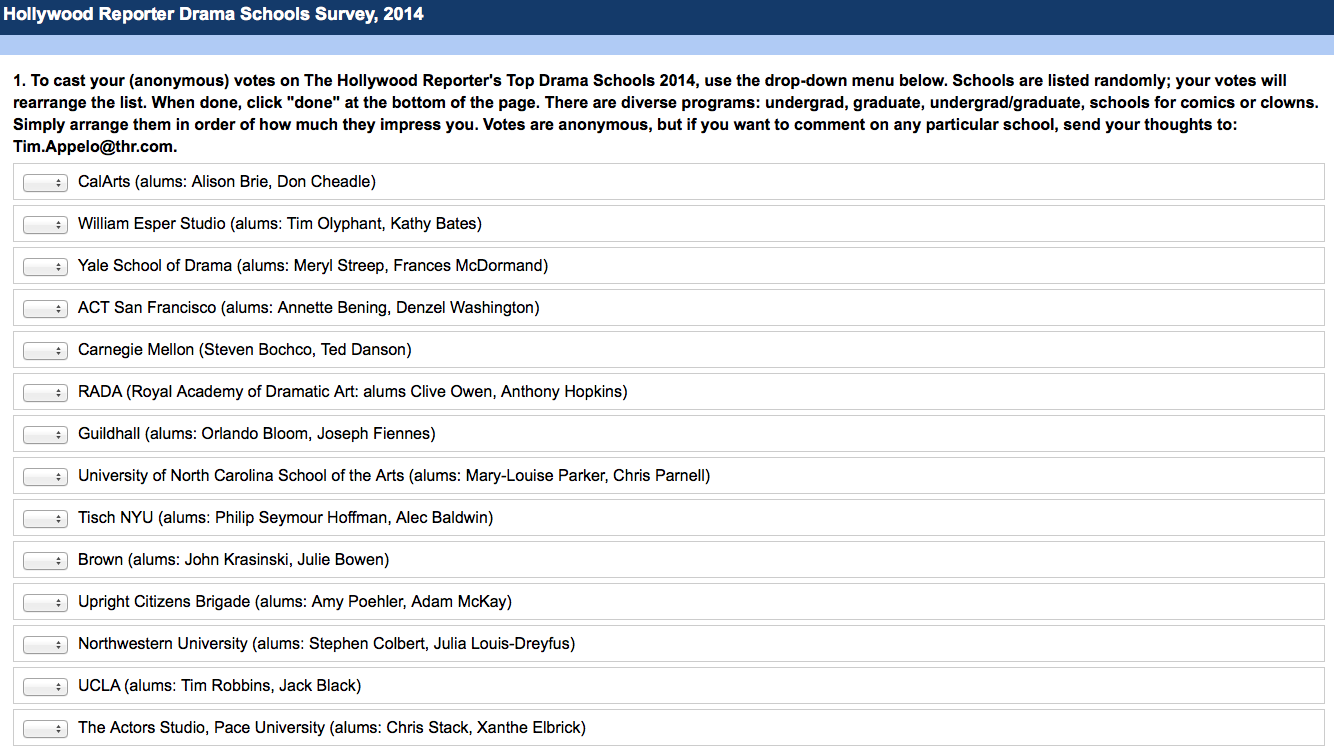
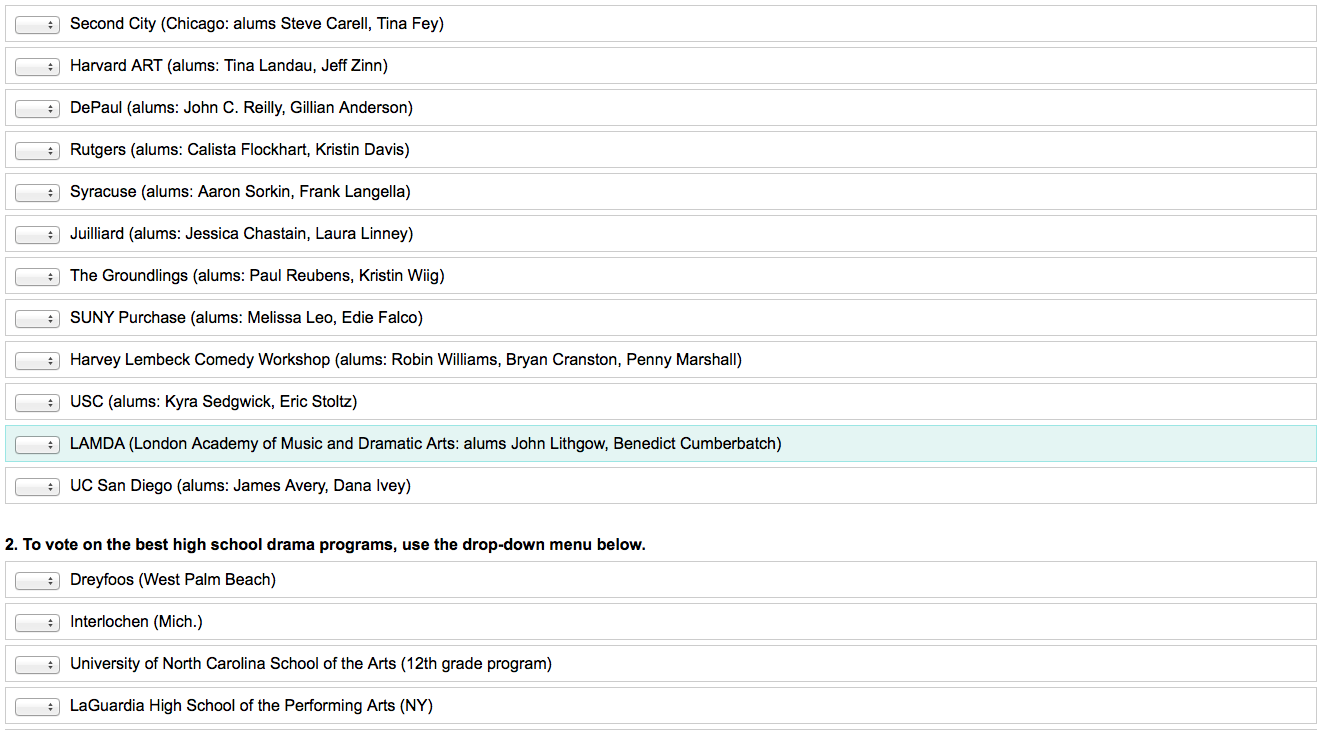
THR 1THR 2THR 3We all know that web traffic is the lifeblood of online media, giving rise to such essential reporting as “Which Game of Thrones Character Are You?,” “Which Breakfast Club Character Are You?” and every imaginable variant on this gambit. It is, of course, clickbait, designed to get you to interact with a site and see some advertising and increase page views, engagement time and other such metrics. Frankly, after finding out which Muppet I am (Beaker, if you must know), I stopped taking the bait.

But there’s some more high-minded clickbait out there, and The Hollywood Reporter is engaging in it right now. Via SurveyMonkey, THR is asking people to vote for what they think are the Best Drama Programs, at the high school and collegiate level (there’s no distinction between undergraduate and graduate for the latter). While I couldn’t find the survey on their website, it was being tweeted around, so I have the survey sans preface, sans methodology, sans everything. The fact that the schools you can choose from are pre-selected could be the top results of a larger study, but as it travels the tubes of the Internet, there’s not necessarily any way to know. (If there is any science behind this, I challenge THR to append it to their survey, and I’ll amend this post accordingly.)

To put it simply, I think this is preposterous and rather insidious, because when the resulting article comes out, a number of aspiring young theatre artists just might think it’s based in some degree of expertise, rather than the result of a narrowly defined popularity contest. A few schools might even cite it in promotional materials, and you can be sure the results will go zipping around with both pride and dismay.

So I’d like to say simply this: if you come across it, ignore it. Don’t fill it out. Don’t share it. Don’t comment on the results when they appear. Recognize it for the clickbait that it is, far beneath the sometimes excellent reporting that has been a part of the truly resurrected THR. If they exist to report on the industry, then they surely could commission a real study, or build a special section about drama education, not exploit us for our eyeballs. Offering a list of schools (and classes and even summer camps) with a slight nudge towards the fame of a few graduates (mostly actors, some of whom graduated decades ago) isn’t designed to inform anyone, it’s designed to get people to read and talk about The Hollywood Reporter. It doesn’t even offer the opportunity for write-in candidates, which would at least make it a fairer popularity contest. And who thinks the resulting article, revealing the skewed results, is likely to come out right around The Tony Awards, when theatre’s profile, like it or not, is at its highest nationally? I sure do.

What’s the harm, I hear some of you say? Isn’t it just another benign internet survey? No, because it will be the basis of boasting, of decision making, of aggravation, depending upon who you are and how you relate to the results.

While I’ve reproduced the survey, you’ll notice I haven’t linked to it. I won’t give them the satisfaction. I hope you won’t either. And if you want to give them a piece of your mind, tweet them at @THR.

P.S. I don’t mean to suggest that THR is the only site to do such spurious surveys. There are others. But this one is happening right now.


On Stage In Milford, With Sweet Understanding

May 5th, 2014 § 5 comments § permalink

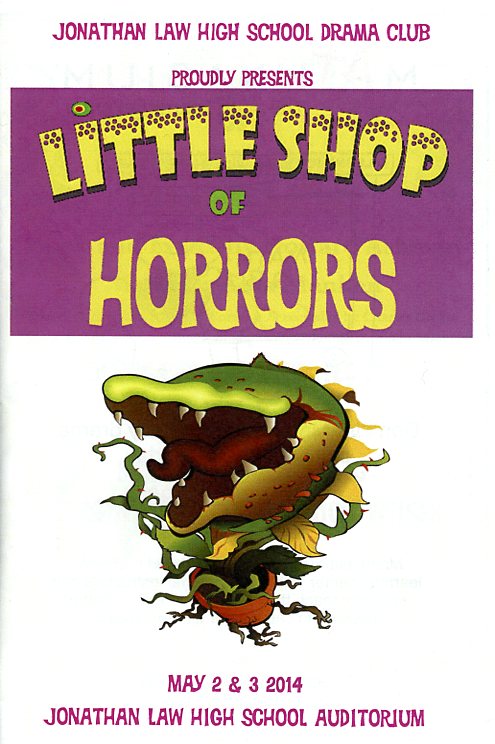
Program cover for Little Shop of Horrors

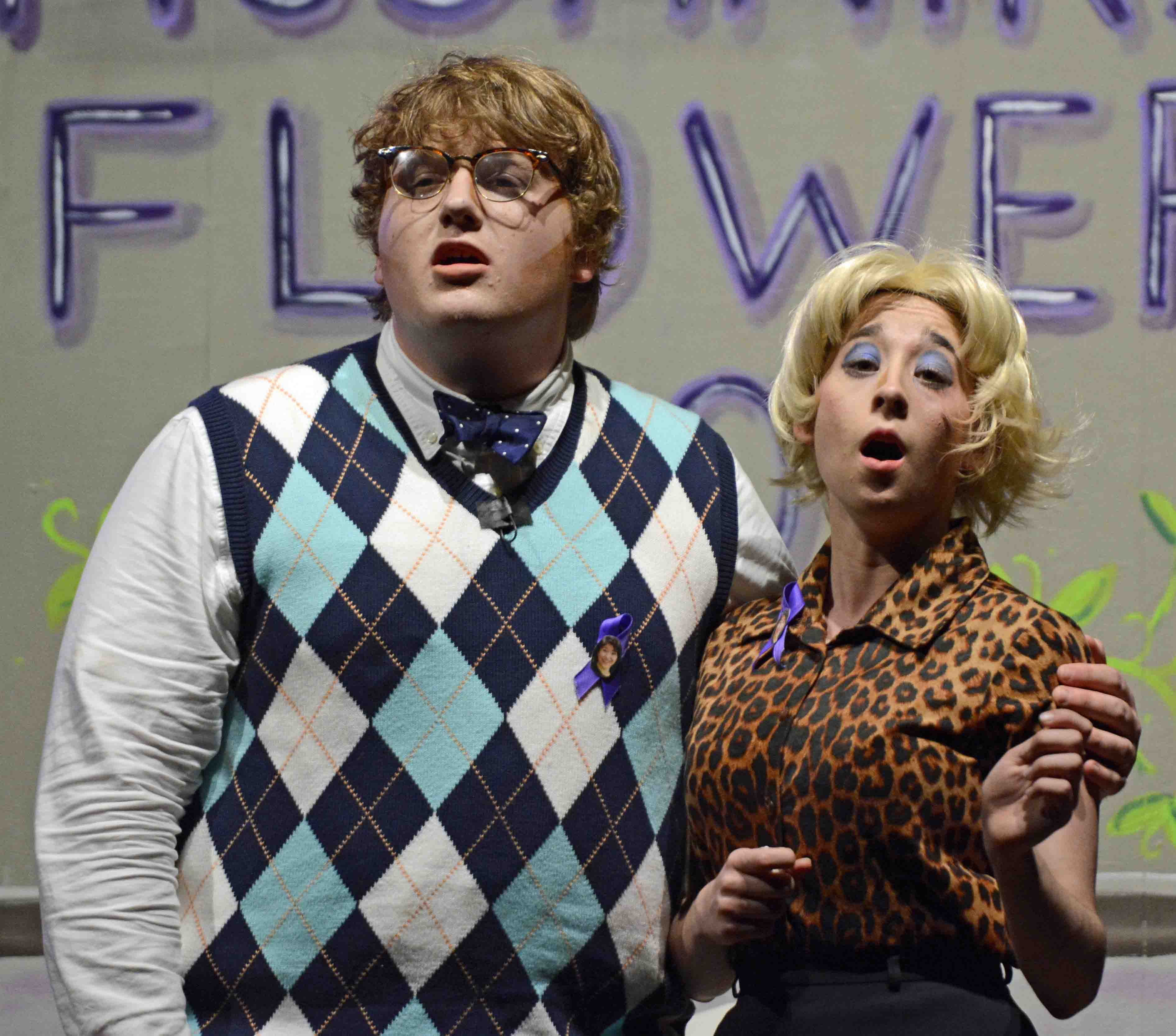
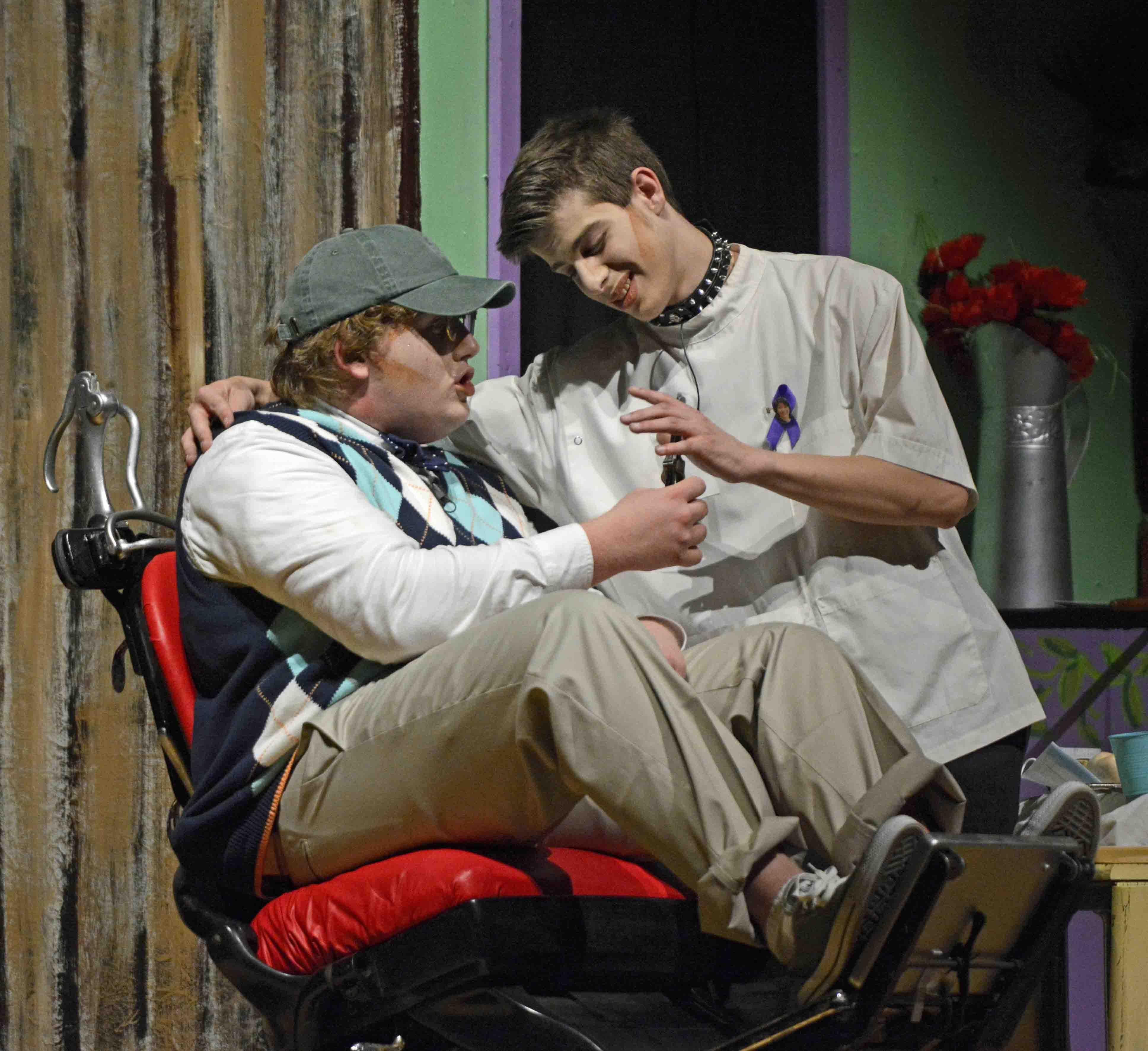
If you somehow managed to materialize in the auditorium of Jonathan Law High School in Milford CT this past weekend just as the band began the opening strains of Little Shop of Horrors, you would have simply thought yourself at a perfectly enjoyable production of that infectious musical, well-rendered by its teen cast. As the show progressed, however, you might have begun to notice something peculiar, a motif in the costumes, worn by every character: a purple ribbon, with a small circle affixed to it.

Of course, if you had seen the news in the prior week, if you drove into the high school lot, if you read the program, you would know that this was not your average high school production. One week earlier at the school, 16-year-old junior Maren Sanchez had been killed by another student, reportedly after she declined his invitation to the prom.

Director Michael Mele

Maren was a vigorous participant in many school activities; the drama club was high among them. On Saturday afternoon, and presumably at the two other performances, the drama club’s faculty advisor and director of the production, Michael Mele, took to the stage pre-show to speak about Maren. He also explained that when the tragedy took place, he assumed the production wouldn’t happen, and that it was the other students who wanted to go forward, as a tribute to Maren. In the program he wrote, “We feel that by proceeding with the show we are doing what she would want us to, to get up there and do the best damn show this school has ever seen.”

Having never attended a show at Jonathan Law before, it’s impossible for me to say whether it met that standard. But I can say that it met an even higher one: that these young students performed together as very likely the bravest cast that I have ever seen.

*    *    *

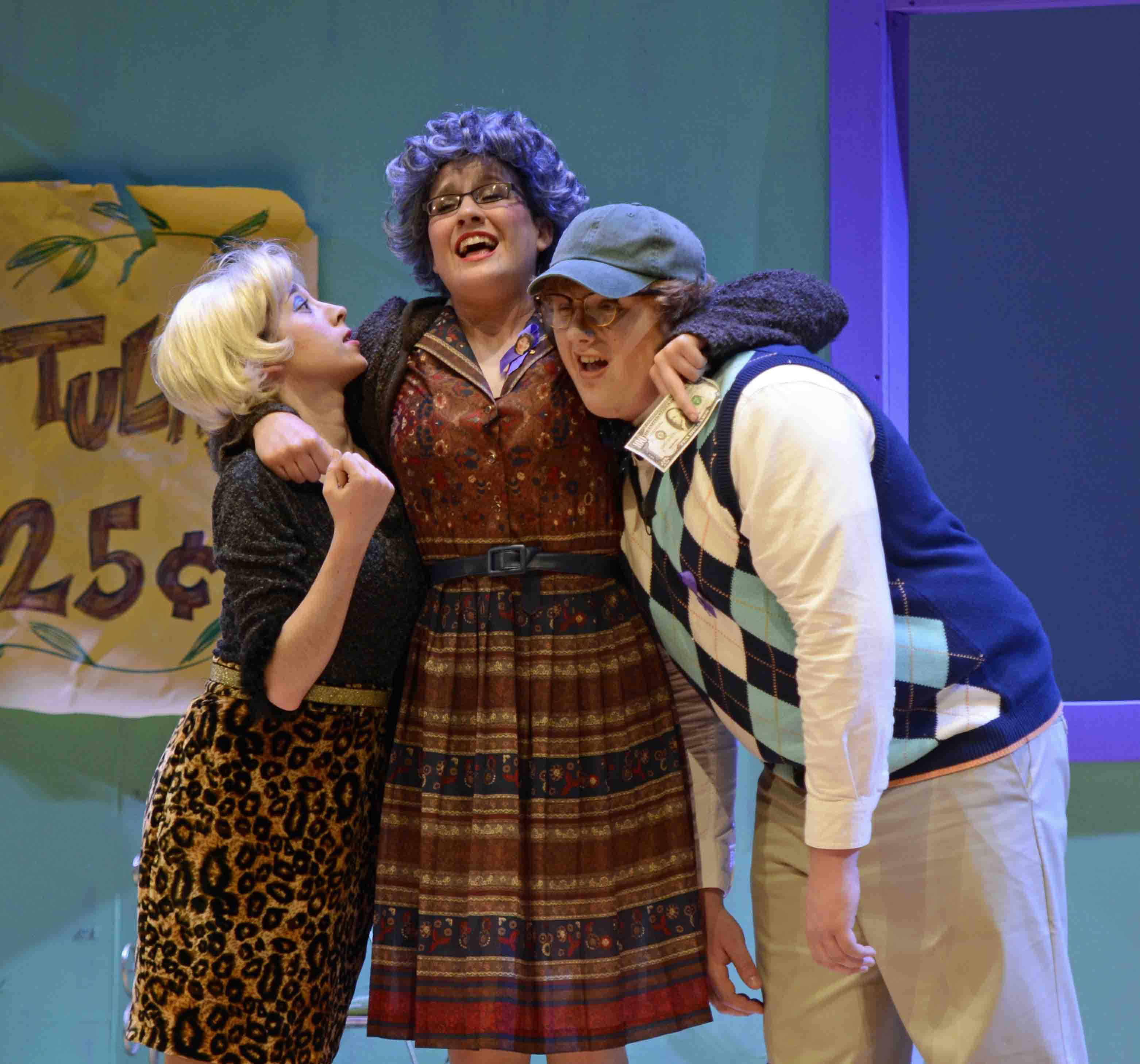
audrey mushnik seymour hughand audrey II seymourWhen we read about a tragedy like Maren’s death, and we read about them far too often, I suspect that most of us feel helpless. “I wish there was something I could do,” is a refrain I’ve heard, and thought myself. In the case of a natural disaster, some may go and donate blood, countless more make a financial contribution. If the tragedy literally hits closer to home, there may be more that can personally be done.

As I read various accounts of Maren’s death, I felt helpless once again, even though it did hit close to home: Milford is the town adjacent to Orange, where I grew up. As a teen, I spent a good bit of time in Milford, because that’s where the movie theatres were; even now when I take the train to see family and friends, I get on and off at the Milford station.

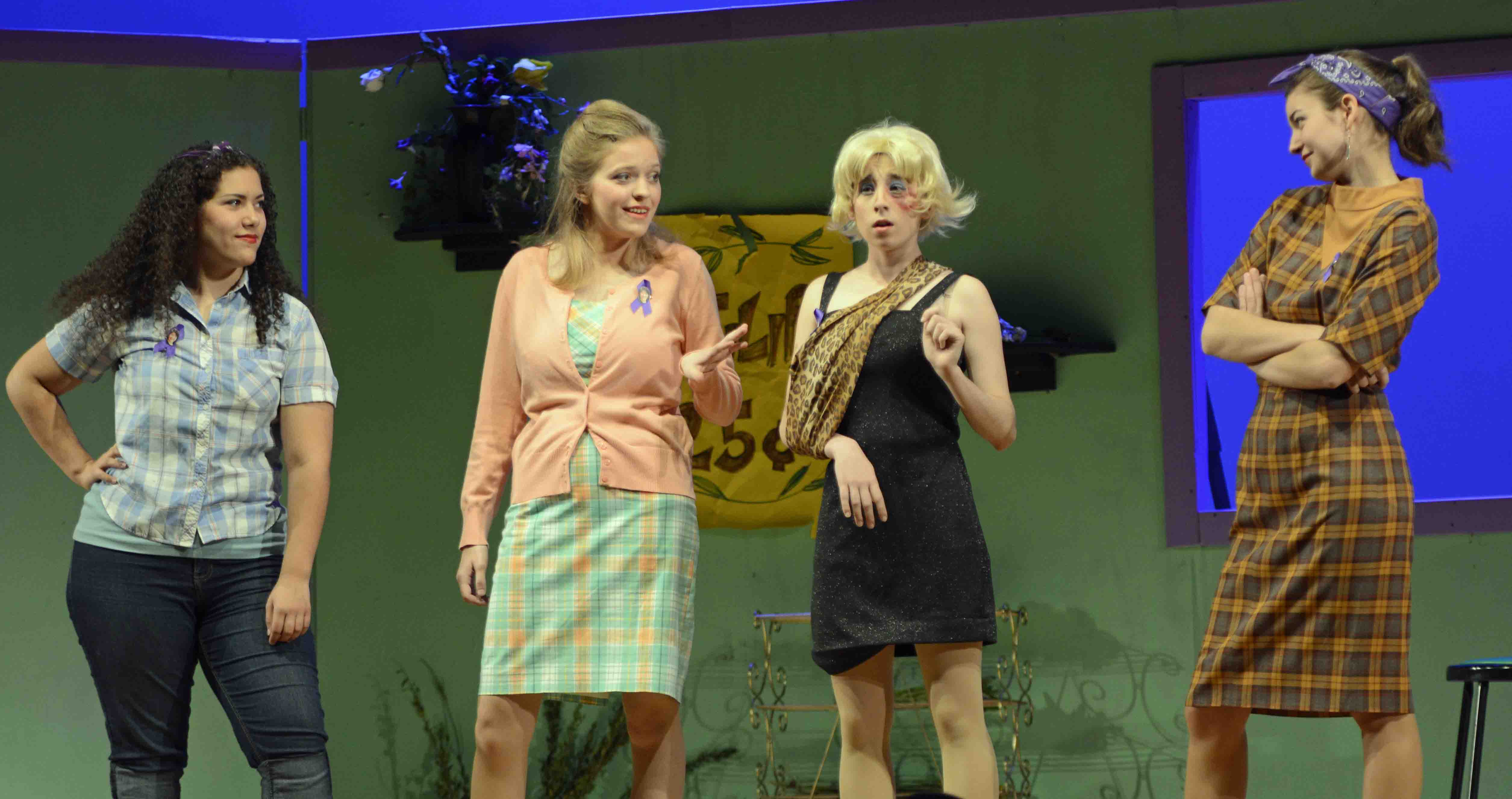
cryal ronette chiffon audreyWhen I first read that Maren was an enthusiastic member of the drama club, I began to wonder whether there was in fact something I could do; when I learned she was to have been the person animating the ravenous plant Audrey II, I suspected I might be able to help. Imagining that if the show went forward they might need a puppeteer, I wrote to Mr. Mele (who I’ve never met before) and said that if they needed someone to come in and perform as Audrey II, I had connections to the puppetry community through my time at The O’Neill Theater Center, and I’d be honored to help. I wrote perhaps seven hours after Maren’s death.

On Sunday morning, a bit after 8 am, Mr. Mele returned my e-mail (apologizing for not responding sooner, if you can imagine). He wrote that the decision had been made to go forward with the show and that, yes, they could use help. I immediately sent messages to Stephanie D’Abruzzo of Avenue Q fame; to Pam Arciero, who runs the O’Neill’s Puppetry Conference; and to Martin P. Robinson, who designed and performed Audrey II in the original production and the Broadway revival. They are all Sesame Street veterans as well. Stephanie called within 20 minutes and as I reached for the phone, an e-mail popped in from Pam. This is all before 9 am on a Sunday morning.

audrey II and austin squareBy Monday, they had roped in Bart Roccoberton, head of the Puppetry Arts program at the University of Connecticut; by the end of the day, Bart had cleared the decks for a UConn student, Austin Costello, who had performed Audrey II before, to complete his academic work and be in Milford from Tuesday through the final show on Saturday. Austin carried the heaviest load, my puppetry friends had made the right calls, all I did was set things in motion. Inexplicably, they thanked me for doing so.

When I met Austin for the first time following Saturday’s matinee, I explained the chain of events that had brought him to the high school. My instinct was that if the show was to go on, it would have been very difficult for another student to take their friend’s role so soon, and to bring in a student from another high school would have been challenging in its own way. With someone who knew the show, who could focus on the work so that the drama club could focus on both performing and, if at all possible, to begin healing, one small part of the production might be less laden with sorrow. In our brief meeting, I sense that Austin was a perfect choice, warm and good-natured, utterly professional, pleased to have been able to help. Not to detract from the bravery of the students and their advisors, but Austin, especially due to his modesty, was an unsung hero this past weekend.

*    *   *

I mentioned that the cast all wore purple ribbons; at intermission I saw audience members wearing them as well. The small circle, it turns out, was Maren’s photo. With this small gesture, she was on stage with her castmates throughout the performance. Purple was her favorite color, as I had read in news reports; many members of the audience were wearing purple shirts, and even the crew wore purple show t-shirts, presumably not a coincidence. The memorial at street side, with balloons, lit candles and stuffed animals, was dominated by purple; trees along the town’s green carried purple ribbons as well.

As I said, the performance went without a hint of the tragedy that pervaded it, save for the ribbons. The only glitches were those that could happen to any show; one zipper got stuck mid-scene, to the frustration of the young performer, but he powered through like a pro. The only overt acknowledgment of Maren came at the very end.

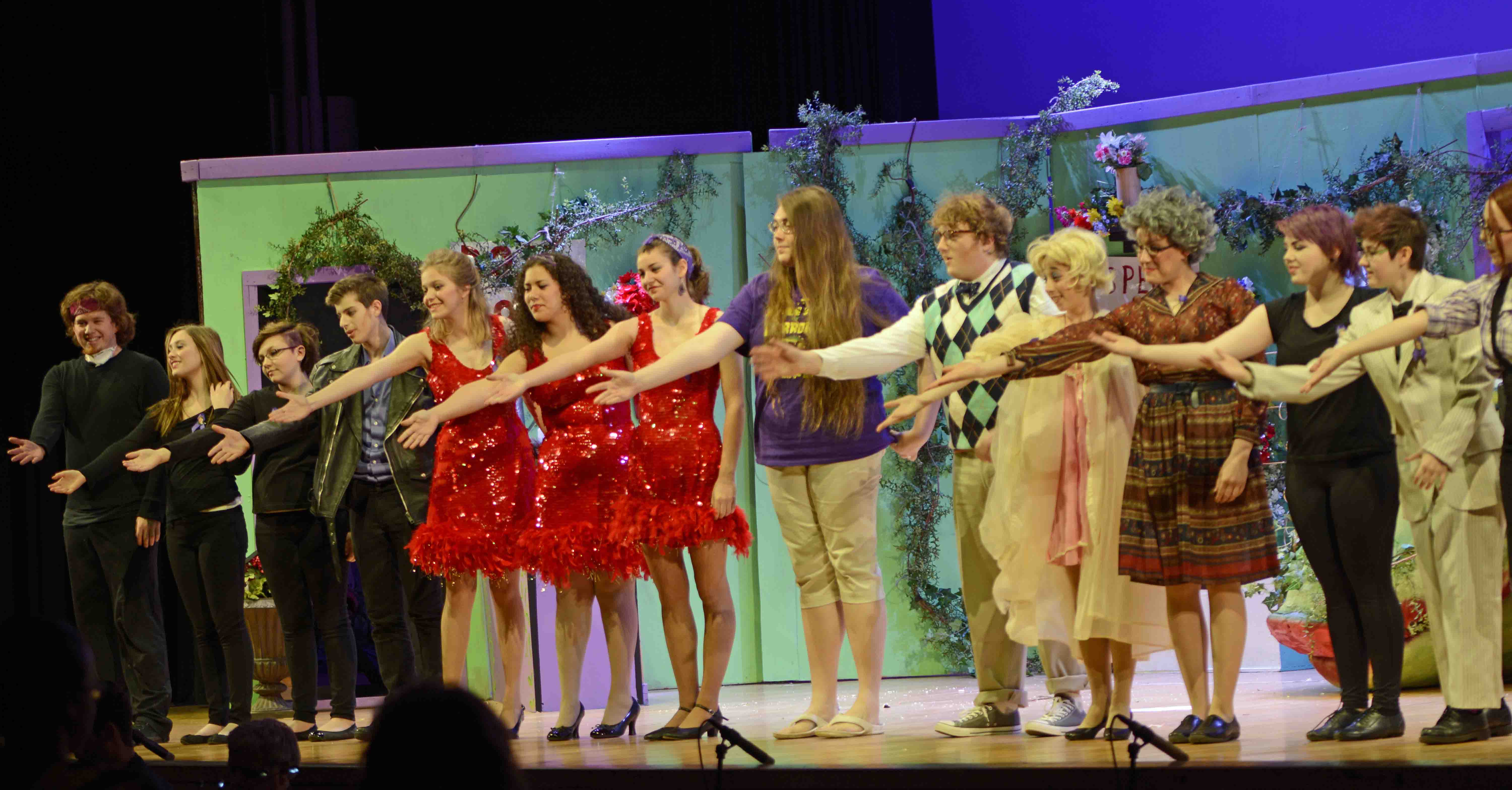
curtain callThe cast came out for its curtain call as so many casts do: ensemble, supporting players, leading actors taking bows in succession. Then a company bow, a gesture to the band, to the back of the house where light and sound were being run and where Mr. Mele sat, an acknowledgment of the audience. They joined hands and bowed once again. Then they did something extraordinary that I shall never forget.

The company separated at the middle, each half moving a few steps toward the stage left and stage right wings, leaving an empty space center stage. As they moved their upstage arms towards the gap, which was filled by a purple circle of light, the final strains of The Beatles’ “In My Life” came over the sound system. And then the lights went out. They gave Maren the final bow.

*   *   *

Sadly, I have no doubt that other high school shows are touched by tragedy every year; the passing of family members, even the untimely passing of a cast member or fellow student. I hope that few experience the wrenching, inexplicable loss that happened at Jonathan Law.

seymour and audreyseymour and orinI write not to record my own tiny role, but to recognize everyone who came together to put on Little Shop of Horrors, which included students from Sacred Heart, West Haven, Westbrook, Trumbull and Amity High Schools, the last being my alma mater. No doubt there were members of the media there at one of the evening performances, since they had certainly followed the events of the past week; I saw none on Saturday afternoon. I wish I could say that the show had sold to the rafters, but the houses were not all full. Despite the press attention every aspect of Maren’s death had received, it did not generate ticket sales, and I think I understand why: in some ways, as an outsider, I felt like I was intruding on something special and private. I went because I had caused someone else to do great service to the show, but I went with mixed emotions. I suspect others felt similarly about buying a ticket. Sadness and loss do not drive people to the theatre, I fear.

So I finish with two thoughts in this fragmentary account.

The first, to audiences everywhere, with no chastisement to my southern Connecticut neighbors intended: when a show proceeds in the wake of tragedy, I hope you will flock to it. Performers who undertake a tribute through the stage want you to join with them, as they commingle the exuberance of a production with their private tears of loss. Live performance requires us to come together always, and there is never a greater time to come together than to celebrate a life even indirectly, as with Little Shop – even of someone we never knew – and to comfort, support, appreciate and applaud those who would celebrate it in whatever manner they choose, should they choose to invite us in.

More importantly, I say to everyone who had a hand in Little Shop of Horrors this weekend: you honored your friend and I was honored to bear witness to that. It makes me deeply sad that you had to perform such a rite so early in your young lives, but please know that I saw much more than one of my favorite musicals, and that with your loving tribute, you helped to insure that Maren is, to paraphrase the show, somewhere that’s purple.


Today, Children, We’re Not Going To Do A Show

April 28th, 2014 § 1 comment § permalink

Of course, on the face of it, it’s simply the dumbest thing you’ve ever heard.

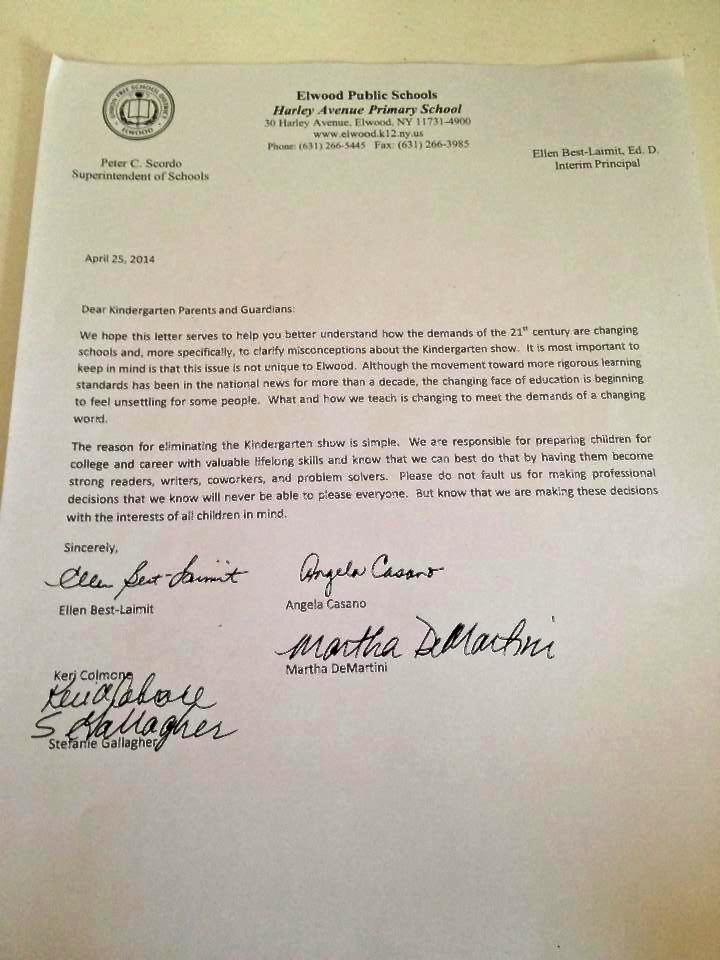
In a letter to the parents of kindergarten students at Harley Avenue Primary School in Elwood, N.Y., the principal and kindergarten teachers wrote:

“The reason for eliminating the Kindergarten show is simple. We are responsible for preparing children for college and career with valuable lifelong skills and know that we can best do that by having them become strong readers, writers, coworkers and problem solvers.”

The Washington Post seemed to be first on the case, with a story titled, “Kindergarten show canceled so kids can keep studying to become ‘college and career ready.’ Really.” That pretty much set the tone and I jumped into the fray, sharing it online with introductory words including “dumb” and “shame.” I happened to be e-mailing with a producer at CBS News on a personal topic and passed the article along to her, and I tweeted it in the direction of a reporter at The New York Post, knowing how they like to take umbrage at things. I wanted people to see how ridiculous this was, and is.

Kindergarten-1Most people leaped right on the bandwagon with similar sentiments, and my Facebook post of the article was shared more than 70 times. This morning, Google News shows me that the story has been picked up by outlets like Gawker and the Post, and I saw a quick report on it on CBS This Morning. Even London’s Daily Mail got in on the act, so we look dopey overseas, too. I don’t flatter myself that I had any role in spreading this story very specifically; I cite the examples just to show that it’s getting around.

But I was caught up short when a high school classmate effectively took me to task on Facebook for not considering what the letter might actually mean. Greg, who teaches high school in New Hampshire, who had a long career as a professional dancer, and who I haven’t laid eyes on in about 30 years, said he saw the letter as an effort by the principal and teachers who signed it to highlight the strictures of common core efforts and a push to teach to tests, a cry for reconsideration of increasingly constrained teaching opportunities. “Is it possible,” he wrote, “That these folks are saying, tongue firmly in cheek, ‘Our hands are tied! The onerous burden of government regulation leaves us no choice!’”

The situation seems so preposterous, the farce that it tries to explain away is so extreme, that Greg’s assertion that it was activism is worth considering. Could this be the most creative indictment of arts cuts and standardized teaching that’s ever come to light, couched in a letter of apology?

In my haste towards sarcasm, I failed to take into account the hundreds of thousands of dedicated teachers who have to grapple with ever-evolving teacher requirements, shrinking funding and so many other indignities of our modern education system. My mom was an elementary school teacher who left the profession because of the stress of functioning within a system under siege, and this was back in the 1980s. In the kind of knee-jerk reaction that the Internet makes so easy, I may not have shown respect to a field I admire so much, all because of a few paragraphs in a letter that found its way to the media. I regret if anything I posted suggested otherwise.

That said, I doubt Greg’s suggestion (echoed by others in entirely separate posts) that the letter was an act of political theatre. Would a principal and teachers have conspired to write such a letter and leak it to the press, putting their jobs at risk? If so, why did it turn up in Washington DC instead of in New York (the school is on Long Island)? Why were the signatories all refusing any comment to the press? While the letter may have been suffused with frustration, I doubt it was a political act, and if it was, it was a failed one, because instead of drawing light to important issues, it has drawn only scorn to the school.

Now if in fact sentiment about preparing kindergartners for college pervades every aspect of education in Elwood, that may not be the fault of the teachers or even the principal. As my schoolmate Greg points out, the ultimate responsibility here lies with the school board, which is really dictating the district’s agenda. By the time it trickles down to the elementary school and its staff, it’s required, not optional. Someone needs to start questioning that school board at their very next meeting as to whether this is what they truly believe.

But whether the letter is botched activism or simply the most extravagantly preposterous outcome of arts cuts, No Child Left Behind and Common Core, let’s turn it into an activism moment.

Right now, the media is primed to cover the story because of its wryly comic value. We may well see it discussed tonight on The Daily Show, The Colbert Report, Letterman, Fallon and the like. I suspect it will be of equal appeal to Rachel Maddow and Sean Hannity, for entirely opposite reasons. It could take on a life of its own. It will be more ridicule, most likely, not constructive conversation. But can we turn it to the benefit of the arts?

If you’re part of an educational institution that values the arts, or an arts institution, can you use this letter as the pretext to get on local radio, local TV, on editorial pages, on blogs, to express what so many did on Facebook yesterday? The very values that the letter implies are more important than any play are exactly those that participating in a show – even at such an early age – ­can build. This is one of those moments when the arts have the spotlight unexpectedly and arts groups and arts educators should seize that spotlight for the benefits we believe in and the values we know to be true, instead of seeing one school chastised and ridiculed.

This isn’t about a single group of kindergartners, but about our core values for all students – that the arts are not disposable, that they are not frivolous, and that they can in fact prepare students for life. It may seem an exaggeration of the scenario in question, but just as the story will be used to extrapolate theories about the pros and cons of how children are being taught, let’s use it as a microcosm of what its happening at every level of the education system, a bellwether, a call to arms that’s impossible to ignore. If this doesn’t make arts cuts comprehensible to absolutely everyone, what will?

And for goodness sakes, isn’t kindergarten mostly about introducing children to the idea of school, to socializing them with children who don’t live on their street or aren’t relatives or friends of the family? You know what’s a great socializer? Working together, perhaps singing together. We call that, in the biz, a show.


Has There Been A Stage Outrage Overreaction at Arizona State?

April 24th, 2014 § 5 comments § permalink

Arizona State University's Gammage Auditorium

Arizona State University’s Gammage Auditorium

[This post has been updated twice since it was originally published. I urge you to read it fully before drawing any conclusions.]

Rent is at the center of an academic controversy again, with a few twists. This time, it’s not the whole show, it’s just one song, “La Vie Boheme.” It involves multiple high schools and a college simultaneously. The performance is over and done. But the song echoes.

Here’s the gist, summarized from video and written reports from AZcentral.com: earlier this month, students from Arizona high schools attended the Arizona All-State musical festival on the Arizona State University campus, under the auspices of the school’s Herberger Institute for Design and the Arts. While there, they attended a performance made up of various pieces by the university’s performing arts groups, across many disciplines. The Lyric Opera Theatre program performed the aforementioned number from Jonathan Larson’s musical. Reportedly some of the students were uncomfortable with the content and physicality of the presentation and decided to leave during the performance, some fairly quickly. They shared their feelings with their teachers and their parents.

Subsequently, the Herberger Institute sent an e-mail to the music teachers of the groups in attendance. It read, in part:

“We sincerely apologize for the poor programming and lack of communication that led to the presentation of an inappropriate scene from the musical Rent at our host concert. I apologized directly to your students in each ensemble rehearsal on Friday afternoon, but I wanted to make sure you know that the entire School of Music community feels remorse over this unfortunate decision.

We have addressed this situation with those responsible. I assure you that we will implement a new protocol for the review of performance material so that this does not happen again.”

A similar but not identical statement was issued to the media. It read, in part:

“The faculty member who coordinated the host concert trusted that those planning the musical theatre portion of the concert would make appropriate decisions regarding the selection from the musical Rent. Unfortunately, this did not occur and an inappropriate scene was presented. The poor decision made by our Lyric Opera Theatre faculty marred the experience for many. The Herberger Institute for Design and the Arts recognizes an audience’s right to choose what they come to a concert space to see. Unfortunately, the audience was not given a choice as our program contained no warning about the adult content that was presented nor was an announcement made from the stage giving them the opportunity to choose to stay for the performance or not. 

The concerns of parents and directors were taken seriously with personal emails and phone calls made immediately, and a process has been put in place to reconfigure the leadership and organization of the Lyric Opera Theatre program so this does not happen again.”

The media message finished with “The School of Music deeply regrets this situation.” Both messages were issued by Associate Dean and Interim Director of the School of Music, Heather Landes.

Here’s what we don’t know: did “rows and rows” of students exit the auditorium, as one parent asserts? It’s unclear if that parent was even in attendance, or characterizing a situation based on hearsay. Considering that news reports say the school received 14 or 15 calls about the incident, it’s hard to tell how many of the several hundred students were troubled by the performance, though the calls could have come from teachers, rather than parents. We also don’t know what the staging of the scene was precisely, so a characterization of it as being “pornographic” is most probably hyperbolic (and catnip to TV coverage, as well as a caption writer who declared “an extreme performance … left the students shocked and disgusted”), even if a bare behind was flashed. I certainly hope the staging was exuberant and enthusiastic, as the show calls for. [I did attempt to get more details, but save for the prepared statements, received no other response to my inquiries to Prof. Landes and two separate staffers in the Herberger School of Music’s communications office.]

It does appear that the high school teachers who brought their students to the event didn’t know what the programming would be, and it turned up without the context of a full production. While I wouldn’t bat an eye at high schoolers seeing a discrete performance of that song, I grant that some parents and teachers might not condone even a flash of partial nudity or simulated intimacy. Because high schools do have a supervisory right and responsibility over what their students see while under their care, especially when away from school, I agree that somewhere along the way, a step was missed. A heads-up wouldn’t have been out of line, though an actual warning would have been. Although unless these schools have private showers for gym class and school sports, someone’s butt wouldn’t exactly be a revelation. Some pelvic thrusts or a bit of groping? Like it or not, par for the course in so many aspects of our popular culture, familiar except in the most sheltered of teen lives. I’m speculating now, but shudder to think that the portrayal of same sex couples could have brought on such swift disapproval by the offended teens.

A mistake was made, students made a choice not to watch once they saw a glimpse something they preferred not to sit through, no one was harmed, and given what ensued, it’s highly unlikely that such a thing would have ever happened again. The rather profound mea culpas – remorse? really? – that were issued strike me as a bit much, especially with emphatic statement about new protocols and reconfiguring. The disavowal of the scene from Rent is overboard, unless the production went way overboard. Given that mooning provoked the complaints, it’s perhaps a bit glib to say now that the statements suggest asses were being covered, but I can’t resist.

But there’s more. I turn your attention to a statement issued jointly last night by Acting Dean Landes and Dr. William Reber, Director of the Opera and Musical Theatre training programs since 1991 at the ASU School of Music, announcing that Reber would no longer lead the Lyric Opera Theatre program.

“Dr. Reber made the decision to step down from his administrative role as director of the Lyric Opera Theatre program voluntarily, and we respect his decision. He remains a faculty member of the ASU School of Music; where he has served the students of ASU for more than 23 years and will continue to do so. Our school and our students have greatly benefited, and will continue to greatly benefit, from his creative spirit, his commitment and his love and passion for music…

Leadership in the arts requires both artistic vision and difficult work. It also requires the willingness to take responsibility for how that work is presented and communicated. This incident was important enough to the school and its relationship with the Arizona community that Dr. Reber felt he needed to accept responsibility, and he has chosen to use this as a teaching opportunity for his students about the role and responsibility of an arts leader, not just to the organization he leads but also to the community at large.”

I’m not so sanguine about Dr. Reber “needing to accept responsibility” in the way that he did; one never knows the behind the scenes pressures that lead to such a prepared, jointly-issued set of remarks. I can’t help but think that the university felt it needed someone to take blame for this, needed someone publicly shamed, and this was the solution worked out. While I applaud Dr. Reber for not throwing anyone under the bus, it troubles me that the university couldn’t absorb this gaffe and maintain intact a program that was, apparently, working just fine save for this one-off gaffe. Dr. Reber protected his staff, but couldn’t ASU have found a way to fully protect its faculty and programs? 

Unlike a content controversy in a high school alone, where all the stakeholders are close by, a university setting is rather different. In the case of ASU, it’s a public university, so there’s all kinds of governmental politics that come into play. I have no idea what the ASU town-gown situation is, and how that may have affected into this. ASU’s students certainly aren’t necessarily all from Tempe, where the school is located, nor were the high school groups, so this is a statewide issue. But the strongest constituency for a school, its alumni, could be scattered across the country. I fear that a vocal minority has prompted swift results while the majority of Dr. Reber’s potential supporters didn’t even know that a problem existed.

So here’s the deal. If you live in Arizona and believe that Dr. Reber should still be running the Lyric Opera Theatre program (without having his hands tied over the work he does for the university’s students), start writing to the school’s president Dr. Michael Crow (Michael.Crow@asu.edu). Don’t call him names or presume anything about his personal beliefs and politics, just speak out in support of a vital theatre program and urge him to reinstate Dr. Reber to the Lyric Opera Theatre. Do the same if you’re just a supporter of quality arts education, for both high school and college students, no matter where you live. If you’re an alumnus or alumna of ASU, write to Dr. Crow as well, but you might also want to include R.F. “Rick” Shangraw Jr. (rick.shangraw@asu.edu), the head of the ASU Foundation, on your note, and mention whether these circumstances will have any impact on your future donations to the school. That can get a university’s attention.

Early reports and an online petition, since amended, incorrectly had it that Dr. Reber resigned or was forced to resign. He’ll remain on faculty and teach, but it still seems a shame that he’s been separated from the Lyric Opera Theatre program he ran. While some parts of the local community may be satisfied by this outcome, it’s worth noting that such events could cast a pall over the creative arts on campus. To insure that ASU can be a strong resource not only for its current students, but for students who may want to attend in the future, ASU should be standing behind Dr. Reber, acknowledging the error but not bending over backwards to placate the public. Because let me tell you, if aspiring theatre students, if aspiring arts students, hear that at Arizona State, Rent is something to apologize for, they may well think twice about where they want to go to school.

P.S. It may interest you to know that the incoming dean of the Herberger Institute for Design and the Arts, Steven Tepper, is the author of the book Not Here, Not Now, Not That: Protest over Art and Culture in America, which by coincidence is on its way to me from Amazon as I write. I’m dying to know what he makes of all this.

Update, April 24 1 p.m.: On Facebook, I saw the following statement shared, which adds very important perspective to this discussion. It is a personal statement from Dr. David Schildkret of the ASU School of Music, and in no way an official one from the school, in response to the online petition:

“A petition is circulating that castigates ASU for allowing Bill Reber to step aside as Director of Lyric Opera Theater. Earlier this month, LOT presented a portion of Rent to high school students without warning of adult content. It was part of an ASU School of Music showcase for the Arizona All-State music festival. Bill, recognizing how damaging this is to our school, has chosen to step aside. I believe the petition, while well-intentioned, is misguided. I posted this on their Facebook page. I am speaking for myself, at no one’s urging, and in no official capacity. Here is the post.

Friends: I speak as a friend and colleague of Bill Reber who deeply admires what he has done. I feel that this petition fails to recognize the honor and nobility Bill has shown by his actions.

Please understand the incident. Students participating in the Arizona All-State came to a concert that was meant to showcase our School of Music. An excerpt from Rent was offered as part of that. The excerpt, “La Vie Bohème,” included explicit language and highly suggestive staging. It was NOT appropriate for a general high school audience, and there was no warning of that. (When the same excerpt was presented in a preview for the Lyric Opera Guild, the staging was toned down. That didn’t happen when the same material was performed for 14-year-olds, and even Bill was surprised by that.)

The students in the audience did not come to see Rent. They did not know (none of us did, in fact) that material that was not school-appropriate would be presented. About a quarter of them left the hall and returned after the Rent excerpt ended.

This is not about a few offended parents. It is about the responsibility of artists to know their audience. It is about what we were trying to present to students and teachers at All-State. The question is not whether Rent itself is problematic. The question is whether this was the suitable occasion for this particular performance. (“Seasons of Love” would have been touching and appropriate and would have caused no such difficulty.)

Make no mistake, this damaged the ASU School of Music. You may not like that, but it is the reality. It undid work to build bridges to local schools that many of us, including Bill Reber, have undertaken with zeal and passion for years.

If in fact the university had caved to a few cranky parents, I would sign the petition in capital letters. But people were legitimately and justifiably offended at an occasion that was meant to be anything but offensive. That is their right.

Please give Bill Reber the credit he deserves. He did not succumb to strongarm tactics: he is more powerful than that. He felt that a wrong choice had been made and took responsibility for it. He has stepped up to say that he recognizes that we accomplish most when we respect our audience. He has stepped up to say that there were better choices to be made and that he could have seen to making them.

I deeply admire Bill for this. He is a model for all of us. By all means, send him letters of affection, thanks, and support: he deserves them. But don’t dishonor him by trivializing his very courageous and noble actions.”

I wish the school had been more forthcoming from the start with this kind of clear information. It mitigates a good deal of what I’ve written, and provides essential context, but I leave my post intact rather than remove or alter it. Thank you, Dr. Schildkret.

Update, April 24, 4 p.m.: Dr. Schildkret has written me directly to respond to something which I questioned in my original piece. He says:

“Rows and rows of people really did walk out of the performance on 4/11. About 25% of the audience left for that piece. Some of that was teachers taking their classes out en masse so that the teachers wouldn’t get in trouble.”

Once again, my thanks to Dr. Schildkret for straight answers to important questions. From here on, I leave everyone to draw their own conclusions.


 

Season After Season After Seasons of Love

April 17th, 2014 § 0 comments § permalink

As I prepared to go to Trumbull CT last month to see the high school’s production of Rent, many people asked, or wrote me to ask, if I would be writing about it. My consistent reply, “I doubt it,” was met with surprise by one and all, who asked, ‘Why not?’

rent finaleI had been very vocal in my support for the show when it was canceled back in the fall, and I know that I played some role in helping to turn the tide back in favor of the production, though it was the students and adults in the community who really carried the day. But in anticipation of the show, I had no idea what might move me to write. After all, I was already “in the bag” for the production – delighted that it was happening, loving it even before I saw it. What, I wondered, would I have to say other than that it was great? It was great, incidentally, to the degree that I watched with even a shred of objectivity.

The night, however, had an entirely unexpected effect on me. It all happened after the final curtain call.

*   *   *

I drove up to Trumbull with Jonathan Larson’s father Al and sister Julie, who I have known since, during my tenure, the American Theatre Wing negotiated for and ultimately took over the responsibility of giving The Jonathan Larson Grants. Though I didn’t consult the Larsons or ask for their support as I undertook my advocacy in Trumbull in the late fall, I did keep them posted. The day the show was put back on the schedule, they said they would come in from Los Angeles to see the production and we made plans to go together, several months hence.

The only people who knew that the Larsons were coming to that first of four performances were Jessica Spillane, the teacher who runs the drama program in Trumbull, and Larissa Mark, the student president of the Thespian Troupe. It seems they really know how to keep a secret. After the performance, Ms. Spillane instructed the students not to rush to take off their costumes, but to gather in a corridor directly behind the stage. She did not tell them why.

seasons of loveSo when she introduced Al and Julie, the reaction from the cast and crew was stunning. The most extraordinary mixture of shock, joy and tears erupted in equal measure, as some 60 or so students realized that they had just performed for the family of the late composer who died before most of them were born.

Julie, following my own tendency in such situations, withdrew to the sidelines, though she graciously spoke with anyone who approached her; I stood by her with the extra barrier of my camera, as I tried in vain to capture the entirety of the scene. Al, however, was immediately surrounded, as one by one students came up to thank him, to shake his hand, and most remarkably, ask if they could hug him.

I understood yet marveled at their compulsion to commune with the father of the writer they would only know through his words and music. This was as close as they could possibly come to Jonathan, and this kindly gentleman in his late 80s, who I have no doubt couldn’t hear a great deal of what was said to him, gave them each a turn, as crying teens tentatively stepped up, and then boldly embraced a man who was a stranger only minutes before.

I have never discussed the experience of Jonathan’s death with the Larsons in the years I’ve known them. It is a sad tale well known to anyone who knew about theatre in the mid-90s and there was no reason for me to inquire after details. That said, in bringing the grants to the Theatre Wing, I felt a great responsibility for Jonathan’s legacy and it brought me close this family that endured a terrible loss even as they saw Rent triumph. Seeing those students so raw with emotion, so desirous of connection, so profoundly moved to try to convey their own sense of loss was perhaps the only way in which I have ever participated so emotionally with Jonathan, with his family, and with Rent.

*  *  *

Eventually, it became time to pull Al away from the students, who would have surely kept him there all night. It was getting late, we had to drive back to Manhattan, the whole experience of the day had to be as exhausting for Al and Julie as it was for me. We made it out of the corridor into the larger school hallway, but Al and Julie proceeded by inches while I moved unfettered. A few parents who spotted me offered their thanks; one or two revealed themselves to be siblings or spouses of people I had gone to high school with, 34 years ago and a few miles away.

As I casually leaned against a wall, a young man approached me, and asked if I was Howard Sherman. Recognizing him as a Facebook friend, I quickly offered up, “And you must be…” and indeed I was correct. But this young man, who I’d not met before, was not some random social media connection.

I had gone to high school with the young man’s uncle and his aunt; I had first met his father, who is several years younger than me, when the father was perhaps no more than 8 and I was a much older 13.  Most important though, is that I knew his grandfather, who was my scoutmaster in my Boy Scout days.

Boy Scouting, by and large, is not a vivid memory for me. I was not driven to achieve a top rank, I don’t have close friends today who I knew from the activity. But there is one aspect that I will never forget: the day that this young man’s grandfather died of a heart attack on a camping trip, when I was 17 years old and a senior leader in the scout ranks.

candleI wasn’t on the trip. I had skipped it in favor of performing Abbott and Costello’s “Who’s On First?” at my school’s annual Pops Concert, although that was accidental; another friend had been grounded and couldn’t fulfill the commitment, so I stepped in. I learned of my scoutmaster’s death only a few hours before the performance and I actually followed the dictum of “the show must go on,” performing a comedy routine while in sorrow, even though it could have easily been excised from the performance.

I have always felt pangs of guilt over not having been on the trip. Not because I believe I could have done anything to help medically, but because there were so many younger scouts who were there when this sudden passing took place. I should have been there to support them. Who knows whether I would have been able to do so. I will always wonder.

I skipped the cast party and remember sitting at the kitchen table late into the night talking about this death with my parents. I remember saying to them how sad I was that I never got to tell my scoutmaster that I loved him. Wisely, they explained that such occasions didn’t arise under everyday circumstances, but that surely he knew from my loyalty that I cared for him and that surely it was mutual. It was the night I resolved to always try to let the people I care for know it at all times, in action and in words.

So here I was standing with a grandson who never knew his grandfather, a man whose loss I’ve never forgotten. Via Facebook, I knew that the young man was in a show at his own high school nearby: Carousel. As he is a senior, I asked the standard adult question, “Do you know where you’re going to college yet?” He replied that he was still working it out.

Jokingly, I said, “You don’t plan to go into theatre, do you?” I regretted my jest as soon as he said he was. I immediately said that he should call me any time for advice or help, and I meant it sincerely. I hope he takes me up on it. It’s the very least I can do.

When he stepped away, I began sobbing. It would be easy to say it was just the late hour, or a release of emotions from what I had witnessed earlier in the corridor. But I knew that I had been thrust back into that Saturday night in 1979 when a commitment to perform both took me away from somewhere I perhaps should have been, even as it placed me where I belonged, and where I’d spend my life.

*   *   *

That one night at Trumbull was a roller coaster (a ride I studiously avoid). I had stirrings of pride in something I felt very separate from when it actually happened, since my role had ended back in December. My perception of theatre was bound up with grief that night, through this young man – who I hope to know better – and his family, as well as through the members of the Larson family, both present and absent, and also through the Trumbull thespians, so profoundly in touch with their emotions so openly and so suddenly.

Many will be quick to tell you that part of how we experience the arts has a great deal to do with what we bring to that experience. I unwittingly brought a lot to Trumbull that night and I came away with more. It may be too soon know exactly how much. I may never know. But whether in high school auditoriums or Broadway houses, I’ll keep seeking. Who knows what I’ll find, where I’ve already found so much in the darkness and embrace of the theatre.


The Broadway ‘Soul Train’ Hasn’t Left The Station

April 16th, 2014 § 0 comments § permalink

Broadway dreams being immediately blown up into pending productions is something that really gets my goat. Why? Because it’s a case of hyperbole becoming ostensible fact in the press, and the only people it serves are those trying to make a nascent production into reality.

When I last wrote about this phenomenon about nine months ago (it really makes me cranky), I suggested that it makes an argument for why paid professional arts journalism is so essential – to separate real news from puffery. I regret to say that I’ve been proven wrong in that regard.

soul trainPerhaps you saw one of the many announcements yesterday about the new Broadway show based on the syndicated TV series, Soul Train. “‘Soul Train’ Headed for Broadway” was the headline in both USA Today and The Chicago Tribune. “Soul Train’s A Comin’ To Broadway,” declared The Wall Street Journal. “Rock Of Ages producer is bringing Soul Train to Broadway,” announced The A.V. Club.

Here’s the problem. There is no Soul Train musical. No writers. No director. It’s unclear if any music rights have been acquired. All there is, right now, is a producer who has licensed the trademark and plans to develop a show.

Every article I saw actually makes note of this fact in some way, but it’s buried at least a few paragraphs in. One of the examples cited above makes it the very last sentence. But I’d be willing to bet that the vast majority of people who glanced at this story (with 120 Google News citations and climbing) thinks it’s a done deal.

Mind you, I take no pleasure in pointing this out, because I know three out of the four journalists involved in these stories pretty well, and I may get some grief from them. It’s certainly worth pointing out that journalists rarely write their own headlines, so the majority of the responsibility may not lie with the writers. In our clickbait world of online news, “happening” is much stronger than “may happen,” although such a distinction can be quickly elided by aggregators. But somewhere along the way, accuracy is sacrificed.

But I should in all fairness note that headlines more reflective of reality did appear: “Soul Train Aims To Pull Into Broadway Station” (Variety), “Soul Train May Boogie To Broadway” (The Grio, running an Associated Press story), and “Soul Train Making Tracks To Broadway?” (San Diego Union Tribune) are examples. Jim Hebert at the Union Tribune struck a strong note of skepticism in his copy, going so far as to say “don’t hold your breath on this one…” The cause is not lost.

I suppose if I were the producer and publicist for the show – and keep in mind I was a publicist for more than a decade – I’d be thrilled by the amount of attention garnered by the existence of a legal agreement. But when I see so many worthy arts activities that actually exist, eager and even desperate for media attention, this inflation of intentions is really rather depressing. I assume anyone who has a show that has already been written feels much the same way. But clearly the retro lure of a famous brand, with photos ready to run, holds greater sway than what’s happening now (those last three words actually being connected to a property someone may option any day).

In the film The Man Who Shot Liberty Valance, there’s a famous quote: “When the legend becomes fact, print the legend.” Fifty years later, it’s been simplified in a way that would make Jimmy Stewart, John Wayne and perhaps even Lee Marvin blanch, since we no longer wait for something to become legend: “Print the hype, with a great headline.”


The Stage: “What Can David Lan Really Achieve At Ground Zero?”

April 10th, 2014 § 0 comments § permalink

It is unquestionably a sign of his achievements at The Young Vic that David Lan has been named consulting artistic director for the planned arts centre at the site of the former World Trade Center in lower Manhattan.

Selection to be a part of this important element in rebuilding Ground Zero, the site of the 2001 terrorist attacks, was also a mark of achievement for, among others, Signature Theatre Company, architect Frank Gehry, and The Joyce Theatre.

But in the ensuing 10 years, the Signature abandoned its for Ground Zero and successfully built and opened a three-theatre complex on West 42nd Street. Gehry’s involvement going forward is in limbo. The Joyce, a home to numerous dance companies, still hopes for a role in programming the arts center, but has seen plans for the largest theatre among the three still under discussion drop from 1,000 seats to 550, only slightly larger than their longtime home. In the scheme of New York theatres, the city’s relative paucity of 1,000 seat venues other than on Broadway might have been more useful to the ecology of the arts.

Mayor Bloomberg, whose administration was involved in discussions for the redevelopment plans over his 12 year tenure, is out of office now. Before leaving, he allocated $50 million in city funds to a rival new arts facility, the Culture Shed, but none for the Ground Zero project. The city’s new mayor, Bill de Blasio, has yet to appoint a cultural affairs commissioner and is quiet on the project.

Even Mr. Lan’s participation seems somewhat fleeting, in that his appointment is only through September and he has told The New York Times that he does not foresee a programming role for himself. Maggie Boepple, president of the arts center’s seven member board (Stephen Daldry was recently named to the group) told the Times that there was no need for full-time artistic leadership because performances won’t begin until 2018 or 2019. What creative influence will Lan’s temporary engagement have in the next six months?

When the arts centre concept was first announced, the talk was heartening. The city committed to the idea that the arts had both a spiritual and economic role to play in healing lower Manhattan. Over time, the importance of that message has eroded.

Given the planning, emotional and political implications that surround the rebuilding of Ground Zero, it’s difficult not to be sceptical. The Wall Street Journal cites a daunting cost of $469 million, with only $155 million allocated by the federal government. Fundamentally, the Ground Zero Arts Center is a real estate project first and an arts project second, and that often places impractical burdens on creative work. Even during his limited engagement, I hope Mr. Lan can talk frankly and practically, challenging all existing presumptions, if the project is to ever succeed.