Senator Coburn Trolls The Arts With Annual P.R. Ploy

November 3rd, 2014 § 0 comments § permalink

In the song “The Book Report” from the musical You’re A Good Man, Charlie Brown, Lucy van Pelt struggles to complete her homework assignment: 100 words on Peter Rabbit. Falling short, she concludes it thusly: “And they were very very very very very very happy to be home. The very very very end.”

Senator Coburn's WastebookIn honor of this blatant effort to reach a designated threshold without utilizing meaningful content, I would like to present the very very very first “Lucy Van Pelt Award for Verbal and Political Padding” to Senator Tom Coburn (R, Oklahoma), for the 2014 edition of his much-publicized “Wastebook.” For those who haven’t heard of it, the Wastebook is Coburn’s perennial compilation of excessive and/or unnecessary federal spending. It tends to generate a good bit of attention for its most absurd items in all manner of media. A careful parsing of Coburn’s annual lists may reveal a partisan bent and a truckful of snark, though in reviewing the past few years of reports, I did note that he wasn’t above calling attention to what he deemed wasteful spending in his home state too.

The new report, on its comic book meets tabloid cover, trumpets $25 billion in government waste in only 100 examples. Without being deeply grounded in every item he cites, I must admit that a few do make one wonder. However, I have to chide Coburn for a few of his 2014 examples, specifically those derived from National Endowment for the Arts grants. Alongside “Swedish Massages for Rascally Rabbits” and “Watching Grass Grow,” Coburn calls out:

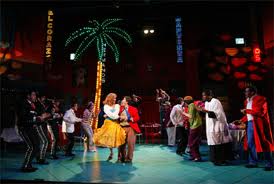
  • “Teen Zombie Sings, Tries To Get A Date To The Dance” ($10,000 for the musical Zombie in Love at Oregon Children’s Theatre)
  • “Colorado Orchestra Targets Youth With Stoner Symphony” ($15,000 for a Colorado Symphony concert thematically linked to the state’s newly legal industry, but performing standard symphonic works)
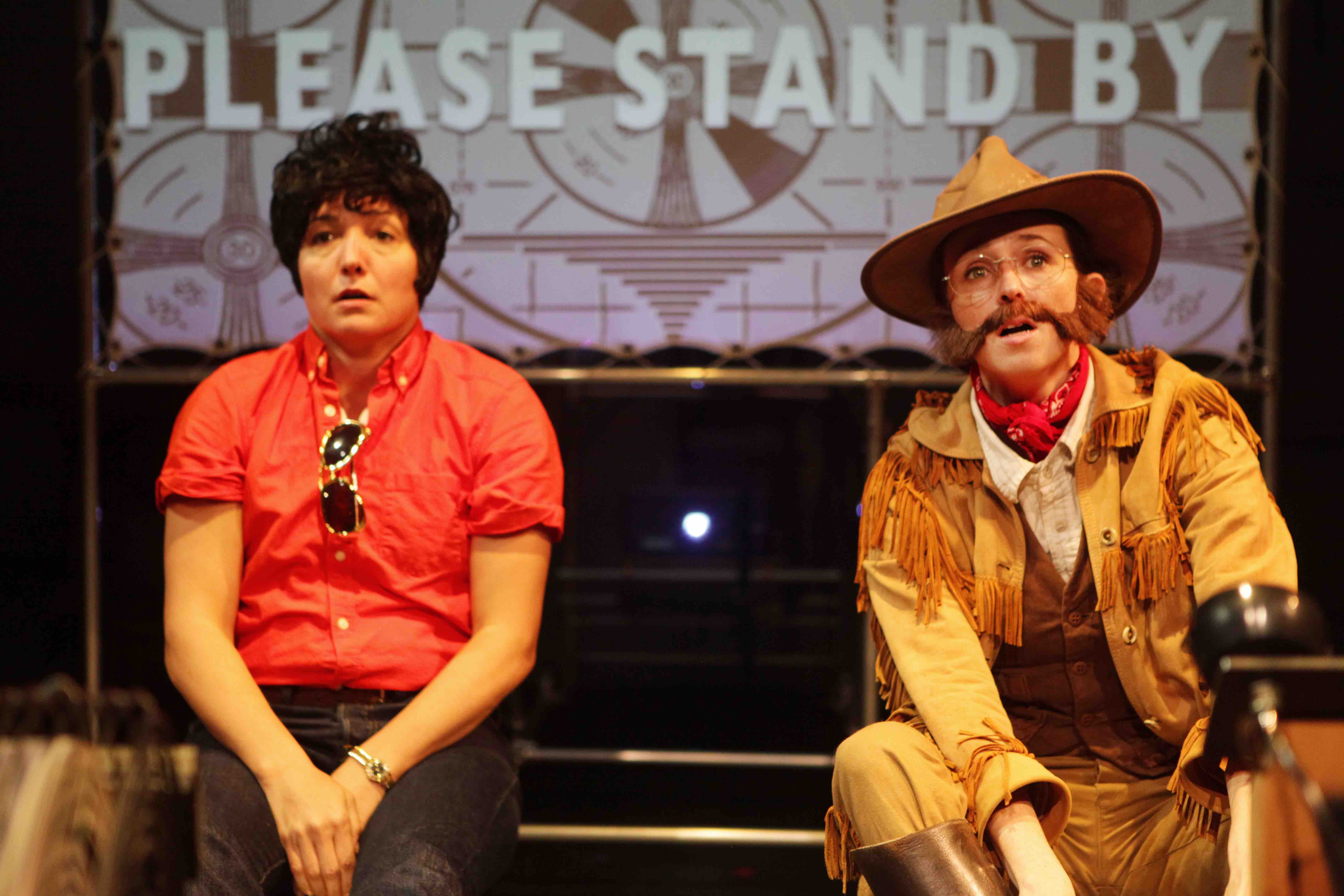
  • “Roosevelt and Elvis Make A Hallucinatory Pilgrimage To Graceland” ($10,000 to The TEAM for their play RoosevElvis, to be seen this winter at the COIL Festival)
  • “Bruce Lee Play Panned As Promoting Racial Stereotypes” ($70,000 to Signature Theatre Company for the production of David Henry Hwang’s Kung Fu)
The TEAM’s RoosevElvis (Photo by Sue Kessler)

Libby King and Kristen Sieh in The TEAM’s RoosevElvis (Photo by Sue Kessler)

While Coburn surely hasn’t seen or read any of these productions, his efforts to make these minimal grants into shameful instances of government funds gone awry relies only on inevitably reductive synopses and selectively quotes from the odd negative review as if to justify his point about these NEA funded projects. The headlines are of course chosen to make the work itself sound as absurd as possible. Worth noting: Coburn seems to have a particular distaste for children’s theatre, having also called out $10,000 for the production of the musical Mooseltoe at the Centralia Cultural Society in Illinois in the 2013 Wastebook. There are other arts related items in the 2014 report, but they’re actually funded outside of the NEA, the largest being $90 million for the State Department’s Cultural Exchange programs, targeted by Coburn for a handful of unconventional performers he selected from a much larger pool, a rigged argument at best.

Coburn’s increased role as an arts critic is no doubt due to the mileage he got out of his 2013 list’s inclusion of a $697,000 grant to the theatre company The Civilians for their musical The Great Immensity, about climate change. Obviously the subject matter was a hot-button for the Senator, and I imagine that numerous arts groups must be envious of the sum (far in excess of what groups typically get from the NEA), but Coburn fails to take into account the respect accorded to the work of The Civilians in artistic circles – and arts groups should take note that the largesse came not from the NEA, but from the National Science Foundation, due to the specific subject. It may be a bigger and easier target for Coburn, but it’s not a worthy one.

Whatever the politics and bias behind it, I’m willing to grant that there’s some value in Coburn’s list, such as highlighting the famous Alaskan Bridge to Nowhere or calling out excessive spending on the incompetent overhaul of government computer systems. But his four NEA-based examples this year are simply padding, as they represent only 0.00042% of his report’s dollar total, but 4% of his report. It’s just another example of a politician attacking the arts as an easy target, when there are bigger and more essential fish to fry.

Cole Horibe in Kung Fu at Signature Theatre (Photo: Joan Marcus)

Cole Horibe in Kung Fu at Signature Theatre (Photo: Joan Marcus)

Regarding the four “wasteful” grants in question, I can offer a personal opinion on only one, namely Kung Fu, which was ambitious and perhaps not completely realized in its debut at Signature. But it was – and is – a worthy project by an artist whose work is always deserving of support. By the way, David Hwang has told me there’s more work to be done on the piece and he’s recently made public note of plans to remount it soon to implement further changes. When that happens, I’ll do my best to invite Senator Coburn to Kung Fu as my guest though he may be out of the public eye and not up to it – he’s leaving Congress at the end of the year for health reasons, and this year’s list may be his parting shot.

Of course, health permitting, Coburn could keep producing the Wastebook after leaving office, if he has a real commitment to exposing government waste. But I’m willing to bet that he won’t. Why do I say that? Because surely most people realize that his annual screed is produced by his staff, maybe even eager young interns, not by Coburn’s own personal research and writing efforts. Come to think of it, I wonder how much the Wastebook cost the U.S. taxpayer each year, in staff research and writing time? I suspect it’s more than the federal government gave to Mooseltoe.

P.S. Let’s all go see The TEAM’s RoosevElvis when it plays New York’s P.S. 122 in January 2015 and each decide for ourselves whether the $10,000 from the NEA was well spent. I, for one, wasn’t aware of the show, but I’m now looking forward to it. Gee, thanks Senator Coburn!


How To Fail At Canceling The Most Popular Play in High School Theatre

October 21st, 2014 § 11 comments § permalink

Almost, MaineEarlier this month, the administration at Maiden High School in Maiden, North Carolina tried to put a stop to the student production of John Cariani’s Almost, Maine. With permission slips in hand, the cast chosen and rehearsals just underway, the school announced the show was off. But it’s only off school grounds. The play will go on.

*   *   *

As first reported last week by WSOC TV in two reports [here and here], with additional reporting from Think Progress, Almost, Maine was shuttered because of a single scene, entitled “They Fell,” in which two buddies reach the startling discovery that they love one another – by actually falling down. Repeatedly. There’s no sexual innuendo, no physical contact, and the words “gay” and “homosexual” aren’t spoken. The scene takes up six pages of a 54 page text.

It’s not as if the school didn’t know the play was in the works. Maiden High School junior Conner Baker, who was to direct the production, said that when the administration was asked for permission, they gave it within a day.

“Our teacher advisor spoke to our principal,” said Baker, “who then spoke to the superintendent. We were told through our student advisor.”

She explained that students had to get permission slips with parents expressly agreeing to let their children participate, which hadn’t happened before in her experience. Of the permission slip, she said, “I don’t remember it word for word. It was along the lines of, ‘We have chosen Almost, Maine as our fall play this year. The play includes nine vignettes about love, one of which is centered around two male best friends who realize they are in love with each other’.”

Baker also described parents being required to come to one of two meetings in person to give their approval, also a new requirement. “Whenever a parent came in, I explained to them the content of the play and told them that for their child to audition, they needed to sign the permission slip.” Students also were permitted to audition with the scene in question, but Baker said she didn’t know where that requirement came from. “We were told by our teacher, though I know it wasn’t her decision. I also do not know why.”

After the show was cast and had just begun rehearsals, the word came that the show was off. “We were told by our teacher. They said the community isn’t ready for it. There wasn’t really a big discussion about it.”

*   *   *

Maiden High School’s logo

In spite of all the strictures placed on the audition process – the permission slips, parents coming to meetings – the school’s statement, issued after the news media began to pick up the story, clearly sought to obfuscate the issue, using the ‘approval hadn’t been given’ excuse that crops up so regularly in instances of school theatre censorship. Issued by Principal Rob Bliss (Robert_Bliss@catawbaschools.net) , it read:

“Our faculty and staff are still in review of potential performances to be conducted by our students this fall. At this time, no final decision has been made regarding whether and what drama performances are to be presented this fall. In regards to the request for students to perform the play “Almost Maine,” careful review and consideration was given to the contents of this play. The play contained sexually-explicit overtones and multiple sexual innuendos that are not aligned with our mission and educational objectives.

“As principal of Maiden High School, I have an obligation to ensure that all material, including drama performances is appropriate and educationally sound for students of all ages.”

The consensus in conversations on Facebook between various students was that some adults and churches in the area had made their displeasure known to the school administration, focusing on the gay storyline. None of them appear to have made their concerns known publicly. Yet this prompted the school to pull the plug without giving any hearing to those in support of the play.

*   *   *

Upon learning about the cancelation, one area adult, Carmen Eckard, a former local teacher, sent an e-mail to a number of administrators at the school. She wrote, in part:

“These kids have spent years fostering their love of theatre. In fact, I taught many of them at Startown Elementary, and they loved theatre class! That has blossomed into a real appreciation and dedication, and the decision to cancel a play after rehearsals had begun is extraordinarily disrespectful, and counterintuitive to education.

“Their passion is now spurred, and they will show you how dedicated they are.  I’m sure you’ll quickly realize that a mistake has been made.

“My advice would be to reinstate the play, before Huffington Post picks up this story. It’s just the kind of thing they love, and I’m sure we’ll all appreciate not  being highlighted in national news as a ‘backwards’ town, again.”

She received a response from the school superintendent Dr. Dan Brigman (dan_brigman@catawbaschools.net), who thanked her for writing, but didn’t address Almost, Maine at all, simply saying another appropriate play would be found. [For legal reasons, I am paraphrasing the superintendent’s brief reply.]

It seems a shame that Brigman didn’t heed Eckard’s warning, given the media attention that has resulted  from the cancelation (even reaching up into Maine). As for being highlighted in the national news “again,” while I didn’t ask Eckard what she was referring to specifically, I am assuming it was the 2012 stories about local Pastor Charles Worley of the Providence Road Baptist Church in Maiden. Worley got lots of press, far beyond HuffPo, for stating that gays and lesbians should be confined behind an electrified fence. Plenty of North Carolinians spoke out against Worley at the time, but his church remains active in the community.

*   *   *

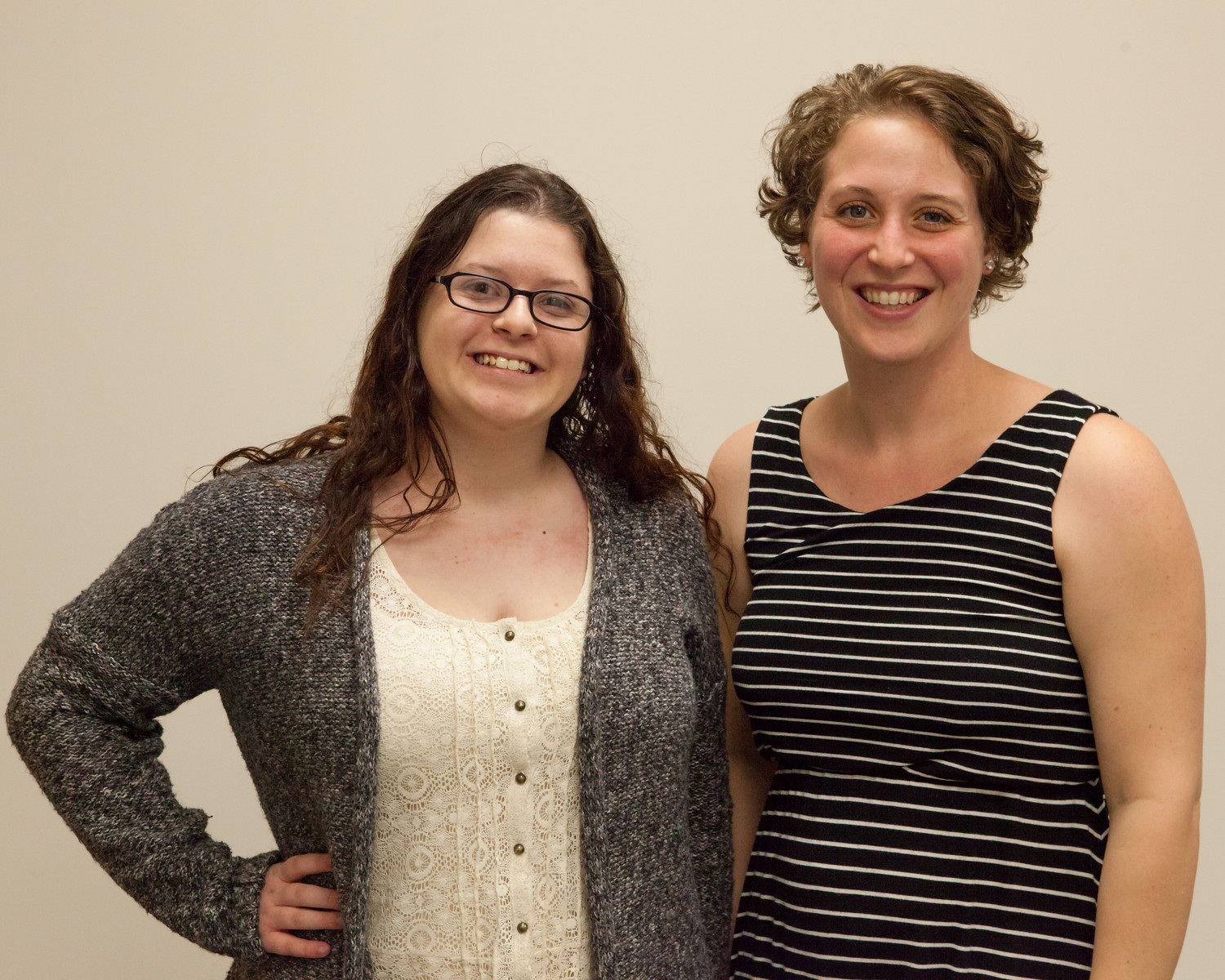
Conner Baker (l.) and Carmen Eckard (photo by Eckard Photographic)

Conner Baker (l.) and Carmen Eckard (photo by Eckard Photographic)

Eckard did more than just write a letter. She got involved.

“As soon as I realized that it was my old students and the play was Almost, Maine, I started looking for ways to help,” she wrote in an e-mail. “By Friday, Connor and I had scheduled a meeting, and people had started contacting both of us, asking for ways to help.”

In my very first communications with Baker and Eckard, both immediately said they hoped to try to do the play off-campus, so I asked them both whether they considered fighting the decision.

Referring to the response she received from the principal, Eckard continued, “The response I received convinced me pretty thoroughly that trying to change the ruling would be a waste of time. It also gives the power in the situation completely to the school board – it’s their decision. The community is extraordinarily conservative.”

Conner Baker said, “I think at first we considered that, but as a group, we just want to do what’s best for us. Our whole reasoning behind speaking out was to be able to do the show.”

While many outside groups and individuals offered their support, Baker and Eckard felt it was best not to be antagonistic as they went forward.

Eckard explained, “The kids said, ‘The main thing we want to do is that we don’t want to alienate the community, we want to keep things positive. We’re going to take our play somewhere else for people who want to see it.’ I think this way will make people happy-ish.”

*   *   *

Before learning that the show might go on off-campus, playwright John Cariani learned of the situation in Maiden and crafted a reply that was posted to the Almost, Maine Facebook page. It read, in part:

“If Maiden High School administrators take issue with ‘They Fell’ because it’s about two young men who are simply stating their feelings for one another, they are calling into question the validity of same-sex love by making it seem wrong and different and other. They are allowing a dangerous cycle of fear and self-hatred among LGBTQ youth to continue, and, consequently, they are tacitly promoting homophobia. This is simply not necessary. Nor is it helpful. We don’t need any more Tyler Clementis or Jamey Rodemeyers and Jamey Hubleys. We need kids to know that it’ll “get better.” Falling in love is tough enough when you’re young. Let’s remove the stigma of falling in love with someone of the same sex…

“By canceling the play, it seems to me that school officials are pleasing parents and pillars of the community rather than serving the students. I think there’s a better solution than to stop the production.”

In a phone conversation, I asked Cariani if he had originally conceived of his play being performed by high schools, where it is enormously popular, landing as number one on the Educational Theatre Association’s list of the most produced plays in high school theatre this year. (You can see a list of upcoming productions by searching on the Dramatists Play Service website’s Page to Stage page.)
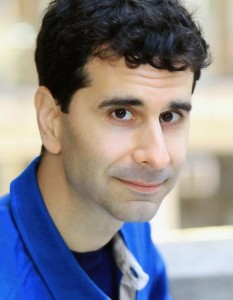
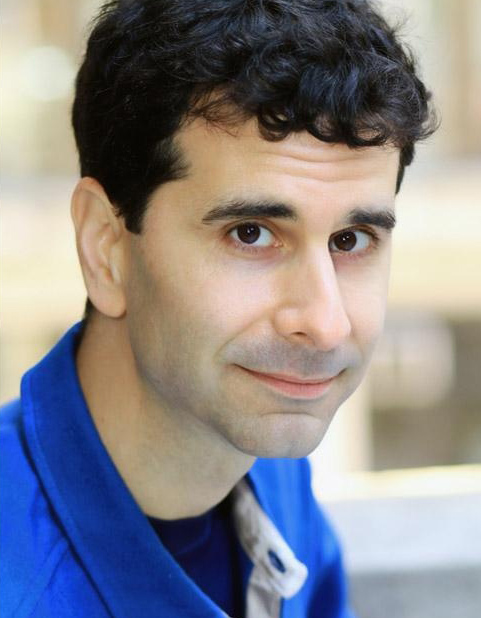
John Cariani, author of Almost, Maine

John Cariani, author of Almost, Maine

“Not at all,” he replied. “I thought it was a play for adults. The first high school production was Cape Elizabeth High School in Maine. They were a great theatre program when I was growing up [also in Maine, but in another school system]. Their teacher approached me and I thought, ‘High school students can’t do this play.’ But I got to see their production. The teacher helped me to understand that high school kids are on the verge of adulthood, but still optimistic of what the world can do for them and what they can do for the world. That is what makes high school kids, when they do it well, do it super-well.”

Cariani said he knew of a couple of instances in the past where there were efforts to censor or cancel the play. He noted one at Bel Air High in Maryland where the American Civil Liberties Union was instrumental in insuring the play went on. He also echoed Baker and Eckard’s sentiments about how to go forward.

“It’s important that we achieve our goals without being mean,” he offered. “It’s dangerous.”

But, I wondered, given the countless productions around the country, wasn’t it possible that some school might have already done, or might be planning to do, the show and altering “They Fell” unilaterally? What would he like to say to anyone who has done that or contemplates that, against the legal contract of the license and copyright law?

“It’s lying,” said Cariani, “because that’s not the play.”

*   *   *

Some of the Maiden High Students who will continue to work on Almost, Maine

Some of the Maiden High Students who will continue to work on Almost, Maine (Photo by Eckard Photographic)

Last night, October 20, Baker and Eckard held a small meeting to begin organizing the play for production away from Maiden High School, discussing possible venues, budgets and timing.

I asked Baker whether she thought she might lose any of her cast, since the show is no longer a school activity, especially because the school has already begun surveying students as to their interest in participating in an alternate play under official auspices.

“Only one person for sure said they couldn’t do it anymore,” she replied. “But the show really is meant for four actors and we have a cast of 20, so even if half of them dropped out, we could still do it.”

Maiden senior Logan Riley wrote to me, regarding the school’s effort to mount its own show, “The school system wants to have another show to settle the unrest in the community. This does not mean that we will actually put on another show.”

Moving the play off school grounds could still result in opposition. Are either Baker or Eckard concerned?

“We don’t care if they oppose it,” said Eckard. “Free speech! It won’t matter if they are against a public performance, because those of us involved aren’t under any particular employment or jurisdiction that would cause us to fear retribution.”

Baker echoed the sentiment. “I mean, people will complain no matter where we perform it. We aren’t forcing anyone to come out and see it, but if people do protest, it won’t stop us from performing it.

*   *   *

So the students of Maiden High School are going forward with Almost, Maine, targeting the first weekend in January for production. They’ve set up a Kickstarter page to raise the funds they need and hope to confirm a location shortly. Their cleverly named website-to-be is www.almost maiden.com.

This isn’t the first time students have taken a show off of school grounds to get it done (there are many precedents, including Wilton CT and La Grande OR) and one has to applaud the Maiden students’ commitment to seeing the show happen, with its myriad messages of love intact. I have to confess to feeling that the school is getting off easy, since the relocated production also shifts the spotlight off of their efforts to silence the students and the play, leaving intact the utterly unacceptable official message that LGBTQ love is something to be hidden away – even as North Carolina begins legal same sex marriages.

But Conner Baker has a simple reason for how the play will now happen, and it’s pretty hard to argue against.

“We aren’t doing it to upset anyone,” she says. “We just want to do what we love doing.”
 

Not All Great Works Stay Great, In Text Or Performance

October 16th, 2014 § 2 comments § permalink

As headlines go, “A challenge for the arts: Stop sanitizing and show the great works as they were created” embodies what many of us were taught in school about the well-made essay: tell people what you’re going to tell them, offer support for your thesis, then tell them what you’ve told them. Unlike many instances where newspaper headlines misrepresent the content of the article that follows, I would say that Philip Kennicott’s article in The Washington Post on October 4th was accurately summarized. As a result, the unsettled feeling I had upon reading it remained with me as I read the piece itself, and long afterwards.

To select two paragraphs which explicitly reinforce Kennicott’s thesis, I offer first:

Censoring art to make it more palatable to contemporary audiences warps our sense of goodness, making our tolerance seem magically delivered rather than hard-won through centuries of struggle. It erases the complex, chaotic history of tolerance, especially problematic at a moment in history when the West is given to lecturing the “rest” on new and culturally alien extensions of compassion and decency across gender, sexual and sectarian lines.

Later in the piece, Kennicott asserts:

To preserve their independence, the arts need to stand resolutely aside from the increasingly complex rituals of giving and taking offense in American society. The demanding and delivering of apologies, the strange habit of being offended on behalf of other people even when you’re not personally offended, the futile but aggressive attempt to quantify offensiveness and demand parity in mudslinging — this is the stuff of degraded political discourse, fit only for politicians, partisans and people who enjoy this kind of sport.

I’m troubled by Kennicott’s charge that the arts in some way fail when they demonstrate sensitivity to prevailing social attitudes. While there are certainly many great works of art that contain misogynistic, racist, and classist attitudes (to name but three), to present them today and excuse them from criticism simply because they are “great” fails to in any way address how society has advanced when addressing inclusion, diversity and equality in the arts. It’s no small matter that the majority of the great works of the Western arts canon were also written by white men, and while that doesn’t negate their value, presenting them as if preserved in amber can be not only profoundly offensive but artistically stultifying.

I don’t happen to take to reworkings of classic works simply in order to fend off complaint; erasing the n-word from Huckleberry Finn struck me as patently absurd when a new edition doing just that appeared a few years ago. By way of example, the same holds true for productions of To Kill A Mockingbird which would eradicate that same word. In both cases, it’s a disservice both to the work and those who consume it. Frankly, I also don’t believe that any work should be, in total, deemed off limits because of changing mores.

But this conversation isn’t as binary as Kennicott presented, a choice between fidelity or censorship. Whether considering a work taught in classrooms or presented professionally on stage, one also has to factor in the interpretation and context, both separately and together.

Mark Lamos’s production of The Taming of the Shrew at Yale Rep in 2003 (T. Charles Erickson photo)

Mark Lamos’s production of The Taming of the Shrew at Yale Rep in 2003 (T. Charles Erickson photo)

There are many Jews who think The Merchant of Venice should never be performed, due to its ant-Semitic elements; I don’t happen to share their opinion. I would however be troubled to find a production that takes to heart the classification of the play as one of Shakespeare’s comedies, playing the shaming of Shylock for boisterous laughs. I know many people who feel the same way about The Taming of the Shrew, but a production by Mark Lamos at Yale Rep some years ago, featuring an all-male Latino cast, took the casual misogyny of the play, once seen as comic, and transmuted it into an exploration of modern male sexual identity, holding the play at a distance to be examined through a modern framing device, rather than asking us to accept the humbling of Kate as a just dénouement. Given the volume of Shakespeare productions every year, I imagine there are numerous interpretations which don’t bowdlerize the language, but instead imbue the plays with new insight; the Donmar Warehouse’s all-female Julius Caesar and Henry IV surely are important examples.

Mhlekazi Andy Mosiea as Tamino in Isango Ensemble’s The Magic Flute (Keith Pattison photo)

Mhlekazi Andy Mosiea as Tamino in Isango Ensemble’s The Magic Flute (Keith Pattison photo)

As I contemplated this issue, I happened upon online information about a South African production of The Magic Flute by the Isango Ensemble, currently touring the U.S.,  which has an all-black cast; this presumably immediately alters the perception of the blackamoor Monostatos, who Kennicott used as a key discussion point. At the same time, I was reading a great deal about the Metropolitan Opera’s imminent production of The Death of Klinghoffer, which is at the center of enormous controversy over its depiction of an incident from the real historical past, but on which I can offer no opinion because I haven’t seen it; the controversy only points up the fact that it isn’t solely works from the distant past which can provoke.

Citing counter-examples production by production would be endless, so let me turn to the issue of context. When a class is taught or a company produces a work whose social attitudes reflect less enlightened views, it’s worth noting whether any framing is provided, for students or audience. If a teacher assigned Huckleberry Finn without prior discussion and comprehensive followup, I would question their tact and their skills; to foist the book on students sans preface would, I imagine, be very upsetting to students. The same holds true for reading or seeing The Merchant of Venice without addressing the status of Jews in Shakespeare’s era, in discussion or supporting materials. Exploring how or why we might see these works today, why they may hold value even when they contain retrograde views, seems essential. It won’t necessarily preempt controversy, but it certainly demonstrates that the people presenting the work understand its complexity and challenges, and that they hope to grapple with those challenges by presenting it in a new light.

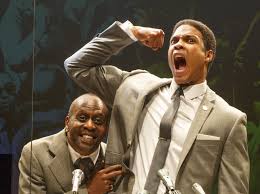
K. Todd Freeman and Ray Fisher in Fetch Clay, Make Man at New York Theatre Workshop

K. Todd Freeman and Ray Fisher in Fetch Clay, Make Man at New York Theatre Workshop

There are also examples of artists addressing work which would now be seen as offensive by placing it within the context of new works and adaptations. Screenings of films featuring Lincoln Perry, better known by the derogatory name Stepin Fetchit, who at one time was the most famous black actor in the movies, would likely be met by scorn if simply programmed without introduction or discussion of the actor and his character at the time he was working. However, playwright Will Power has worked to address Perry’s legacy by making him a leading character in the play Fetch Clay, Make Man, which places him alongside Cassius Clay (as he became Muhammed Ali) as two icons of African-American popular culture. It’s also unlikely that few theatre companies would produces the once hugely popular melodrama The Octoroon, with its far outdated racial views, but Branden Jacobs-Jenkins has deconstructed the work as part of his play An Octoroon, folding the original material directly into commentary on the same piece.

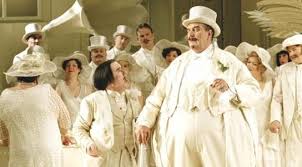
Jonathan Miller’s production of The Mikado for the English National Opera

Jonathan Miller’s production of The Mikado for the English National Opera

There are many who defend The Mikado by citing Gilbert and Sullivan’s love of Asian culture and their efforts to represent it, but that often accompanies productions with white actors in yellowface; this ongoing controversy arose once again this summer in Seattle. But 28 years ago director Jonathan Miller found a way to present the work by resetting it in a seaside English resort, allowing the characters in what was widely known to be a spoof of the British aristocracy to be seen as exactly that, instead of antiquated racial caricatures. Again, context and interpretation is all.

I take exception to Kennicott’s characterization of “Cultural leaders who fret about art causing discomfort,” since it evidences a lack of comprehension of the role of those leaders. Yes, we should want all artistic ventures to be brave and bold, and to even take audiences places where they might not necessarily think to go. But they must do so in the context of serving their community, and indeed their many communities, because they do not and cannot exist in a vacuum where art cannot be challenged, often vigorously, in critiques and discussion simply because it has been declared art.

In every generation, art is a dialogue between artists and audiences, whether in performance or fixed texts and images; just as some works aren’t recognized or accepted when first created, there are also those which cease to hold meaning or whose meaning changes as society advances. If an artistic leader chooses to produce a season of vintage works with passé portrayals of women, people of color, people with disabilities, sexual orientation and so on as they might have first been seen, that is absolutely their right. But it is also the right of those who know the work or see it to challenge those decisions – though I abhor the kinds of threats that have emerged over Klinghoffer or Exhibit B at the Barbican, even as I support the rights of the voices which oppose those works to express their opinions. It is very easy in theory to say all works should remain fixed, but reality is another matter altogether.

There are no absolutes in this discussion. If works out of copyright are altered for this production or that, the work itself remains fixed for yet another day, and each example can be judged in relation to the original text. Inevitably, for every leader, whether teacher or producer, it is a matter of balancing a wide range of opinions and perceptions. I personally believe in art for art’s sake alongside art for audiences’ sake, but art for history’s sake serves only the past and runs the risk of propagating the failings of the past. In the arts, history should not be wholly erased, but it should first and foremost be the foundation upon which we build a better future.

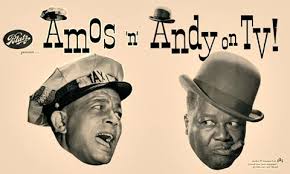
amos andyP.S. Among the examples Kennicott cites as falling prey to cultural sanitization is Amos and Andy. While it is true that the show was recognized as an avatar of racial insensitivity when viewed through the enlightened prism of the 1960s civil rights struggle, its absence from the airwaves or cable box is now due just as much to it no longer being commercially viable as to its racial stereotyping. That holds true as well for countless shows from the era, for reasons ranging from a changed society where the work is no longer seen as positive (such as my childhood favorites F Troop and I Dream of Jeannie) to their being in black and white and in the old TV aspect ratio. But Amos and Andy hasn’t been erased: you can view the TV episodes in the collection of the Paley Center for Media or buy the DVDs on Amazon and see for yourself why it’s now for the history books and academic, not mass entertainment.


Two Top Ten Lists Tell Tales Of Theatre Today

October 14th, 2014 § 5 comments § permalink

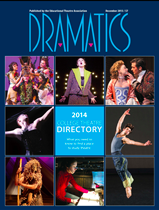
Aside from being the month of copious pumpkin flavored foodstuffs, October also brings two perennial theatrical top ten lists that are worthy of note: American Theatre magazine’s list of the most produced plays in Theatre Communications Group theatres for the coming season and Dramatics magazine’s lists of the most produced plays, musicals and one-acts in high school theatre for the prior year. They both say a great deal about the state of theatre in their respective spheres of production, both by what’s listed explicitly, as well as by what doesn’t appear.

In the broadest sense, both lists are startlingly predictable, although for different reasons. If you happen to find a bookie willing to give you odds on predicting the lists, here’s the trick for each: for the American Theatre list, bet heavily on plays which appeared on Broadway, or had acclaimed Off-Broadway runs, in the past year or two. For the Dramatics list, bet heavily on the plays that appeared on the prior year’s list.

But in the interest of learning, let’s unpack each list not quite so reductively.

American Theatre

at_oct14_coverAs I’ve written in the past, what happens in New York theatre is a superb predictor of what will happen in regional theatre in the coming seasons, especially when it comes to plays. Any play that makes it to Broadway, or gets a great New York Times review, is going to grab the attention of regional producers. Throw in Tony nominations, let alone a Tony win – or the Pulitzer – and those are the plays that will quickly crop up on regional theatre schedules.

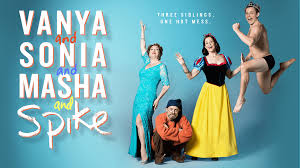
Anyone who follows the pattern of production would have easily guessed that Christopher Durang’s Vanya and Sonia and Masha and Spike would proliferate this year, being a thoughtful, literary based comedy with a cast of only six. That American Theatre lists 27 productions doesn’t even take into account the 11 theatres that did the show in 2013-14, and certainly there are non-TCG theatres which are doing the show as well. It’s no surprise that Durang has said he made more money this past year than in any other year of his career; it’s a shame that financial success has taken so long for such a prodigiously gifted writer and teacher.

In general, shows on the American Theatre list have about a three year stay, typically peaking in their second year on the list, but this can vary depending upon when titles are released by licensing houses and agents to regional theatres. 25 years ago (and more significantly years before that) theatres might have had to compete with commercial tours, but play tours are exceedingly rare birds these days, if not extinct.

vsmsPerhaps this rush to the familiar and popular and NYC-annointed is disheartening, but it’s worth observing that the American Theatre list notes how many productions each title gets, and that after the first couple of slots, we’re usually looking at plays that are getting 7 or 8 productions in a given season, across TCG’s current universe of 474 member companies (404 of which were included in this year’s figures). Since the magazine notes a universe of 1,876 productions, suddenly 27 stagings of a single show doesn’t seem so dominant after all. Granted, TCG drops Shakespeare from their calculations, but even he only counted for 77 productions of all of his plays across this field. So reading between the lines, the American Theatre list suggests there’s very little unanimity about what’s done at TCG member theatres in any given year, a less quantifiable achievement but an important one.

Dramatics

Screen Shot 2014-10-13 at 5.34.58 PMWhile titles come and go on the American Theatre list, stasis is the best word to describe the lists of most produced high school plays (it’s somewhat less true for musicals). Nine of the plays on the 2014 list were on the 2013 list; 2014 was topped by John Cariani’s Almost, Maine, followed by A Midsummer Night’s Dream and the two titles were in reverse order the prior year. The other duplicated titles were Our Town, 12 Angry Men (Jurors), You Can’t Take It With You, Romeo and Juliet, The Crucible, Harvey and The Importance of Being Earnest.

Like the American Theatre list, the Dramatics survey doesn’t cover the entirety of high school theatre production; only those schools that are members of the Educational Theatre Association’s International Thespian Society have the opportunity to participate, representing more than 4,000 high schools out of a universe of 28,500 public, private and parochial secondary schools in the country. Unlike the Dramatics list, there are no hard numbers about how many productions each show receives, so one can only judge relative popularity.

almost maineAlmost, Maine’s swift ascension to the top rungs of the list is extraordinary, but it’s due in no small part to its construction as a series of thematically linked scenes, originally played by just four actors but easily expandable for casts where actor salaries aren’t an issue. Looking at recent American Theatre lists, they tend to be topped by plays with small casts (Venus in Fur, Red, Good People and The 39 Steps), while the Dramatics list is the reverse, with larger cast plays dominating, in order to be inclusive of more students (though paling next to musicals where casts in school shows might expand to 50 or more).

The most important trend on the Dramatics list (which has been produced since 1938) is the lack of trends. Though a full assessment of the history of top high school plays would take considerable effort, it’s worth noting that Our Town was on the list not only in 2014 and 2013, but also in 2009, 1999 and 1989; the same is true for You Can’t Take It With You. Other frequently appearing titles are Arsenic and Old Lace, various adaptations of Alice in Wonderland, Harvey, and The Miracle Worker.

No doubt the lack of newer plays with large casts is a significant reason why older classic tend to rule this list; certainly the classic nature of these works and their relative lack of controversial elements play into it as well. But as I watched Sheri Wilner’s play Kingdom City at the La Jolla Playhouse a few weeks ago, in which a drama director is compelled to choose a play from the Dramatics list, I wondered: is the list self-perpetuating? Are there numerous schools that seek what’s mainstream and accepted at other schools, and so do the same plays propagate themselves because administrators see the Dramatics list as having an implied educational seal of approval?

That may well be, and if it’s true, it’s an unfortunate side effect of a quantitative survey. But it’s also worth noting that many of these plays, vintage though they may be, have common themes, chief among them exhortations to march to your own drummer, to matter how out of step you may be to the conventional wisdom. They may be artistic expressions from other eras about the importance of individuality, but in the hands of teachers thinking about more than just placating parents, they are also opportunities to celebrate those among us who may seem different or unique, and for fighting for what you believe in against prevailing sentiment or structures.

*   *   *

Looking at musicals on the American Theatre list is a challenge, because their list is an aggregate of plays and musicals, and while many regional companies now do a musical or two, it’s much harder for any groundswell to emerge. In the last five years, only three musicals have made it onto the TCG lists, each for one year only: Into The Woods, Spring Awakening and The 25th Annual Putnam County Spelling Bee. That doesn’t mean there’s a dearth of musical production, it simply shows that the work is being done by companies outside of the TCG universe.

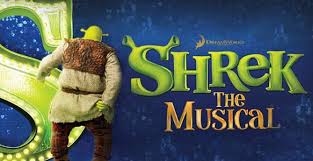
shrekMusicals are of course a staple of high school theatre, but the top ten lists from Dramatics are somewhat more fluid. While staples like Guys and Dolls, Grease, Once Upon a Mattress, You’re A Good Man Charlie Brown and Little Shop of Horrors maintain their presence, newer musicals arrive every year or two, with works like Seussical, Legally Blonde, Spelling Bee, and Thoroughly Modern Millie appearing frequently in recent years. At the peak spot, after a six-year run, Beauty and the Beast was bested this year by Shrek; as with professional companies, when popular new works are released into the market, they quickly rise to the top. How long they’ll stay is anyone’s guess, but I have little doubt that we’ll one day see Aladdin and Wicked settle in for long tenures.

*   *   *

When I looked at both the American Theatre and Dramatics lists over a span of time, the distinct predictability of each was troubling. Coming out when they do, before most theatrical production for the next theatre season is set, I’d like to see them looked at not as any manner of affirmation, but as a challenge – whether to professional companies or school schedules. I admire and enjoy the plays that are listed here, and nothing herein should be construed as critical of any of these shows; audiences around the country deserve the opportunity to see them. While I do have the benefit of living in New York and seeing most of these popular shows there, I must confess that I am most intrigued by the theatre companies and school groups that might just say to themselves, ‘Let’s not do the shows, or too many of the shows, that appear on these lists. Let’s find something else.’ Those plays may never appear as part of any aggregation, but I suspect the groups’ work will be all the more interesting for it, benefiting both artists and audiences.


Quiet Kryptonite Fells California High School Theatre Superheroines

October 8th, 2014 § 2 comments § permalink

A couple of weeks ago, yet another high school play was canceled over its content, this time at Santiago High School in Corona, California. Unlike the cases we often hear about, there was no press about the decision, no student protest, no faculty outcry. By the time I learned of it and communicated briefly on social media with a couple of students involved in the show, they were ready to just move on. The play was to have been performed in the latter part of this month.

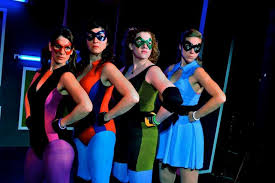
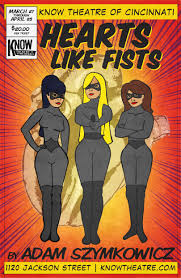
Hearts Like Fists at Flux Theatre Ensemble

Hearts Like Fists at Theatre of NOTE

The play, Hearts Like Fists, was first produced only two years ago, debuting at Theatre of NOTE in Los Angeles in August 2012. It made its East Coast premiere in December of the same year at New York’s Flux Theatre Ensemble. Described in a synopsis as “a superhero noir comedy about the dangers of love,” it has already been produced at several high schools, including the Jewish Community High School of the Bay Area and at Sachse High School in Sachse, Texas; it will be done next month at TMI – The Episcopal School of Texas in San Antonio. As someone who sees real value in high school students having the opportunity to work on contemporary plays, I was very pleased to see that such a new work had been quickly found by schools.

How did I learn of the quiet cancelation in Corona? My high school theatre advocacy was mentioned in conversation on Facebook where the play’s author, Adam Szymkowicz, had shared the news, which he only learned of through students who had contacted him on Twitter. While a school representative, in response to my inquiry, said that the cancelation was due to the play not having received the proper approval, that is an oft-cited reason that typically differs from other accounts. But with no other accounts to go by in this case, I’m left only with a vague sense of something amiss, since I doubt that any teacher would go into rehearsal for a show without having followed the appropriate protocols. That would be a willful challenge to an administration, putting employment at risk.

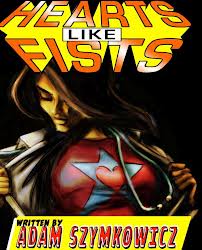
Advertising for production at Cal State Fullerton

Advertising for production at Theatre of NOTE

In my opinion, the play has an enormous amount to offer school theatre troupes, as it addresses love, rejection, and female empowerment by inverting many comic book tropes, offering strong female roles in a stylized ensemble work with 9 or 10 roles. It does, however, contain stage violence and a handful of phrases that might well bring parents up short. Shorn of context, they include, “She knees him in the groin,” “I promised you angry sex,” and “I’m thinking about your body pressed against mine…I’m thinking about taking of all your clothes piece by piece…Then I would tear into you, with my hands and with my teeth. I would leave marks.”

While these phrases are not typical of the dialogue in Hearts Like Fists, and indeed these examples comprise the majority of what I thought could prove problematic for schools, one can imagine parents who might take exception to hearing this out of the mouths of 17-year-olds, even if the same students might discuss such things in their own lives or hear them even on broadcast TV. But as a result, the skittishness of administrators to allow them to be spoken in performance is not a complete shock. It’s a shame, really, because the play offers so much, but schools have long proven themselves to be risk averse.

I know Szymkowicz entirely from online interactions, stemming in large part from his impressive ongoing series of interviews with other playwrights, so I reached out to him about the cancelation, both before and after reading the play. Via e-mail, I asked Szymkowicz about the fact that in his Facebook dialogue, he seemed disinclined to make an issue of the cancelation.

Adam Szymkowicz

Adam Szymkowicz

“As a playwright I am used to plays being postponed or cancelled for various reasons,” he replied. “Productions appear out of nowhere and sometimes just as mysteriously, planned productions don’t happen. I’m not saying it’s a fun thing about being a playwright but at this point I’m used to it. It never occurred to me that I have any power in whether or not planned productions do actually happen. Either people want to do a play or they don’t. I can’t make people do my play just because they said they would.” Szymkowicz noted that the show has had 10 productions, with four more coming up, and would soon be his most produced work.

Had he ever thought about Hearts Like Fists as a play for high schools, I wondered. “No,” was his simple reply. “It was a commission for South Coast Repertory. But I specifically didn’t have cursing in it because of how sensitive it seemed that Orange County audience was to curse words based on the reading of another play I had there.  The fact that high schools have been doing it is a happy accident.”

But, in hindsight, does he believe there are facets of the play that particularly speak to high school performers and/or audiences? “I think loving the wrong person is an experience a lot of people have in high school,” he observed. “Also being a secret superhero (metaphorically) or having super powers not yet fully expressed. All general love confusion. High school is, for some, a confusing time.”

As is the case with a number of newer musicals, I wondered if he would consider authorizing a high school version of the show, with his own content edits. “I looked at the play once,” he wrote, “a year or so ago, with an eye to that, but I couldn’t figure out how to make tamer versions of certain scenes still work.”

Given the few phrases that might well give schools pause, I wondered whether Szymkowicz had considered that schools that have done or will do the show might be making their own, unauthorized edits, and how he would feel about that. He replied, “I wouldn’t like that and, of course, as you know, contractually they are forbidden from doing so.”

hearts like fists at knowHowever, he wasn’t opposed to school editions on principle, saying, “If it doesn’t harm the play, sure. I am glad high schools are doing more challenging work and pushing boundaries and creating conversations. I worry about work that is sanitized past the point of having meaning or worth. But if you as a writer can take out something too adult (not that we all agree on what that is) but still have a play you are proud of, more power to you. Some wonderful plays are done frequently at the high school level.”

Finally, I asked Szymkowicz whether there was anything he’d like to say to the students, or to the administration, about the play being canceled.

“I spoke to a few of the students over Twitter who seem heartbroken and sent my regrets that this happened after they had already started rehearsals. I suspect the administration thought it would harm his/her community in some way to do this play. I think it is a bigger harm to not let them do the play.  But look. I’m a playwright, not an administrator. I think theater is a good thing. I think communication is always better than shutting down conversations that make us uncomfortable. And honestly I also think my play is kind of tame. I suspect if these kids wrote plays themselves they would be much more upsetting or explicit than my play.”

I happen to agree strongly with Szymkowicz that communication is better than cancelation, and I believe that somewhere in the process of play selection, the start of production at Santiago High and the cancelation, some essential communication was missed. I admire the teacher who wanted to bring new work to her students and I respect the playwright for his decision that any alteration in the play would be to its detriment, and that even in high schools, he wants to see his play done as written, which is his absolute right. Much as I’d like to figure out if there’s a villain here, I can’t. And, sadly, circumstances have insured that Szymkowicz’s villain, the rejected, lovelorn Doctor X won’t be found at Santiago High either.


Disability And The Return Of “Freak”

September 26th, 2014 § 1 comment § permalink

I anticipate that this October will be the month of “freak,” and not because of Halloween. Though that won’t help.

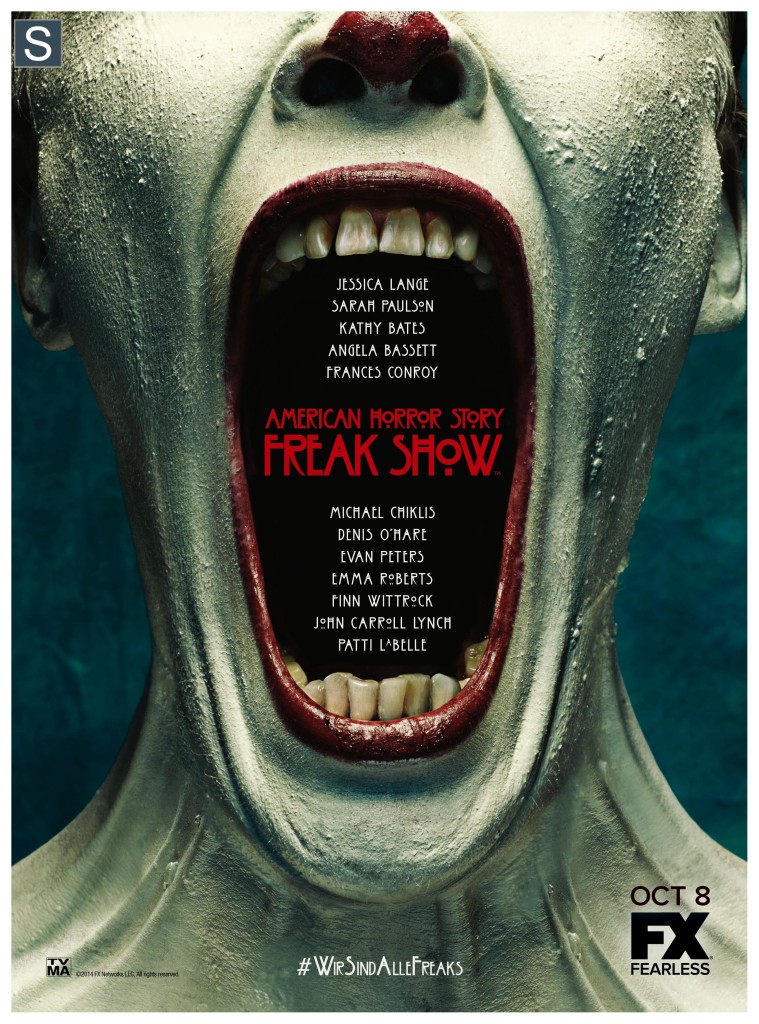
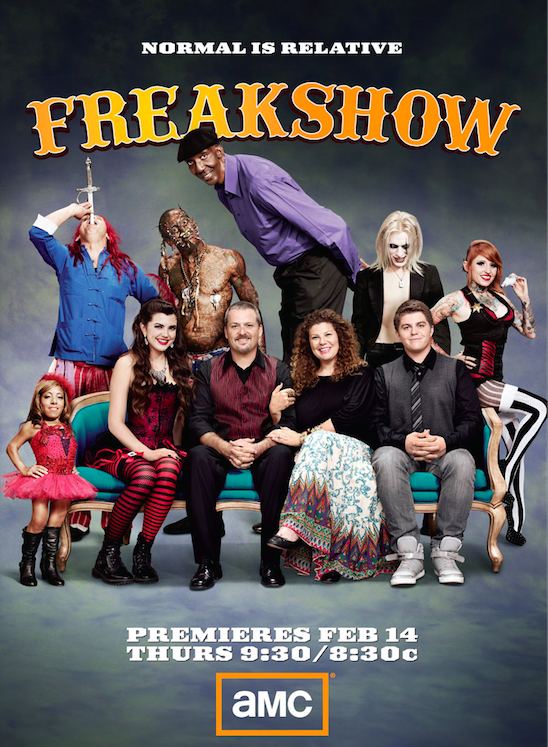
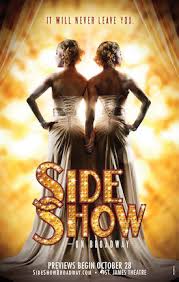
AHS FS mouthBecause the media can’t resist trend stories, and any three or more items with a common link can constitute a trend, the confluence of the AMC series Freakshow; the new season of American Horror Story, entitled “Freak Show”; and the Broadway musical Side Show, with its opening number inviting audiences to “Come Look at the Freaks,” will prove irresistible. However, they may also engender more frequent use of the word “freak” to apply to people with disabilities, bringing into vogue a term used far too often to marginalize those who don’t match up with what is far too often termed as “normal.” What, after all, is normal anyway?

“Freak” is a particularly ugly word when applied to a person with a disability, since it is not only designed to clearly label them as being something other than the prevailing “standard,” but it has been layered over centuries with implications of fear and horror and objectification. Many people went to see side shows in order to gaze with at best fascination, but often with superiority or revulsion at people who, in some cases, could find no other employment (and developed extraordinary skills to combat that) and for whom medical treatments and assistive tools were unavailable. That connotation lingers.

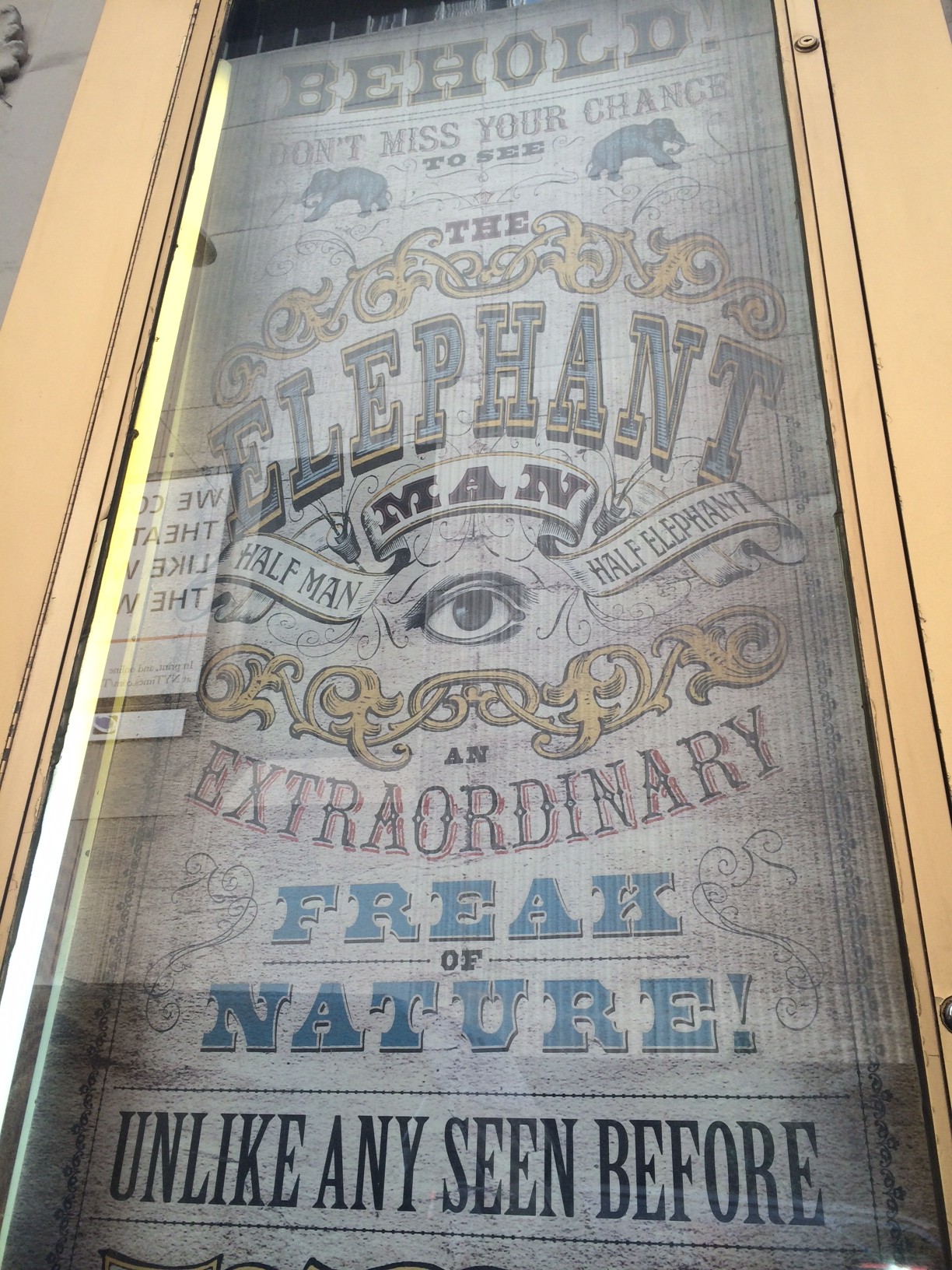
elephant man house boardPart of the challenge that’s barreling towards us in the next month comes from how these works are advertised. The deeply unsettling ads for American Horror Story, whether in TV or on subway signage, are determined to link “freak” with “scary” and “strange.” In an effort to recall the very side shows in which John Merrick was displayed, the pending Broadway revival of The Elephant Man already has theatre signage imploring passers-by to “Behold an extraordinary freak of nature.” And how many people may come out of Side Show humming the often-sung and whispered, “Come look at the freaks/Come gape at the geeks/Come examine these aberrations/Their malformations/Grotesque physiques/Only pennies for peeks”? It’s quite possible that more people will see or hear the word “freak” than will actually see the shows that contain or employ them, reinsinuating the term back into common parlance, devoid of context or understanding.

AMC’s FREAK SHOWScreen Shot 2014-09-26 at 11.25.30 AMEach of these examples may be very different works – one a reality TV show, one a fictional horror fantasy, one a Broadway musical – but they’re all rooted in the setting of a circus or carnival sideshow or, as they were often known, freak show. The side show has proven a rich location for tales of fiction and fact for many years, from William Lindsay Gresham’s noir Nightmare Alley to an early and rare Spalding Gray monologue In Search of The Monkey Girl to Katherine Dunn’s family saga Geek Love. The legacy of Tod Browning’s film Freaks lingers after 80 years, along with the debate over whether it was utter exploitation, or something more.

This is not to suggest that we can entirely eradicate “freak,” but that as these depictions proliferate, we should be thinking about the context in which they’re used. In the various accounts being told, it would be dishonest to pretend that “freak” was not a common term for people with disabilities. Within each work, it’s an accurate term (although in its out of town run at The Kennedy Center, I noticed Side Show’s careful use of “disabled” at one point, anachronistically but diplomatically), no different than the term “crippled” in Martin McDonough’s The Cripple of Inishmaan, which played on Broadway in the spring.

Daniel Radcliffe and Sarah Greene in The Cripple of Inishmaan

Daniel Radcliffe and Sarah Greene in The Cripple of Inishmaan

But Inishmaan is also the example that provokes my concern about “the fr-word” this fall. While in Ireland in the 1930s, no one was stopping to find a more proper term for the boy they all called, to his own frustration, “Cripple Billy.” But when the show was discussed or written about, the term was used over and over again, with some critics seemingly of the opinion that since it was spoken so often in the play, they could use it in their own writing. But those critics were writing in 2014, not 1934, and their language should not have been the language of the play except when making direct quotes.

Just like the language regarding race, the best term for discussing those who have disabilities has been evolving. Terms like “handicapped” and “differently abled,” which were seen as proper not so long ago, are now problematic; for comparison’s sake, think about how terms like “Oriental” or “Negro” seem today. Worth remembering is that the long-prevailing language was imposed upon minority groups without consultation or consent; now it’s incumbent upon us to employ the preferred terms that groups choose for their own self-definition.

side show posterThat’s not to say the word is never to be uttered. Beginning in the 1960s, the counterculture embraced “freak” specifically to define themselves as outside of conventional society, but the term was usually dissociated from physical attributes and was more of a state of mind; we began to hear about “freak flags flying” from groups that assiduously wanted to be perceived as outside the mainstream. There are nouveau side shows in a number of places, including Coney Island and Venice Beach, but on recent looks, their bills of fare were just as apt to favor people who displayed outré body art or performed stunts than those with disabilities, and in every case the performers are there under their own agency.

Indeed, just as LGBTQ activists embraced the derogatory “queer” as an emblem of their own efforts at acceptance, and to confront those who sought to suppress them, there are those in the disability community who proudly call themselves “freaks” or “crips,” and those names are often claimed by performers with disabilities as well. But no differently than someone straight should call a member of the LGBTQ community “a queer,” no one should think that they have the right to label someone with a disability “a freak.” Those individuals can self-identify as such, but it doesn’t cut both ways.

As Christopher Shinn wrote so eloquently for The Atlantic, disability is not a metaphor. I would add to that sentiment that “freak,” when applied to a person, is not a title of mystery and wonder. It’s a slur. So see these shows according to your own taste. But think carefully about how you’re going to talk about them afterwards.

This essay appeared in a somewhat different form as part of The Guardian’s op-ed section, “Comment is Free.” Click here for that edited and condensed version.


In Pennsylvania, Director Is Fired Over School “Spamalot”

September 19th, 2014 § 146 comments § permalink

Screen Shot 2014-08-05 at 10.49.54 AMI am angry and I am sad. But I am not entirely surprised.

Earlier this morning, Dawn Burch, drama director at South Williamsport Area Junior/Senior High School in Pennsylvania, was fired from her position. By e-mail. The reason given? “Job performance.”

It doesn’t take a detective to figure out what’s really going on. At the beginning of July, Burch asserted that her musical choice for this school year, Spamalot, had been nixed by the school due to its gay content. School officials vehemently denied that was the case.

In late August, Keystone Progress and I received copies of school e-mails between Burch, principal Jesse Smith and superintendent Mark Stamm regarding the decision. An e-mail from Smith from the end of June cited “homosexual themes” as the reason for canceling the show.

So now, less than a month after the administration’s efforts to hide their own actions were revealed, Burch suddenly loses her job. Save for holding auditions and beginning rehearsals for the school’s fall play, Alice in Wonderland, she has barely undertaken her job for this year, as prior to that it was summer break. When exactly did these job performance issues come to light? Awfully coincidental, no?

I believe Burch has been fired for telling the truth. Burch has been fired for not being willing to accept that gay life was not something to be hidden away, not something to be ashamed of, not something to be afraid of. It hardly takes another Right-to-Know request to put together the pieces.

I wanted to interview Burch about what has transpired, but she was too emotional to say much more than the bare facts of the firing as cited above, except to express concern about what would happen to the fall play and to the students already cast, who were looking forward to being in the show. Will it still happen? Who knows. But even on a difficult day, Burch’s main concern was for the students. She may not be a teacher (and therefore has no tenure), but putting the needs of students first is a sign of an excellent teacher, accredited or not. There are many ways to teach.

It’s worth noting that at a Board of Education meeting a week and a half ago, conversation regarding the Spamalot issue was expressly deferred until this coming Monday, September 22. So it’s quite remarkable that this decisive action took place even before the South Williamsport community could discuss the issue publicly; that they were denied any opportunity to speak before the issue was resolved and that it became a referendum on Burch’s performance, rather than about condoning homophobia and then hiding that fact. Will the topic still be discussed Monday night? Perhaps. But there’s going to be a lot of discussion in the past tense when it comes to Burch.

Perhaps we’ll all be surprised. Perhaps overwhelming support for Burch will be in evidence on Monday night. Perhaps the Board of Ed members will discover that this is an issue that will be a factor when they run for reelection. Perhaps parents will make clear that they can’t trust the word of the board chair, the superintendent and the principal, given their efforts to obscure the truth in this situation. Perhaps the press will cover the fallout of this firing with rigor and depth, and a truer picture will emerge.

I don’t know how the students will feel, or what they’ll be told about the loss of their drama director. I don’t know how they’ll react, or if they will at all. But just as kids are smart enough to intuit a great many things from a very early age, I suspect many of them are going to realize that they’ve just been given a lesson in right and wrong, in honor and duplicity, in the politics of fear and silence. They’ve seen just how badly their elders can behave in the name of protecting them. I hope they’ll see through it as well.

And I hope they’ll realize that Dawn Burch is a hero. I think plenty of people already do.


Questions On School Theatre Censorship, For South Williamsport & Beyond

September 18th, 2014 § 1 comment § permalink

Screen Shot 2014-08-05 at 10.49.54 AMEven if I were to attend the Board of Education meeting of the South Williamsport Area School District in Pennsylvania this coming Monday, September 22, I couldn’t speak. That’s because the district only allows comment from residents and taxpayers, and I am neither. Even if I were permitted to speak, I very likely would only be permitted to make a statement, since many school boards allow public comments at meetings, but don’t necessarily engage in dialogue. I have no idea what the practice is in South Williamsport.

I remain very concerned about the school’s decision to cancel the musical Spamalot due to, in the words of Principal Jesse Smith, “homosexual themes.” This is no longer an issue about play choice, but about institutional bias. As a result, I have a lot of questions I wish I could ask, both at that meeting and elsewhere in South Williamsport, about all that has transpired over this clear effort to suppress any portrayal of gay life at the Junior/Senior High School, even in a piece as non-doctrinaire as a Monty Python musical.

So all I can do I toss my questions out into the universe, hoping that perhaps a resident or taxpayer might ask them, or speak to them, before Monday night, during the Board of Education meeting itself, and afterwards.

1. Principal Jesse Smith: when this story was first reported, a quote was falsely attributed to you, which has rightly been corrected and/or excised. In school e-mails, you expressed concern that this falsely attributed statement made you look like a bigot. However, the central issue remains – you don’t think it appropriate for homosexual characters or relationships to appear in a school show. This leads me to ask an obvious question: do you personally support or oppose equal rights for all people – gay, straight, bisexual and transgender? Do you personally think the portrayal of gay characters in Spamalot is inappropriate in a school setting, or are you acceding to the opinions and wishes of those who do?

2. Superintendent Mark Stamm: internal e-mails from the school have you declaring that Mr. Smith’s original decision on this issue is “sound.” Therefore, it’s only natural to ask you the same question put to him: do you personally support or oppose equal rights for all – gay, straight, bisexual or transgender?

3. Board of Education chair John Engel: On July 3, regarding the initial assertions that Spamalot was canceled due to gay content, a story from PennLive/Patriot-News said, “Homosexuality did not enter into that decision, Engel said.” The released e-mails prove that homosexuality was the reason for the decision. So, were you given false information by school district staff that led you to make this incorrect statement, or were you attempting to obscure the facts? As an elected official, what is your position regarding the dissemination of incorrect information to the public by any member of the school staff or school board?

4. WNEP Television: You first reported the story of the cancelation of Spamalot and, regrettably, that story contained a noteworthy error which proved distracting. Several days later, you aired a second story about the community coming together. However, since then, you have not reported on the story at all, even after multiple sources revealed that indeed it was the show’s gay content that provoked censorship. Is this fulfilling your responsibility as a source of local news? Have you scared yourselves away from covering an important story?

5. PennLive.com/Patriot-News: You also wrote about the Spamalot controversy when it first broke in July, but have not written about it since the school e-mails were revealed. Why do you not consider those facts newsworthy, especially since they contradict material you previously reported?

6. The news staff of the Williamsport Sun-Gazette: Why did it take a blogger and a progressive advocacy organization to bring forward the truth of the reasons for Spamalot’s cancelation through Right-to-Know requests? Given the information you published originally, it was clear there were varying accounts, and there was an obvious way to clear things up. Why didn’t you do this on your own? Why, once the e-mails were revealed, did it take you another 10 days to report the story?

7. The editorial page staff of the Williamsport Sun-Gazette: Since your paper ultimately wrote about the release of e-mails which made clear that Spamalot was canceled due to its “homosexual themes,” and prior statements from school administrators had been designed to obscure that fact, you have not mentioned this issue at all – either with any letters to the editor or an editorial. In fact, you haven’t offered an editorial about this situation at all since the story first emerged in early July, even though you have managed 10 pieces relating to the Federal government, including terrorism and the IRS, among many others, in that time. Why haven’t you written a word about a case of anti-gay bias in your own backyard?

8. Superintendent Stamm: When you spoke to the Sun-Gazette about the released e-mails, you spoke about statements being taken out of context. However, as the Right-to-Know administrator for the district, you were personally responsible for redacting the context in the e-mails, presumably with advice of counsel. Is it reasonable to complain about lack of context that you blacked out? Also, you defended Mr. Smith’s signature on a check for the rights to Spamalot by saying the attached contract was folded. Is folded material a legitimate excuse for not understanding why disbursements are being made?

9. To the (claimed) South Williamsport area parent who contacted me via my website: You wrote, “I have a child that attends the So. Wmspst school district and would never want him exposed to that sexual sin. There are still parents and students and many members of our community who do not agree with homosexuality or gay marriage… We have freedom of speech also-I don’t want to see our innocent children exposed to that. They don’t need to grow up thinking that it’s normal. Some of us still have morals. Keep it out of South!” Your freedom of speech absolutely does guarantee you the right to express your opinions. However, a public school has the responsibility to prepare students for life and to teach them about the world beyond their local community. Do you believe that your disagreement with aspects of the world can dictate what students learn and perform?

10. All officials and residents in South Williamsport: national news reports on this issue have the potential to leave a lasting image of your town as one that does not believe in inclusion and equality. Will you make a public effort to assure members of the local, regional and national community that South Williamsport accepts, respects and welcomes all people as equals, without regard to gender, age, race, religion, disability or sexual orientation?

I realize that my questions go far beyond the scope of a Board of Education meeting. But that meeting is as good a reason and opportunity as any to start raising these questions, since they arose from a school issue. Now all I can do is hope that they get asked.


The Stage: American Stages

September 4th, 2014 § 0 comments § permalink

I created the fortnightly “American Stages” column for The Stage in London in 2013 with the mandate to cover news of American theatre news that didn’t necessarily warrant a standalone story and wasn’t being widely covered in other UK media. It gave me the ongoing opportunity to mix commercial with not-for-profit, Broadway with regional, as I saw fit, all targeted primarily at a readership of theatre professionals in the UK. Beginning in October 2014, the column became a weekly feature. Given the relatively tricky formatting of the original pieces, this pages serves as an index that will take you to each column as it appears on The Stage’s website, and will be updated on a rolling (and somewhat erratic) basis.

Sex and the City’s Cynthia Nixon makes directing debut in New York, 6 February 2015

Proof that you don’t need a star to break even on Broadway, 30 January, 2015

Julie Taymor directing Anne Hathaway set to be this spring’s hot ticket, 23 January 2015

Ruth Wilson and Jake Gyllenhaal open Broadway premiere of Constellations, 16 January 2015

The Last Ship leads winter Broadway closures, 9 January 2015

The year ahead in US theatre, 19 December 2014

Matilda recoups its investment, 12 December 2014

Bradley Cooper opens in The Elephant Man, 5 December 2014

Sting tries to stop The Last Ship sinking, 28 November 2014

Glenn Close returns to Broadway after 20 years, 21 November 2o14

Up Here musical to premiere at La Jolla Playhouse, 14 November 2014

Holly Hunter and Martin Short return to New York theatre, 7 November 2014

Sting’s The Last Ship opens and Halloween on stage, 31 October 2014

Al Pacino to star in China Doll by David Mamet in 2015, 24 October 2014

Anna D Shapiro steps up at Steppenwolf and Doctor Zhivago musical heads for Broadway, 17 October 2014

Steve Martin’s new musical and America’s top ten plays, 26 September 2014

Broadway’s first female-penned play in two years, 12 September 2014

Is Broadway getting a new theatre?, 29 August 2014

A sneak preview of Broadway’s new season, 15 August 2014

Re-revivals and Icelandic oddities, 1 August 2014

Song catalogues continue to woo producers and bullets for Broadway shows, 18 July 2014

Les Mis reinvented, 4 July 2014

Chicago picks up the slack for Broadway’s summer lull, 20 June 2014

Californian premieres, busy Rees and Off-Off-Broadway finally hits Broadway, 6 June 2014

Blood, mud and magic of Shakespeare heads across the Atlantic, 23 May 2014

Irish revival, Lucille Lortel Awards and Abba goes Greek, 9 May 2014

Tony determinations kick off the awards season and God gets the theatre bug, 25 April 2014

Radcliffe on Broadway, King and I rumours and Carole King off stage, 11 April 2014

If/Then kicks off Tony Awards madness, 28 March 2014

Bryan Cranston plays the president, Randi Zuckerberg plays guitar, 14 March 2014

Disappearing clowns, prog-metal Sweeney Todd and The Bridges of Madison County, 28 February 2014

King Kong heads home, Hugh Jackman helms the Tonys, 14 February 2014

Bradley Cooper, Hugh Jackman and Fatboy Slim – the stars aline in New York, 31 January 2014

Ghostly appearances from Satchmo, Tupac Shakur and Patti LuPone, 17 January 2014

Hugh Jackman disappears from Houdini, Rebecca Hall makes Broadway debut, 3 January 2014

The Iceman Cometh (but not quite yet), unpaid interns and The Sound of Music, 20 December 2013

Punchdrunk’s new restaurant, Daniel Kitson and dinner with Alan Ayckbourn, 6 December 2013

Nelson’s quartet complete plus Broadway openers and closers, 22 November 2013

Bruce Norris returns, A Time To Kill dies and Idina Menzel flies back to Broadway, 8 November 2013

A costly Betrayal, Julie Taymor returns and new musical composers on Sesame Street, 25 October 2013

Orlando Bloom, Emma Thompson and the Donmar on Broadway, 11 October 2013

The House of Mouse, Shakespeare spoofs and Terminator 2 on stage, 27 September 2013

New York City Opera in trouble, Sondheim celebrated, 13 September 2013


Guest Post: A Welcoming School “Spamalot” in Pennsylvania Coal Country

August 28th, 2014 § 15 comments § permalink

Among the many responses I’ve received to my accounts of the censorship of the musical Spamalot at South Williamsport Junior/Senior High in Pennsylvania was a tweet from Dane Rooney, an English teacher and drama director in Shenandoah PA, who spoke of his own school’s Spamalot. I invited him to e-mail me with more information, but instead of a handful of bullet points, I got an essay. I asked if I could share his communication and, with a few adjustments by Dane for wider readership, this is his account of productions of both Spamalot and The Producers at this Central Pennsylvania school of less than 500 students across six grades. – Howard Sherman

BY DANE ROONEY

Ever since I was in kindergarten, I wanted to act and direct. Coming from Shenandoah – a small town in the hard coal region of Northeastern Pennsylvania – opportunities to act were scarce. Even entering high school, there wasn’t a consistent theater organization. That is until 2001, when I was a sophomore and my brother Colin was in seventh grade. We joined the club and performed in Grease, and since then, the Shenandoah Valley Drama Club has produced a musical every spring. I graduated college and was hired as an English teacher at SV in 2007. I also began directing the musicals.

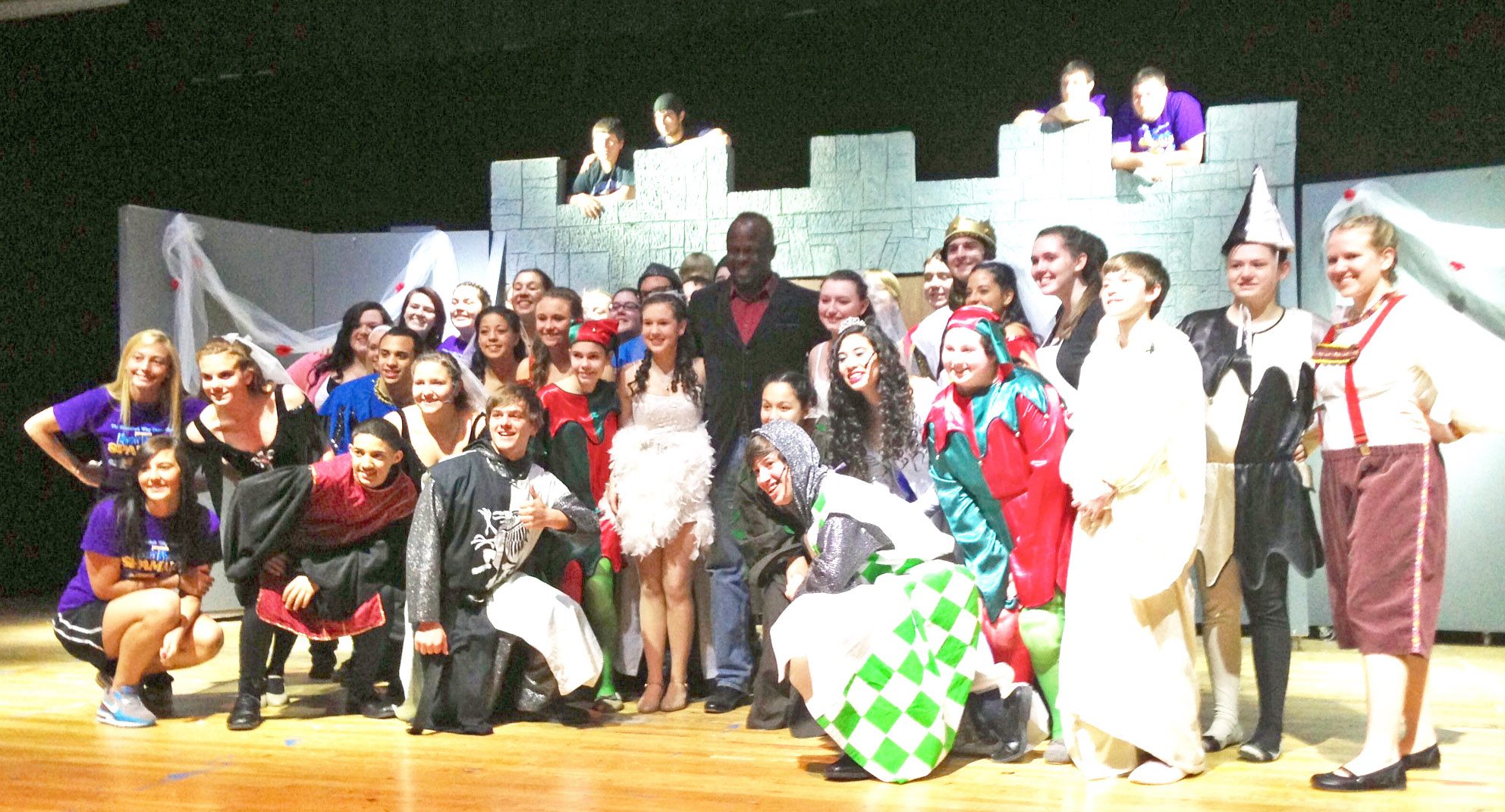
The Shenandoah Valley High School cast of Spamalot with the visiting ambassador of Nigeria.

The Shenandoah Valley High School cast of Monty Python’s Spamalot with the visiting ambassador of Nigeria.

Every single year I hoped that Monty Python’s Spamalot would become available. Hours before the opening of Grease in 2001, we watched Monty Python and the Holy Grail to relieve some of our nerves. It became a ritual for a while, and so when Colin and I saw the Broadway tour in Hershey in 2008, I felt that one year, the SVDC would have the opportunity to produce the hit comedy. Colin passed away that year from meningitis, so producing Spamalot took on a deeper meaning than just a silly comedy.

Just like South Williamsport High School planned for their 2015 production, SVDC wanted to produce Spamalot after success with How to Succeed in Business without Really Trying. Once the rights were available in PA in February of 2013, the Shenandoah Valley High School principal and superintendent approved the show without any “school edition” edits or optional dialogue/lyrics, which Eric Idle makes available through Theatrical Rights Worldwide. The administration and school board trusted me with the show’s material and felt that it would be a great production choice. On April 19th 2013, the Shenandoah Valley Drama Club became the first high school in Pennsylvania to produce Monty Python’s Spamalot.

Not only was I excited to direct one of my dream shows, but the students were thrilled about the choice to perform in Spamalot as well; many of them already loved the film version. Typically high school drama clubs have a majority of girls in the cast, however over the last four years, our drama club has become a predominantly male cast. The show fit us perfectly: the cast, the humor, the edginess, and that certain strangeness in most Python works.

Though Shenandoah is an even smaller town than Williamsport (located about 60 miles from us), no questions were ever raised about the gay marriage or the gay characters in the show. In fact, I was more concerned about the song “You Won’t Succeed on Broadway” which is a song poking fun at Broadway and the large Jewish community involved in Broadway productions.

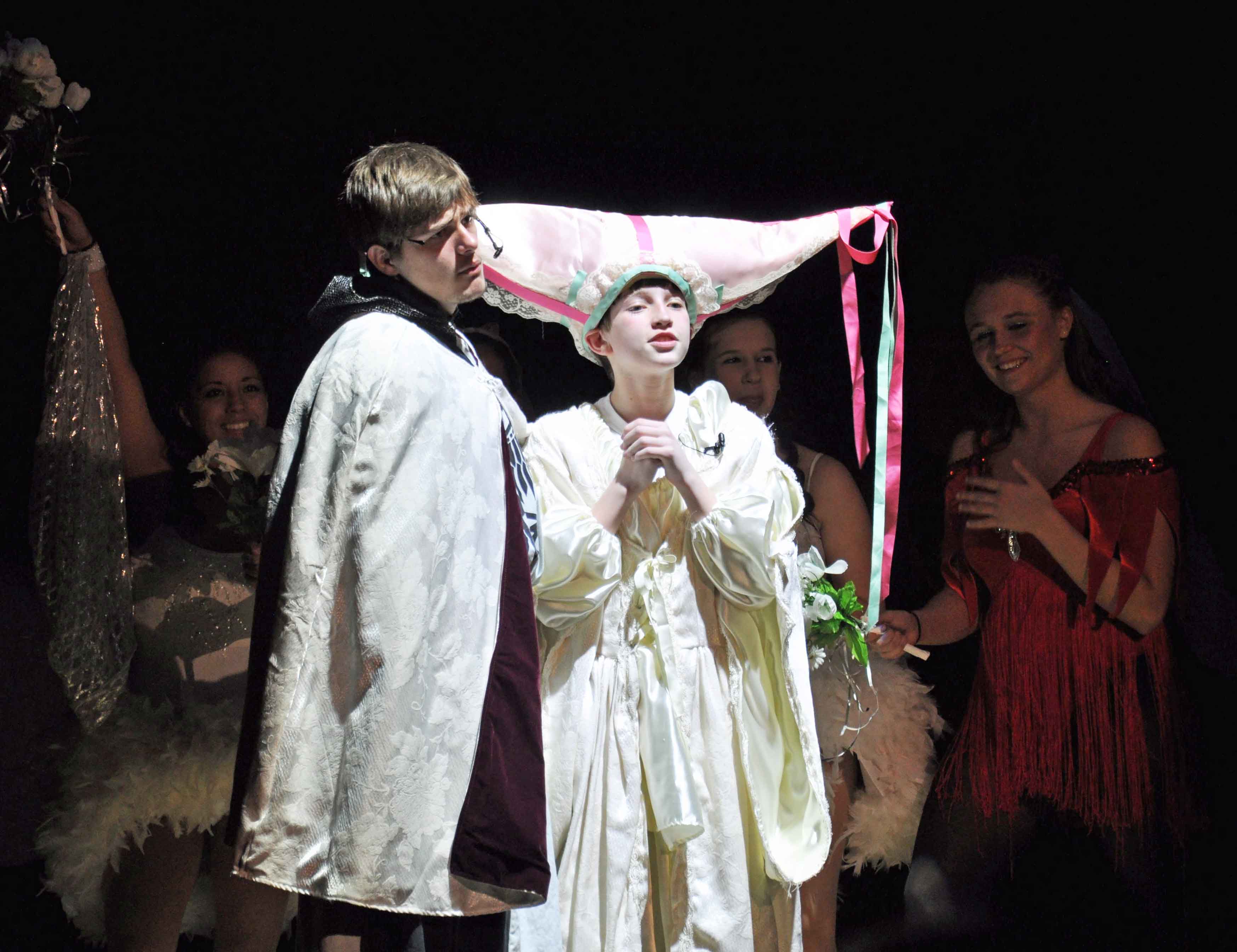
Danny Schaffer and Eric Rooney at the wedding of Sir Lancelot and Prince Herbert at Shenandoah Valley High School’s Spamalot

Danny Schaffer and Eric Rooney at the wedding of Sir Lancelot and Prince Herbert at Shenandoah Valley High School’s Spamalot

The students who played Sir Lancelot and Prince Herbert (the couple who get married at the end of the show) treated their characters with seriousness and humor. Both actors were nominated for Best Comedic Actor at our local high school awards, and the senior who played Lancelot (and other various characters) won the award. “His Name Is Lancelot”, the song in which Lancelot comes out of the closet, was by far a crowd favorite. The trick was casting some of the most charismatic students in our school as the gay male rumba dancers. I assembled four football players, the school mascot, and a class clown and we tried to keep it as much of a secret from the student population as possible. We worked countless late night hours at dance rehearsals, working around their sports schedules. When they appeared and the song began, I could hardly hear the music; the crowd burst into an uproar of applause, laughter, and cheers. I’m not even sure if they know the impact they had on the drama club, the student body, and the community; but I hope they know now and I know they were proud to portray gay characters in such a great scene and I am proud of them for doing it so bravely.

This song and this play became a highlight for our drama club. The audience loved the show and, to up the ante even further, we chose to perform The Producers the next year (April 2014). Because of the success of Spamalot (in which our cast size was about 30), we had over 60 kids in seventh through twelfth grade make the cut for the cast of The Producers. With stellar comedic actors, we pulled off another edgy musical, even topping Spamalot according to most audience response.

Angelo Maskornick as Roger De Bris and Eric Rooney as Carmen Ghia in Shenandoah Valley High School’s The Producers.

Angelo Maskornick as Roger De Bris and Eric Rooney as Carmen Ghia in Shenandoah Valley High School’s The Producers (Photo by Mary Sajone)

In The Producers, the students who played Roger De Bris and Carmen Ghia, the gay director and his partner/assistant, were so believable that audience members were “aww-ing” at some of the more tender moments between the pair. During the song “Keep It Gay” in which Roger explains that all theater must have something gay in it, the members of Roger’s production team pulled audience members onto the stage to join in the dance and conga line. The audience couldn’t stop laughing and enjoying themselves. On our final performance, the junior who played Roger went all out after “Springtime for Hitler” by laying a surprise kiss on his onstage partner, sending the audience into an uproar that nearly resulted in a premature standing ovation. It was as if our audience wanted them to be as affectionate as any straight couple in a high school musical.

However, I heard of one concerned comment that was made. Someone was worried about any closeted seventh grader watching upperclassmen portray gay characters in a satiric way. This person’s concern was that a closeted youngster might feel even more afraid to be themselves. I, however, feel passionately that, by choosing shows with gay characters and portraying them in a truthful way, we lighten the weight that a closeted seventh grader holds on his or her shoulders. Seeing a popular junior and sophomore act as a loving gay couple in a successful show like The Producers allows that seventh grader to fear no more; it allows a community to accept, to laugh, and to love. It also opens the doors for other actors to expand the roles they audition for in upcoming years, to make it okay to play any type of role. The high school actors playing gay characters in both Spamalot and The Producers performed for the thrill of acting, entering the stage with humor and bravery; what they never expected is that when they took their final bows, they left that stage heroes.

This year, we estimate that 80 to 90 students will be auditioning for the musical – that’s nearly a fifth of the school’s population. We have become the most popular and largest organization in our school, including all sports and extracurricular activities. Theater is alive and well at Shenandoah Valley High School.

As an educator, it is my duty and an honor to provide my students with everything they need to succeed. It is my job to ensure the safety of my students, and that means creating an environment free of judgment, prejudice, and hate. This story of how the SV Drama Club includes gay characters is one that I’m proud of, but the fact of the matter is, it never needed to be explained or justified over a year ago when we produced it. I am happy to share our story if it means that a high school may stop and think about the harm they are doing upon their community and student body if they decide to exclude a show based on the show’s inclusion of gay characters.

The fact is this: Spamalot is a perfect show for any high school, and if you’re lucky, it will have an astounding effect on your students, community and organization as it did at Shenandoah Valley High School.