Of Censorship, Schools, Musicals & Authors’ Rights: My Top Posts of 2014

December 29th, 2014 § 1 comment § permalink

Hands on a Hardbody at Houston’s Theatre Under The Stars

Hands on a Hardbody at Houston’s Theatre Under The Stars

Are these my “best” blog posts of 2014? I couldn’t say. All I know is that they’re my most read, from a year in which page views on my site more than doubled over 2013.

Certainly 2014 was a year in which my writing found more focus, and whether the most-read posts bear out readers’ interest in that focus, or are simply a byproduct of a somewhat narrower range of subjects, I also don’t know. But if you’ve only discovered me part way through the year, or only read me sporadically, maybe there are a few posts here that escaped your attention, and if you’re interested, this will save you some scrolling and clicking.

Curtain Call for Little Shop of Horrors at Jonathan Law High School

Curtain call for Little Shop of Horrors at Jonathan Law High School

Before I start the official list, I want to bring your attention to a post which finished just out of the Top 10, the sad and yet remarkable story which bears out the sentiment “the show must go,” even when the show is a high school musical and when one of the cast members is murdered. To me, this story encapsulates so much about what theatre can offer, even at the worst times.

May 5: On Stage In Milford, With Sweet Understanding

Here’s the full rundown of the Top 10, in publication order, with some related posts included in my comments so as not to be too repetitive. Clicking on the titles will take you to the individual pieces.

January 22: Who Thinks It’s OK to ‘Improve’ Playwrights’ Work?

Was I surprised by this instance of unauthorized text alterations to a Brian Friel play at the Asolo Rep? Yes. But this turned out to merely be the precursor to a more widely-known incident yet to come, in Texas in June. Still, it was evidence that the issue of copyright and author’s rights isn’t just about high schools tinkering with “inappropriate” content – it can happen anywhere.

March 3: When A Theatre Review Condescends

It’s not usually fair to criticize a critic for a review of a production, since it’s their opinion, so when I wrote this piece taking a Philadelphia critic to task, I tried to do so on the basis of text and fact, not opinion. I received a lot of response about this piece, a great deal of it privately.

March 26: How You Can Save Arts Journalism Starting Right Now

Some found my stated “solution” overly simplistic, so either I failed to make, or they failed to recognize, my point about arts journalism lasting only as long as the metrics bear out an interest on the part of readers.

May 28: A Whispered Broadway Milestone No One’s Cheering

If you find me rather grouchy every Monday at 3 pm, it’s because that’s when the Broadway grosses are released, with one or more shows variously pronouncing the achievement of a new “sales record.” A number of outlets report these figures week in and week out, even though there’s usually a limited amount of actual news that matters to anyone outside the business. The “season” and “annual” compilation figures tend to provoke me even more, due to the perpetually positive spin even when the real story can be found by looking just a bit more carefully at the numbers.

June 3: When The Audience Bellows Louder Than Big Daddy

I was a bit surprised that this piece got the attention it did, as I wrote it after several West Coast outlets had already reported on this incident. Why my account drew lots of eyes I’ll never know, but I do hope it’s used in many arts management classrooms to speak to the essential nature of a well-trained front of house staff, no matter what size your theatre may be.

June 13: Into The Woods With Misplaced Outrage

The movie’s out. Now people can like the changes or not, but at least they’re judging the complete work, not stray accounts (which even Sondheim ended up disavowing). I’m seeing it on New Year’s Eve, FYI.

June 20: Rebuilding “Hardbody” At A Houston Chop Shop

I remain the only writer to interview Theater Under the Stars artistic director Bruce Lumpkin about his reworking of the text and score of the musical Hands On A Hardbody. The theatre pretty much circled the wagons as soon as my piece came out, even declining to speak with American Theatre magazine when Isaac Butler looked at the incident and the issue a few months later.

June 26: Under-The-Radar Transition at Women’s Project Theater

Let’s hear it for anonymous tips! I was the first to report this story, an unpleasant account of the ousting of an artistic leader by a board that sought to portray it as a voluntary separation (foreshadowing the scenario between Ari Roth and Theater J just this month). I do find myself wondering why the outcry over Theater J has been so much greater, when the Women’s Project situation had some notable similarities.

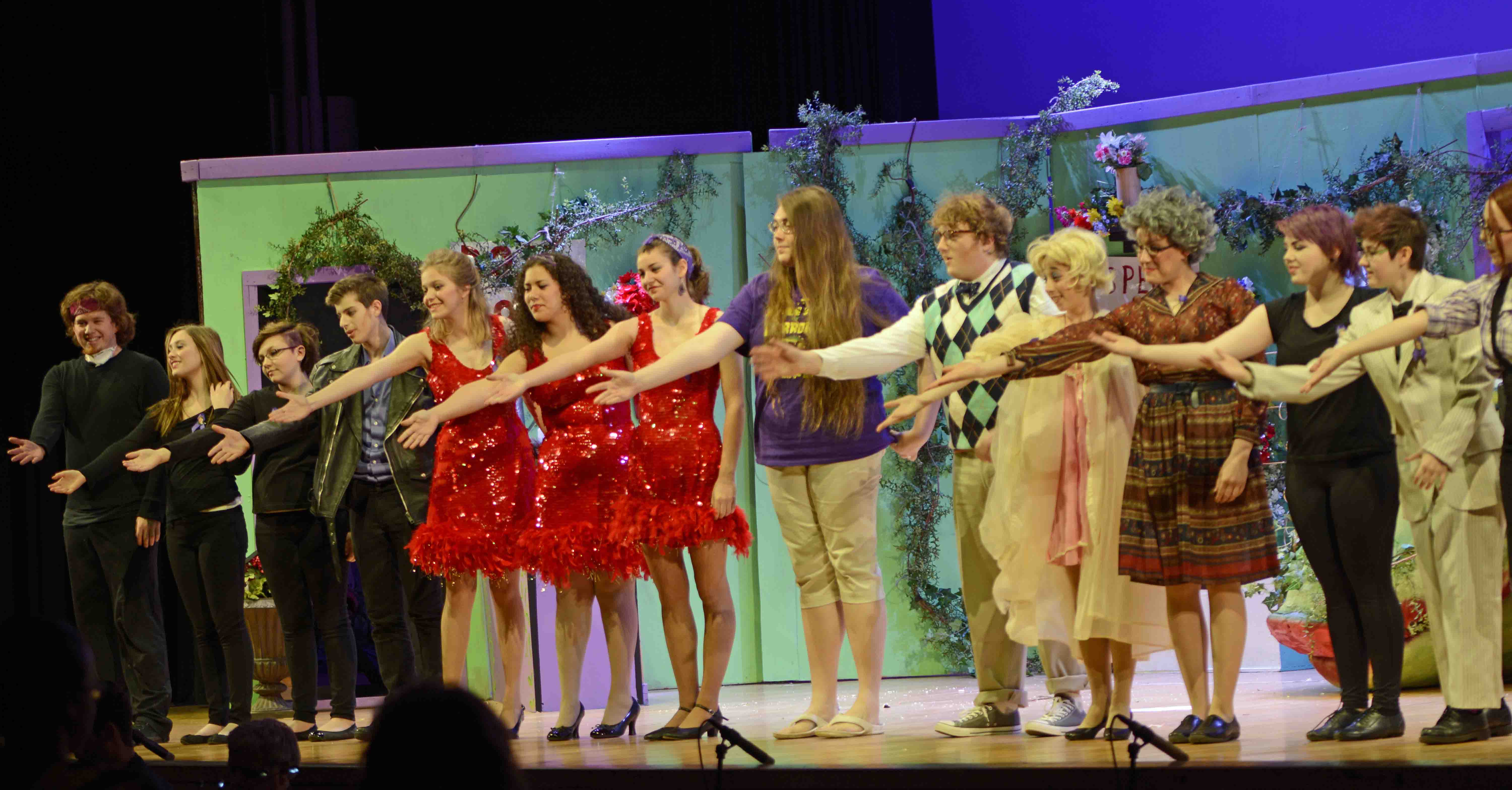
Monty Python’s SpamalotSeptember 19: In Pennsylvania, Director Is Fired Over School “Spamalot”

This was certainly the biggest school theatre censorship story of the year that I covered, as it played out over the course of nearly four months, from when it was first reported in the local Pennsylvania media. It was the final, unfortunate post that received the most attention, but for those who don’t want to start at the end, two other highly read posts on the situation in South Williamsport PA were “Trying To Find Out A Lot About A Canceled Spamalot” (July 15) and “Facts Emerge About School ‘Spamalot’ Struck Out Over Gay Content” (August 21). I wish I had written a blunter headline for the latter story, because it revealed that school officials had indeed lied about the reasons behind the cancelation of the show, and I regret not calling them out as strongly as possible. To my knowledge, they have not been held to account for spreading disinformation.

October 21: How To Fail At Canceling The Most Popular Play In High School Theatre

While the school was let off the hook for buckling under to outside pressure because the students took matters into their own hands, it’s encouraging to know that their production of Almost, Maine is only weeks away, as detailed in “Falling For ‘Almost, Maine’ in North Carolina in January.”

Though I don’t place it in the official Top 10, because it’s a compilation rather than something I actually “wrote,” my piece chronicling the censorship and restoration of work by my friends at the Reduced Shakespeare Company as they embarked on a tour starting in Northern Ireland is also one of my most read for 2014.

January 26: “The Reduced Shakespeare Controversy (abridged).”

Finally, my thanks to you for reading, clicking, liking, favoriting and sharing, and for your comments on the posts themselves, on Twitter and on Facebook. It’s truly appreciated.


Timeline: Ari Roth’s Firing From Washington DC’s Theater J

December 21st, 2014 § 5 comments § permalink

Ari Roth

Ari Roth

I have never attended Theater J in Washington DC. I have become increasingly aware of its work as controversy over that work has risen in recent years, while at the same time I have become aware of the high regard in which the company and its longtime artistic director, Ari Roth, are held by many theatre professionals I admire and call my friends. That Roth was fired this week after nearly two decades is simultaneously shocking and wholly unsurprising, as the theatre seems to have been on a collision course with the Washington DC Jewish Community Center, of which Theater J is a resident program (as opposed to a tenant), for some time over work that some in the Jewish community perceived as anti-Israel and therefore not deserving of a place in a JCC.

I cannot judge the work itself, because I have neither seen nor read it. I cannot be seen as impartial, at least by some, because I am a theatre professional who regularly speaks out against censorship, and because I am a Jew who does not believe that my religion requires unquestioning support of the State of Israel and its political, social and military policies. I do believe in the importance of Israel for the Jewish people and its right to exist, but I also believe in the rights of Palestinians to their own homeland as well, and the right and necessity of both populations to live in peace.

So rather than opine at length, I choose to share with you excerpts from many stories about Theater J, with links to the full reports, which in turn link to yet more. I decry the pressure that Theater J has been subjected to and the manner of Ari Roth’s firing. I believe that Roth’s artistic vision will ultimately be best served at his planned new company Mosaic Theater Company – a name I love for its ability to invoke both the Moses of biblical times, as well as the ancient art form of arranging multi-colored tiles to create art, suggesting the coming together of many fragments to make a larger and more cohesive whole. As for what happens to Theater J now, I hope it doesn’t become a home for only feel-good Jewish stories, but manages to sustain itself as a place that challenges those who attend and fosters debate among them, characteristics that I was taught from a very early age were a central part of Judaism.

From “Theater J incident illustrates larger dialogue on Israel at Jewish institutions” by Peter Marks in The Washington Post, August 6, 2011:

Andy Shallal, an Iraqi-born Muslim, was deeply proud of the open conversation channel he had maintained with Ari Roth, longtime artistic director of Theater J, a highly regarded branch of the D.C. Jewish Community Center. Together with another local theater lover, Mimi Conway, they’d created the Peace Cafe, an after-play forum, complete with plates of hummus and pita bread supplied by Shallal’s popular Busboys and Poets dining spots, that had become a mainstay of Theater J’s programming.

The makeshift cafe — established 10 years ago, during the run of a politically charged solo play about the Mideast by David Hare — has been important as an outlet for debate over issues raised in Theater J’s sometimes provocative repertory, especially for an outsider such as Shallal. “It was an emotional experience for me, to walk into a Jewish community center, to grow up as a Muslim, thinking of Israelis as really scary people,” he says. “I walked through that door, and it was a very beautiful experience.”

Then, suddenly, a few months ago, a curtain was drawn. The community center’s then-chief executive officer, Arna Meyer Mickelson, told Shallal that the Peace Cafe could no longer use the facilities of the center, at 16th and Q streets NW. “She said, ‘We appreciate what you’ve done, but we can’t have Peace Cafes at Theater J anymore,’ ” Shallal recalls. “I think she was waiting for the right moment to cut the strings.”

From “Heated Dialogue, Onstage and Off, at Theater J” by Lonnie Firestone in American Theatre magazine, February 2012

Maybe it’s the temperature, maybe it’s the politics—but there’s something about plays from the Middle East. Ask Ari Roth, artistic director of Theater J in Washington, D.C., who has produced more plays from that region than any other theatre artist in America. Roth can attest that the dialogue in plays from this part of the world is “more scalding than subtle. But that’s good, arresting theatre.”

Heated dialogue has become a Theater J trademark, both during the plays and at post-show talkbacks. A focus on Israel and the Middle East is one surefire way to attract passionate audiences (and occasional detractors). Since taking the helm of Theater J in 1998, Roth has been as avid about producing work that engages with Israeli life, culture and politics as he has about producing plays about American Jewish life.

From “Where do Jewish federations draw the ‘red line’ on opinions about Israel?” by Jason Kamaras on JNS.org, September 23, 2013:

Ari Roth, artistic director of Theater J, told JNS.org that “The Admission” is all based on “actual research done by three historians,” rather than implying the “fictitious 1948 massacre” that Young Israel’s Levi described in his letter. “The Admission” was also featured in an April 2013 workshop that was underwritten by the Israeli Consulate of New York, which Roth called an Israeli “hechsher” on the play.

COPMA does not acknowledge Theater J’s slate of more than 35 plays and workshops relating to Israel over the last 16 years, said Roth, who among other plays the group has performed cited “Dai” (“Enough”), which details the experiences of 14 different Israelis in the moments before a suicide bombing.

Theater J also never actually produced “Seven Jewish Children,” explained Roth. Instead, the group held a “critical dissection” of the play, featuring readings of “Seven Jewish Children” and response plays, as well as a talk to start the event that included “what troubled me about the play,” Roth said.

The DC federation, in an April 2011 statement, said it would not fund “any organization that encourages boycott of, divestment from, or sanctions against the State of Israel in pursuit of goals to isolate and delegitimize the Jewish State.” Theater J “stands squarely” against the BDS movement, Roth told JNS.org.

“We are all about bringing Israeli art over here, engaging with Israel,” he said. “We are a leading importer of Israeli cultural talent to Washington.”
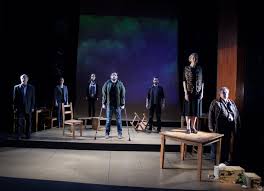
Hanna Eady, Elizabeth Anne Jernigan, Leila Buck, Danny Gavigan, Pomme Koch, Kimberly Schraf, and Michael Tolaydo in The Admission (Photo by C. Stanley Photography)

Hanna Eady, Elizabeth Anne Jernigan, Leila Buck, Danny Gavigan, Pomme Koch, Kimberly Schraf, and Michael Tolaydo in The Admission (Photo by C. Stanley Photography)

From “Theater J Scales Back Show as Pro-Israel Critics Pressure Washington D.C. Troupe” by Nathan Guttman in the Jewish Daily Forward, October 9, 2013:

In an apparent bow to the right in the Jewish culture wars, Theater J, a celebrated theatrical group housed at Washington’s DC Jewish Community Center, will not produce a play set to open this spring that has been denounced by critics as anti-Israel.

The troupe will instead run a workshop on the play and a moderated discussion. . .

The compromise reached between Theater J and the DCJCC will likely not put an end to the heated political debate about the play. Activists from a group called Citizens Opposed to Propaganda Masquerading as Art, which organized the pressure campaign, have made clear they will not discuss anything short of removing the play altogether. The group’s chairman, Robert Samet, told the Forward earlier that he would accept only the play’s cancellation.

Carole Zawatsky, CEO of the DCJCC, told the Forward that the decision to cancel the full production was not a result of the outside pressure. “This had nothing to do with COPMA,” she said. “COPMA is trying to shut down the conversation and we are trying to broaden it.”

The DCJCC explained the decision as stemming from their “guiding principle” that plays from Israel should be done in partnership with Israeli theater companies. And since a planned partnership did not materialize, Theater J will not present a full production in Washington. The workshop, Zawatsky said, will include the play’s author, Motti Lerner, alongside other historians, artists and political figures.

The controversy surrounding production of The Admission is only the latest in a series of attacks against the capital city’s Jewish theater company involving plays related to Israel. Theater J rejected the earlier rounds of criticism, insisting on its right to stage the plays in question as a matter of artistic freedom.

This time, however, the debate was deepened by a call from the theater’s detractors to withhold donations from the city’s Jewish federation because of its support for the artistic group.

From a letter by The Dramatists Guild and the Dramatists Legal Defense Fund to the Jewish Federation of Greater Washington and the DC JCC, January 27, 2014:

We understand that a group that calls itself Citizens Opposed to Propaganda Masquerading as Art has been formed to discourage Theatre J’s production of The Admission by advocating a boycott of your organizations and other intimidating tactics. Yes, private citizens have a right to object to the plays you produce by not funding you, and no, their actions do not constitute “censorship” in the strictest sense, but the bullying tactics of this group in order to impose their political worldview on the choice of plays you present must not succeed. As the representative of writers of all political persuasions, religious beliefs, etc., the Dramatists Guild strongly opposes their actions and agenda.

We find it ironic that COPMA’s wish to stifle the play is purportedly in defense of Israel, yet the Israeli minister of Home Security himself has said: “In the past, some plays by Motti Lerner have created stormed discourse … This discourse is taking place in the public sphere and that is where it should be. The State of Israel is proud of the freedom of expression in the arts in it and especially the freedom of expression in the theater.”

Should the Jewish Federation of Greater Washington and the DCJCC have a lower standard for the freedom of expression than Israel? Surely if a state under siege since its founding can withstand criticism in the form of drama, so can your audiences.

From “For Jewish groups, a stand-off between open debate and support of Israel” by Marc Fisher in The Washington Post,” May 28, 2014:

The D.C. Jewish Community Center runs a popular music festival featuring klezmer, a cappella, Broadway, liturgical and classical sounds. This year, they invited a Brooklyn feminist punk rock band called The Shondes — Yiddish for “disgrace” — to join the lineup.

Weeks later, the center uninvited The Shondes because the band’s leader had made public statements questioning whether Israel should exist as a Jewish state.

The JCC has staged an “Embracing Democracy” series over the past year, tackling tough issues with speakers on American Jews’ relationship with Israel and the birth of the Jewish state. David Harris-Gershon was asked to speak on his memoir about how he changed after a Palestinian terrorist’s bomb in Jerusalem seriously injured his wife.

But the JCC withdrew Harris-Gershon’s invitation after discovering that he had written a blog post sympathetic to the boycott and divestment movement against Israel. . .

“A wonderful aspect of Jewish tradition is healthy debate,” says Stuart Weinblatt, rabbi at Congregation B’nai Tzedek in Potomac, Md. “But ultimately, a big tent does have parameters. It’s not inappropriate for the JCC or any institution to ask, ‘Does this play or speaker convey a narrative that helps people understand Israel’s ongoing struggle?’ There are plenty of venues willing to host productions critical of Israel. The Jewish community doesn’t need to be that place.”

“You have to push the envelope, you have to challenge,” says Gil Steinlauf, senior rabbi at Adas Israel Congregation in the District. “This is the essence of what it means to be Jewish: We welcome dissent. And I do see a move away from that welcome in the Jewish community.”

From “DCJCC Cancels Theater J’s Middle East Festival, Prompting Censorship Debate” by Nathan Guttman in the Jewish Daily Forward, November 25, 2014:

Theater J, a nationally acclaimed group under the auspices of the Washington DC Jewish Community Center, is battling a decision by the JCC to cancel its annual Voices From a Changing Middle East Festival. The theatrical festival, which in the past has included works critical of Israeli policy, was asked to accept a rigorous vetting process of artists this year to limit that criticism.

“Increasingly, Theater J is being kept from programming as freely, as fiercely, and expressing itself as fully as it needs,” the artistic director, Ari Roth, wrote to the company’s executive committee in September, in an internal document obtained by the Forward. “We find the culture of open discourse and dissent within our Jewish Community Center to be evaporating.”

Theater J and the DCJCC are not the only institutions caught between donors concerned about negative depictions of Israel and creators arguing for artistic freedom; New York City’s Metropolitan Opera is still reeling from the protests against its decision to produce “The Death of Klinghoffer”; the JCC in Manhattan came under fire in 2011 for partnering with progressive organizations, and in San Francisco, the Jewish film festival was the first, in 2009, to face pressure from donors to change its programming.

“It’s pervasive,” said Elise Bernhardt, former president and CEO of the now-defunct Foundation for Jewish Culture. “At the end of the day, they are shooting themselves in the foot.” Bernhardt said that attempts to censor Jewish art will only deter young members from being involved in the community.

From an e-mail sent by DCJCC Executive Director Carole Zawatsky to the DC JCC board on December 18, 2014:

I am writing to let you know that Ari Roth will be stepping down as the Artistic Director of Theater J. Ari has been a great leader of our theater program for the last 18 years and has grown Theater J into an award-winning and groundbreaking destination for our community. Under his guidance, Theater J has become the premier Jewish theater in the country and has gained national critical acclaim. We are so proud of the heights we have reached with Ari at the helm. While Ari will no longer be the Artistic Director of Theater J, we have offered Ari the opportunity to continue to curate the Voices From a Changing Middle East Festival and use its branding wherever his next endeavor shall be.

To all the people who have worked most closely with Ari to make Theater J the incredible success it is today, I want to assure you of our continued commitment to Theater J’s mission of presenting thought-provoking, engaging theater. While a search is underway for a new Artistic Director, Theater J will continue operating under the leadership of two people you already know well: Managing Director Rebecca Ende and now Associate Artistic Director Shirley Serotsky.

From “Artistic director Ari Roth is fired from Theater J” by Peter Marks in The Washington Post on December 18, 2014:

Ari Roth, longtime artistic director of Theater J, an organization he has built over the past 18 years into one of the city’s most artistically probing and ambitious theater companies, said he was fired Thursday. Roth said notice of his dismissal was delivered by Carole R. Zawatsky, chief executive officer of the DC Jewish Community Center, of which Theater J is an arm. The cause given, he said, was insubordination, violating what he called the JCC’s “communications protocol.”.  .  .

On Thursday night, the DCJCC released a statement quoting Zawatsky as saying: “Ari Roth has had an incredible 18-year tenure leading Theater J, and we know there will be great opportunities ahead for him. Ari leaves us with a vibrant theater that will continue to thrive.”

Roth and Zawatsky, who was hired by the JCC in 2011, clashed repeatedly over some of Roth’s programming choices, particularly as they concerned the Middle East. Earlier this year, Theater J’s world premiere of “The Admission,” a play by Israeli dramatist Motti Lerner about a purported massacre of Palestinian villagers in 1948 by Israeli soldiers, was downgraded by the center from a full production to a workshop. That occurred after a small local activist group’s campaign to stop the play asked donors to withhold funds from the JCC’s parent body.

The group, calling itself Citizens Opposed to Propaganda Masquerading as Art, launched a similar effort in protest of a Theater J offering in 2011, “Return to Haifa,” a play that featured Arab and Israeli actors. From the highly regarded Cameri Theatre of Tel Aviv, Boaz Gaon’s drama — adapted from a novella by a spokesman for the Popular Front for the Liberation of Palestine, later assassinated — portrayed a Palestinian family returning to the home it had fled in 1948 that was occupied by Israeli Jews.

The latest and apparently final dispute was over the fate of Theater J’s Voices From a Changing Middle East Festival, an ongoing series of which “Return to Haifa” and “The Admission” were a part. Last month, the Jewish Daily Forward reported that the DCJCC was eliminating iterations of the festival. Roth said his commenting to the media after the article appeared was the reason given to support the charge of insubordination.

From “Ari Roth’s Firing From Theater J Is Part of a Larger Conflict About Jewish Criticism of Israel” by Benjamin Freed in the Washingtonian on December 19, 2014:

But the aggressive pushback that Israel’s critics like Roth and Judis from their fellow Jews isn’t a recent phenomeon, says Alan Elsner, the vice president of communications for J Street, a left-wing Middle East policy organization that calls itself pro-Israel and pro-peace. The group was founded in 2008 because the subject of Israel “had become so toxic that institutions, people, synagogues felt they couldn’t discuss it intelligently anymore,” he says.

Elsner believes the loud, hawkish voices that attack people like Roth are a slim portion of the the American Jewish community, but they do include some wealthy donors flexing their political clout. But those reactions, Elsner says, come at the expense of the Jewish population’s future.

“It’s a formula for driving away young people, driving away people who love Israel, but are not supportive of the settlements, and see the current government destroying the country,” he says. “The right has been in power in Israel with short breaks since 1977, and they’ve pursued building settlements and had three or four wars. The problem is, how do American Jews who support Israel and love Israel engage in a meaningful dialogue with Israel without being cast out of the tent?”

From “Ari Roth’s swift departure from Theater J follows a tumultuous tenure” by Peter Marks in The Washington Post, December 19, 2014:

As Ari Roth, Theater J’s longtime artistic director, recalled it, he sat down over a couple of lunches with Rabbi Bruce Lustig of the Washington Hebrew Congregation and the JCC’s chief executive, Carole R. Zawatsky, in an effort to undo the ire and mistrust that had soured his dealings with his boss.

“We went to marriage counseling,” is how Roth wryly describes those attempts. “We worked on our relationship.”

The meetings apparently came to naught, for on Thursday, Roth was fired by Zawatsky from the job he had held for 18 years, a tenure during which he built Theater J into one of the leading Jewish theaters in the country and one of the most important outposts for plays about Israel and its neighbors. His termination came after he refused to sign a severance agreement that would have given him six months’ salary and required that he keep quiet about the nature of his exit.

The firing, which was greeted with expressions of disbelief and widespread condemnation by everyone from Washington actors, directors and artistic directors to playwright Tony Kushner, was in point of fact the culminating event of a difficult, years-long struggle between Roth’s company and those in charge of the august Jewish institution on 16th and Q streets NW that housed it. Furious over some of his programming decisions — including producing a play based on a novel by a onetime spokesman for the Popular Front for the Liberation of Palestine (PFLP), and a staged reading of another playlet, Caryl Churchill’s “Seven Jewish Children,” labeled by some as anti-Semitic — activist groups and others had exerted pressure on the JCC to try to stop them.

The dismissal, though, was not merely the wrenching end to a long-simmering personnel matter involving a headstrong staffer. It was also an illustration of a growing rift in the Jewish community, over what kinds of dialogue concerning Israel can be tolerated at a multipurpose Jewish organization — and whether, in fact, programming perceived as critical of Israeli policies has any place at a center for Jewish culture.

“The work that Ari’s been doing isn’t more or less controversial than it was 10 years ago, but the atmosphere for airing different voices has changed,” said Joshua Ford, who was the DCJCC’s associate executive director until leaving in March. “That’s in part because there’s a perception that Israel is more besieged than ever, and that’s a perception with some reality to it. And part of it is that it’s very, very hard for artists and institutions just to get along in general.

“Artists need to be artists,” Ford added, “and institutions need to answer to more than just their artistic impulses.”

From “Ari Roth, Director of Jewish Theater, Is Fired” by Michael Paulson in The New York Times, December 19, 2014:

Under Mr. Roth’s leadership, Theater J has periodically produced work that has tested the Jewish Community Center. This year, the agency scaled back a production of “The Admission,” which depicted a disputed incident of Israeli soldiers killing Palestinians in 1948, and canceled a Middle East festival; in 2010 the theater scuttled a production of a play about Bernie Madoff after objections from Elie Wiesel, the Holocaust survivor and writer; in 2009 there was controversy over a play by Caryl Churchill that some saw as anti-Semitic.

Mr. Roth said he was fired after unsuccessful efforts to negotiate an agreement to allow him to do some of his most contested work as a freelancer, or to make Theater J, which is producing six shows this season and has a $1.6 million budget, financially independent from the Jewish Community Center. He said he had recently been reprimanded for speaking to the news media without permission, and that he believed the J.C.C. wanted him gone to eliminate a possible source of concern for donors during a coming capital campaign.

“This was a long time coming, but it was becoming clear that for the theater to fully express itself, not just on the Middle East but on a whole range of issues, there was a growing artistic impasse,” he said.
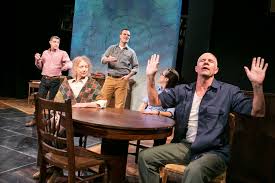
Tony Kushner’s The Intelligent Homosexual’s Guide... at Theater J

Tony Kushner’s The Intelligent Homosexual’s Guide… at Theater J

At the conclusion of Friday’s evening’s performance at Theater J, the following statement from playwright Tony Kushner was shared with the audience, read by members of the company of Kushner’s The Intelligent Homosexual’s Guide to Capitalism and Socialism with a Key to the Scriptures, Theater J’s current production:

We know it’s been a long evening of theater, but we’d like to take one more moment of your time. We wouldn’t be standing here tonight without the hard work and fierce dedication of our friend and colleague, the artistic director of Theater J, Ari Roth. Yesterday, Ari was fired by the CEO of the Washington, D.C. Jewish Community Center in consultation with the Executive Committee of the Board of Trustees of this center. This decision is of grave concern to theater artists and audiences alike. Ari wasn’t fired, as the executive committee has claimed, because of ‘insubordination.’ That is a preposterous and cowardly whitewashing of the truth. Ari was fired because he believes that a theater company with a mission to explore Jewish themes and issues cannot acquiesce to demands for an uncritical acceptance of the positions of the Israeli government regarding the Palestinian-Israeli conflict, or to an insistence on silence. Ari was fired because he refused to surrender to censorship; he was fired because he believes that freedom of speech and freedom of expression are both American values and Jewish values. “The Intelligent Homosexual’s Guide” has 3 more performances. We can’t continue without expressing our shock and dismay at this violation of principles we cherish. Theater artists and administrators across the country are already speaking out in protest. We join them, and we hope you’ll join us. We call on the full Board of the DCJCC to renounce the action its executive committee has taken, and by renouncing it, demonstrate its support for theater that engages with contemporary reality in all its complexity, free of the fear of censors. Thanks for listening, thanks for being a great audience, and Ari, thanks for everything–shabat shalom, Godspeed, and good night.

https://www.youtube.com/watch?v=BqTCWWaH7r0

In a New York Times Magazine article, “Can Liberal Zionists Count On Hillary Clinton?” published on Sunday, December 21, 2014 and wholly unrelated to the firing of Ari Roth at Theater J, one paragraph struck me as particularly apt to the themes and reality surrounding the theater and its place in discourse about Israel and the Middle East, echoing the observations of others:

“In many segments of American Jewry,” Zemel said, “one is free to disagree with the president of the United States, but the prime minister of Israel is sacrosanct. How patently absurd!” Zemel’s criticism of the current Israeli government pivoted to a discussion of how the Holocaust and that summer’s flare-ups of anti-Semitism in Europe reminded them all that Israel was existentially necessary. “We must love Israel even harder,” he concluded, quoting from the Israeli national anthem. “Od lo avda tikvateinu. We have not yet lost our hope.”

From “An Interview With Former Theater J Artistic Director Ari Roth” on HowlRound.com, December 21, 2014:

If you look around the country, how many plays are there on an annual basis that touch on the Middle East conflict? And then you think it’s such a rich source of drama and there are so many talented people writing about it, why aren’t they touching this subject? I don’t think they should use my example as a cautionary tale, they should use my example as a reason to do more of it. I shouldn’t be one of the only TCG theater artists engaged in this issue. It’s inexplicable to me that we don’t have a dozen other theater companies engaging in this theater subject. It isn’t the third rail, it isn’t that volatile or lethal. There’s not that much paranoid Jewish money that is so concerned about this issue being voiced. I think artists ask themselves how much do they know, how much more could they learn about the conflict and what’s my responsibility to reflect that on our stage? A lot of people could be doing this work and should be.

Via Twitter, a final observation from The Washington Post’s Peter Marks:
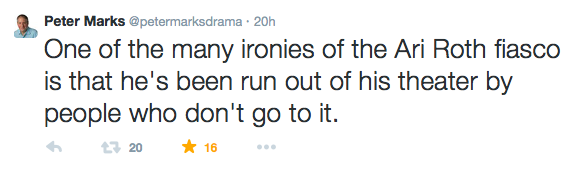
Peter Marks twitter

*   *   *

Update, December 22, 2014, 1 pm: The artistic directors of a broad cross-section of U.S. theatres have sent a letter regarding Ari Roth’s firing to the Board of Directors of the Washington Jewish Community Center. It reads:

We, the undersigned Artistic Directors, are outraged by the action of the JCC in Washington DC in summarily dismissing the long-serving Artistic Director of Theater J, Ari Roth, on the morning of December 18.

The stated cause was ‘insubordination’, and it is absolutely clear that Roth was fired because of the content of the work he has so thoughtfully and ably championed for the last two decades.

Ari Roth is a capable, brilliant and inspiring leader of the American non-profit theater. The actions of the JCC, in terminating him for blatantly political reasons, violate the principles of artistic freedom and free expression that have been at the heart of the non-profit theater movement for over half a century. Such actions undermine the freedom of us all.

A free people need a free art; debate, dissent, and conflict are at the heart of what makes theater work, and what makes democracy possible. We deplore the actions of the JCC, offer our complete support for Ari Roth, urge the American theater community to protest these events in all possible ways, and call upon the full Board of the JCC to renounce this action of the Executive Committee of the JCC.

Update, December 28, 2014 11 am:

From “D.C. Jewish Community Center head details ‘insubordination’ of Ari Roth” by Peter Marks in The Washington Post, December 26, 2014:

The battle over the firing of Theater J artistic director Ari Roth took another bitter turn this week, with the circulation of remarks by his boss at the D.C. Jewish Community Center, Carole R. Zawatsky, accusing him of “a pattern of insubordination, unprofessionalism and actions that no employer would ever sanction.”

That pattern, Zawatsky charged in a letter sent by e-mail Wednesday to “Members of the Israel arts community,” included an attempt “to force the DCJCC to give up Theater J to his sole control.” She added that after that failed to occur, “he had begun to work on a new venture, while still employed by DCJCC,” and that “despite clear and written warnings” he “continued to disregard direction” from his superiors.

“Ari Roth,” she contended, “was not fired because of his politics or because of outside pressure.”

From “The Facts on the Ground at Theater J” by Isaac Butler in American Theatre magazine, December 28, 2014:

In their own ways, both Zawatsky and Roth’s versions of the story identify the same problems: an untenable relationship between the theatre and the center, mirrored or manifested by their own untenable relationship; a document outlining possible ways those relationships could change; and Roth’s future plans for a new company and decision to leave. But both use these points of evidence for radically different, somewhat incompatible interpretations of the last few years.

And if you assume the politics of Israel-related programming was the cause of Roth’s firing, a few additional ironies seep into the story. For one, Roth is hardly a radical leftist on Israeli politics: He is instead a mainstream, left-of-center, two-state-solution-supporting moderate. He has said, both in his interview with HowlRound and with me, that he willingly embraced the DCJCC’s “red line” about work that promotes BDS (Boycott, Divestment and Sanctions, a movement that tries to use economic and cultural pressure to end Israeli occupation of Palestinian land).

What’s more, the work that actually landed him in hot water in the first place was a staged examination of whether or not a play by the greatest living English-language playwright was anti-Semitic—and then two plays by Israeli Jews attempting to reconcile with the events surrounding their nation’s founding.

But the past is prologue. Leaving aside the trail of events that brought Roth, Zawatsky, Theater J and the DCJCC to this impasse, the question is: What now?

*   *   *

I will continue to add to and amend this post if I discover thoughtful and pertinent information I believe to be constructive to the narrative and the issues.
 

Falling For “Almost, Maine” in North Carolina in January

December 19th, 2014 § 0 comments § permalink

Almost, Maine in North CarolinaMany of you already know the story of the Maiden High School production of John Cariani’s Almost, Maine, shuttered by school officials this fall due to the content of a single scene in which two men discover that they love one another. The cancellation rightly got a great deal of attention, not least because Almost, Maine is the most popular new play done in high schools nationally, a widely accepted work that hit a wall in one North Carolina town due to the school administration caving in to their own worst instincts and to outside pressure, even though the source of the pressure managed to remain under the radar.

So in the season of love and good cheer, it seems the optimal time to affirm that Almost, Maine will go on next month, with students taking the show off campus, producing it independently in a nearby town with the help of Carmen Eckard, a former teacher who taught a number of the students when they were in elementary school.

Hosted by the United Arts Council of Catawba County, Almost, Maine will be presented at the SALT Block Auditorium in Hickory NC on January 15, 16 and 17 at 8 pm. While there have been some shifts in the cast, the production will feature seven current Maiden High students, two recent graduates and a Maiden High student as stage manager. Conner Baker, the student who was directing the show at the school has joined the cast, so she’ll be co-directing the show with a local attorney, William Morgan, who previously directed the show at an area community theatre.

Many familiar with this story will also recall that in order to produce the show independently, Eckard and Baker launched a Kickstarter campaign that sought to raise $1,000 to cover expenses. That effort yielded over $6,500 in funds, and with program ad sales, the production is sure to bring in yet more revenue by mid-January. In a bright silver lining to the cloud cast by the school’s censorship, the bulk of the donations to the production will be shared by the Arts Council and OutRight Youth Catawba, which seeks, in their words, “to reduce the isolation felt by LGBTQ youth by providing a sense of community and developing programs and services to counteract the prejudice and oppression that LGBTQ youth often face.”

Both tickets and program ads are available from the production’s website: http://almostmaiden.com

As for a fall show at the high school, I’m told there was no replacement once Almost, Maine was nixed. That’s a loss for every student at the school and a black eye for every administrator, school board member and community member who worked to shut down Almost, Maine. I can only hope they’ll all make the short trip from Maiden to Hickory to support the show and the students who kept it going – and to, in part, counteract a narrow-minded decision that gave in to suppression of young people’s ambitions and lives, rather than standing for love.


It’s Only A Movie, Until It’s More

December 18th, 2014 § 0 comments § permalink

the interview posterAs the Sony hacking case has played out over the past several weeks, it’s a story that has been relegated mostly to the business pages and, simultaneously, the gossip industry. With no one explicitly claiming responsibility for the breach of the entertainment giant’s computer system, the focus has been more on the corporate ramifications, placing it in business reports, and the stream of buzzworthy stories including the e-mails between Amy Pascal and Scott Rudin and the pontifications of Aaron Sorkin have been fodder for everyone from The New York Times to Entertainment Tonight. That the personal records of Sony employees past and present, including medical files, had been taken and released publicly didn’t seem to figure into the narrative in a significant way; it was just one more data hack (e.g. Target) that only hit home if it had happened to you now or in the past.

Of course, things escalated this week when a direct threat was made against theatres showing the Seth Rogen- James Franco film The Interview. The air of genuine concern rose yet higher when the U.S. government asserted that the hack had been engineered by North Korea in retaliation for The Interview’s depiction of an ultimately successful plot on the life of their dictatorial leader Kim Jong-un.

team america kim jong il

“Kim Jong-il” in Team America: World Police

Yet if my social media feeds are any indication, the vast majority of people, even this morning, find the whole situation slightly ridiculous and still worthy of snark. In the wake of theatre chains, and finally Sony, pulling The Interview from exhibition, the prevailing response seems to be inordinate attention to the Alamo Drafthouse’s (in Dallas/Fort Worth) decision to screen Team America: World Police, which a decade ago rendered Kim Jong-il as a literal puppet dictator, as well as jokes about Rogen’s affinity for smoking marijuana leading to an international crisis and this really being the fault of NBC for canceling Freaks and Geeks.

Kevin Smith in Live Free or Die Hard

Kevin Smith in Live Free or Die Hard

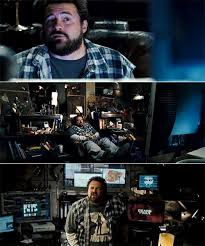
I’ll admit to having paid minimal attention to the hack story until the combination of the threat against theatres and theatre patrons, the yanking of the film and the U.S. pointing its finger towards North Korea reached a critical mass for me. Like many, I’ve probably been lulled by too many years of watching action and espionage films in which there is always some megalomaniac trying to get rich or conquer the world, be it Dr. No or Dr. Evil. As for hacking, it’s always been made to seem a bit romantic and alluring (Sandra Bullock in The Net, Angelina Jolie in Hackers) or all-powerful yet benign (Kevin Smith in his mother’s basement in one of the later Die Hard films).

But now we’ve moved from the world of fictional espionage into a real life amalgamation of terrorism and blackmail. Yes, as many have pointed out, it’s questionable whether North Korea or any malefactor could carry out coordinated attacks in movie theatres across the country. But it would take only one such incident to genuinely terrorize the country, with social and economic ripples far greater than those felt after the movie theatre shooting in Aurora, Colorado. Frankly, even if the perpetrator of the Sony hack was just bluffing, who’s to say that some copycat might not take the opportunity into their own hands in just one community? The very threat of terrorism is what has lifted the scenario into a much more troubling realm, and even if the ransom to be paid was the suppression of one film instead of one billion dollars, the result is that it worked, and set an awful precedent.

Any number of commentators, professional and amateur, have been quick to say that Sony “caved,” that they allowed the perpetrator of the threat to win, but that’s a simplistic response. Already faced with a massive economic hit from the data release, which will most likely continue, could the company risk being seen as insensitive to the threat, could it have taken the risk that there was no real danger? They’ve been in a no-win situation for weeks now, and no matter what choice they had made, it would have been seen as wrong. I’m not an apologist for their decision, but I can at least see them as having been given the proverbial Sophie’s choice.

I deplore what has taken place, which is a form of censorship by blackmail. Instead of providing a ransom to get something back, Sony has had to withhold something to, hopefully, eliminate any possibility of a violent reprisal. Their data is out of their control, never to be reined back in. And our constitutional right to freedom of speech has been infringed upon by some outside entity, even if it was Sony who made the decision to shelve The Interview.

The Death of Klinghoffer at The Metropolitan Opera

The Death of Klinghoffer at The Metropolitan Opera

Watching a big corporation being hamstrung may seem pretty distant from the world of live performance, but it’s really not. The rhetoric surrounding the Metropolitan Opera’s production of The Death of Klinghoffer this fall, due to its supposedly anti-Semitic content, was marked with significant vitriol which never quite reached the level of threat, but still prompted major security measures to be put into place. Those with short memories may have already forgotten the threats against Terrence McNally’s Corpus Christi, which forced Manhattan Theatre Club to implement a range of protections from those who decried it as sacrilegious. No one found those scenarios funny, and even if protections were being taken against individuals and groups, rather than a government, even if each played in one theatre instead of 2,000, the parallels are there.

kim jong un and dennis rodman

Kim Jong-un and Dennis Rodman

As of this morning, our government is reportedly weighing its choices on how to address the North Korean actions, even as some are suggesting that it isn’t North Korea at all, or if it is, it’s North Korea in alliance with other people or governments. There are hawks already taking verbal flight to cry out for retaliation, but its worth noting that while Sony is a Japanese corporation, Japan may be more cautious than we are, since North Korea regularly fires test missiles across their airspace, and who knows what their leader might do if provoked. We may find his flirtations with Dennis Rodman hilarious, but this is a country that has been ruled with a vicious iron hand for decades, a country where citizens have virtually no rights or freedom.

The era of digital warfare has sprung into full view with the Sony hack and The Interview’s suppression. No matter who’s behind it, it has proven that through the control of computers and information, not only with armaments, free will and basic rights can be bent all too quickly. While the hack is real, perhaps the threat is an elaborate hoax. Of the latter, we may never know with 100% certainty. But the question now is how does America guarantee its right to free speech against opponents both domestic and foreign, even when that speech is as inconsequential as I imagine The Interview to be.

Update, December 18, 3:30 p.m.: for those who saw Alamo Drafthouse’s plan to screen Team America in place of The Interview as a stand against censorship, I’m afraid you’re out of luck. Paramount has withdrawn that film from release as well, despite the fact that it’s a decade old. This is how the slippery slope carries us all downhill.


Nailing The Broadway Bolter To Her Seat

December 9th, 2014 § 2 comments § permalink

Wall STreet Journal headlineIn a week when flaws in Rolling Stone’s reporting of a culture of rape on the University of Virginia campus created national headlines, the lapses of a single cultural reporter at the Wall Street Journal doesn’t seem to amount to a hill of beans. But it’s a story that is much buzzed about in theatrical circles, and perhaps throughout the field of the arts, with implications much greater than Joanne Kaufman’s self-appointed role as a serial “Broadway bolter,” who has accepted who knows how many complimentary tickets only to depart frequently at intermission.

In a column last week, Kaufman declared:

I’m embarrassed by how unembarrassed I am to admit that the very next night, I took early leave of “The Country House,” and the following night of “It’s Only a Play.” If only. Don’t ask me what happened during the second acts of “Matilda,” “Kinky Boots,” “Pippin” and, reaching back a few seasons, “Boeing-Boeing” and “Billy Elliott. ” Really, I have no idea. But I am nothing if not cosmopolitan in my tastes, or distastes—French farces, English musicals set in gritty industrial cities, and American entertainments involving Charlemagne ’s Frankish kin.

I happen to believe that, for the regular theatregoer, there’s nothing wrong with leaving a show at intermission. You paid for the right to be there and if you’re miserable, it’s probably to your benefit and the benefit of the rest of the audience if you depart. It’s your right (so long as it’s not done mid-scene, which is far too disruptive) and frankly the rest of the audience and the actors are probably better off without your repeated loud sighs, your ongoing dialogue with the person you came with, or your snoring.

But anyone who is attending in a professional capacity, let alone someone with complimentary tickets, has to stick it out – because it’s their job, or simply good manners as a guest. If not, the tickets have been accepted under false pretenses and the individual’s credibility is damaged, if not destroyed.

O & M blog headlineNow it’s important to note that in my circles, both personal and online, there seems to be little sympathy or tolerance for Kaufman’s recurring disappearing act. Other journalists have shot verbal arrows at her on Twitter, as have theatre professionals from every discipline in the field. She has been the subject of nothing less than ongoing ridicule, and she’s likely to be a longtime theatre punchline. Publicist Rick Miramontez (a friend and professional colleague) has had a blog post in which he calls out Kaufman go viral, in part because he lays bare her failings and also because many assume that p.r. people will kowtow to the media at all costs.

Miramontez wrote, as part of declaring that he would no longer invite Kaufman or provide her with complimentary tickets:

I couldn’t help but feel a bit like a chump for having accommodated the woman so many times over the years.  Certainly every audience member, paid or comped, has the right to form whatever opinions they might about any production they see, but I don’t think it’s too much to expect those who attend on press tickets stay for the duration.   Would a fine art writer only peer at half a canvas before deciding she’s bored and it’s time to move on?  Does a music reporter think he can make an informed decision on an album if he only listens to a couple of tracks?  Why would we accept such sheer laziness from our theatrical press?

Since others have effectively demolished Kaufman’s questionable professional ethics, I need not rehash them further. But let me go a step beyond.

Unlike bloggers with their own sites (say for example, me), journalists don’t simply write something and have it magically appear in print or online. There’s at least one editor and a copy editor who has seen the piece, and at a paper like the Wall Street Journal, probably more. So it’s important to note that Kaufman was not writing in a vacuum, but rather with the tacit approval of every staffer at the WSJ who got a glimpse of her piece. It’s more than a bit worrisome that no one at the paper apparently saw anything wrong with either Kaufman’s actions or her almost gleeful confession of her ethical gaffes. Frankly, why did this piece run at all?

While her piece was opinion rather than reportage, surely average readers may now wonder about the veracity of other WSJ writing – and that’s a shame, because I know many arts reporters at the paper and know them to operate with the highest integrity and profound respect for the arts. While I haven’t asked him, I can’t help but think that Kaufman’s actions are particularly galling to the WSJ’s drama critic Terry Teachout, especially as many accounts of the “Broadway bolter” incorrectly identified her as the WSJ’s theatre critic.

Should it be up to publicists to put Kaufman on the straight and narrow? Even if she does start paying for tickets, will her bosses only permit her to attend with a minder? Will she become a culture writer only on works of 90 minutes or less, since that’s all she can tolerate? Perhaps she’ll need an ankle bracelet so they can be certain that she stays for the duration.

In a moment of sympathy, I’m willing to suggest that perhaps Kaufman, and her editors, fell prey to aping the lingua franca of the internet: snark (see prior paragraph as an example). Maybe the flip, contrarian tone was an effort to mimic the style of bloggers and tweeters. But in the august, conservative WSJ, it stuck out like a sore thumb – and while it may well have tapped into a new audience, it did so only to be met by significant derision. It seems that, for all of the angst surrounding critical arts coverage in general, Kaufman had truly crossed a bridge too far by slamming work she hadn’t even bothered to assess in full. If anything, she proved that there is still a place and desire for arts journalism, but that she may have no place in it.

Guardian headlineOn the same subway ride during which I read Kaufman’s piece, I also read an essay by Tim Walker, who has recently been let go from his position as theatre critic for London’s Sunday Telegraph. Understandably troubled by the ongoing culling of arts critics in London (an issue in the U.S. as well, and a concern I share), he cites a conversation about criticism he recently had:

One leading impresario told me he looked around at the motley crowd that had turned up to sit in judgment on one of his productions and he realised he didn’t know a single one of them. “They were young, spotty, out of their comfort zones and clearly exhausted, having been diverted at the last minute from other tasks at their hard-pressed media organisations,” he lamented. “Honestly, after all the work we had put in on our side, and all the investment, it felt like a slap in the face.”

The conventional wisdom is that readers of theatre reviews are migrating – along with the advertising – to online, but who, honestly, can name an internet critic who has the authority of, say, the Guardian’s Michael Billington? Or – until he also joined the exodus – the Telegraph’s Charles Spencer?

While he has given himself the cover of quoting someone else, Walker seems to side with his unnamed commentator. He also mimics someone in a vastly more significant situation, namely the prosecutor in the Michael Brown case, who repeatedly spoke of the failings of social media before revealing the wholly inadequate results of the grand jury findings. Two decades after the advent of general internet use, nearly a decade after the advent of social media, one can no longer make the case for journalism, or any endeavor, by slamming the reality of how we communicate now and continuing to proclaim the superiority of the “mainstream media.” Walker’s legitimate concerns about the state of arts criticism are undone by condescension, just as Kaufman skewered herself with her own glee over her risable actions.

Arts journalism is no different from any other facet of journalism today in that many of the old structures are falling and the future is evolving at an exceptionally fast pace, chewing up both practices and people in the process. But the bottom line is that if you find the rug pulled out from under you, it won’t serve the field to have you bemoaning the new and ever-changing normal; if you still have a platform, use it to imagine a better, sustainable future. And by all means, if you have a platform, use it professionally and ethically, lest you go out on a limb and saw it off behind yourself.


Paying A Legitimate Toll To Ease On Down The Road

December 3rd, 2014 § 11 comments § permalink

Not to dash anyone’s dreams, but I think it’s fair to say that the majority of the hundreds of thousands of students who participate in high school theatre annually will not go on to professional careers in the arts. The same holds true for the student musicians in orchestras, bands and ensembles. They all benefit from the experience in many ways: from the teamwork, the discipline and the appreciation of the challenge and hard work that goes into such endeavors, to name but a few attributes.

But for some students, those high school experiences may be the foundation of a career, of a life, and it’s an excellent place for skills and principles to be taught. As a result, I have, on multiple occasions, heard creative artists talk about their wish that students could learn about the basics of copyright, which can for writers, composers, designers, and others be the root of how they’ll be able to make a life in the creative arts, how their work will reach audiences, how they’ll actually earn a living.

I’m not suggesting that everyone get schooled in the intricacies of copyright law, but that as part of the process of creating and performing shows, students should come to understand that there is a value in the words they speak and the songs they sing, a concept that’s increasingly frayed in an era of file sharing, sampling, streaming and downloading. Creative artists try to make this case publicly from time to time, whether it’s Taylor Swift pulling her music from Spotify over the service’s allegedly substandard rate of compensation to artists or Jason Robert Brown trying to explain why copying and sharing his sheet music is tantamount to theft of his work. But without an appreciation for what copyright protects and supports, it’s difficult for the average young person to understand what this might one day mean to them, or to the people who create work that they love.

*   *   *

The Wiz at Skyline High SchoolAll of this brings me to a seemingly insignificant example, that of a production of the musical The Wiz at Skyline High School in Oakland, California back in 2011. Like countless schools, Skyline mounted a classic musical for their students’ education and enjoyment, in this case playing eight performances in their 900 seat auditorium, charging $10 a head. These facts might be wholly unremarkable, except for one salient point: the school didn’t pay for the rights to perform the show.

The licensing house Samuel French only learned this year about the production, and consequently went about the process of collecting their standard royalty. Over the course of a few months, French staff corresponded with school staff and volunteers connected with the drama program, administration and ultimately the school system’s attorney. French’s executive director Bruce Lazarus shared the complete correspondence with me, given my interest in authors’ rights and in school theatre.

The Wiz Broadway posterI’m very sympathetic to any school that wants to give their students a great arts experience, and so the drama advisor’s discussion in the correspondence of limited resources and constrained budgets really struck me. Oakland is a large district and Skyline is an inner-city school; I have no reason to doubt their concerns about the quoted royalty costs for The Wiz being beyond their means. But their solution to this quandary took them off course.

Skyline claims that they did their own “adaptation” of The Wiz, securing music online and assembling their own text, under the belief that this released them from any responsibility to the authors and the licensing house. While they tagged their ads for the show with the word “adaptation,” it’s a footnote, and if one looks at available photos or videos from the production, it seems pretty clear that their Wiz is firmly rooted in the original material, even the original Broadway production. Surely the text was a corruption of the original and perhaps songs were reordered or even eliminated. It’s also worth noting that Skyline initially inquired about the rights, but then opted to do the show without an agreement.

*   *   *

OK, so one school made a mistake over three and a half years ago – what’s the big deal? That brings me to the position taken by the Oakland Unified School District regarding French’s pursuit of appropriate royalties. OUSD has completely denied that French has any legitimate claim per their attorney, Michael L. Smith. In a mid-October letter, Mr. Smith cites copyright law statute of limitations, saying that since it has been more than three years since the alleged copyright violation, French is “time barred from any legal proceeding.” Explication of that position constitutes the majority of the letter, save for a phrase in which Mr. Smith states, “As you are likely aware, there are limitations on exclusive rights that may apply in this instance, including fair use.”

As I’m no attorney, I can’t research or debate the fine points of statutes of limitation, either under federal or California law. However, I’ve read enough to understand that there’s some disagreement within the courts, as to when the three-year clock begins on a copyright violation. It may be from the date of the alleged infringement itself, in this case the date of the March and April 2011 performances, but it also may be from the date the infringement is discovered, which according to French was in September 2014. We’ll see how that plays out.

The passing allusion to fair use provisions is perhaps of greater interest in this case. Fair use provides for the utilization of copyrighted work under certain circumstances in certain ways. Per the U.S. Copyright office:

Copyright Law cites examples of activities that courts have regarded as fair use: “quotation of excerpts in a review or criticism for purposes of illustration or comment; quotation of short passages in a scholarly or technical work, for illustration or clarification of the author’s observations; use in a parody of some of the content of the work parodied; summary of an address or article, with brief quotations, in a news report; reproduction by a library of a portion of a work to replace part of a damaged copy; reproduction by a teacher or student of a small part of a work to illustrate a lesson; reproduction of a work in legislative or judicial proceedings or reports; incidental and fortuitous reproduction, in a newsreel or broadcast, of a work located in the scene of an event being reported.”

*   *   *

Rather than parsing the claims and counterclaims between Samuel French and the school district, I consulted an attorney about fair use, though in the abstract, not with the specifics of the show or school involved. I turned to M. Graham Coleman, a partner at the firm of Davis Wright Tremaine in their New York office. Coleman works in all legal aspects of live theatre production and counsels clients on all aspects of copyright and creative law. He has also represented me on some small matters.

“In our internet society, “ said Coleman, “there is a distortion of fair use. We live in a world where it’s so easy to use someone’s proprietary material. The fact that you based work on something else doesn’t get you off the hook with the original owner.”

Without knowing the specifics of Skyline’s The Wiz, Coleman said, “They probably edited, they probably varied it, but they probably didn’t move it into fair use. Taking a protectable work and attempting to ‘fair use’ it is not an exercise for the amateur.”

Regarding the language in fair use rules that cite educational purposes, Coleman said, “Regardless of who you are, once you start charging an audience admission, you’re a commercial enterprise. Educational use would be deemed to mean classroom.”

While Coleman noted that the cost of pursuing each and every copyright violation by schools might be cost prohibitive for the rights owners, he said that, “It becomes a matter of principle and cost-effectiveness goes out the window. They will be policed. Avoiding doing it the bona fide way will catch up with you.”

*   *   *

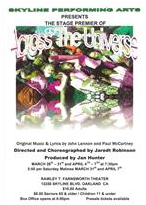
Across The Universe at Skyline High SchoolThat’s where the Skyline scenario gets more complicated – because their “adaptation” of The Wiz wasn’t their only such appropriation of copyrighted material. In 2012, the school produced a stage version of Julie Taymor’s Beatles-inspired film Across The Universe, billing it accordingly and crediting John Lennon and Paul McCartney as the songwriters. The problem is, there is no authorized stage adaptation of the film, although there have been intermittent reports that Taymor is contemplating her own, which her attorney affirmed to me. In this case, the Skyline production is still within the statute of limitations for a copyright claim.

across the universe movie posterI attempted to contact both the principal of Skyline High and the superintendent of the school district about this subject, ultimately reaching the district’s director of communications Troy Flint. In response to my questions about The Wiz, Flint said, “We believe that we were within our rights. I can’t go into detail because I’m not prepared to discuss our legal strategy. We believe this use was permissible.”

He couldn’t speak to Across The Universe; it seemed that I may have been the first to bring it to the district’s attention. Flint said he didn’t know whether other Skyline productions, such as Hairspray and Dreamgirls, had been done with licenses from rights companies, although I was able to confirm independently that Hairspray was properly licensed. Which raises the question of why standard protocol for licensing productions was followed with some shows and not others.

*   *   *

My fundamental interest is in seeing vital and successful academic theatre. So while their identities are easily accessible, I’ve avoided naming the teacher, principal and even the superintendent at Skyline because I don’t want to make this one example personal. But I do want to make it an example.

Whether or not I, or anyone, personally agree with the provisions of U.S. copyright law isn’t pertinent to this discussion, and neither is ignorance of the law. The fact is that the people who create work (and their heirs and estates) have the right to control and benefit from that work during the copyright term. Whether the content is found in a published script and score, shared on the internet or transcribed from other media, the laws hold.

If the Skyline examples were the sole violations, a general caution would be unnecessary, but in the past three months alone, Samuel French has discovered 35 unlicensed/unauthorized productions at schools and amateur companies, according to the company’s director of licensing compliance Lori Thimsen. Multiply that out over other rights houses, and over time, and the number is significant. This even happens at the professional level.

At the start, I suggested that students should know the basic of copyright law, both out of respect for those who might make their careers as creative artists, as well as for those who will almost certainly be consumers of copyrighted content throughout their lives. But it occurs to me that these lessons are appropriate for their teachers as well, notwithstanding the current legal stance at Skyline High. There can and should be appreciation for creators’ achievements as well as their rights, and appropriate payment for the use of their work – and those who regularly work with that material should make absolutely certain they know the parameters, to avoid and prevent unwitting, and certainly intentional, violations.

*   *   *

One final note: some of you may remember Tom Hanks’s Oscar acceptance speech for the film Philadelphia, when he paid tribute to his high school drama teacher for playing a role in his path to success. It might interest you to know that Hanks attended Skyline High and thanks in part to a significant gift from him, the school’s theatre – where the shows in question were performed – was renovated and renamed for that teacher, Rawley Farnsworth, in 2002. Hanks also used the occasion of the Oscars to cite Farnsworth and a high school classmate as examples of gay men who were so instrumental in his personal growth.

I have no doubt that there are other such inspirational teachers and students at Skyline High today, perhaps working in the arts there under constrained budgets and resources. Yet regardless of statutes of limitations, it seems that the Rawley T. Farnsworth Theatre should be a place where respect for and responsibility to artists is taught and practiced, as a fundamental principle – and where students get to perform works as their creators intended, not as knockoffs designed to save money.

*   *   *

Update, December 3, 2014, 4 pm: This post went live at at approximately 10:30 am EST this morning. I received an e-mail from OUSD’s director of communications Troy Flint at approximately 1 pm asking whether the post was finished and whether he could add to his comments from yesterday. I indicated that the post was live and provided a link, saying that I have updated posts before and would consider an addendum with anything I found to be pertinent. He just called to provide the following statement, which I reproduce in its entirety.

Whatever the legality of the situation at Skyline regarding The Wiz and Across The Universe, the fundamental principle is that we want the students to respect artists’ work and what they put into the product. My understanding is that Skyline’s use of this material is legally defensible, but that’s not the best or highest standard.

As we help our students develop artistically, we want to make sure they have the proper respect and understanding of the work that’s involved with creating a play for the stage or the cinema. So we have spoken with the instructors at Skyline about making sure they follow all the protocols regarding rights and licensing, because we don’t want to be in a position of having the legality of one of our productions questioned as they are now and we don’t want to be perceived as taking advantage of artists unintentionally as we are now. It’s not just a legal issue but an issue of educating students properly.

While everyone I have spoken with about this issue disagrees fairly strenuously with the opinion of the OUSD legal counsel, it’s encouraging that the district wants to stand for artists’ rights and avoid this sort of conflict going forward. I hope they will ultimately teach not only the principle, but the law. As for past practice, I leave that to the lawyers.

Update, December 3, 2014, 7 pm: Following my update with the statement from the school district, I received a statement of response from Bruce Lazarus, executive director of Samuel French. It is excerpted here.

By withholding the proper royalty for The Wiz from the authors, the OUSD is communicating to their students that artistic work is worthless. Is this an appropriate message for any budding artist? That you too can grow up to write a successful musical…only to then have a school district destroy your work and willfully withhold payment?

It needs to be made clear to the OUSD and the students involved that an artist’s livelihood depends on receiving payment for their creative work. This is how artists make a living. How they pay the rent and feed their families. It is simply unbelievable that this issue can be tossed aside with an “Our bad, won’t happen again” response without consideration of payment for their unauthorized taking of another’s property.

Are other students of the OUSD, those that are not artists, being educated to expect payment for their services rendered when they presumably become doctors, engineers, entrepreneurs and the next leaders of the Bay Area? Of course they are. And so it goes for the artists in your classrooms, who should be able to grow up KNOWING there is protection for their future work and a real living wage to be made.

Equal time granted, I leave it the respective parties to resolve the issue of what has already taken place.


Reversing Course On “Legally Blonde” Censorship At Newman University

November 25th, 2014 § 3 comments § permalink

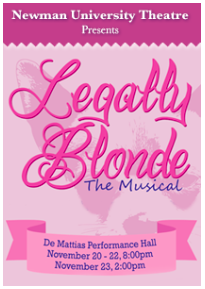
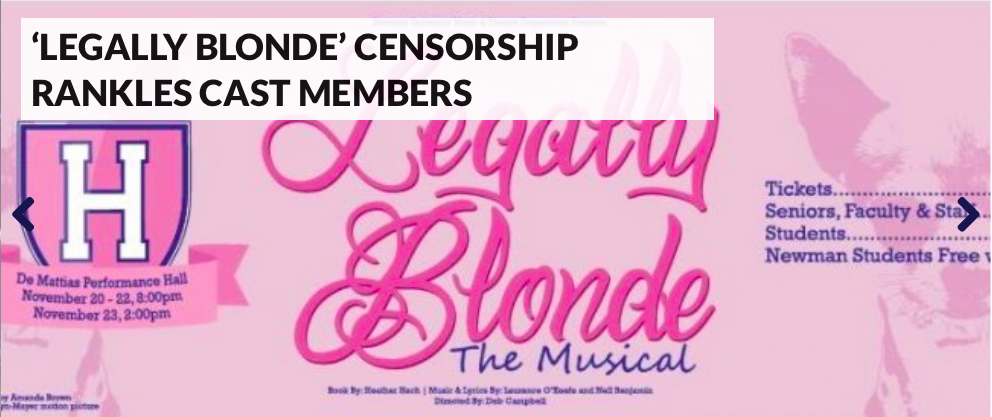
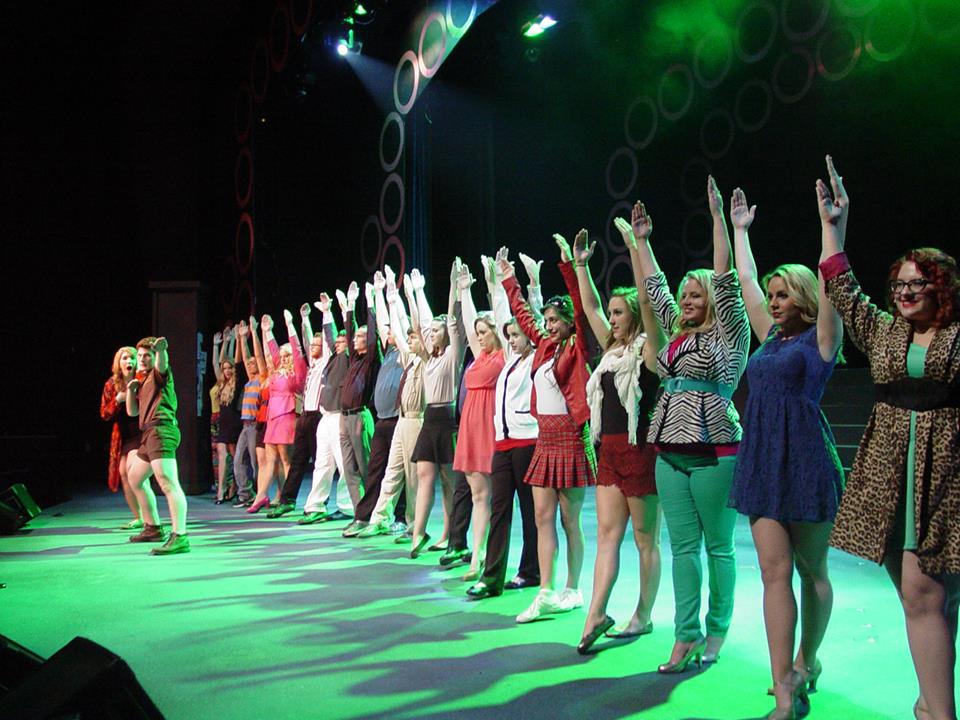
Legally Blonde at Newman UniversityTo say that Newman University’s production of the musical Legally Blonde was performed with its book and lyrics intact this past Saturday and Sunday would seem to be a wholly unremarkable event. But because that wasn’t the case at Thursday and Friday’s shows, the fidelity of the latter two performances is rather more intriguing. How did a university production suddenly shift away from censorship halfway through a four performance run? How, to paraphrase a lyric from The Producers, did Legally Blonde go right?

*   *   *

Newman University in Wichita, Kansas is a Catholic school with an undergraduate enrollment of 2,795, according to data from the U.S. News and World Report online rankings. It was founded by a religious order, the Adorers of the Blood of Christ as a women’s college in 1933, becoming co-ed in 1965.

The theater program at Newman is in just its fourth year. It was only in 2013 that students could declare as theatre majors, and the program currently has 18 majors and 12 minors. The school boasts two theatres and the theatre program produces four shows each year. Past productions include Lend Me A Tenor, Iphigenia in Aulis and in Taurus, Measure For Measure, and this fall’s Buried Child. Director of Theatre Mark Manette notes that there have been some rumblings about the content of some of the department’s productions in the past, including sexual content in Tenor and Pippin, citing one 2012 letter to the school newspaper saying that the school was producing plays with “a heaping helping of sexual innuendo.”

In announcing Legally Blonde, Manette felt he was choosing a mainstream, modern show for his students, aware that it is one of the most popular musicals in high school theatre. Save for making some very minor script emendations – “god damn” is a problem at a faith-based university, for example – the show went into rehearsals using the script as written. In the words of senior C.L. Smet, a theatre major who was cast as Paulette, “There were very light hints of censorship early on, but only the type of things that we are used to. In most shows we are asked to take out all instances of using the lord’s name in vain because we go to a Catholic university.”

*   *   *

Manette’s purview over the theatre department does not require him to submit his play selection for approval to the university. But with rehearsals underway, he was called to the Provost’s office on November 6, in order to address rumors that had begun to swirl about the content of Legally Blonde.

“When I was called into the office I was told that our production featured live masturbation, drug use, and two guys kissing,” said Manette. “My response was that the show features none of these things. But the seed of the rumors could be traced to the two changed lines:  ‘Masturbatory emissions’ and ‘Get you high and laid’.”

Although Manette clarified the show’s content, he was still asked to make changes to the script. “I was told that I had to make the changes or else,” said Manette. “I did send a letter to the Provost stating that I had signed a contract not to make any changes to the script. He took that up the ladder, so to speak, and told me to go forward with making changes.”

C.L. Smet and Trevor Farney in Legally Blone at Newman University

C.L. Smet and Trevor Farney in Legally Blonde at Newman University (Photo courtesy of Newman University)

According to Smet, “Nothing seemed weird until a few days before tech week started, when individual cast members started being pulled aside and told that we had to change lines.  For instance, my line ‘What’s she got that you don’t got, three tits?’ had to be changed to ‘three boobs’ ­ this was a very minor change compared to many others but was still frustrating and unnecessary right before tech week.  We were told by our director, music director, and the head of our department that these changes were from the administration directly.  We were told that several higher-ups…were lodging complaints about the content.”

“We were also told repeatedly not to raise hell about the issue, because if we were to dig too deep we might cause more harm than good,” Smet related. “Obviously, however, we decided to pursue the matter. I was one of the loudest about my disappointment with the administration.  I attempted to have a meeting with the President of our college.  However, when I told them it was regarding Legally Blonde censorship, I was told she ‘didn’t speak to students,’ which I find very hard to believe.  Many other students were confused and bothered by the censorship.  A few of them were willing to just lay low and let it pass, but most of my fellow theatre majors saw the utter illegality of the changes and wanted to do something to help.  Apart from the legal issues, many students were just sad that at the college level we were expected to perform a watered-down play, as if the world would end if somebody say “masturbate” on stage.  It was a very frustrating and confusing time for everybody involved.”

*   *   *

Newman University’s The VantageOn the evening of the first performance, the school newspaper, The Vantage, published its weekly print edition with a lead story on the censorship of the Legally Blonde text. The story was assigned by the paper’s editor-in-chief, senior Matt Riedl – who happened to be a member of the Legally Blonde ensemble.

“It was my decision as editor-in-chief to pursue the story,” said Riedl. “It wasn’t something that was being brought out by the administration. We thought it was our responsibility. Every viewpoint can be voiced. There had been a few voices that had been pro-censorship, but we thought it was important that every viewpoint be represented.”

The story by Delaney Hiegert, ran with the headline “Legally Blonde Censorship Rankles Cast Members,” as well as a subheadline, “Illegally Changed?” It cited Provost Michael Austin confirming that the show would be a censored version.

There were at least six lyric changes to the musical, as well as multiple dialogue changes, in order to make the play more appropriate for all audiences, he said. The changes involved taking out any sexually derogatory remarks, references to sex and drugs, any use of the word “Christ,” and most all cursing.

For instance, Elle Woods’ line “masturbatory emissions” has been changed to “accidental emissions,” and Professor Callahan’s line, “Get you high and laid,” has been changed to “Get you entertained.”

“When we do plays, we are inviting not just the campus, but the community to come watch,” said Austin. “We have to be very careful to represent the values of the institution.”

The Vantage article spoke not only to the changes to Blonde, but the greater potential impact of the censorship on the theatre program. Quoting freshman Trevor Farney:

“I loved being a part of Buried Child. I love the directors and the people I’ve gotten to work with,” Farney said. “But I don’t want to act in something that’s just going to be a watered-down version of what it should be. In Legally Blonde, the censorship is annoying but it doesn’t hurt the production that much. But if the censorship continues, I don’t even know if I’d want to stay in the program. And that’s a shame.”

The Vantage story made the alteration of the Blonde script a campus-wide issue. Riedl cited that the piece received 1500 page views on the paper’s website, in contrast to the prior month’s top story, which had only 700. He noticed that in some places, in particular the theatre’s lobby, someone had flipped the papers upside down in their racks, so that the headline wouldn’t show. He said that his girlfriend reported sitting in the theatre pre-show and watched as many people read the paper’s front page.

“The article in the Vantage was huge,” said Smet. “It had a massive impact around campus and the entire Wichita theatre community.  The outpouring of support was awesome, and it encouraged the cast to continue fighting.”

*   *   *

Legally Blonde at Newman University

Legally Blonde at Newman University (Photo courtesy of Newman University)

The first two performances of Legally Blonde at Newman contained the mandated cuts and substitutions imposed by the administration. But C.L. Smet says that change was already afoot.

“Once the Vantage article was published, cast members became even more open about not being okay with the censorship,” Smet said. “For our Saturday performance we returned 100% to the written word of the script – we did the play that was actually written.  We joked that it was the first Legally Blonde performance we’d done, and after the show we all had a group bonding moment celebrating the uncensored show.”

Riedl described the decision in similar terms. “We decided to perform the musical in its full uncensored form on Saturday and Sunday,” he said. “It was kind of a group decision. We had a little meeting before our performance on Friday and we talked about it. The coverage was getting so widespread and everyone was talking about it so we decided we weren’t going to put up with it any longer. We were going to subvert the order to change.”

The student motivated changes don’t precisely jibe with the account from Provost Michael Austin.

“We ended up not making the changes,” said Dr. Austin. “They went on according to script. We looked at what might be possible but decided that we’d do it the way it was in the script.”

Austin did say that the issue was a major one for the school, saying it was “hotly debated and discussed.” He said that he attended the show on Sunday and that the show was performed as written, but could not speak to whether the complete text was in use at all performances.

Riedl professed surprise when informed that the administration had withdrawn its requests for text changes. “Really? That’s interesting,” he said. “Because I was under the impression it was a cast decision. There’s definitely some confusion there. I had not heard that. That’s very interesting.”

Riedl went on to recount a moment during the Saturday night show, during the song, “Blood in the Water.” “‘Get you high and get you laid’ was supposed to ‘get you entertained,’ he recounted. “From the stage, I heard someone whisper, ‘I thought that was supposed to be censored.’ It took some power to not break character from that.”

With somewhat conflicting stories about how the show was restored to its original text, Manette seemed to walk a careful line about what had taken place. He ascribed the choice to the students, noting that, “The people who had called for the censorship were not the ones behind the decision to do the show as written.”

*   *   *

Fahrenheit 451The issue of censorship is not an off-limits topic on the Newman University campus. It’s worth noting that all freshman this year were assigned to read Ray Bradbury’s Fahrenheit 451, the now classic novel in which censorship is taken to its ultimate extreme, with all books being sought out and burned by “fireman,” forcing lovers of knowledge into clandestine circles designed to preserve knowledge and texts.

“There is artwork all over the building regarding censorship related to that novel,” Manette said. “Most members of the faculty and audience were appalled at the idea of censoring a production.   Two pieces of art work across from the entrance of the theatre were mysteriously taken down on opening night – one was a nude – and they were miraculously replaced after the show closed.  Coincidental?”

Smet told a similar story. “There was a great deal of other censorship happening in our arts department — nude paintings and “controversial” art work were removed from the hallways against the art department’s will.  The entire fine arts sector of Newman was upset that they were being censored.  Many people told us they supported us ‘fighting the power’.”

*   *   *

It’s unclear precisely where the complaints about Legally Blonde began and it’s also not certain exactly when or if approval was given to perform the show as written, as it was at the latter two performances. Precisely who in the administration really wanted the show edited remains somewhat vague, and no one with direct knowledge would speak to it on the record. But certainly the students took matters into their own hands, perhaps with the tacit approval of some members of the school administration.

Dr. Austin was quite clear about lessons learned from the imbroglio.

“Generally, I can say that the incident was not handled well,” he wrote to me, “for which I take full responsibility. We will not be suggesting changes to plays in the future, nor do we have any plans to exercise prior restraint on plays chosen by the Theatre Department.”

Austin’s statement is very encouraging, suggesting that Mark Manette will be able to continue to build Newman University’s theatre department and give his students the opportunity to work on a wide range of shows – as they were written. For the staff of The Vantage, they’ve gotten proof of the power of independent journalism to foster change. As for the cast of Legally Blonde? They’ve demonstrated that the words spoken on a stage matter, and that the words of authors come first.

*   *   *

Note: interviews for this article were conducted through a combination of voice interviews and e-mail correspondence. The word “said” may apply to both voice and e-mail communications.


Cumberbatch vs. Jacobi: Breaking The Imitation Game Code

November 24th, 2014 § 4 comments § permalink

Benedict Cumberbatch in The Imitation Game

Benedict Cumberbatch in The Imitation Game

As prestige movies open pell-mell in the next few weeks, and Oscar campaigns already underway blaze into full public awareness, one of the contenders will surely be The Imitation Game, starring Benedict Cumberbatch and Keira Knightley. It tells the story of Alan Turing, the British mathematician who is widely credited with breaking the Nazi’s “Enigma” code and whose name is regularly invoked in discussions of artificial intelligence, specifically over how or whether we might one day create a machine whose thoughts are indistinguishable from those of a human.

Alan Turing

Alan Turing

As with any major film, especially one with Oscar hopes, there will be a near-avalanche of stories about the film: its director, its stars, its writer – and the man who inspired it. I don’t want to give much away for those unfamiliar with the tale, but Turing’s life truly encompassed World War II intrigue, intellectual triumph, reprehensible bias, persecution and injustice, and great tragedy. There’s going to be a cottage industry of stories on Turing – paeans, revisionist history, alternative views, and so on, right up through Oscar night.

For many, this may be their first encounter with the Turing story and they’ll be drawn in by the considerable glamour and talent of Cumberbatch and Knightley (I haven’t seen it yet, so I’m going solely on the advance word and promotion). There’s a cautionary part of the story that’s well worth being told many times over.

Breaking The Code

Broadway logo for Derek Jacobi in Breaking The Code

But for theatregoers with moderately long memories (I count myself among them), The Imitation Game will come as something less than a revelation historically, because the West End and Broadway beat the movies to the punch almost 30 years ago, with Derek Jacobi as Turing in Hugh Whitemore’s play Breaking The Code. Like The Imitation Game, it was based on Andrew Hodges’s book Alan Turing: The Enigma.

Breaking The Code played for six months in New York 1987-88, following on the heels of Jacobi’s triumphant performances in the Royal Shakespeare Company’s repertory of Cyrano de Bergerac and Much Ado About Nothing (both opposite Sinead Cusack); I was fortunate enough to have seen all three, and it cemented my deep admiration for Jacobi as one of the finest actors of his generation. As for the play, while I long believed that it was Jacobi who truly made the experience remarkable, and unrepeatable, I saw the show years later at the Berkshire Theatre Festival with Jamey Sheridan in the Turing role, and to my surprise I was once again fascinated and deeply moved.

Now of course vastly more people see most movies than see a play, but as Imitation Game launches, I was thrilled to discover that Jacobi’s performance has been preserved, in a 1996 BBC adaptation of the play by Hugh Whitemore, available online in its entirety.

https://www.youtube.com/watch?v=S23yie-779k

While it is an adaptation, not simply a film of the play, the TV version will give us a chance to see two portrayals of one man by two superb actors, refracted through the views of different writers and directors – and societal growth and change regarding LGBTQ life and rights – at an interval of 30 years.


The Irreconcilable Dissonance Between Cosby’s Comedy And His Alleged Crimes

November 20th, 2014 § 1 comment § permalink

To Russell, My Brother, Whom I Slept WithA couple of years ago, in conversation with a childhood friend on Facebook, we began recalling the hours spent in my basement listening to the early comedy records of Bill Cosby. Suddenly, a business associate from my adult life joined in, demanding to know how we could reminisce about this, given the many allegations made against Cosby, and the one out-of-court settlement, regarding his sexual assaults on women. Because the dialogue was focused on fond memories, not Cosby himself per se, and because this associate wouldn’t let it go, I unfriended him. I did so despite the fact that I knew of the charges, believed them, and had already ceased to enjoy Cosby’s new work. At that moment, however, I just wanted reverie.

Bill Cosby Ia A Very Funny Fellow Right!I did not then, nor do I now, countenance any of the actions with which Cosby is charged. I abhor them. I feel deeply sympathetic towards, and supportive of, any woman who may have been harassed, drugged or assaulted by him. I wish that he could stand trial for what he’s been accused of, so that he could be tried in the judicial system and not solely in the media. This is a case in which justice will likely never be done, in which there will always be unanswered questions – especially from Cosby himself, whose silence, as they say, speaks volumes.

Why Is There Air?But I can’t deny how much Cosby’s comedy meant to me in my youth. Long-unseen friends recall it readily at a distance of 40 years. The only time my brother and I came together peacefully as kids was to listen to comedy recordings, which we committed to memory. Later, when I lived with my parents for a year post-college, my family gathered in the room in our house where my godmother spent the final year of her life, promptly at 8 pm on Thursday, to watch The Cosby Show.

So what do I do with treasured recollections in which an alleged predator played a central role? How can I even remember the work with warmth – work which in and of itself seems timeless in much of the material – even as I disavow its creator?

The Best of Rolf HarrisAudiences in England faced these same questions when the pedophilia scandal at the BBC arose, first over the late Jimmy Savile and a bit later over Rolf Harris. I followed those stories in horror and disbelief, though it was Harris whose work I actually knew: his novelty hit “Tie Me Kangaroo Down Sport” was a staple on the Dr. Demento radio show, another touchstone for me. In the case of Harris, who also became known as an artist, communities began removing his paintings and eradicating his murals. This is akin to what TV Land has just done by removing The Cosby Show from their line-up, to dissociate themselves from the now irrevocably tarnished brand and likely because no advertiser would accept the association. But in each case, those who were entertained, unknowing, must reconsider their relationship, to the men, and to the work. Let’s not forget that Stephen Collins, who portrayed the father on the popular family drama 7th Heaven, is under scrutiny for what appears to be self-admitted incidents of child abuse, surfaced during his contentious divorce proceedings.

7th HeavenIn the cases of Savile, Harris, Collins and Cosby, the issue is criminal actions against others. Unconscionable. As an aside, it’s worth recalling that Paul Reubens was immediately shunned two decades ago following his arrest for masturbating in a porn theatre – a crime, at odds with his role as a Saturday morning children’s performer, but in that case a victimless one. Though he managed to secure acting roles intermittently, it’s only in the past few years that his Pee Wee Herman persona has been publicly embraced once again. I wonder whether his resurrection would have been possible had his transgression occurred in the era of social media – or whether he might have been rescued by it. Certainly it is social media which has allowed the long-standing allegations against Cosby to engage the public consciousness at last.

WonderfulnessI could go underground with my appreciation of Cosby’s work, but that feels hypocritical. I cannot rewrite my past, even as it is – and should be – impossible to reconcile it with what has reemerged in the past few weeks, with greater traction than ever before. Given the enormous influence of The Cosby Show, I’m certainly far from the only person in this confused state; I suspect my affinity for the comedy recordings may be somewhat more rarified, especially among those younger than I am. No doubt I Spy and Fat Albert fans are experiencing profound dissonance as well. In fact, I hope they are.

I normally write because I have something very specific I want to say. In this case, I write because I’m grappling with deeply conflicted feelings. What do we all do when our childhood heroes are alleged, or revealed, to be profoundly different from the work and personae for which they became famous? How do we stand with victims, and against all such crimes, yet harbor genuinely warm memories created by the same artist? I can rethink my feelings about Cosby the man, and I have, but I don’t know that I can rethink my childhood, and the role he played in it. Should I? Can you? And if we truly can’t, where does that leave us? Are we hypocrites, or dupes, or forever divided as truth intrudes, maybe forcing us to even rewrite our own memories.

Addendum, 5 pm, November 20: As I discuss this post on Twitter, Facebook and e-mail, another corollary presents itself, though its not as clearcut. Phil Spector was convicted of murder, yet no one seems to shun the classic records he made as a producer. Is it because he’s not the named artist, and so the line is less clear? But let’s remember, whatever Cosby has done, his alleged crimes aren’t Phylicia Rashad’s, or Lisa Bonet’s, or Robert Culp’s, and so on. Must their work be excised and shunned because of their co-star’s actions? For that matter, have people stopped watching the Police Squad movies because of O.J. Simpson? It may be difficult not to view them through the prism of true-life revelations, but there seem to be no correct or consistent actions or reactions.


Signs Of The Times At The Cafe Edison

November 8th, 2014 § 0 comments § permalink

When the news hit on Thursday, it flew around the New York theatre community as quickly as the unexpected closing of a Broadway show.

The Cafe Edison on 47th Street is a fixture, one that opened in 1980, but seems as if it has been there much, much longer. From the moment people heard it was being evicted to make way for an upscale restaurant, mourning began (even though it will be around for another month or so), with theatre district denizens eulogizing it as one of the last vestiges of the “old” Times Square, more of a piece with Colony Records and Howard Johnson’s than American Eagle and the Build-a-Bear Workshop.

Others have written eloquent commemorations of a place not yet quite gone (Julie Klausner’s is startlingly similar to my own thoughts on both the restaurant and the announcement), so I won’t attempt to top any of them (I am on record in the New York Daily News). However, as some stalwarts organized before today’s matinee to rally against the decision by the owners of the space, which is part of the Edison Hotel, I felt the least I could do was to commemorate their demonstration of support.

If you’d like to sign a petition in support of the Cafe Edison, in hope of persuading the craven property owners to reverse their edict, click here for the official effort.

Cafe Edison awning

Edison Matzoh Balls

Edison We Serve Deli Style

Edison Where Will I Get My Whitefish

Edison Two Signs

Edison Please Pay

Edison Don’t Blitz My Blintzes

Edison Nametags

Edison Save The Cafe

edison-many-signs

Edison Jackie Hoffman