The Stage: Is Broadway taking full advantage of its summer?

August 20th, 2015 § 0 comments § permalink

Penn & Teller (photo by Joan Marcus)

Penn & Teller (photo by Joan Marcus)

For the week ending July 19, almost at summer’s halfway point, there were 29 shows on Broadway, meaning 11 theatres were dark. To be sure, some of those only became vacant a few weeks ago. Owners of empty theatres may be taking this downtime for some necessary repair and deep cleaning, impossible while a show is running. There are marquees in and around Times Square already advertising their next tenants.

That said, it always seems a bit counterintuitive that more than a quarter of the 40 Broadway theatres are usually dark during the summer, when New York is flooded with tourists. It seems an unfortunate time for a cyclical contraction (often matched in January and early February).

Illusionists Penn and Teller have a short-term run at the Marquis Theatre, their first New York gig in 15 years. While they’ve been in residence in Las Vegas and making television shows, they’ve clearly built up great interest, because this two-man (and one female assistant) show is doing very solid business, grossing more than $1.2 million in the week examined, even at 80% houses at the Marquis Theatre.

The Marquis was also home to another short-term booking in late 2014, when The Illusionists did comparably well, including a week over the New Year holiday when the gross leapt up to $2.2 million. Magic? I think not. They’ll be back in November.

While I don’t want to see Broadway houses turned into Vegas showcases and concert halls as a rule, these shows’ success suggests that during gaps in Broadway theatre schedules it could be very lucrative to bring in shows and acts that are touring, or small enough to be mounted for genuinely limited runs, akin to An Act of God, which has just ended at Studio 54.

You might remember Judy Garland’s last stands at the Palace in the 1960s, or Lena Horne’s triumph at the Nederlander in the 1980s – Broadway costs have made this type of event much rarer now. Yet, just as American television has revived the idea of summer replacement series, instead of leaving new programming to cable, perhaps it’s time to revisit summer entertainments on Broadway and Off-Broadway. I see some regional theatres using this tactic, since the real estate (an ugly way to describe our beloved theatres, I know) is otherwise just sitting there, not making money for anyone.

Many Broadway musical performers have acts they perform around the country with symphonies. But maybe during the summer, a few of those concerts could take up residence here in New York, both to capitalize on the tourist trade and give us locals a chance to savor more from our greatest talents, in the venues where they made their names.

Or maybe, just maybe, people will buck the conventional wisdom, as the musical Hamilton is, and open full shows in the summer, instead of during the October to April season. After all, it worked out pretty well for A Chorus Line, Avenue Q and Hairspray.

This column originally appeared in The Stage newspaper.

Is Cumbermania Turning The Media Into Show Doctors?

August 19th, 2015 § 1 comment § permalink

Benedict Cumberbatch in rehearsals for Hamlet

Benedict Cumberbatch in rehearsal for Hamlet

Four years ago, I pondered whether, in this age of social media and vastly accelerated information distribution online, “Will The Embargo Hold?” I was referring to the long-accepted practice by which theatrical productions designated a preview period, during which the production would be refined and altered, in view of the public, but with the critical press waiting until the defined opening night to render their verdicts.

The Benedict Cumberbatch Hamlet, now in previews at The Barbican in London, has been perhaps the highest profile test of the arts embargo, with several outlets sending critics and reporters to the very first performance. Some wrote out and out reviews, some claimed they were simply reporting on it, but nonetheless, the production was described with specificity and opinions were rendered. A wave of commentary on the breach of the embargo ensued.

A report in The Daily Beast on Monday, elaborated upon in The Telegraph yesterday, added a new twist to the conversation. According to the Beast, Hamlet’s “To be or not to be” soliloquy, which had been relocated to the very start of the play in early previews, was now back in its original place in Shakespeare’s script.

There’s no question that the director’s early vision regarding one of the most famous speeches in theatrical history was a surprise, and you may have your own views about whether such a change is advisable. But Hamlet is in the public domain, as are all Shakespeare’s works, which means they can be manipulated, reworked, transformed and pillaged as artists see fit. Director Lyndsey Turner had every right to try this approach.

But because of the reporting on those very early previews, Turner’s directorial decision was subjected not only to scrutiny, but to scorn from some quarters. As a result, we don’t know whether the restoration of the speech to its original place in the script was driven by critical, academic and public outcry, or simply because Turner (and perhaps Cumberbatch) decided it wasn’t working. Deprived of the opportunity to experiment and explore a bit without critical judgment, I expect that even the reviews of the final version will still opine about the placement of the speech, even though it’s back where it began and many critics never even saw the initial, atypical version.

The press’s near-obsession with the Cumberbatch Hamlet is quite extraordinary. It seems that there are news stories almost daily, whether about the production itself, about Cumberbatch’s request that audience members don’t shoot video of it, and so on. It’s not entirely unexpected for a show which sold out its run a year in advance, but surely bigger stars have taken to the stage before; perhaps this is the first UK social media theatre blockbuster and it has forced the mainstream media to struggle to keep up.

While I was fully aware of the increasing permeability of the arts embargo, I’m still troubled by what’s happened with this Hamlet. Has the exceptionally early appearance of reviews and “reports,” which gave other outlets the right to report on that coverage even if they elected not to review the production themselves, had a fundamental effect on the production? Has Lyndsey Turner directly or indirectly been forced to alter her production, in part because the shock impact of reworking the text has been eliminated by the press, and because of criticism of the approach?

While I suspect the slow crumbling of the embargo has been accelerated by Cumbermania, it may last in general use for a while yet. Theatres will likely cling to their stated openings for as long as possible, even when media outlets make their voices heard somewhat prematurely, in the eyes of the producers and artists involved. But it’s possible that, especially for productions with major stars, this may force shows back towards more limited previews, lest the press be allowed to start playing show doctor (or dictator) at their own discretion. And if that’s the case, are artists – regardless of whether they’re working in a commercial or not-for-profit settings – losing out? And ultimately, are audiences losing out as well?


Broadway’s Associates Are Asking For A Bit of Security

August 14th, 2015 § 0 comments § permalink

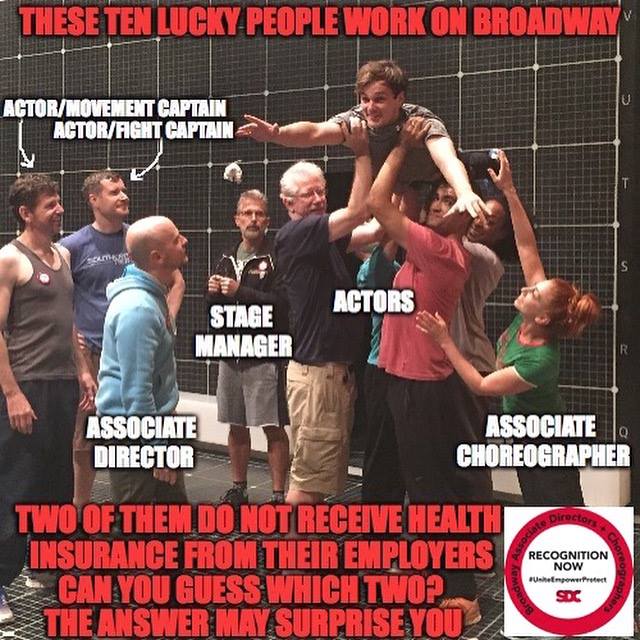
sdc associates imageLabor negotiations only tend to break into the news when they concern large public sector unions or when things are going badly. This does not concern the former or, so far as I know, the latter. But there is an item on the table in the current negotiations between The Broadway League and the Stage Directors and Choreography Society (SDC) that I find of interest, even if it is rather inside pool for the theatre industry, and even more specifically, Broadway.

SDC has put forward a proposal asking that, with their new Broadway contract, the Associate Directors and Associate Choreographers who work on Broadway shows be included as part of the bargaining unit for the first time. The goal is not to establish minimum salaries, but to seek health and pension payments for the associates during the term of their employment, which, with a successful show, can extend for years.

Because the term ‘associate’ is often confused with ‘assistant,’ and I’ve made the mistake myself more than once, it’s worth understanding the title. Associates are typically the people who remain with a show week after week to maintain the production, whether it’s notes for actors as productions roll along, rehearsing understudies and even “putting in” new cast members. Associates may travel with shows as they tour, and in some cases on shows with numerous subsequent incarnations, an associate may rehearse the cast for several weeks before the director or choreographer arrives to handle the final phase of the staging. I’m skimming the surface here. But in short, we are not talking about people who run to get the tuna sandwiches for lunch.

The position has evolved over the years, as shows have run longer and productions have become more technically complex. Some of the work I’ve mentioned cursorily was traditionally the sole purview of the production stage manager, and on some productions, it can certainly remain their responsibility. (There are superb stage managers out there and nothing I’m saying here should in any way be construed as minimizing their essential roles in maintaining shows as well.) But on the bigger shows, engineered to (hopefully) last for years, associates are much more de rigeur. Certain directors and choreographers of note tend to work with the same associates for long periods of time, because of the trust developed that allows those artists to reliably delegate tasks and productions, secure that their vision will be sustained. It’s important to note, however, that while directors and choreographers have significant say in who they want to work with, and on a practical basis the associates work for them, legally all associates are employed by the production, not the artists themselves.

The only reason I’ve heard about this topic in the current negotiations is because the associates have been organizing themselves on Facebook, and in my wide circle of “friends,” so many of whom I’ve never met, some are Broadway associates – and some are the directors and choreographers themselves. It was only yesterday that I saw the associates’ campaign for recognition move beyond a private Facebook group and onto SDC’s own Facebook page. There’s been no press release, no phone calls soliciting support.

But it came as a surprise to me that with the many unions establishing work rules and compensation minimums on Broadway, somehow the associates have slipped through the cracks, despite the responsibility and skills that the position now requires. Some of this surely stems from how the role has evolved over the past 30 years or so.

Is being an associate a training ground for the next generation of directors and choreographers, something we all should care about? It can be: a cursory look at the IBDB shows me that Marc Bruni, director of Beautiful, was associate director for nine Broadway productions before getting the top gig with the Carole King show; Warren Carlyle was the associate choreographer on two shows before he started creating the dances – and directing – Broadway shows on his own. But there are plenty of associates for whom that may well be their particular calling, who find perpetual satisfaction and success in their expertise at channeling directors and choreographers to keep shows fresh and tight, as we now see productions running for 10 or 20 years or more.

I understand why the producers of the Broadway League may be reticent about this; after all, I’ve been a theatre manager, and sat in union negotiations representing producers (albeit not-for-profit ones). There’s always the belief that when a new union comes in, or when new disciplines are added to an existing bargaining unit, the inevitable result is to drive up costs and perhaps create limitations on employee responsibilities. Even though the request right now is only for health and pension contributions, and salaries are entirely negotiable, I’m sure the producers are concerned that once assistants are in the bargaining unit, there may be additional requests in future negotiations.

It’s worth noting that associates working on productions like The Lion King and Aladdin are afforded these benefits, because Disney negotiates its own union contracts. All of its workers are corporate employees of Disney, and participate in standard Disney employee benefit programs. Of course, other producers, who are primarily independent, may say that Disney can afford to do this precisely because they are a large corporation, not a limited partnership formed to mount a single production. But Disney shows still have to balance expenses against income, like any other show.

I have to say that I look at the current situation not as an avowed ally of either the associates or the producers, but rather as the son of an insurance salesman, as well was someone who traded in my bar mitzvah savings bonds at age 16 because I realized I could get a better rate in a mutual fund. I also look at it as someone who had no opportunity for a retirement savings plan, let alone an employer contribution, until I was in my 30s, and who has had to buy health insurance on the open market for the past several years (and I say with genuine appreciation, thank you, President Obama).

My voice doesn’t really matter one little bit, because I’m not at the table or directly connected to the interested parties. But I don’t think its unreasonable for enterprises which may be grossing anywhere from $500,000 to $2 million a week to give long-term employees who are surrounded by countless colleagues who do receive health and pension benefits the same level of security. And while audiences may never realize it, it matters to them too, especially if they’re seeing a show after the first couple of months on Broadway or in a subsequent sit-down company or on a tour.


Writing A Different Script About Respect for Playwrights

August 7th, 2015 § 17 comments § permalink

Call for submissions on Words Players TheatreIt would be hypocritical of me to speak out against precisely how people have expressed their feelings about, and to, Words Players Theatre in Rochester, Minnesota, because I spend so much of my time now speaking on behalf of the rights of artists to express themselves as they see fit. So as one of the first people to raise the issue of the play submission guidelines proffered by Words Players, I can only say that I’m disappointed in myself, for not engendering a more constructive dialogue.

I’m not reneging on any of the points I raised with the blog post I put up last Saturday – I still see the guidelines as written as very problematic, and I want to see Words Players bring their short play festival’s selection and production model into line with widely accepted practice. I want to know that the young people who participate in this program are learning about the ethics of art as well as the practice of it, because even if Words Players turns out to be their only foray on stage, they can carry appreciation and respect for the work of creative artists through their lives, and maybe even stand and defend such work at some point in the future. I want other programs and producers to learn from this example.

Since Monday, I have been in touch by phone, by e-mail, by Facebook messenger and by text both with playwrights as well as with staff and parents at Words Players. I have seen numerous public communications and had private ones shared with me, as well as some that were intended to be public but were excised from public forums. I am extremely dismayed by the extraordinary level of invective, attack and profanity that has been hurled in the direction of Minnesota, just as I was deeply troubled by the seeming intent and implications of the original submission request. But I‘m not calling anyone out, or even quoting anyone, because I’d like us all to move forward together.

I won’t share any specifics from my assorted personal conversations because none of them were on the record. While I am an advocate, not a journalist, I believe I can only advocate for change if people can trust that when they speak to me, they are not immediately speaking to anyone who follows me on social media or reads my blog. But just as I worried about the lessons that Words Players was teaching to the young people who participate in their program, I’m now worried about the lessons the creative community and its allies (in which I certainly include myself) have inadvertently taught them as well, even in service of a position I strongly support.

When I first began writing about incidents of censorship, which in those early days was solely in the academic sphere, I admit I allowed my outrage to boil over at times in print. It made for good reading, I suppose, and there’s something cathartic about writing that way. But I think if you were to read all that I’ve written on the subject of artists’ rights and censorship since 2011, you’ll find that I’ve tempered my tone, even in some of the most egregious cases – at least I hope I have. Mind you, my anger at certain people who tried to silence or shut down, or manipulate the text of, certain plays and musicals is ever-present.

Of course, I am not a teacher who has been overruled, reprimanded or fired for choosing to produce a play. I am not a playwright who has seen their work trivialized or vandalized by a theatre (or theatres) over the course of pursuing my career. I have not been invited into some of these debates, but rather inserted myself. I recognize that all too readily. But I have made my life in the theatre and I hope it’s apparent to anyone who knows or reads me that it’s my goal to perhaps in some way leave it a little better, a little stronger, than it was when I came into the field.

So I’m not about to tell anyone exactly what they should think or say, seven days into the contretemps over Words Players. But I hope that can I ask everyone involved that they consider the true goals here, which are – I believe – to insure that the words of playwrights, novice or veteran, are treated as central, essential and the absolute domain of each playwright, as well as to see the young people at Words Players and beyond have the best possible experience with theatre and the arts.

To quote Travis Bedard’s 2amtheater blog post from yesterday, “Northland Words Theatre isn’t the enemy, they are us. They are a scrappy theatre trying to make stuff they love on a wing and a prayer. They got something wrong. So we help them fix it and help them to understand why we’re so shocked at the call.”

I wish I’d said that when I first wrote about issue. I’m genuinely sorry that I didn’t. I didn’t realize that perhaps I had to. I’ll try to do better in the future.

So here’s what I believe: a script is not a mere starting point – it is the point. It provokes dialogue between creative artists as they build a production in service of that script, it creates dialogue between those artists and audiences.

There’s still more conversation to be had on this subject, with Words Players and with other companies too. I’ll have that conversation for as long as people are willing to talk about it with me. I’ll welcome every voice that wants to participate, in the hope of persuading people to share my perspective, which is consistent with that of the vast majority of the creative community.

Ultimately, everyone has the right to express themselves as they see fit. But I’d like to suggest that perhaps we can all have a better conversation.

Howard Sherman is director of the Arts Integrity Initiative at the New School for Drama.


The Generous Audience Engagement of Lin-Manuel Miranda

August 5th, 2015 § 14 comments § permalink

hamilton-sunsetIt is not my habit to offer my opinion about current productions, and I tend to even avoid doing so retrospectively. But I do want to briefly discuss the shows I’ve seen over the past week or so, because they’re never the same each night, because they’re exceptionally brief, and because they’re free. I’m referring to the “Ham4Ham Show,” the two to three minute bits of entertainment offered up outside the Richard Rodgers Theatre at the ticket lottery two hours before each preview of the new musical Hamilton.

For those who haven’t seen them or heard about them, the Ham4Ham shows can be anything – you have no idea what you’ll get – that the protean Lin-Manuel Miranda and the company choose to present. It could be a song, a dance, a Q & A with Lin in which he answers using only the lyrics of a favorite musical. But what it means is that those who’ve trekked to 46th Street in hope of snagging a pair of seats in the front row of the theatre for the performance two hours hence for only $10 a ticket may walk away empty handed, but they’ve gotten a little something more than suspense out of the experience.

Now it’s easy to look at this and be cynical, if you tend that way, thinking this is all about selling tickets. But while videos of the nightly event may spread out on social media (and the show’s official accounts do participate in that), the performance is first and foremost for people who haven’t bought seats, and very possibly can’t get or can’t afford tickets any other way. It is an act of generosity by Lin and the company, without a marketing message attached; indeed, it seems more an expression of gratitude to fans than anything else.

I say this as someone who has attended a dozen of these little shows, and viewed others online. I find the spirit of the crowd and of those who come out to perform to be enormously congenial and electric. I’ve seen no jostling for space, no rivalry among those competing for the same tickets, and I’ve watched the crowd spill into the street in blazing heat and humidity without complaint. I don’t attend to enter the lottery – I’ve been going to see, enjoy and record the shows for those without the proximity or time to attend in person. It just so happens that my office is on 46th Street and I simply have to cross Broadway to be there.

As theatres talk about how to engage audiences, there’s no question that Ham4Ham is a sterling example, if not necessarily a replicable model. To tick off just some the things that make this unique: 1) Lin-Manuel wrote and stars in Hamilton, so it’s truly his show, 2) no one is required to perform, they’re doing it entirely of their own accord, 3) lots of theatres don’t have the easy foot traffic that New York can generate to draw impromptu crowds, 4) not every show has the advance excitement (and sales) that Hamilton has generated off of its run at The Public – and so on. But it’s also worth noting that, my personal example aside, people would be there trying for the cheap tickets regardless – Ham4Ham is simply a bonus.

For all the reasons why Ham4Ham would be difficult to reproduce, there is something at its core that can perhaps provoke other models of engagement for other shows, for other theatres. If we can all learn from Lin-Manuel’s example and actively engage in giving something to audiences that they can’t get anywhere else, outside of the space that they need a ticket to enter, that may even stand alone and apart from what’s being offered on our stages, then perhaps we’ll find some new friends and new relationships that go far beyond just ‘how do we sell more tickets.’

Once Hamilton opens on Thursday, Ham4Ham may be less frequent, or perhaps change in format. So for everyone who has been out on 46th Street since the Ham4Ham shows began, thanks Lin, thanks Ariana, thanks Jon, thanks Renee, thanks Okieriete, thanks Karen, thanks Jon, thanks Philippa, thanks Alex – and thanks everyone I haven’t named too. The best show in town was the crowd, outside the R. Rodgers Theatre for A. Hamilton.

*   *   *   *

The videos above were all shot by me (and let’s hear it for the iPhone), as was the photo at the top of the post, but here are a few more, shot by others in the crowd, that I think you’ll enjoy:


Taylor Swift Cannot Always Save Your Show

August 4th, 2015 § 0 comments § permalink

Taylor SwiftIt is, without question, the feel-good theatre and pop culture copyright story of the day.

Taylor Swift comes to rescue of Sydney’s Belvoir Street Theatre over use of hit song Shake It Off.” “‘Permission granted’: Taylor Swift’s 11th-hour rescue for Sydney theatre show.” “Taylor Swift says yes to Belvoir Street SOS, theatre set to Shake It Off.” And so on.

The fast story is this: Belvoir Street Theatre, a well-known and respected Australian theatre company is producing a play, Seventeen, in which a group of elderly (and acclaimed) actors play 17 year olds. The director of the show wanted to use “Shake It Off” as a choreographed number at the show’s climax. But going through normal channels, the music publisher had denied the company the rights, for reasons unknown.

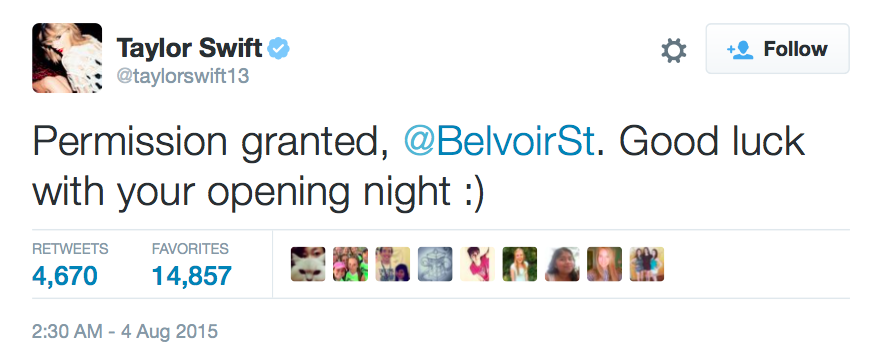
Taylor Swift tweetFive days before opening, all conventional efforts exhausted, the company resorted to trying to reach Swift on social media and in what may be a first, she granted the rights via Twitter just hours ago. While I suspect there are some contractual details to be worked out beyond “Permission granted,” presumably the tweet from Swift gives Belvoir Street enough comfort that they can proceed. While news reports indicate that alternate music and staging was being prepared, now everything can continue according to the theatre’s and the production’s original plans.

It is, as I say, a happy ending, and having the reigning queen of pop music as your deus ex machina is quite the capper. But I would caution others who want to try this approach not to count on a recurrence: music licensing (or the licensing of any copyrighted material) via social media is not, in my estimation, going to become the new normal.

The fact is, Belvoir Street got lucky. To be sure, they waged a heck of a campaign, with people like Tim Minchin tweeting support and online pleas like “Please ‪@taylorswift13 help these seventy-year-olds Shake It Off!” making the case on emotion, rather than business grounds. And, of course, Swift seems to be very personally involved in every single aspect of her career, including her social media feeds, so she and her team actually saw and considered the request, having undoubtedly known nothing of the original denial.

Just don’t try this at home with your show, whether it’s a fringe production or at a resident company like Belvoir Street. There are lots of artists who have people paid to monitor their social media (as I’m sure Swift does as well), but they’re not necessarily as shrewd or as generous as Taylor. They also have people paid to monitor unauthorized use of their words and music. Proceeding deep into rehearsals with material you don’t have rights to can easily bring heartache, and while that might merely be more song fodder for Swift, it can be unsettling to a production and possibly even expensive for a company when last minute changes need to be made.

There’s no question that pop music added to plays can enhance a production, without turning it into a jukebox musical. I vividly recall the Steppenwolf production of Balm in Gilead which interpolated now-vintage Bruce Springsteen recordings so brilliantly, and Trinity Rep’s All The King’s Men which made Randy Newman’s songs from his Good Old Boys album seem as if they’d been written expressly for the show. I can’t say whether the music was properly licensed in either of those cases – both are over 25 years old and my Playbills are in storage – but even if they weren’t then, I can’t imagine these shows getting away without the rights agreements now.

So the story here is not so much that Belvoir Street dodged a bullet, but that Taylor Swift deflected it. While she may seem to be omnipresent these days, she can’t actually be everywhere, and other artists and songwriters may not be quite as magnanimous. So when it comes to using existing songs, it may be like you’ve got this music in your mind, saying it’s gonna be alright, but that’s not necessarily the case. When it comes to copyright, you just can’t shake it off.

Howard Sherman is the director of the Arts Integrity Initiative at the New School for Drama.

Taylor Swift Cannot Always Save Your Show

August 4th, 2015 § 1 comment § permalink

Taylor SwiftIt is, without question, the feel-good theatre and pop culture copyright story of the day.

Taylor Swift comes to rescue of Sydney’s Belvoir Street Theatre over use of hit song Shake It Off.” “‘Permission granted’: Taylor Swift’s 11th-hour rescue for Sydney theatre show.” “Taylor Swift says yes to Belvoir Street SOS, theatre set to Shake It Off.” And so on.

The fast story is this: Belvoir Street Theatre, a well-known and respected Australian theatre company is producing a play, Seventeen, in which a group of elderly (and acclaimed) actors play 17 year olds. The director of the show wanted to use “Shake It Off” as a choreographed number at the show’s climax. But going through normal channels, the music publisher had denied the company the rights, for reasons unknown.

Taylor Swift tweetFive days before opening, all conventional efforts exhausted, the company resorted to trying to reach Swift on social media and in what may be a first, she granted the rights via Twitter just hours ago. While I suspect there are some contractual details to be worked out beyond “Permission granted,” presumably the tweet from Swift gives Belvoir Street enough comfort that they can proceed. While news reports indicate that alternate music and staging was being prepared, now everything can continue according to the theatre’s and the production’s original plans.

It is, as I say, a happy ending, and having the reigning queen of pop music as your deus ex machina is quite the capper. But I would caution others who want to try this approach not to count on a recurrence: music licensing (or the licensing of any copyrighted material) via social media is not, in my estimation, going to become the new normal.

The fact is, Belvoir Street got lucky. To be sure, they waged a heck of a campaign, with people like Tim Minchin tweeting support and online pleas like “Please ‪@taylorswift13 help these seventy-year-olds Shake It Off!” making the case on emotion, rather than business grounds. And, of course, Swift seems to be very personally involved in every single aspect of her career, including her social media feeds, so she and her team actually saw and considered the request, having undoubtedly known nothing of the original denial.

Just don’t try this at home with your show, whether it’s a fringe production or at a resident company like Belvoir Street. There are lots of artists who have people paid to monitor their social media (as I’m sure Swift does as well), but they’re not necessarily as shrewd or as generous as Taylor. They also have people paid to monitor unauthorized use of their words and music. Proceeding deep into rehearsals with material you don’t have rights to can easily bring heartache, and while that might merely be more song fodder for Swift, it can be unsettling to a production and possibly even expensive for a company when last minute changes need to be made.

There’s no question that pop music added to plays can enhance a production, without turning it into a jukebox musical. I vividly recall the Steppenwolf production of Balm in Gilead which interpolated now-vintage Bruce Springsteen recordings so brilliantly, and Trinity Rep’s All The King’s Men which made Randy Newman’s songs from his Good Old Boys album seem as if they’d been written expressly for the show. I can’t say whether the music was properly licensed in either of those cases – both are over 25 years old and my Playbills are in storage – but even if they weren’t then, I can’t imagine these shows getting away without the rights agreements now.

So the story here is not so much that Belvoir Street dodged a bullet, but that Taylor Swift deflected it. While she may seem to be omnipresent these days, she can’t actually be everywhere, and other artists and songwriters may not be quite as magnanimous. So when it comes to using existing songs, it may be like you’ve got this music in your mind, saying it’s gonna be alright, but that’s not necessarily the case. When it comes to copyright, you just can’t shake it off.

Howard Sherman is the director of the Arts Integrity Initiative at the New School for Drama.


The Lost Plays of H. Edward Sherman

August 3rd, 2015 § 5 comments § permalink

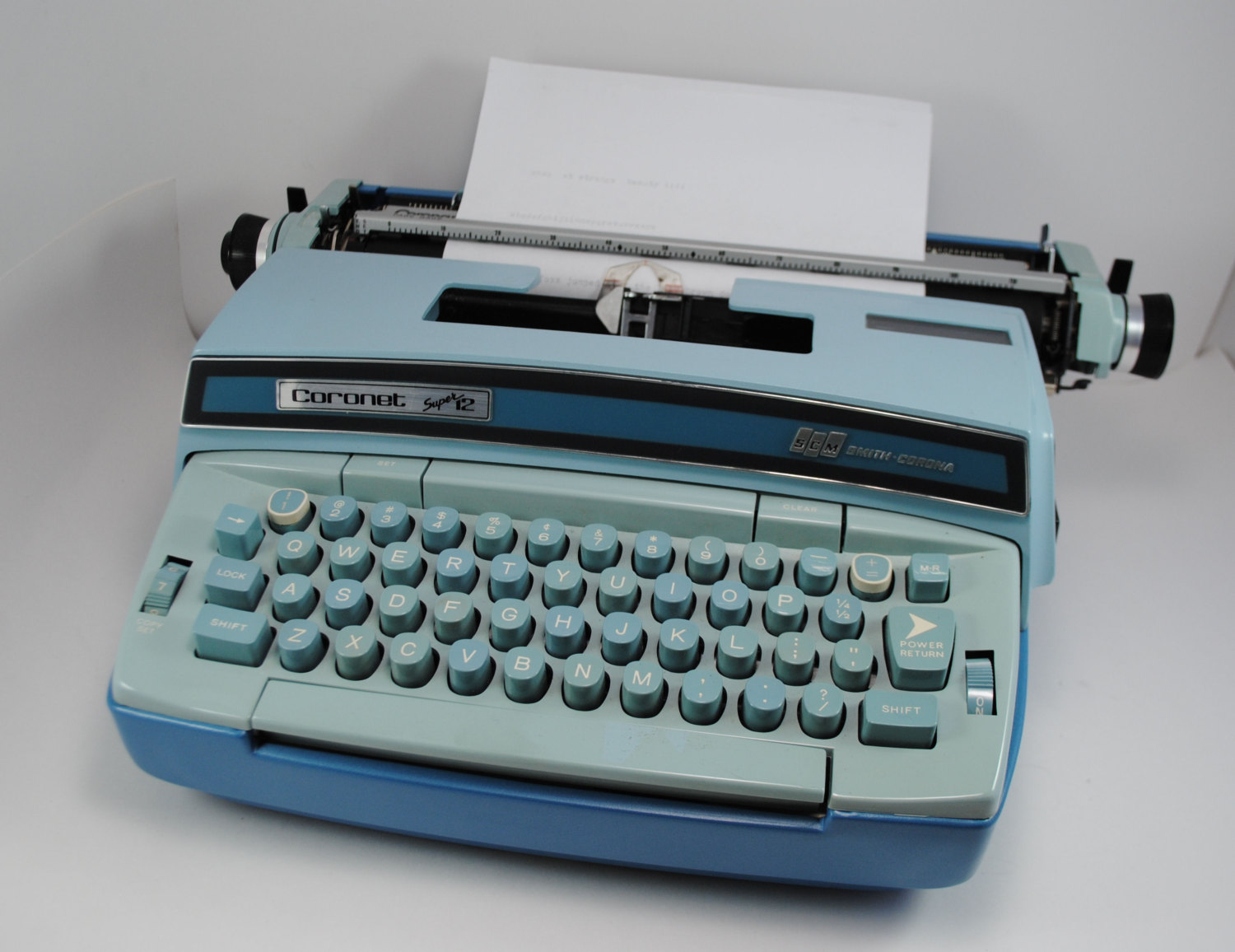
The doppelgänger of the Smith Corona typewriter I used for over a decade

A close facsimile of the Smith Corona typewriter I used for over a decade.

Last weekend, I shared a story and wrote a blog post about Dylan Lawrence, a 13-year-old in Lincoln, Nebraska who staged what appeared to be a fairly impressive production of Shrek The Musical in a neighbor’s backyard. The story seemed to touch an awful lot of people, perhaps because they responded as I had, when introducing the article on Facebook.

Sometimes, those of us who work in the theatre need a quick reminder of the impulse that got us started, which can get lost amid the realities of having made the thing we love into our job. That’s why I think this story is so terrific, because, in one way or another, wherever we grew up or however we got started, to paraphrase Lin-Manuel’s Tony acceptance rap, we were that kid. Let’s share this – let’s make Dylan Lawrence a star, for every kid out there making theatre in a backyard, a basement, or on Broadway.

Frankly, I found myself jealous of Dylan’s energy and initiative, wishing I had been that creative and entrepreneurial at his age, to the degree one can be jealous of someone today over one’s own perceived deficiencies 40 years in the past.

A few days later, I happened on a news story from the UK, announcing that a small London pub theatre would be producing the world premiere of a play by Arthur Miller. Impressed by such a discovery, I read on, only to learn that the unstaged play in question had been written by Miller as a 20-year-old college sophomore. Frankly, while Miller’s reputation is secure, I had to wonder whether the play in question would add to the Miller canon, if it would contradict some aspect of it (a la Go Tell A Watchman), or would it simply be a novelty that goes back into the Miller archives after this run.

These two incidents began to work on me, as did a flip comment I made, entirely in jest, to a Twitter commenter about the Miller story. I said something to the effect that I doubted if anyone wanted to read my unproduced plays.

Shortly thereafter, it hit me. I actually have some unproduced plays. Or at least I had them. I’m not digging through old files and boxes for them, for me or anyone else, and I’m really hoping that no one else has copies. But I am willing to share with you what I recall of my efforts, which I haven’t thought about in quite some time.

It’s worth noting that I saw very little theatre as a child. I attended a children’s theatre show at Long Wharf Theatre in 1967 for the fifth birthday of a kindergarten classmate, of which I remember nothing but the seeming vast darkness of that actually intimate space. In second grade, my parents took my brother and me to see the national tour of Fiddler on the Roof at the Shubert Theatre in New Haven, and what I remember most is “Tevye’s Dream.” It stands out not because I liked the number, but because as a child I was very skittish about anything supernatural, and so my parents had spent a lot of time preparing me for the appearance of Frumah Sarah. The anticipation was so significant, and the event so anticlimactic, that it was my greatest takeaway. My first Broadway show, circa 1975, was Stephen Schwartz’s The Magic Show. My second was Beatlemania.

Despite a paucity of real world examples, I conceived of a passion for theatre, and my parents enrolled me in a Saturday morning drama program at the New Haven YMCA. I believe I was in fourth grade. I dimly recall the space in which we worked, that there were only a few other kids involved, perhaps three or four, and I have no memory of the class leader. But I do remember that the program concluded with some manner of performance – I don’t even recall any audience – of the play I wrote for the group, Love and Hate. The plot? No idea. But remarkably, I do think that even then I was aware of a book called War and Peace, and that it sounded pretty good, so I mimicked the wide scope of its title. I suspect I performed in Love and Hate as well, but that aspect is too indistinct. My older brother wouldn’t have attended out of disinterest, so I can’t ask him about it, and my sister would have been to young to sit through it. With my parents gone, these threads are all that is left of Love and Hate.

My next writing efforts, some time during fifth and sixth grade, were both done under the tutelage of my synagogue’s cantor, one Solomon Epstein, who was a young Jewish man from the south whose lasting gifts to me included several of my formative cultural experiences, notably my first art museum visits, as well as my lingering tendency, despite my New England upbringing, to say “y’all.”

It was Cantor Epstein who had our second grade Hebrew school class sing a short pop cantata called Joseph and the Amazing Technicolor Dreamcoat, years before it was expanded into a stage show (I managed to tell Lord Lloyd Webber this story years later). He staged several similar, but longer, works as multimedia events on the synagogue’s stage – after all, this was the early 70s. I remember learning how to synchronize three sets of dual slide projectors with a big electrical box called a crossfader, and asking him whether the rabbi would permit him to have an attractive young woman of 17 or 18 years of age dance in the synagogue in a body suit (it was fine, apparently).

But he also encouraged me to write, going so far as to loan me a portable Smith Corona electric typewriter, which was so much easier than the vintage manual typewriter that dated from my parents’ school days, and probably before; they later bought me my own electric, the same model as the one I’d borrowed. First, I undertook to do my own adaptation of the Peanuts comics for the stage (an avowed fan of the strip and quite aware of You’re A Good Man, Charlie Brown). I did little more than transcribe the various cartoons from the comics, which I had been cutting from the newspaper and pasting into scrapbooks for years, and arrange them in short scenes. My only innovation, not entirely surprising given my guide, was to invent a new character, a Jewish “Peanut” named “Tsvi,” which not so coincidentally is my Hebrew name. The title of this opus: Happiness is a Jewish Peanut. Clearly at that time I was seeking my cultural identity by placing myself among characters I loved.

Subsequently, I tackled a more significant project, adapting a novel, the name of which escapes me now. It was a wry Jewish fantasy about the lives of babies in heaven before they’re born and sent to earth, but it actually had a narrative, which ended with its main character being launched to meet its parents. I recall that in the book’s mythology, the philtrum, or “drip canal,” under our nose is where God snapped his fingers against us to bring us to mortal life send us to earth. Funny what stays with us, no? Again, I was probably transcribing more than writing, but as this was a several hundred page novel, I did have to assert some basic editing skills, if nothing else.

My last writing attempt never got beyond the outline phase, but it was a special high school project that proved too overwhelming. Looking back, it was utterly self-indulgent and also self-revelatory, a play in which I imagined a version of myself, to be played by me. This main character, a high school student in a school much like mine, was to look at the talents of other students I –I mean he – admired and then, in turn, he/I would demonstrate those very same talents, at least on a par with, if not better than, those I envied. It would have been great fodder for a therapist, but as drama, no doubt quite inert, albeit a showcase for whatever talents I actually had.

To be honest, I still have ideas for plays, and screenplays, from time to time, some of which have been turned over and over in my head for many years as the circumstances of the world, or of my life, have changed. I honestly believe one or two of them are pretty good, but I have found that my impulse to write is best served by the essay form, the blog form, because it allows me to pursue a single idea in a single writing session. It is the commitment of returning to the same story, over and over, day after day, tweaking, adjusting, and fixing endlessly that has staved off any real creative efforts. It is why I admire playwrights (and screenwriters, and novelists) so very much.

I unearth all of this now because of young Arthur Miller decades ago, because of young Dylan Lawrence today, and because of the countless youthful creative artists who may not yet realize that’s where they’re headed, who may not have the support and access that Dylan Lawrence, Arthur Miller and I all had. We know what happened with Miller, and I plan to follow and support Dylan in any way I can – as I will do as much as I’m able for any young person inspired by the arts, especially theatre, and I hope that holds true for those who read my blog.

As for me, I came to understand that I am not a dramatic storyteller, but an avid consumer of stories, who wants nothing more than to play some role in their getting told, and in supporting and knowing those who tell them. Just as there are undoubtedly countless young artists and administrators – and audiences – to be nurtured, I hope there are at least as many parents, mentors and teachers to pave the way, declining budgets and skittish authority figures be damned.

And check back with me in about 20 years. Maybe by then I’ll have enough material for a marginally entertaining one-man show. You never know.

 

Disrespecting Playwrights and Their Words with Young Players in Minnesota

August 1st, 2015 § 46 comments § permalink

Call for submissions on Words Players TheatreI should say right up front that, until about two hours before I began writing, I didn’t know anything about the Words Players Theatre of Rochester, Minnesota or its parent organization, Northland Words. I only learned about them because the company had raised the online ire of people in the creative community. In particular, what caught my eye was a blog post by playwright Donna Hoke, “Dissecting The Most Disgusting Call For Plays I’ve Ever Seen,” in which she does exactly what she says she’s going to do in her title, line by line, word by word. I share her concern, but I’d like to take a macro view of the message that the company appears to be sending.

Throughout their call for plays for Words Players 2015 Original Short Play Festival, the company’s director Daved Driscoll says several things worthy of admiration: there’s a commitment to young performers, as well as a desire to find work which he feels will appeal to his local community. I don’t think anyone would argue with those goals.

But where his message gets into trouble is, first, in the margins, so to speak. “Our emphasis is perhaps less on the artist-centered goal of producing ‘great art’,” he writes; elsewhere he notes “our desire to give writers and directors first-hand experience of the vagaries of ‘marketability’ as much as the more arcane goals of ‘art’.” If Words Players’ primary goal is to sell tickets, that’s perfectly fine, but that intimates that their efforts are more commercial than not-for-profit, and Northland Words is a 501(c)(3) tax-exempt organization. Yet plenty of not-for-profits are accused of chasing sales over creative pursuits, so they’re not alone, but it’s awfully dissonant to be asking for plays from artists while dissing art itself. Why not focus affirmatively on what’s sought, rather than what’s not wanted? Instead, Words Players notes, “We prefer most of all plays that are significant and interesting, without off-putting superciliousness.”

Secondly, Driscoll states that, “We largely ignore considerations of age, race and gender in our casting decisions.” While that would be jarring in a professional setting, it’s perhaps somewhat less troubling in a company that’s focused on youth. After all, Lin-Manuel Miranda has noted that he doesn’t mind when schools without Latino students perform In The Heights, because once kids hit college, they’re going to be typed and should have a certain freedom to play any role while very young, though he does ask that they give respect to the culture they portray, and neither paint their skin nor adopt bad accents in doing so. However, Miranda doesn’t condone willfully altering the characters themselves, let alone the story, and neither do I. That choice should be the playwright’s, not the director’s or the artistic director’s.

I’d also suggest that in pointing out his youth emphasis, Driscoll could do better than, “The audience invariably includes a large percentage of young people.  We will prefer scripts that appeal to them as well as to old, non-young people.” I believe most old, non-young people like myself wouldn’t mind at all that the work is for and by the young, were our decrepit state not reinforced redundantly. Honestly, young people play adults all the time in school theatre and community theatre where casts are young, so it’s not really an issue.

But what moves beyond poor communications and into the realm of unacceptable is how Driscoll speaks of how the theatre will handle the work of the very writers he’s soliciting. “Our production of the play is our only ‘compensation’ for its use,” he writes, later emphasizing the point by saying, “We don’t pay for the scripts.” Now if there are youthful writers in the local community who are the peers of the performers, who wish to write and be part of the program, that seems fair, provided no one else is getting paid either. But in a call for submissions that has clearly reached beyond the confines of Words Players and even Rochester. Minnesota, the idea that playwrights should give the company their scripts gratis devalues the work of writers – and if the youthful acting company knows of this, it suggests to them that writers’ words have no value.

Compounding this perspective, Driscoll writes, “While authors are welcome to confer with the directors, such conference is at the discretion of each director.  Student directors will develop their autonomous interpretation and will maintain independent control of each production.  They will in all probability modify settings and dialogue to fit our production situation and their own visions of the shows.  Directors will, in particular, strive to make each play ‘entertaining’ to our audiences and may modify the scripts, accordingly.” This is the behavior of Hollywood studios towards writers, and they pay huge piles of money for that right; in the theatre, while a work is under copyright, the playwright has the final say about what words are spoken, unless they’re inveigled into giving away that right.

Finally, there’s a mission statement at the bottom of the call for plays which reads, in part, as follows: “Merely preserving ‘the way it was done’ is for mummies and pottery shards, not performance art.” I agree, but there’s a difference between fresh interpretations and wholesale vandalism, especially when a play is new and in no way trapped in amber.

Every theatre can set its play selection guidelines as it sees fit, but Words Players seems to be emphasizing the players over the words, and insulting playwrights in the process. The guidelines bother me for the same reason it bothers me when school administrators and professional directors and many others mess with copyrighted texts without permission: because not only is it in most cases legally and always ethically wrong (at least in the U.S.), it’s setting such a disastrous example for the young people who witness this disregard, bordering on contempt, for the writer’s art.

It’s unclear how many plays will be in the Words Players festival, how many people will attend and what they might be charged. But when it comes to compensation, royalties for amateur productions of short works are often little more than the price of a couple of movie tickets and a bag of popcorn, so they’re hardly onerous for any company. But no payment gives a licensee the right to have its way unilaterally with the text in theatre, unless the playwright inexplicably chooses to grant it.

Online, people wrote that they saw this same call last year and spoke out about it, but that it’s unchanged – they were ignored. Facebook and Twitter posts suggest that Words Players response has been, essentially, “if you don’t like it, then don’t submit.” They’ve been removing dissent from their social media. They’re trying to hide the efforts of those that might inform their community of reasonable standards and guide them towards more appropriate behavior.

I’m not writing just on behalf the playwrights – I’m writing on behalf of every single kid in that program. If those kids admire theatre and the arts, then regardless of whether they become professional artists or simply audience members in the future, any adults giving them training need to distinguish between creative rights and wrongs for them now, because they are the path to our future and to the health of the theatre.

In the call for plays by Words Players, Mr. Driscoll is teaching bad lessons (Donna Hoke has made some strong points on that as well). Either he should choose the plays he wants and treat them with respect, or he should write them himself and let the directors and performers have at them if he likes. The latter choice is his right if he is the author. But no one should be asking for plays if they’re not going to produce them with professional conduct and ethical standards, even for only one or two performances with a cast of young people in Rochester, Minnesota. Every play has meaning, as does every production, and Words Players will best serve its community by altering its practices to set the right example.

Update, August 5, 3:30 pm: Yesterday, Doug Wright, president of The Dramatists Guild, sent a letter to Daved Driscoll of Words Players outlining the reasons why playwrights and the Guild were so troubled by the theatre’s play submission guidelines. This morning, Driscoll responded in writing to the Guild, and subsequently did an interview with Playbill discussing their desire to conform to professional and ethical standards. Conversations between those parties will be ongoing, and if welcome, I hope to participate in them as well.

Update, August 7, 2 pm: The conversations online and offline surrounding this topic have, in some cases, metastasized far beyond my intent and perhaps the intent of others who drew attention to this situation. I hope you’ll read my followup post as well, “Writing A Different Script About Respect for Playwrights.”

Note: an earlier version of this post contained two photos of prior productions in the Words Players Original Short Plays Festival. While the photos were made available for download without restriction on the company’s website, I have removed them at the suggestion of several commenters.

Howard Sherman is director of the Arts Integrity Initiative at The New School for Drama.


Saluting a Backyard Theatrical Impresario In Lincoln, Nebraska

July 26th, 2015 § 7 comments § permalink

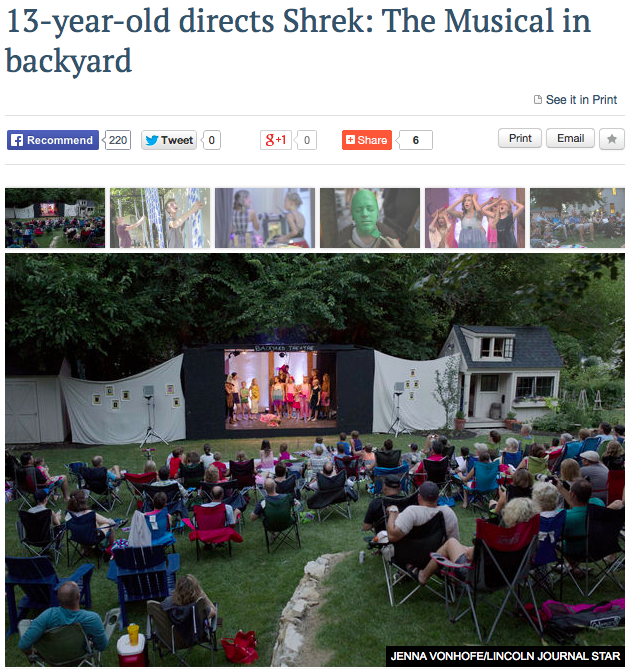
Shrek in the Journal StarSundays tend to be slow days for theatre news, if you get most of your theatre news online. By the time I sit down to trawl through “the Sunday papers” for theatre stories to share, primarily through my Twitter account, I’ve seen most of what’s on offer already. The New York Times Arts stories start filtering out through Twitter and Facebook as early as Wednesday, the Sunday column of Chris Jones at The Chicago Tribune is usually available by Friday afternoon, and so on.

I look at my theatre news curation on Sundays as perfunctory (just as Saturdays tend to be particularly busy), knowing I’m unlikely to find much, which is why a story in the Lincoln, Nebraska Journal Star managed to catch my eye. It’s not, so far as I can tell, in the paper’s arts or entertainment section, but in local news, the sort of charming slice of life that columnists look for to illuminate their communities. However reporter Conor Dunn found out about impresario Dylan Lawrence’s production of Shrek: The Musical in a neighbor’s backyard, I’m awfully glad it came to the paper’s attention, and that I stumbled upon it. If you haven’t seen it yet, here’s a taste:

Now 13, Dylan pulled off his first major production this weekend — “Shrek: The Musical” — at The Backyard Theatre in southeast Lincoln, a venue literally carved out of a family’s backyard and completely run by kids.

This isn’t the first time Dylan has directed a play, however. It’s just in a new location. Last summer, he and 10 of his friends performed “The Wizard of Oz” in his Lincoln backyard. Dylan said the cast put the show together in just nine days and about 70 people attended.

*   *   *

While most theatrical productions have a set and a stage crew, Dylan took most of the roles on himself, alongside directing and performing as Lord Farquaad in the show.

He’s sewn the costumes, designed the props, rented a sound system and also created light cues using a software program on his laptop. He even created The Backyard Theatre’s website.

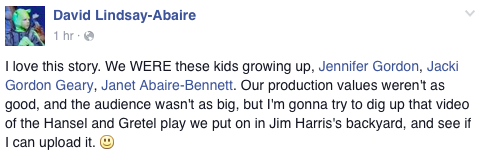
David Lindsay Abaire Facebook post re ShrekI have no doubt that there are other Dylan Lawrences out there, so I like to look at this story not as a wholly unique incident, but rather as emblematic of the grassroots love of theatre that inspires kids, and that in turn can inspire even those of us working at it professionally. I’m glad it’s finding resonance online ­– my post has been “liked” on Facebook 72 times in less than two hours and shared 37 times, including by David Lindsay-Abaire, who wrote the show’s book and lyrics. I suspect the number will climb much higher, because I believe that many more people will connect to it in the same way that I did.

There was one comment posted to me on Twitter, where I also shared the Journal Star story, saying “Hope he has the rights.” While I am adamant that authors should be compensated for their work, I wonder whether this ad hoc production by children 14 and under, with no institutional backing or adult leadership, reaches the level at which a license is required, and I intend to find out. However, if it turns out that a license should be paid, I don’t want my decision to share a local story that might have otherwise gone unnoticed to be visited upon Dylan and his company; consequently, I’ll pay for any rights required myself, to help Dylan practice what I preach, because it’s a small price to pay for encouraging the love of theatre and for a tale that reminds so many of us why we got into this crazy and thrilling business in the first place.

I performed on stage for the very first time as Charlie Brown at my day camp’s condensation of You’re A Good Man, Charlie Brown into about 20 minutes. I’m willing to bet it was unauthorized and unlicensed, and I don’t say that to encourage scofflaws, but merely as a fact. While it sounds like The Backyard Players of Lincoln, Nebraska are considerably more sophisticated than the rudimentary theatrics at Camp Jolly circa 1969, I feel a kinship to Dylan, even though he is obviously significantly more enterprising than I was. So I urge you to read his story and, perhaps, remember that very first time you made a stage in your backyard or your basement, or sang a show tune in elementary school before you’d even seen a play. Because we all started somewhere, and we need to always celebrate those taking their first theatrical steps whenever the opportunity presents itself.

Update, July 27, 7 a.m.: 18 hours after I first shared the Journal Star story via Facebook, my posting has been liked 107 times and shared 81 times. I have no way of knowing how it spread beyond there, but the original story on the Journal Star website has been “Facebook recommended” over 2700 times. We are that kid.