When A White Actor Goes To “The Mountaintop”

October 29th, 2015 § 1 comment § permalink

People are dumbfounded. People are incredulous. People are angry.

Robert Branch and Camila Christian in The Mountaintop at Kent State University

Robert Branch and Camila Christian in The Mountaintop at Kent State University

In the past few hours, a month-old story began circulating on social media about a production of Katori Hall’s widely produced The Mountaintop, specifically a story from the Akron Beacon-Journal about a production of the play at Kent State University in late September and early October. What has everyone so riled up? The two photos from the production of Hall’s two-character play about Dr. Martin Luther King’s imagined encounter with a motel housekeeper on the night before his assassination show a white male in both photos. And it’s not an error by the paper.

For his production, under the auspices of the African Community Theatre at Kent State, Michael Oatman who is the company creative director this year, said that he had double cast the role of Dr. King, with a black actor performing for three shows and a white actor performing for three shows. In an interview on the university website, Oatman explained his concept:

While Oatman understands that the piece may stir some controversy he also hopes that it stirs discussion about America’s original sin: race. “I truly wanted to explore the issue of racial ownership and authenticity.  I didn’t want this to be a stunt, but a true exploration of King’s wish that we all be judged by the content of our character and not the color of our skin,” said Oatman about his non-traditional cast.  “I wanted the contrast . . . I wanted to see how the words rang differently or indeed the same, coming from two different actors, with two different racial backgrounds.”

How was this allowed to happen? First off, no one apparently raised the issue during the two-weekend run. Despite appearing in a general circulation paper and online on both the paper’s site and the school’s site, it seems that there was not an immediate rush on anyone’s part to question this creative decision. Was this because Oatman is African-American and the African Community Theatre operates under the auspices of the school’s Department of Pan-African Studies, and so it was assumed that this approach was sanctioned?

Wasn’t the school in violation of the licensing agreement, in this case with Dramatists Play Service? Well, that depends upon how you interpret the contract and the play text. While the usual language about not making any changes was in place, it happens that the script doesn’t explicitly state that Dr. Martin Luther King is to be played by a black actor. Needless to say, most people would assume that to be implicit when hiring someone to play a civil rights leader who has been gone less than fifty years. But it was not absolutely specified. DPS informed me that as a result of the Kent State production, Mountaintop contracts going forward will carry language stating that both characters are to be played by black actors – unless permission to do otherwise is requested and granted.

Robert Branch as Dr. Martin Luther King in the Kent State University production of The Mountaintop

Robert Branch as Dr. Martin Luther King in the Kent State University production of The Mountaintop

So with this production already in the rearview mirror, what are some of the takeaways from this? The first is that even when it seems obvious, if playwrights wish for certain roles to be played by actors of certain, ages, genders, race, ethnicity or disability, they need to make it very clear in their script and give clear instructions to their agents and their licensing house as well. Apparently you can’t be too careful.

While it is quite surprising to imagine Dr. King, or Malala Yousafzai, or Cesar Chavez played by white actors, let’s remember that we are now in the post-Hamilton era, which suggests to the narrowminded that roles meant for people of color can now be played by white actors if traditionally (or historically) white characters can be played by actors of color. I would, and frequently do, argue that this is a false equivalency.

Could such specificity lead to playwrights declaring that their characters can only be played by white actors? Yes, and whether we like it or not, that’s their right. For as long as work is under copyright, it is the decision of the author (or their estate) to decide what may be done with or to their work. Yes, that may seem to stifle creativity on the part of directors and limit opportunities for actors in some works, but in the theatre in the U.S. – as opposed to film or television – the authors own their plays and have the final word.

Michael Oatman

Michael Oatman

So it’s interesting to note that Michael Oatman, who directed the Kent State Mountaintop, is a playwright, and that his bio on the Kent State site doesn’t list directing credits, only writing credits. One has to wonder if in the wake of this production, Oatman had a playwright to playwright conversation with Hall, who now has explicit protection to prevent this situation from recurring – although not completely extinguishing the possibility of racial revision of the characters at some point in the future with her consent. Not knowing Oatman’s work, I wonder whether he either has asserted his authorial protections on productions, or desires to protect his own plays, or whether he welcomes the reworking of racial representation in the stories he seeks to tell.

There’s another key takeaway here, regarding academic productions, and that is that universities are not immune from the protections afforded by copyright law, and licensing agreements. While a scene may be tackled in a classroom setting in ways that may not fully comport with the text, when work is presented before an audience, the rules apply to everyone. I have heard tales of college productions, directed by faculty and by students, that flout the stipulation of works under copyright, and while the Kent State Mountaintop managed to get its six performances in before anyone with authority over the work, or in the broader theatrical community, caught on, academic theatre is a huge market and playwrights don’t want to see their work distorted there anymore than they would in a professional production. That’s not to say that directors with new ideas shouldn’t pitch them. But they have to be prepared to stick with the letter and spirit of the original text if approval isn’t forthcoming, or move on to a work where they can gain that approval, or which has entered the public domain, in which case they can do anything they like.

A final observation, based solely on seeing the two pieces I’ve referred to online. I find it curious that the Akron newspaper’s two photos both include the white actor playing Dr. King, Robert Branch (one which includes Cristal Christian, the black actress playing Camae, the housekeeper), but that there’s no photo of the black actor. The same situation crops up in the interview on the Kent State site – Oatman is interviewed, as are Branch and Christian. Again, no mention of the alternate Dr. King. Indeed, he’s not even named. The same holds true for an article on the site KentWired.com.

Is it possible that whoever the black actor was happened to be unavailable to be interviewed or photographed? Did these media outlets choose to excise him from their coverage? Was this accident, or strategy? Or did the double casting concept get abandoned at some point in the process, since it is only described in an August feature?

As this story becomes more widely known, I imagine members of the creative community will be reaching out to Michael Oatman to better understand the rationale behind his approach, and perhaps to share their views on this concept for The Mountaintop. Hall has posted on Facebook in regards to posts about this production that “an article,” presumably by her, is forthcoming; I await it eagerly. For those upset that this approach was ever taken, the Kent State production can now be the source for worthwhile conversations about representations of race on stage and how much latitude a director has with any script, ethically and legally, when staging copyrighted works.

We’re not going to see a repeat of this particular case unless Katori Hall says it’s OK. And maybe we’ll see much more specific character descriptions in scripts in the wake of this incident – but hopefully we’ll also see playwrights making clear when they not only allow, but encourage, racially diverse casts, as a signal to directors that diversity and indeed variety is desirable.

Update, November 9, 3 pm: Earlier today, the website The Root published Katori Hall’s own account of learning about the Kent State production, her conversation with the director and her response to what took place. It is essential reading.

Update, November 16, 5 pm: In a report in the Akron Beacon Journal, it was revealed that no black actor appeared in Kent State production of The MountaintopClick here for more details, including Katori Hall’s reaction.

Thanks to David Dubov-Flinn who first brought the Kent State production to my attention.

Howard Sherman is director of the Arts Integrity Initiative at The New School for Performing Arts School of Drama and interim director of the Alliance for Inclusion in the Arts.

When A White Actor Goes To “The Mountaintop”

October 29th, 2015 § 18 comments § permalink

People are dumbfounded. People are incredulous. People are angry.

Robert Branch and Camila Christian in The Mountaintop at Kent State University

Robert Branch and Camila Christian in The Mountaintop at Kent State University

In the past few hours, a month-old story began circulating on social media about a production of Katori Hall’s widely produced The Mountaintop, specifically a story from the Akron Beacon-Journal about a production of the play at Kent State University in late September and early October. What has everyone so riled up? The two photos from the production of Hall’s two-character play about Dr. Martin Luther King’s imagined encounter with a motel housekeeper on the night before his assassination show a white male in both photos. And it’s not an error by the paper.

For his production, under the auspices of the African Community Theatre at Kent State, Michael Oatman who is the company creative director this year, said that he had double cast the role of Dr. King, with a black actor performing for three shows and a white actor performing for three shows. In an interview on the university website, Oatman explained his concept:

While Oatman understands that the piece may stir some controversy he also hopes that it stirs discussion about America’s original sin: race. “I truly wanted to explore the issue of racial ownership and authenticity.  I didn’t want this to be a stunt, but a true exploration of King’s wish that we all be judged by the content of our character and not the color of our skin,” said Oatman about his non-traditional cast.  “I wanted the contrast . . . I wanted to see how the words rang differently or indeed the same, coming from two different actors, with two different racial backgrounds.”

How was this allowed to happen? First off, no one apparently raised the issue during the two-weekend run. Despite appearing in a general circulation paper and online on both the paper’s site and the school’s site, it seems that there was not an immediate rush on anyone’s part to question this creative decision. Was this because Oatman is African-American and the African Community Theatre operates under the auspices of the school’s Department of Pan-African Studies, and so it was assumed that this approach was sanctioned?

Wasn’t the school in violation of the licensing agreement, in this case with Dramatists Play Service? Well, that depends upon how you interpret the contract and the play text. While the usual language about not making any changes was in place, it happens that the script doesn’t explicitly state that Dr. Martin Luther King is to be played by a black actor. Needless to say, most people would assume that to be implicit when hiring someone to play a civil rights leader who has been gone less than fifty years. But it was not absolutely specified. DPS informed me that as a result of the Kent State production, Mountaintop contracts going forward will carry language stating that both characters are to be played by black actors – unless permission to do otherwise is requested and granted.

Robert Branch as Dr. Martin Luther King in the Kent State University production of The Mountaintop

Robert Branch as Dr. Martin Luther King in the Kent State University production of The Mountaintop

So with this production already in the rearview mirror, what are some of the takeaways from this? The first is that even when it seems obvious, if playwrights wish for certain roles to be played by actors of certain, ages, genders, race, ethnicity or disability, they need to make it very clear in their script and give clear instructions to their agents and their licensing house as well. Apparently you can’t be too careful.

While it is quite surprising to imagine Dr. King, or Malala Yousafzai, or Cesar Chavez played by white actors, let’s remember that we are now in the post-Hamilton era, which suggests to the narrowminded that roles meant for people of color can now be played by white actors if traditionally (or historically) white characters can be played by actors of color. I would, and frequently do, argue that this is a false equivalency.

Could such specificity lead to playwrights declaring that their characters can only be played by white actors? Yes, and whether we like it or not, that’s their right. For as long as work is under copyright, it is the decision of the author (or their estate) to decide what may be done with or to their work. Yes, that may seem to stifle creativity on the part of directors and limit opportunities for actors in some works, but in the theatre in the U.S. – as opposed to film or television – the authors own their plays and have the final word.

Michael Oatman

Michael Oatman

So it’s interesting to note that Michael Oatman, who directed the Kent State Mountaintop, is a playwright, and that his bio on the Kent State site doesn’t list directing credits, only writing credits. One has to wonder if in the wake of this production, Oatman had a playwright to playwright conversation with Hall, who now has explicit protection to prevent this situation from recurring – although not completely extinguishing the possibility of racial revision of the characters at some point in the future with her consent. Not knowing Oatman’s work, I wonder whether he either has asserted his authorial protections on productions, or desires to protect his own plays, or whether he welcomes the reworking of racial representation in the stories he seeks to tell.

There’s another key takeaway here, regarding academic productions, and that is that universities are not immune from the protections afforded by copyright law, and licensing agreements. While a scene may be tackled in a classroom setting in ways that may not fully comport with the text, when work is presented before an audience, the rules apply to everyone. I have heard tales of college productions, directed by faculty and by students, that flout the stipulation of works under copyright, and while the Kent State Mountaintop managed to get its six performances in before anyone with authority over the work, or in the broader theatrical community, caught on, academic theatre is a huge market and playwrights don’t want to see their work distorted there anymore than they would in a professional production. That’s not to say that directors with new ideas shouldn’t pitch them. But they have to be prepared to stick with the letter and spirit of the original text if approval isn’t forthcoming, or move on to a work where they can gain that approval, or which has entered the public domain, in which case they can do anything they like.

A final observation, based solely on seeing the two pieces I’ve referred to online. I find it curious that the Akron newspaper’s two photos both include the white actor playing Dr. King, Robert Branch (one which includes Cristal Christian, the black actress playing Camae, the housekeeper), but that there’s no photo of the black actor. The same situation crops up in the interview on the Kent State site – Oatman is interviewed, as are Branch and Christian. Again, no mention of the alternate Dr. King. Indeed, he’s not even named. The same holds true for an article on the site KentWired.com.

Is it possible that whoever the black actor was happened to be unavailable to be interviewed or photographed? Did these media outlets choose to excise him from their coverage? Was this accident, or strategy? Or did the double casting concept get abandoned at some point in the process, since it is only described in an August feature?

As this story becomes more widely known, I imagine members of the creative community will be reaching out to Michael Oatman to better understand the rationale behind his approach, and perhaps to share their views on this concept for The Mountaintop. Hall has posted on Facebook in regards to posts about this production that “an article,” presumably by her, is forthcoming; I await it eagerly. For those upset that this approach was ever taken, the Kent State production can now be the source for worthwhile conversations about representations of race on stage and how much latitude a director has with any script, ethically and legally, when staging copyrighted works.

We’re not going to see a repeat of this particular case unless Katori Hall says it’s OK. And maybe we’ll see much more specific character descriptions in scripts in the wake of this incident – but hopefully we’ll also see playwrights making clear when they not only allow, but encourage, racially diverse casts, as a signal to directors that diversity and indeed variety is desirable.

Update, November 9, 3 pm: Earlier today, the website The Root published Katori Hall’s own account of learning about the Kent State production, her conversation with the director and her response to what took place. It is essential reading.

Update, November 16, 5 pm: In a report in the Akron Beacon Journal, it was revealed that no black actor appeared in Kent State production of The Mountaintop. Click here for more details, including Katori Hall’s reaction.

Thanks to David Dubov-Flinn who first brought the Kent State production to my attention.

Howard Sherman is director of the Arts Integrity Initiative at The New School for Performing Arts School of Drama and interim director of the Alliance for Inclusion in the Arts.


When A Facebook Comment Says More Than a Long Blog Post About Diversity

October 16th, 2015 § 7 comments § permalink

HESherman Facebook home page“Is there a link for this so I can read the whole thing if there’s more?”

“Maybe this wants to grow up and become a blog post?”

“I’ve been encouraging him to do so!!!!”

“This, I feel, is not just a statement for theater folk, but a life statement, a ‘how are you living in the world’ statement.”

The quotes above have all been written in the past 24 hours or so in response to a comment I made on Facebook – not a blog post, not an essay, but a comment, although admittedly not a short one. The response is gratifying, even as I feel awkward about repeating some of the positive remarks it engendered.

I share them because there’s been a lot of likes and shares and comments for a short burst I essentially blurted out on Wednesday afternoon, after seeing an array of responses to American Theatre editor Rob Weinert-Kendt’s apology for aspects of his Monday post about The Mikado and the heinous practice of yellowface. My comment was not about either of Rob’s pieces, but rather some of the defenses of yellowface that they elicited, and outright attacks on those who seek to abolish it. I stand, as I made clear several weeks ago in my own blog post, with the latter group.

Much as I stare at my comment, I don’t see how I can expand it. It addresses multiple issues on which I speak and write frequently, composed directly in one of those Facebook comment boxes, borne of anger and empathy, effective in its terseness. I feel that trying to elaborate upon it will only reduce it, though I appreciate the appeals of those who would like there to be more. I have to thank my friend and colleague Jacqueline Lawton, who lifted it out of the comments section and reiterated it as a Facebook post on her timeline, for getting it more attention that it would have otherwise received.

Because the Facebook algorithm is a mercurial beast, and it’s impossible to know who may have seen the comment, or how long it will be floating around in people’s feeds, I share it now, unedited, primarily as a means of preserving a relatively off-the-cuff cri de coeur – despite my concerns, that in my haste, I did not properly differentiate between my use of the terms “race” and “ethnicity,” even though I should know better.

“One of the great fallacies employed by those who resist making the American theatre more diverse is that when opening up traditionally or even specifically white roles to people of color, it should be a two way street – that if black, API, Latino, and Native Americans can play Willy Loman or Hedda Gabler, white actors should be able to perform in the works of August Wilson. That’s nonsense. The whole point of diversifying our theatre is not to give white artists yet more opportunities, but to try to address the systemic imbalance, and indeed exclusion, that artists of color, artists with disabilities and even non-male artists have experienced. Of course, when it comes to roles specifically written for POC, those roles should be played by actors of that race or ethnicity – and again, not reducing it to the level of only Italians should play Italians and only Jews should plays Jews, but that no one should be painting their faces to pretend to an ethnicity which is obviously not theirs, while denying that opportunity to people of that race. To those who would claim that our theatre isn’t centered around white men, look no further than the results of the Dramatists Guild’s The Count, which shows that four out of every five plays produced in America is by a white man. As for those who charge racism on the part of people striving for equality in the 21st century, I would suggest you don’t fully appreciate the racial struggles that have been part of this country’s original sin since Europeans began eradicating Native Americans and forcibly bringing Africans to these shores as slaves. Perhaps those in theatre can’t ever hope to directly redress this history, but we can at least seek to model a better world in our work and on our stages. And certainly we can do better than to engage in ad hominem attacks and threats against others in our field who seek equality.”

Will I say more on this subject? Absolutely. It’s become very central to my belief about the world of the arts, and the world at large. But as someone who usually goes on too long about just about everything, I’d like to stick with atypical brevity, hoping it provokes more conversation, more writing, more thinking about how we can all do better at embracing everyone who seeks a role in the arts. And if my few sentences above prove at all useful, they’re yours to employ in the good fight for diversity and inclusion.

P.S. Because advocates can have a tendency to become single-minded and even humorless in their pursuits, I must share with you my favorite response to my squib of a doctrine, among the many I read, courtesy of the dreaded auto-correct: “Wow! That’s it in a buttshell!!”

Howard Sherman is interim director of the Alliance for Inclusion in the Arts.


Ghostly Echoes In LA Theatre Dispute Need Hard And Fast Answers

October 2nd, 2015 § 0 comments § permalink

Deborah Puette in Tommy Smith’s Ghost Light at Echo Theater Company

Deborah Puette in Tommy Smith’s Ghost Light at Echo Theater Company

“This is a community art, built only on the goodwill between artists, and there isn’t enough money to bring in lawyers.”

If you ask me, that quote in The Los Angeles Times, from playwright Tommy Smith, is a rather contradictory one. Referring to the playwright’s current dispute with the Echo Theatre Company in Los Angeles, it suggests magnanimity, but then says that’s the chosen path only because legal recourse is too expensive. If it’s about good will, why is it in the press?

In the September 30 article by David Ng, Smith charges the company with, among other things, producing his play Ghost Light without a contract and willfully excluding the author from rehearsals. Performances date back to early August.

If Smith’s account is accurate, the behavior of the company is unconscionable, violating pretty much every tenet of the playwright-producer relationship and amounting to outright theft of creative material. It is exactly the sort of treatment that prompted playwrights to react to the call for submissions by Words Players Theatre, an amateur youth troupe in Minnesota, rising to a level of vehemence that may have undermined some of the completely legitimate arguments. Is this in part a similar scenario, but at a professional level, exactly the sort of behavior that many wanted to be sure Words Players wasn’t instilling in young writers and directors?

Here’s the problem with calling for equally passionate reaction to what’s happened at Echo Theater: the theatre claims it has a signed contract and that the playwright was paid for performances. And while David Ng’s article carries the headline, “Why a playwright is urging L.A. theatergoers to boycott his latest,” the article states that all future performances have been canceled, negating any need for a boycott at least. What we have here is a “he said/they said” situation.

Now it’s important to note that Ng attempted to contact Smith’s agent, which Smith’s website indicates is Jessica Amato at The Gersh Agency in New York. He received no response according to his article, and my own inquiry, via e-mail, 24 hours ago, also yielded no reply. I have written to Smith on Twitter to try to engage with him directly, but have as of yet been unsuccessful (though I should note that I’m writing from London, and an eight-hour time difference might be a factor). Ng also said Echo Theatre didn’t respond when he asked for more information about the contract they say they have.

If indeed Echo Theater proffered a contract that proposed to give Chris Fields, the company’s artistic director “complete authorial control over the production,” then the situation is shameful. If the play was proposed as a workshop and produced without a valid production agreement in place, it’s actionable. I would refer Smith and Amato to the Dramatists Legal Defense Fund, who I believe would vigorously pursue such a claim, including identifying an attorney who might take on the case pro bono. No matter the size of the company, the length of the play or the dollars at stake, the rights of artists to control their work must be defended.

The LA Times report as it stands is unsatisfying, and not quite the basis for a public campaign just yet. Now that it’s out in the open, someone beyond Smith needs to fully open up, whether it’s Echo Theater, by producing an executed copy of the contract in question to prove their claim (although if it includes language about ceding authorial rights the issue won’t stop there), or Smith’s agent, to corroborate the scenario he laid out.

There’s more to this story for sure. But whatever’s happened in Los Angeles, the dispute about Ghost Light can’t be allowed to become a phantom, because there’s too much at stake that’s vital to all playwrights to let it simply disappear, echoing as it evanesces.

PART II, October 6, 2015

At the end of my original post, I had asked the parties involved in the dispute over the production of Ghost Light at Echo Theater to speak up and shed more light on the situation. One responded, one demurred, and one stayed silent.

Jessica Amato of The Gersh Agency, who represents Tommy Smith, had not responded to my e-mail last week, but took my phone call yesterday. She said that in regards to inquiries about Ghost Light at Echo Theater, only the playwright could address questions regarding the play’s production. She confirmed that the e-mail address I had found for Smith, through a mutual acquaintance, was indeed the correct one, and said that if he wished to make any statement or speak with me, a response would be at his discretion.

Smith, however, has not responded to my inquiries, either on Twitter, as I had attempted last week, or via e-mail, despite two attempts yesterday, with more than 24 hours now passed. After sending notices to the Los Angeles press with his charges against Echo Theater’s production of Ghost Light last week, and speaking with the Los Angeles Times for the story that ran on September 30, Smith did not take the opportunity to discuss the issue any further, at least not with me.

I did hear from Chris Fields, the artistic director of Echo Theater, first via e-mail and then in two phone calls, a brief conversation on Sunday and a longer interview yesterday. In between those two calls, Fields sent me a copy of the theatre’s June agreement with Tommy Smith for the production of 12 performances (not described as a workshop) of Ghost Light, as well as a canceled check in payment of an author’s fee for those performances. It was exceedingly brief, amounting to a single paragraph in a three paragraph letter. One other paragraph had been redacted, which Fields explained as pertaining to a separate production of a play by Smith; the payment amount was also redacted on the check, however the agreement’s first paragraph indicated that the subsequent paragraphs were terms for two purposes, only one being Ghost Light. Provided the redacted paragraph was as described by Fields, what I saw appears to corroborate the statement Fields made to David Ng at the Los Angeles Times last week and contradict Smith’s account of Ghost Light being produced without an agreement.

In our conversation, Fields spoke highly of Smith’s work and recounted Echo’s production history with his plays, including the successful August debut of Ghost Light. When asked about the discrepancy between the theatre’s position and Smith’s assertions, Fields indicated that it stemmed from conversations about a new author’s agreement that was being negotiated in early September, in response to Smith’s request for an increased author’s fee. He denied any effort to alter the play or its title without Smith’s consent, or asking for any form of authorial control.

“He asked for more money,” said Fields. “I forgot I’d contracted for 12 performances.” But saying that even once he realized that he was not averse to an increase, Fields prepared a revised agreement that he described as “acknowledging that earlier agreement is void and authorizing additional performances.”

According to Fields, Smith said that the new agreement was not sufficient and that his agent would not accept it, and they agreed that Smith would send revisions. Among other points raised in the Smith draft, Fields said, “He sent agreement with language insisting on meeting with marketing and publicity director. It was moot because marketing already existed and the image we used came from him.” Fields said there was also standard language about authorial approval and consultation, but that in this case the agreement pertained to an existing production, which had already opened and been reviewed, so there was some disagreement regarding reasonable approvals language. There were communications between Fields, Smith and Smith’s agent, but Fields said that conversations over the new agreement lapsed on September 9; the next performance of the play was to be September 26.

Without an updated agreement, the June agreement was still in force, and Echo gave its scheduled performance on September 26. In communications the next day between Fields and Smith, in which Smith expressed his displeasure with the performance going forward the night before, Fields said he ultimately informed Smith that the remaining two scheduled performances would be canceled. It seems that Smith began his efforts to contact the media the next day.

So what can we take from this falling out between a playwright and theatre company that had worked together several times previously?

First, this is an object lesson on the benefit of representation. It appears that the original agreement, which as I noted was quite brief, was executed directly between Smith and the theatre. With an agent or attorney negotiating it, or if it fully followed Dramatists Guild guidelines, Smith would have perhaps had the fee and protections that he apparently sought to address with a revised agreement, negating the need for another contract.

Second, while contracts can be superseded and negated with new agreements, old agreements don’t lapse as a result of negotiation, but only upon execution of the new agreement encompassing those terms. While the situation may not have been ideal for Echo to proceed with more performances after communications broke down in early September, it appears they were within their rights in giving more performances of the existing production.

Third, playing out a dispute in the media is very tricky. While Smith got very high profile press for his charges via the LA Times, and indeed benefited from a headline which even the story didn’t support, a careful reading of the article suggested that the situation was more complex than was portrayed in the piece. Echo Theater might have helped itself in the situation if they had released the canceled check and brief contract immediately to David Ng, to bolster their position. Recalling an edict from the Bill Clinton campaign, repeated charges not challenged become facts.

It’s clear that a previously fruitful relationship between Tommy Smith and the Echo Theater has gone sour in a dispute over the revision of contractual terms. However, in the absence of any statement or explanation from Smith or his agent beyond his initial claim, it seems that the original agreement was still in force and Echo Theater was producing the show under a valid agreement for which payment had been made and accepted months before.

Update, October 7, 9 pm: Reporting further on the dispute between Tommy Smith and the Echo Theater Company, David Ng’s follow-up story included a new statement from Smith:

“After taking the time to consult with legal representation, I am profusely apologizing for and retracting my statements about Echo Theater Company and its project Ghost Light,” he said.

Smith said he consulted with the Dramatists Guild, the New York-based professional association of playwrights, on the matter.

“I thank Echo for allowing me the time to fully understand my situation and consider this difficult admission,” the playwright said. “I am sorry that the public had to be involved at all.”

Howard Sherman is the director of the Arts Integrity Initiative at The New School for Performing Arts.

Ghostly Echoes In LA Theatre Dispute Need Hard And Fast Answers

October 2nd, 2015 § 0 comments § permalink

Deborah Puette in Tommy Smith’s “Ghost Light” at Echo Theater Company

Deborah Puette in Tommy Smith’s “Ghost Light” at Echo Theater Company

“This is a community art, built only on the goodwill between artists, and there isn’t enough money to bring in lawyers.”

If you ask me, that quote in The Los Angeles Times, from playwright Tommy Smith, is a rather contradictory one. Referring to the playwright’s current dispute with the Echo Theatre Company in Los Angeles, it suggests magnanimity, but then says that’s the chosen path only because legal recourse is too expensive. If it’s about good will, why is it in the press?

In the September 30 article by David Ng, Smith charges the company with, among other things, producing his play Ghost Light without a contract and willfully excluding the author from rehearsals. Performances date back to early August.

If Smith’s account is accurate, the behavior of the company is unconscionable, violating pretty much every tenet of the playwright-producer relationship and amounting to outright theft of creative material. It is exactly the sort of treatment that prompted playwrights to react to the call for submissions by Words Players Theatre, an amateur youth troupe in Minnesota, rising to a level of vehemence that may have undermined some of the completely legitimate arguments. Is this in part a similar scenario, but at a professional level, exactly the sort of behavior that many wanted to be sure Words Players wasn’t instilling in young writers and directors?

Here’s the problem with calling for equally passionate reaction to what’s happened at Echo Theater: the theatre claims it has a signed contract and that the playwright was paid for performances. And while David Ng’s article carries the headline, “Why a playwright is urging L.A. theatergoers to boycott his latest,” the article states that all future performances have been canceled, negating any need for a boycott at least. What we have here is a “he said/they said” situation.

Now it’s important to note that Ng attempted to contact Smith’s agent, which Smith’s website indicates is Jessica Amato at The Gersh Agency in New York. He received no response according to his article, and my own inquiry, via e-mail, 24 hours ago, also yielded no reply. I have written to Smith on Twitter to try to engage with him directly, but have as of yet been unsuccessful (though I should note that I’m writing from London, and an eight-hour time difference might be a factor). Ng also said Echo Theatre didn’t respond when he asked for more information about the contract they say they have.

If indeed Echo Theater proffered a contract that proposed to give Chris Fields, the company’s artistic director “complete authorial control over the production,” then the situation is shameful. If the play was proposed as a workshop and produced without a valid production agreement in place, it’s actionable. I would refer Smith and Amato to the Dramatists Legal Defense Fund, who I believe would vigorously pursue such a claim, including identifying an attorney who might take on the case pro bono. No matter the size of the company, the length of the play or the dollars at stake, the rights of artists to control their work must be defended.

The LA Times report as it stands is unsatisfying, and not quite the basis for a public campaign just yet. Now that it’s out in the open, someone beyond Smith needs to fully open up, whether it’s Echo Theater, by producing an executed copy of the contract in question to prove their claim (although if it includes language about ceding authorial rights the issue won’t stop there), or Smith’s agent, to corroborate the scenario he laid out.

There’s more to this story for sure. But whatever’s happened in Los Angeles, the dispute about Ghost Light can’t be allowed to become a phantom, because there’s too much at stake that’s vital to all playwrights to let it simply disappear, echoing as it evanesces.

PART II, October 6, 2015

At the end of my original post, I had asked the parties involved in the dispute over the production of Ghost Light at Echo Theater to speak up and shed more light on the situation. One responded, one demurred, and one stayed silent.

Jessica Amato of The Gersh Agency, who represents Tommy Smith, had not responded to my e-mail last week, but took my phone call yesterday. She said that in regards to inquiries about Ghost Light at Echo Theater, only the playwright could address questions regarding the play’s production. She confirmed that the e-mail address I had found for Smith, through a mutual acquaintance, was indeed the correct one, and said that if he wished to make any statement or speak with me, a response would be at his discretion.

Smith, however, has not responded to my inquiries, either on Twitter, as I had attempted last week, or via e-mail, despite two attempts yesterday, with more than 24 hours now passed. After sending notices to the Los Angeles press with his charges against Echo Theater’s production of Ghost Light last week, and speaking with the Los Angeles Times for the story that ran on September 30, Smith did not take the opportunity to discuss the issue any further, at least not with me.

I did hear from Chris Fields, the artistic director of Echo Theater, first via e-mail and then in two phone calls, a brief conversation on Sunday and a longer interview yesterday. In between those two calls, Fields sent me a copy of the theatre’s June agreement with Tommy Smith for the production of 12 performances (not described as a workshop) of Ghost Light, as well as a canceled check in payment of an author’s fee for those performances. It was exceedingly brief, amounting to a single paragraph in a three paragraph letter. One other paragraph had been redacted, which Fields explained as pertaining to a separate production of a play by Smith; the payment amount was also redacted on the check, however the agreement’s first paragraph indicated that the subsequent paragraphs were terms for two purposes, only one being Ghost Light. Provided the redacted paragraph was as described by Fields, what I saw appears to corroborate the statement Fields made to David Ng at the Los Angeles Times last week and contradict Smith’s account of Ghost Light being produced without an agreement.

In our conversation, Fields spoke highly of Smith’s work and recounted Echo’s production history with his plays, including the successful August debut of Ghost Light. When asked about the discrepancy between the theatre’s position and Smith’s assertions, Fields indicated that it stemmed from conversations about a new author’s agreement that was being negotiated in early September, in response to Smith’s request for an increased author’s fee. He denied any effort to alter the play or its title without Smith’s consent, or asking for any form of authorial control.

“He asked for more money,” said Fields. “I forgot I’d contracted for 12 performances.” But saying that even once he realized that he was not averse to an increase, Fields prepared a revised agreement that he described as “acknowledging that earlier agreement is void and authorizing additional performances.”

According to Fields, Smith said that the new agreement was not sufficient and that his agent would not accept it, and they agreed that Smith would send revisions. Among other points raised in the Smith draft, Fields said, “He sent agreement with language insisting on meeting with marketing and publicity director. It was moot because marketing already existed and the image we used came from him.” Fields said there was also standard language about authorial approval and consultation, but that in this case the agreement pertained to an existing production, which had already opened and been reviewed, so there was some disagreement regarding reasonable approvals language. There were communications between Fields, Smith and Smith’s agent, but Fields said that conversations over the new agreement lapsed on September 9; the next performance of the play was to be September 26.

Without an updated agreement, the June agreement was still in force, and Echo gave its scheduled performance on September 26. In communications the next day between Fields and Smith, in which Smith expressed his displeasure with the performance going forward the night before, Fields said he ultimately informed Smith that the remaining two scheduled performances would be canceled. It seems that Smith began his efforts to contact the media the next day.

So what can we take from this falling out between a playwright and theatre company that had worked together several times previously?

First, this is an object lesson on the benefit of representation. It appears that the original agreement, which as I noted was quite brief, was executed directly between Smith and the theatre. With an agent or attorney negotiating it, or if it fully followed Dramatists Guild guidelines, Smith would have perhaps had the fee and protections that he apparently sought to address with a revised agreement, negating the need for another contract.

Second, while contracts can be superseded and negated with new agreements, old agreements don’t lapse as a result of negotiation, but only upon execution of the new agreement encompassing those terms. While the situation may not have been ideal for Echo to proceed with more performances after communications broke down in early September, it appears they were within their rights in giving more performances of the existing production.

Third, playing out a dispute in the media is very tricky. While Smith got very high profile press for his charges via the LA Times, and indeed benefited from a headline which even the story didn’t support, a careful reading of the article suggested that the situation was more complex than was portrayed in the piece. Echo Theater might have helped itself in the situation if they had released the canceled check and brief contract immediately to David Ng, to bolster their position. Recalling an edict from the Bill Clinton campaign, repeated charges not challenged become facts.

It’s clear that a previously fruitful relationship between Tommy Smith and the Echo Theater has gone sour in a dispute over the revision of contractual terms. However, in the absence of any statement or explanation from Smith or his agent beyond his initial claim, it seems that the original agreement was still in force and Echo Theater was producing the show under a valid agreement for which payment had been made and accepted months before.

Update, October 7, 9 pm: Reporting further on the dispute between Tommy Smith and the Echo Theater Company, David Ng’s follow-up story included a new statement from Smith:

“After taking the time to consult with legal representation, I am profusely apologizing for and retracting my statements about Echo Theater Company and its project Ghost Light,” he said.

Smith said he consulted with the Dramatists Guild, the New York-based professional association of playwrights, on the matter.

“I thank Echo for allowing me the time to fully understand my situation and consider this difficult admission,” the playwright said. “I am sorry that the public had to be involved at all.”


Howard Sherman is the director of the Arts Integrity Initiative at The New School for Performing Arts.


American Theatre: A.R. Gurney’s Last Play? For Pete’s Sake, Say It Ain’t So

October 1st, 2015 § 0 comments § permalink

A.R. Gurney (Photo by GregoryCostanzo)

A.R. Gurney (Photo by Gregory Costanzo)

Standing with A.R. Gurney in the garden area outside Connecticut’s Westport Country Playhouse on a summer night evokes a profound feeling of déjà vu. Thirty-one years ago, I met Gurney just after graduating college and beginning a summer job at the Playhouse, when Westport produced 11 shows in 11 weeks. Gurney was a frequent guest during that time, when the theatre also produced his play The Middle Ages.

I’ve seen Gurney, born Albert Ramsdell Gurney Jr. but known to all as Pete, in countless theatre lobbies since then, often near his Connecticut home—at Hartford Stage, where I was public relations director for eight years, during which time the theatre mounted Children and the premiere of The Snow Ball; at Long Wharf Theatre, where his Love Letters had its first sustained production and where I saw it performed by, most notably, Jessica Tandy and Hume Cronyn; and in New York City at the Flea Theater, at Primary Stages, at Lincoln Center.

Gurney, of course, is the enormously prolific author of more than 40 plays, including The Dining Room, The Cocktail HourThe Perfect Party, and Sylvia, which is being revived this month on Broadway. Our meeting in the Westport garden was on the occasion of an “invited performance” of his newest play, Love and Money, which would officially premiere several weeks later at New York’s Signature Theatre.

Pete has let it be known that Love and Money might be his last play, as he turns 85 next month, but he’s been dropping not-so-subtle hints about retiring for at least four years.

We spoke again in his Manhattan apartment a few days later. He’d moved there just a week before, downsizing from his longtime prior home a block away. As in Michael Yeargan’s set for Love and Money, there were packing boxes here and there, a sign of transition in any life—in the play, a home being closed up, but here a new home just beginning to be filled.

HOWARD SHERMAN: So, Pete, is Love and Money really going to be your last play?
A.R. GURNEY: Well, you know, you can’t predict your own psyche to that degree. Playwriting is such a habit with me now. I’ve written an awful lot of plays. You can’t tell what ideas will suddenly strike you.

Jim Houghton [Signature’s artistic director] said, “We want to revive two of your older plays,” and he named the two that I thought would work, and added, ‘We want you to provide a new play at the end.” And I said “A new play? Jim, I’m 84 years old, I don’t think I can whomp up one,” but I did, and it turned out to be a particularly rewarding experience.

What was so rewarding?
I found myself reverting to habits that I really hadn’t done in quite a while. I wrote plays, I’d occasionally change a line or two, but I knew just what I was doing. This one I didn’t know quite what I was doing, and as the play developed, I changed the nature of it. We added characters—I felt like a kid starting out again, and thank God for [Westport artistic director] Mark Lamos’s tolerance of me, and thank God we still have time at Westport where we can fool with it a little bit.

I noticed a lot of references in Love and Money, both explicit and subtle, to other plays of yours. Does it help if an audience knows your other work?
I found I was footnoting myself as I went along. If the audience wants to make those connections, I’m delighted, but I hope the play isn’t dependent on it. I’m trying to think of other examples in drama and elsewhere where writers have done that, alluded to themselves. Faulkner does it, but I’m no Faulkner.

In 1982, when The Dining Room became your most widely produced play to date, you were already over 50, but you’d been writing since the 1960s. In that sense, you’d been an emerging playwright for an awfully long time.
The Dining Room was an experience full of luck. There just happened to be a slot open in the 60-seat upstairs theatre at Playwrights Horizons, and I had just happened to meet David Trainer, who was looking for something to direct. The play was successful artistically and we managed, with luck, to get some excellent actors in it.

But then there was much more luck involved. The downstairs theatre at Playwrights Horizons opened up. I said to André [Bishop, then-artistic director of the company], “I just don’t think we can move downstairs, 120 seats—I don’t think we can do it.” But one thing led to another. Roger Stevens happened to see it and wanted to put it on at the Kennedy Center, so there was luck in availability of space, and coincidence in availability of actors.

It wasn’t a play that just knocked everyone off their feet—some people didn’t like it at all. If you look at the original review of The Dining Room, it was way in the back of the Times. If that was a breakthrough, it was on rather unusual terms. On the other hand, I enjoyed the experience so much, of writing it, of doing it, and because it was beginning to make a little money, I decided I could leave teaching alone.

You taught literature at MIT, not a liberal arts college and certainly not an arts school. Besides an income, what did teaching give you?
In the end, I learned a lot. I was an English major at Williams College, and it was a very narrow major—I didn’t read around a lot. At MIT I was forced to read classical literature, philosophical argument, Pascal and Descartes, and I had to talk about it with extremely bright students.

So what was the appeal? Just the sense that I was learning a lot in the course of teaching, and performing a lot. As a teacher at MIT, your classes don’t pretend, and they’re eager to learn, or at least I felt they were. But you have to keep them interested. They’ve all been up to the wee hours of the morning doing their problem sets and experiments. You have to become a good theatrical teacher in order to survive.

In your work, you often take off from other literature—the Bible, the classics, Shakespeare. What’s the affinity?
In the first place, most of the stories, whether from the classics or from the Bible, were pretty good stories. What I didn’t realize was that these were at the heart of the traditional WASP culture, these things we had to learn in Sunday school, these plays we had to read at school. As I continued to write, I came to realize that I’m not just trying to swipe a plot that seemed important in the past, but that I’m really writing about Western culture as it was embraced by the WASP culture.

Maybe I was trying to hit common denominators. I felt in order to speak to another human, you have to put your arm around them and say, “We all agree on this story, we’ll agree on this plot, so let’s all work together.” The Golden Fleece really dealt with suburban culture, and what was going on was that men and women were waking up to their responsibilities as parents and their dreams of being more than just parents.

While you were tagged as the great chronicler of WASP culture, you weren’t necessarily celebrating it. You were writing about its downfall and perhaps not regretting that.
Even at the end of Love and Money, I celebrate aspects of WASP culture that I hate to see go—but yes, that’s why my parents really didn’t like what I was doing. They felt I was just poking fun at things they took very seriously. I’d always been the wise guy in the family. I’d always been the outsider making wisecracks at the dinner table, and I found I could do that better on the stage. I didn’t realize to what degree the WASP culture was bankrupt, and I think it is—culturally bankrupt, not financially bankrupt—until really the past three, four, five years. I was just trying to write about what it was and how silly it was in some ways, and one thing led to another.

There are characters in your plays who seem like they might be you—a young man or grown man from Buffalo, N.Y. Were you ever writing veiled autobiography?
I was not absolutely hamstrung by trying to repeat history, but I was aware of some of the characters, such as in Indian Blood or the son in The Cocktail Hour, being like me.

There was a wonderful production of The Cocktail Hour at the Huntington—the character of the young man in that was played by James Waterston, a wonderful actor—and for some reason the play became his story, more than the mother’s or the father’s, maybe because the actors were generous enough to give it to him. His story was extremely moving to me. My son saw the opening and said, “Don’t go near it, Dad, they don’t know what they’re doing.” I went down and saw it anyway and thought they knew exactly what they were doing.

So many of your plays are set in Buffalo. Is it the real Buffalo, or the Buffalo of your mind?
It was my home, although it’s like Dante’s Florence. Dante wrote the Divine Comedy not while living in Florence—he was banished from Florence—but he grew up there, and it was at the heart of his thinking, and he used it as a way of saying very general things about the world. Well, Buffalo, for many reasons, was very influential in my life. My parents, my grandparents, in some cases my great- grandparents, were born there. My great- great-grandfather was one of the first mayors of Buffalo. My wife comes from Buffalo and her family comes from there. So there’s a tribal pressure there, and the story of Buffalo as it changed from an aggressive, vibrant town to a town which is trying to decide what it’s going to be and do next is a general story.

You have worked often with a relatively small core of directors: Daniel Sullivan, Jack O’Brien, Joey Tillinger, Mark Lamos, Jim Simpson, David Saint, and David Trainer. Is there a benefit to that?
We knew each other so well that we could talk easily with one another. But I’ve had very good experiences with other directors. Lila Neugebauer, who directed [Signature’s] Wayside Motor Inn, which had been a real loser of a play—she just brought it to life. I worked with Kim Rubenstein on The Cocktail Hour at Long Wharf, and she was terrific, but she had a very different slant. So I don’t think it’s always important that you work with someone who’s in the same world that you are or who knows what your work should be like. I think Arthur Miller would say the same thing.

What did you think of Jim Simpson’s deconstruction of What I Did Last Summer this past spring at Signature?
When Jim decided to have a drummer onstage and when Michael Yeargan said, “We just want rear-screen projection on paper, the paper of the script,” I said, “Oh, God, that’s not what I had in mind at all.” But I didn’t say, “Knock it off.” I went to a rehearsal and looked at it and thought, “It’s sort of interesting. I’m sort of taken up by this.”

I hope I’m not so old that I can’t respond to change if somebody else wants to do it. But I can’t suddenly change the way a play should be done. That’s the director’s job. And if there’s any kind of argument in its favor, the director has to make it and I’ll try to go along with it.

Take Mark Lamos’s recent production of The Dining Room [at Westport]. When I first saw a rehearsal I said, “It’s a terrific cast, Mark, but it’s not the way I envision it. The dining room table and the scenery is all powder blue. What’s going on? I assume it’s just a rehearsal table.” And he said, “No. What you see is what you get.” Under lights, the way people entered and exited without giving a hint of what the world outside is like, it all worked beautifully. I never would have thought of it myself. But I hope I’m smart enough to know that there are many ways to skin a cat.

Sylvia is only your fourth play to reach Broadway, but your plays have had such success in smaller venues. Was Broadway ever something you wanted?
I’ve never had much luck on Broadway. Lord knows I’d be a fool if I didn’t want to have a play on Broadway. But with Sweet Sue, for example, without Mary Tyler Moore and Lynn Redgrave selling the tickets, it would have closed after a week.

I do think my subjects are not necessarily what Broadway has traditionally been interested in. The pressures of adjusting the script, as we had to with Sweet Sue and again with The Golden Age, which lasted I think two weeks, it just hasn’t appealed to me.

I have to feel compatible and congenial with the audience. I have to feel that these people are people like me, who have some of the same concerns and interests and that’s why they’re at the theatre. As I look around at a Broadway audience, and I hope this changes in Sylvia, I don’t see that many people of whom I can say, “Oh, I’m glad that person is here, I hope I can speak to him or her.”

Though we’ve talked about Jim Simpson, we haven’t talked about your work at the Flea, which has done eight of your plays, making you, as I’ve said before, the hottest 75-year-old Off-Off-Broadway playwright around. What’s the draw?
You know, a lot of people tease me because I’m always sure I’ve written my last play.

I got a call from Swoosie Kurtz, who was performing in The Guys, and she said, “You’ve got to get down here, it’s a terrific play and the whole Flea Theater situation is very interesting.”

And I liked the play very much, I liked Swoosie very much, and I liked Jim Simpson very much.

So I found myself surrounded by younger people, theatres that were available all around me. A lot was happening politically in our country, mostly bad, and I found myself wanting to write with and for these young actors. It was a very refreshing experience for me.

And before too long, I’ll have another play there.

This interview originally appeared in American Theatre magazine.

Putting On Yellowface For The Holidays With Gilbert & Sullivan & NYU

September 15th, 2015 § 13 comments § permalink

Please consider the following two statements.

  1. In a description of Gilbert and Sullivan’s The Mikado: “The location is a fictitious Japanese town.”
  2. “There are no ethnically specific roles in Gilbert and Sullivan.”

The conflict between these two statements seems fairly obvious since even in a fictitious Japanese village, the residents are presumably Japanese, and that is indeed ethnically specific, even if they are endowed with nonsensical names that may have once sounded vaguely foreign to the British upper crust.

The NYGASP Production of The Mikado

The NYGASP Production of The Mikado

Now one could try to explain away this dissonance by saying that the statements are drawn from conflicting sources, however they are both taken from the website of the New York Gilbert & Sullivan Players. The company, which has been producing the works of G&S in Manhattan for 40 years, will be mounting their production of The Mikado at NYU’s Skirball Center from December 26 of this year through January 2, 2016, six performances in total.

It is hardly news that The Mikado is a source of offense and insult to the Asian-American community, both for its at best naïve and at worst ignorant cultural appropriation of 19th century Japanese signifiers, as well as for the seeming intransigence of 20th and 21st century producers when it comes to attempting to contextualize or mitigate how the material is seen today. Particularly awful is the ongoing practice of utilizing yellowface (Caucasian actors made up to appear “Asian”) in order to produce the show, instead of engaging with Asian actors to both reinterpret and perform the piece. Photos of past productions by the NY Gilbert & Sullivan Players suggest their practice is the former.

“History!,” some cry, “Accuracy to the period!” That’s the same foolish argument recently spouted by director Trevor Nunn to explain why his new production of Shakespeare history plays featured an entirely white cast of 22. “But The Mikado is really not about Japan! It’s a spoof of British society,” is another defense. But it has been some 30 years since director Jonathan Miller stripped The Mikado of its faux Japanese veneer and made it quite obviously about the English, banishing the “orientalist” trappings from 100 years earlier. Besides, reviews of prior NY Gilbert & Sullivan Players productions note that the script is regularly updated with topical references germane to the present day, so claims to historical accuracy have already been tossed away.

Looking at the New York Gilbert & Sullivan Players (NYGASP) cast on their website, it appears that the company is almost exclusively white. While our increasingly multicultural society makes it difficult and reductive to assume race and ethnicity based on names and photos, I noted a single person who I would presume to be Latino among the 70 photos and bios, and seemingly no actors of Asian heritage. While I should allow for the possibility that there may be new company members to come, it seems clear that the preponderance of The Mikado company will be white.

Was it only a year ago that editorial pages and arts pages erupted over a production of The Mikado in Seattle precisely because of an all-white cast? Is it possible that in the insular world of Gilbert and Sullivan aficionados, word didn’t reach the founder and artistic director of NYGASP, Albert Bergeret? I doubt it. In Seattle, the uproar was sufficient to warrant a gathering of the arts community to air grievances and discuss the lack of racial and ethnic awareness shown by the Seattle troupe. That it followed on another West Coast controversy, a La Jolla Playhouse production of The Nightingale, a musical adaptation of a China-set Hans Christian Andersen tale that utilized “rainbow casting,” rather than ethnically specific casting, only added fuel to the justifiable controversy.

This year, The Wooster Group sparked protest on both coasts with its production of Cry Trojans, an adaptation of Shakespeare’s Troilus and Cressida that had members of an all-white company in redface portraying Native Americans and appropriating Native American culture, as viewed through the wildly inaccurate prism of American western movies. Yet in a victory for ethnically accurate casting earlier this year, a major Texas theatre company recast its leading actor in The King and I when it was made abundantly clear by the Asian American theatre community that a white actor as the King of Siam simply wasn’t acceptable.

The NYGASP production of The Mikado (photo by William Reynolds)

The NYGASP production of The Mikado (photo by William Reynolds)

That NYGASP will be performing on the NYU campus makes the impending production all the more surprising. It is highly doubtful that the university’s arts programs would undertake an all-white Mikado any more than they would do an all-white production of Porgy and Bess (although copyright probably prevents them from attempting the latter). College campuses are where racial consideration is at the forefront of thinking and action. Is it possible that The Mikado is in the Christmas to New Year’s slot precisely because school will not be in session and the university will be largely vacant, mitigating the potential for protest?  Without school in session, NYGASP can’t even take advantage of the university community, if both parties agreed, to contextualize this production as part of a broader cultural conversation, not to explain it away, but to interrogate the many issues it raises.

“We can’t find qualified performers in the Asian-American community,” is another one of the frequent defenses of yellowface Mikados. After 25 years of countless productions of Miss Saigon, a revised Flower Drum Song with an entirely Asian-American cast, and two current Broadway productions (The King and I and the impending Allegiance) with largely Asian casts, it’s not possible to claim that the talent isn’t out there. Excuses about training or worse, diction (which is noted on the NYGASP site), are utterly implausible.

Admittedly, even with racially authentic casting, The Mikado is a problematic work, since it is rooted in ignorant stereotypes of Japan and not in any real truth. Does that make it unproducible, like, say The Octoroon (as explored by Branden Jacobs-Jenkins’s revisionist An Octoroon), or any number of early musical comedies which traded in now-offensive racial humor? No, as Jonathan Miller proved 30 years ago. And while it seems contradictory, even if the text and characterizations of The Mikado are retrograde, if it is to be done, at least it should be interpreted by Asian actors, who are afforded too little opportunity in theatre, musical theatre, operetta and opera as it is. There are any number of Asian performers who will discuss their reservations about Miss Saigon as well, but at least it affords them work, and the chance to bring some sense of nuance and authenticity to the piece. The same should be true of The Mikado.

The upset surrounding The Mikado at the Skirball Center has just begun to bubble up, originating so far as I saw with Facebook posts from Leah Nanako Winkler, Ming Peiffer, and Mike Lew; Winkler has already posted a blog in which she speaks candidly with NYGASP’s Bergeret and Erin Quill has a strong take as well. Hopefully a great deal more will be said, with the goal that instead of keeping The Mikado trapped in amber as G&S loyalists seem to prefer, it will be brought properly into the 21st century if it is to be performed at all. In a city as large as New York, maybe there are those who see six performances of The Mikado as being insignificant and not worthy of attention. But in a city as modern and multicultural as New York, can and should a yellowface, Causcasian Mikado be countenanced? Now is the time for the last (ny)gasp of clueless Mikados.

Update, September 16, 2 pm: NYGASP has replaced the home page of their website with a statement titled, “The Mikado in the 21st Century.” It reads in part:

Gilbert studied Japanese culture and even brought in Japanese acquaintances to advise the theater company on costumes, props and movements. In its formative years, NYGASP similarly engaged a Japanese advisor, the late Kayko Nakamura, to ensure that our costumes and sets remain true to the spirit of the culture that inspired them. We are dedicating this year’s production of The Mikado to her memory.

One hundred and forty years after the libretto was written, some of Gilbert’s Victorian words and attitudes are certainly outdated, but there is vastly more evidence that Gilbert intended the work to be respectful of the Japanese rather than belittling in any way. Although this is inevitably a subjective appraisal, we feel that NYGASP’s production of The Mikado is a tribute to both the genius of Gilbert and Sullivan and the universal humanity of the characters portrayed in Gilbert’s libretto.

In all of our productions, NYGASP strives to give the actors authentic costumes and evocative sets that capture the essence of a foreign or imaginary culture without caricaturing it in any demeaning or stereotypical way. Lyrics are occasional altered to update topical references and meet contemporary sensibilities; makeup and costumes are intended to be consistent with modern expectations.

Update, September 16, 4 pm: Since I made the original post yesterday, several other pertinent blog posts have appeared, and I wanted to share them as well. There are many aspects to this conversation.

From Ming Peiffer, “#SayNoToMikado: Here’s A Pretty Mess.”

From Melissa Hillman, “I Get To Be Racist Because Art: The Mikado.”

From Chris Peterson, “The Mikado Performed In Yellowface and Why It’s Not OK.”

From Barb Leung, “Breaking Down The Issues with ‘The Mikado’

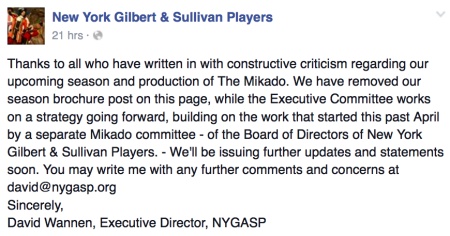
Update, September 17, 7 am: NYGASP has posted the following message on their Facebook page:

NYGASP Facebook post

Update, September 18, 8 am: Overnight, NYGASP announced that they are canceling their production of The Mikado at the Skirball Center, replacing it with The Pirates of Penzance. A statement on their website reads as follows:

New York Gilbert & Sullivan Players announces that the production of The Mikado, planned for December 26, 2015-January 2, 2016, is cancelled. We are pleased to announce that The Pirates of Penzance will run in it’s place for 6 performances over the same dates.

NYGASP never intended to give offense and the company regrets the missed opportunity to responsively adapt this December. Our patrons can be sure we will contact them as soon as we are able, and answer any questions they may have.

We will now look to the future, focusing on how we can affect a production that is imaginative, smart, loyal to Gilbert and Sullivan’s beautiful words, music, and story, and that eliminates elements of performance practice that are offensive.

Thanks to all for the constructive criticism. We sincerely hope that the living legacy of Gilbert & Sullivan remains a source of joy for many generations to come.

David Wannen Executive Director New York Gilbert & Sullivan Players

Update, September 18, 3 pm: The NYGASP production of The Mikado was scheduled to be given a single performance on the campus of Washington and Lee University this coming Monday evening, September 21. As of this afternoon, the production has been replaced with the NYGASP production of The Pirates of Penzance.

*   *   *

Howard Sherman is the interim director of the Alliance for Inclusion in the Arts.


Harassment at a Campus Play About Sexual Violence

September 4th, 2015 § 0 comments § permalink

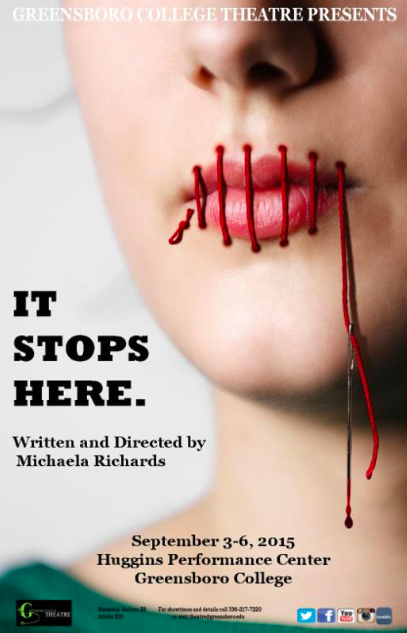
It Stops Here poster

Poster from It Stops Here at Greensboro College

Members of the Greensboro College community have the right to be free from gender-based discrimination, sexual harassment, and sexual misconduct of any kind. 

– from the Greensboro College Sexual Misconduct Policy

To start the new school year, Greensboro College in North Carolina required all of its first-year students to attend a performance of It Stops Here, a play about sexual violence, as part of the college’s newly adopted Sexual Misconduct policy. If that were all there was to report to illuminate how, beyond online training and in-person seminars, the school was employing theatre – a student written and directed play, no less – to confront this topic, it would be a terrific example of the power of theatre. Instead, the first performance of It Stops Here resulted in the harassment of the students performing the play and the opening of a Title IX investigation on the campus within 24 hours of that first presentation. It showed that even the dramatic rendering of sexual violence and its aftermath could provoke vocally insensitive, deeply offensive responses among first year students, and that despite the new steps taken by the school, many more were needed.

*   *   *

In presenting It Stops Here, a project of the college theatre department, it appears that the school’s primary concern was the potential to provoke deeply felt emotional responses in the audience. The play combined the words of the playwright with monologues from survivors of sexual assault that were submitted for use and presented verbatim. There were “trigger warnings” on the show’s promotional materials and an announcement prior to the performance; students acting as ushers were stationed in the aisles with flashlights to immediately assist any student who was overcome and needed to leave quickly.

The production had its first performance, a preview really, at 11 am on Wednesday morning this week, with students required to attend as part of their first-year seminar classes, an ongoing orientation program on how to succeed in college, as the school president described it. Teachers and coaches were to attend with their students, so that the show might provide the basis for further conversation.

“There was a certain segment of the audience that was joking and making crude remarks,” said Luke Powell, a senior theatre major who appears in the play. “One of the first things I noticed was during one of the monologues. One of the girls was doing hers and I could hear that this portion of the audience was catcalling her during this story of a rape victim. That really set me off, because it’s really disrespectful.

“The worst thing that happened,” Powell later said, “was when we get to the end of the play, the stage goes dark and four of the girls do the internal thoughts of a victim during a sexual attack. Some of that group got up to leave, not because they were triggered. Some of the group was saying stuff like ‘oh, you want it,’ and one started making a noise with his hands that sounded like masturbation throughout the five or six minute scene.”

“I expected this to happen,” declared Makenzie Degenhardt, a sophomore theatre major who appears in the play. “It’s a topic people don’t like to talk about. As soon as someone says rape, people get uncomfortable. People make jokes about things they’re uncomfortable with, but in this case it was inappropriate.”

Dagenhardt described hearing, “laughing and reactions that were not appropriate. People were laughing, clapping and encouraging behavior that shouldn’t be happening.” As to how the behavior affected her own performance, Dagenhardt said, “It made me speak louder. When I’m walking down the street and a boy catcalls me, I just ignore it, so I spoke louder to make sure I was heard. I was appalled.”

Dagenhardt said that her initial reaction was, “Oh, boys react like this, this is normal.” But upon reflection she realized, “It shouldn’t be normal. That’s what the point of the show is. If it happens again, I will respond differently.”

Another actor in the play, Emily Parker, a junior theatre major concentrating in musical theatre performance, described being on stage with a male scene partner. “A particular group of boys was talking rudely,” she said. They were talking loudly about how they didn’t want to be there and how they thought he [the male actor] was gay. Typical teenage boy stuff. “He’s so gay’.”

Ana Radulescu, a freshman theatre major concentrating in directing, who was the assistant director for the show, watched from the back of the house. She described the behavior of one pocket of students during the same scene that Dagenhardt referred to. “They did call him a ‘fag’,” she said. “He had a line that said ‘No one in high school ever told me I would have a girlfriend,’ and a bunch of people around me just started laughing.” Radulescu also described hearing a student, as a female actor was speaking on stage, speaking only partially in a whisper to those around him, say, “Whore. Bitch.”

Radulescu also said that another student, seated near where she stood at the back, before the show the show had even started, declaimed things like, “It was consensual – I didn’t rape her” and “I did Haven, I promise.” Haven is the online sexual harassment training all students were required to complete.

*   *   *

Of the five students who spoke on the record for this article, all of them expressed disappointment at the fact that while there were faculty in the theatre during the performance, they were unaware of any efforts by those faculty members to curtail the behavior that continued throughout the show. Several students spoke specifically about the lack of action by the Dean of Students, who they say was seated close to the area that harbored the worst offenders, and couldn’t have possibly missed what was happening. Some students also said that there was less faculty than anticipated, saying that not all of the instructors who were supposed to attend with the students, in order to facilitate subsequent discussion, had been present.

The students who were in the show all expressed, in differing ways, their own indecision about what to do in the face of inappropriate behavior and language. Emily Parker said, “We were in a predicament over whether to confront it or go on with the show.”

Backstage, Rebecca Hougas, a freshman theatre major concentrating in theatre education, was working as assistant stage manager, and said that for much of the play, she wasn’t aware of what was taking place, until late in the show.

“I could hear laughter,” she said, “and I knew this was not a laughing matter.” Hougas said that she really came to understand what was going on by seeing how the actors, who were onstage for most of the performance, reacted when they came offstage. “We had one actor come off the stage in tears over what she was trying to say.”

Several students spoke of actors being physically ill after the performance, and of the company coming together to support one another. Those I spoke with say they were upset upon leaving after the show, even as they had banded together to support one another, but not expecting any significant further fallout from the incident.

*   *   *

I first learned of what had happened at the performance of It Stops Here when, the next day, playwright and advocate Jacqueline Lawton sent me a Tumblr post recounting the event, written by Nicole Swofford, a recent graduate of Greensboro with a theatre degree who is still close with some of the students involved in the production. It described many of the same incidents that were ultimately described to me, but Swofford was also reporting what was said to her, as she hadn’t been at the show.

Swofford was very clear, and very honest, about her intent is posting, writing:

“Greensboro College is a small private college with less than 2,500 students and there hasn’t been a sexual assaulted recorded in the official report in years. Which is a blatant cover to protect the school from getting into to more hot water than it already is (having suffered from lots of financial problems in the past).

This is disgusting, and as a survivor of my own assault, and an alumni of this school I am appalled. All I can ask is that you share this story with everyone, and realize our fight is far from over.”

She had written on Wednesday evening, and her post, along with Facebook posts and comments about the incident, circulated quickly around the campus.

*   *   *

Where this story may differ from other accounts of sexual harassment on college campuses is that, less than 24 hours after the performance, the school opened a Title IX investigation. It did so on its own, not as a result of a specific complaint by a student, faculty or staff member. It is quite possible that this was because students reported Greensboro’s Title IX Coordinator, Emily Scott, as having been present at the performance. Her title at the school also includes “Assistant to the President.”

As information was being routed to me, but before I spoke directly with anyone on campus, a statement from the college president, Dr. Lawrence D. Czarda, addressed the issue in a school-wide communication:

“It has been reported that during a special performance Wednesday of the play “It Stops Here” for First Year Seminar classes, several audience members made comments that were offensive and sexual in nature. Under our new Sexual Misconduct policy, the comments that have been reported qualify as sexual harassment. The Title IX Coordinator has reviewed the reported comments and has asked the Title IX Investigator to gather additional information to determine who is responsible for making the comments. The college is pursuing a formal complaint of sexual misconduct against the students and is working to identify them. Upon results of the investigation, those found responsible will face disciplinary consequences.”

He also wrote:

“However, Wednesday’s incident makes clear that we as an academic and social community still have much to learn. That includes all of us, not just a few students. In addition to the Title IX investigation, the college will be reviewing and discussing the entirety of the context of the incident. Among many other questions, we will address such issues as what faculty and staff who were present might have done differently. Beyond meeting our legal obligations, the College’s goal is to make this incident a learning opportunity for the entire College community.”

When I spoke with Dr. Czarda, he volunteered that, “We do not have a history of sexual assaults on campus.” But he said that in response to the national dialogue about sexual violence, “the board adopted new policies which were put into place July 1. All students were required to take an online training course before the process of moving in. In addition, all students are required to do an on-site training program. All faculty and staff were required to do online and in-person training sessions. The fact that the student production is part of the required training means they’ve heard what these issues are about.”

When asked about what kind of preparation students had been given prior to seeing the play, he cited the online and in-person sexual misconduct training implemented by the school. “Did they know specifically what was going to happen on stage?” Dr. Czarda asked rhetorically, suggesting that they didn’t, that students attended the show without any direct contextual preparation prior to attending. But he said, “I think we did a tolerably good job in prepping the students.”

As to why no member of the faculty or staff intervened in light of the catcalling, insults and disruptions, Dr. Czarda said that was a “key question.” He said, “On the one hand, I have been told that there was some behavior that was not atypical of freshmen,” but he said, “I have not talked to any faculty or staff who heard the comments being made. I’m very troubled by that.” As to whether all faculty who we supposed to attend had done so, he said, “I hope that is not the case.”

Regarding steps being taken to insure that the incident would not recur, Dr. Czarda said that there would be campus security and faculty at every performance; he attended last night’s show. “We will have a very clear, immediate response,” he stated. “I would be totally disheartened and shocked if anything like this happened again.”

The students told me that they had agreed that if there were incidents at subsequent performances, they would simply pause in place until it ceased; some said they might direct their looks to where the believed the interruptions to have come from. Several, jokingly, invoked the name of Patti LuPone and her cellphone incident of earlier this summer.

Luke Powell subsequently reported that the Thursday evening performance had taken place without incident. “I’ve never seen an audience give a standing ovation so quickly,” he wrote.

*   *   *
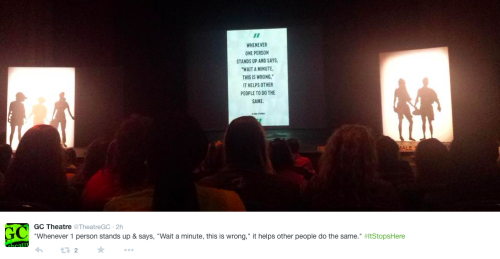
Greensboro Twitter postAs readers can tell from this account, some students who were a part of It Stops Here took me up on my offer to speak with them, others obviously did not, and I don’t think anyone should infer anything from the fact that I did not hear from some. That is their absolute right.

Because institutionally, it is so often the case that in the midst of a crisis organizations initially go silent, trying to decide the best course of action, I have to say that Dr. Czarda’s willingness to speak with me within three hours of my request was both surprising and appreciated.

But I now want to say to Dr. Czarda something I didn’t express when I spoke with him, in part because by the time we spoke, he was getting organized to attend last night’s performance and had limited time. I want to say that while he may be technically correct when he says there is no history of sexual assaults on his campus, that does not mean there haven’t been sexual assaults on his campus, only that they have gone unreported, that they are not part of the school’s records.

Statistically, both on campuses and in the population nationally, sexual assault is too widespread to imagine that Greensboro is a unique sanctuary. Students up until now may have been too afraid, may have been too intimidated, may not have seen genuine evidence of support and understanding in the school environment, prompting them to keep silent. If the prevailing attitude is “it doesn’t happen here” and if the new guidelines have been put in place only to comply with general practice and to insulate the school from future liability, not because of a deep understanding of the prevalence of sexual violence, then there is still a great deal more learning to be done, and not just by the students of Greensboro.

The students I spoke with were uniformly appreciative and indeed surprised by the speed with which the school began its investigation. However, several expressed concern that because the perpetrators sat in the dark and were not immediately discovered and taken out, no one will ever be held accountable. Greensboro College is now on the line both in terms of how it addresses this current situation and what it does now that it has learned that its newly implemented policies are clearly insufficient.

I would also be remiss if I didn’t say to Dr. Czarda and the Greensboro faculty that the students are not only concerned about getting through the performances this weekend. While one noted that they feel “more comfortable knowing that some of the faculty is stepping up and doing their job” and that “the regulations are going to make sure this doesn’t get swept under the rug,” there are now students on your campus who are concerned about recriminations and retaliation because they spoke up, because they spoke out. Beyond insuring the performances go forward smoothly, beyond investigating what took place on Wednesday, you now must do everything possible to make certain that all students connected with this production, and indeed all students (and faculty and staff) are safe and secure on your campus, in the days, weeks and months to come.

What happens at Greensboro in the wake of this incident is not simply a campus matter, but one with impact on every college campus, and for every survivor of sexual assault and their families and friends. If this is what happens when sexual assault is portrayed, what will happen if – and indeed, sadly, when – sexual violence occurs? The school has already been made an example. Now it must demonstrate whether it can set one.

*  *  *

When asked whether they thought that the rest of the audience at Wednesday’s performance had gotten the message of the show, several of the students professed somewhat ruefully that they didn’t know; one said she knew of one student who had expressly communicated how important it had been for her. If the remaining three performances go as well as last night’s did, then hopefully the message of the play will be reaching many more members of the Greensboro College community in the way it was intended to do.

At the conclusion of our conversation, Ana Radulescu summed up so much of what is essential now in regards to Greensboro and It Stops Here.

“We all now understand what those girls who sent us those monologues were talking about. In a way, we were all sexually harassed yesterday and this Title IX report says so. I never knew that through theatre someone could be harassed. Now in six hours, I understand a lot more of what comes out of those girls’ mouths.

“The idea of this piece is to start this conversation. I don’t think we planned on it starting this way. But if you want to look at it, it’s nothing different than what we meant it to do. The fact that it’s not getting ignored is sort of amazing. It has reaffirmed for us that the piece needs to happen, why it needs to happen and why it needs to happen here. If anyone questioned that, well – we have the answer.”

  

Update, September 5: A local television newscast covered the incident at Greensboro College last night. You can view their report here; the video piece is more complete than the accompanying text.

The title of the play discussed in this post is shown on the poster as “It Stops Here” with a period at the end of Here. The punctuation mark has been omitted from the text for clarity.

I attempted to reach the theatre department chair David Schram and Josephine Hull, assistant professor of acting and voice, but neither replied to my inquiries. 

This post will be amended and updated as the situation warrants.

Howard Sherman is the director of the Arts Integrity Initiative at The New School for Performing Arts.
Harassment at a Campus Play About Sexual Violence

September 4th, 2015 § 22 comments § permalink

Members of the Greensboro College community have the right to be free from gender-based discrimination, sexual harassment, and sexual misconduct of any kind. 

– from the Greensboro College Sexual Misconduct Policy

To start the new school year, Greensboro College in North Carolina required all of its first-year students to attend a performance of It Stops Here, a play about sexual violence, as part of the college’s newly adopted Sexual Misconduct policy. If that were all there was to report to illuminate how, beyond online training and in-person seminars, the school was employing theatre – a student written and directed play, no less – to confront this topic, it would be a terrific example of the power of theatre. Instead, the first performance of It Stops Here resulted in the harassment of the students performing the play and the opening of a Title IX investigation on the campus within 24 hours of that first presentation. It showed that even the dramatic rendering of sexual violence and its aftermath could provoke vocally insensitive, deeply offensive responses among first year students, and that despite the new steps taken by the school, many more were needed.

*   *   *

In presenting It Stops Here, a project of the college theatre department, it appears that the school’s primary concern was the potential to provoke deeply felt emotional responses in the audience. The play combined the words of the playwright with monologues from survivors of sexual assault that were submitted for use and presented verbatim. There were “trigger warnings” on the show’s promotional materials and an announcement prior to the performance; students acting as ushers were stationed in the aisles with flashlights to immediately assist any student who was overcome and needed to leave quickly.

The production had its first performance, a preview really, at 11 am on Wednesday morning this week, with students required to attend as part of their first-year seminar classes, an ongoing orientation program on how to succeed in college, as the school president described it. Teachers and coaches were to attend with their students, so that the show might provide the basis for further conversation.

“There was a certain segment of the audience that was joking and making crude remarks,” said Luke Powell, a senior theatre major who appears in the play. “One of the first things I noticed was during one of the monologues. One of the girls was doing hers and I could hear that this portion of the audience was catcalling her during this story of a rape victim. That really set me off, because it’s really disrespectful.

“The worst thing that happened,” Powell later said, “was when we get to the end of the play, the stage goes dark and four of the girls do the internal thoughts of a victim during a sexual attack. Some of that group got up to leave, not because they were triggered. Some of the group was saying stuff like ‘oh, you want it,’ and one started making a noise with his hands that sounded like masturbation throughout the five or six minute scene.”

“I expected this to happen,” declared Makenzie Degenhardt, a sophomore theatre major who appears in the play. “It’s a topic people don’t like to talk about. As soon as someone says rape, people get uncomfortable. People make jokes about things they’re uncomfortable with, but in this case it was inappropriate.”

Dagenhardt described hearing, “laughing and reactions that were not appropriate. People were laughing, clapping and encouraging behavior that shouldn’t be happening.” As to how the behavior affected her own performance, Dagenhardt said, “It made me speak louder. When I’m walking down the street and a boy catcalls me, I just ignore it, so I spoke louder to make sure I was heard. I was appalled.”

Dagenhardt said that her initial reaction was, “Oh, boys react like this, this is normal.” But upon reflection she realized, “It shouldn’t be normal. That’s what the point of the show is. If it happens again, I will respond differently.”

Another actor in the play, Emily Parker, a junior theatre major concentrating in musical theatre performance, described being on stage with a male scene partner. “A particular group of boys was talking rudely,” she said. They were talking loudly about how they didn’t want to be there and how they thought he [the male actor] was gay. Typical teenage boy stuff. “He’s so gay’.”

Ana Radulescu, a freshman theatre major concentrating in directing, who was the assistant director for the show, watched from the back of the house. She described the behavior of one pocket of students during the same scene that Dagenhardt referred to. “They did call him a ‘fag’,” she said. “He had a line that said ‘No one in high school ever told me I would have a girlfriend,’ and a bunch of people around me just started laughing.” Radulescu also described hearing a student, as a female actor was speaking on stage, speaking only partially in a whisper to those around him, say, “Whore. Bitch.”

Radulescu also said that another student, seated near where she stood at the back, before the show the show had even started, declaimed things like, “It was consensual – I didn’t rape her” and “I did Haven, I promise.” Haven is the online sexual harassment training all students were required to complete.

*   *   *

Of the five students who spoke on the record for this article, all of them expressed disappointment at the fact that while there were faculty in the theatre during the performance, they were unaware of any efforts by those faculty members to curtail the behavior that continued throughout the show. Several students spoke specifically about the lack of action by the Dean of Students, who they say was seated close to the area that harbored the worst offenders, and couldn’t have possibly missed what was happening. Some students also said that there was less faculty than anticipated, saying that not all of the instructors who were supposed to attend with the students, in order to facilitate subsequent discussion, had been present.

The students who were in the show all expressed, in differing ways, their own indecision about what to do in the face of inappropriate behavior and language. Emily Parker said, “We were in a predicament over whether to confront it or go on with the show.”

Backstage, Rebecca Hougas, a freshman theatre major concentrating in theatre education, was working as assistant stage manager, and said that for much of the play, she wasn’t aware of what was taking place, until late in the show.

“I could hear laughter,” she said, “and I knew this was not a laughing matter.” Hougas said that she really came to understand what was going on by seeing how the actors, who were onstage for most of the performance, reacted when they came offstage. “We had one actor come off the stage in tears over what she was trying to say.”

Several students spoke of actors being physically ill after the performance, and of the company coming together to support one another. Those I spoke with say they were upset upon leaving after the show, even as they had banded together to support one another, but not expecting any significant further fallout from the incident.

*   *   *

I first learned of what had happened at the performance of It Stops Here when, the next day, playwright and advocate Jacqueline Lawton sent me a Tumblr post recounting the event, written by Nicole Swofford, a recent graduate of Greensboro with a theatre degree who is still close with some of the students involved in the production. It described many of the same incidents that were ultimately described to me, but Swofford was also reporting what was said to her, as she hadn’t been at the show.

Swofford was very clear, and very honest, about her intent is posting, writing:

“Greensboro College is a small private college with less than 2,500 students and there hasn’t been a sexual assaulted recorded in the official report in years. Which is a blatant cover to protect the school from getting into to more hot water than it already is (having suffered from lots of financial problems in the past).

This is disgusting, and as a survivor of my own assault, and an alumni of this school I am appalled. All I can ask is that you share this story with everyone, and realize our fight is far from over.”

She had written on Wednesday evening, and her post, along with Facebook posts and comments about the incident, circulated quickly around the campus.

*   *   *

Where this story may differ from other accounts of sexual harassment on college campuses is that, less than 24 hours after the performance, the school opened a Title IX investigation. It did so on its own, not as a result of a specific complaint by a student, faculty or staff member. It is quite possible that this was because students reported Greensboro’s Title IX Coordinator, Emily Scott, as having been present at the performance. Her title at the school also includes “Assistant to the President.”

As information was being routed to me, but before I spoke directly with anyone on campus, a statement from the college president, Dr. Lawrence D. Czarda, addressed the issue in a school-wide communication:

“It has been reported that during a special performance Wednesday of the play “It Stops Here” for First Year Seminar classes, several audience members made comments that were offensive and sexual in nature. Under our new Sexual Misconduct policy, the comments that have been reported qualify as sexual harassment. The Title IX Coordinator has reviewed the reported comments and has asked the Title IX Investigator to gather additional information to determine who is responsible for making the comments. The college is pursuing a formal complaint of sexual misconduct against the students and is working to identify them. Upon results of the investigation, those found responsible will face disciplinary consequences.”

He also wrote:

“However, Wednesday’s incident makes clear that we as an academic and social community still have much to learn. That includes all of us, not just a few students. In addition to the Title IX investigation, the college will be reviewing and discussing the entirety of the context of the incident. Among many other questions, we will address such issues as what faculty and staff who were present might have done differently. Beyond meeting our legal obligations, the College’s goal is to make this incident a learning opportunity for the entire College community.”

When I spoke with Dr. Czarda, he volunteered that, “We do not have a history of sexual assaults on campus.” But he said that in response to the national dialogue about sexual violence, “the board adopted new policies which were put into place July 1. All students were required to take an online training course before the process of moving in. In addition, all students are required to do an on-site training program. All faculty and staff were required to do online and in-person training sessions. The fact that the student production is part of the required training means they’ve heard what these issues are about.”

When asked about what kind of preparation students had been given prior to seeing the play, he cited the online and in-person sexual misconduct training implemented by the school. “Did they know specifically what was going to happen on stage?” Dr. Czarda asked rhetorically, suggesting that they didn’t, that students attended the show without any direct contextual preparation prior to attending. But he said, “I think we did a tolerably good job in prepping the students.”

As to why no member of the faculty or staff intervened in light of the catcalling, insults and disruptions, Dr. Czarda said that was a “key question.” He said, “On the one hand, I have been told that there was some behavior that was not atypical of freshmen,” but he said, “I have not talked to any faculty or staff who heard the comments being made. I’m very troubled by that.” As to whether all faculty who we supposed to attend had done so, he said, “I hope that is not the case.”

Regarding steps being taken to insure that the incident would not recur, Dr. Czarda said that there would be campus security and faculty at every performance; he attended last night’s show. “We will have a very clear, immediate response,” he stated. “I would be totally disheartened and shocked if anything like this happened again.”

The students told me that they had agreed that if there were incidents at subsequent performances, they would simply pause in place until it ceased; some said they might direct their looks to where the believed the interruptions to have come from. Several, jokingly, invoked the name of Patti LuPone and her cellphone incident of earlier this summer.

Luke Powell subsequently reported that the Thursday evening performance had taken place without incident. “I’ve never seen an audience give a standing ovation so quickly,” he wrote.

*   *   *

Greensboro Twitter postAs readers can tell from this account, some students who were a part of It Stops Here took me up on my offer to speak with them, others obviously did not, and I don’t think anyone should infer anything from the fact that I did not hear from some. That is their absolute right.

Because institutionally, it is so often the case that in the midst of a crisis organizations initially go silent, trying to decide the best course of action, I have to say that Dr. Czarda’s willingness to speak with me within three hours of my request was both surprising and appreciated.

But I now want to say to Dr. Czarda something I didn’t express when I spoke with him, in part because by the time we spoke, he was getting organized to attend last night’s performance and had limited time. I want to say that while he may be technically correct when he says there is no history of sexual assaults on his campus, that does not mean there haven’t been sexual assaults on his campus, only that they have gone unreported, that they are not part of the school’s records.

Statistically, both on campuses and in the population nationally, sexual assault is too widespread to imagine that Greensboro is a unique sanctuary. Students up until now may have been too afraid, may have been too intimidated, may not have seen genuine evidence of support and understanding in the school environment, prompting them to keep silent. If the prevailing attitude is “it doesn’t happen here” and if the new guidelines have been put in place only to comply with general practice and to insulate the school from future liability, not because of a deep understanding of the prevalence of sexual violence, then there is still a great deal more learning to be done, and not just by the students of Greensboro.

The students I spoke with were uniformly appreciative and indeed surprised by the speed with which the school began its investigation. However, several expressed concern that because the perpetrators sat in the dark and were not immediately discovered and taken out, no one will ever be held accountable. Greensboro College is now on the line both in terms of how it addresses this current situation and what it does now that it has learned that its newly implemented policies are clearly insufficient.

I would also be remiss if I didn’t say to Dr. Czarda and the Greensboro faculty that the students are not only concerned about getting through the performances this weekend. While one noted that they feel “more comfortable knowing that some of the faculty is stepping up and doing their job” and that “the regulations are going to make sure this doesn’t get swept under the rug,” there are now students on your campus who are concerned about recriminations and retaliation because they spoke up, because they spoke out. Beyond insuring the performances go forward smoothly, beyond investigating what took place on Wednesday, you now must do everything possible to make certain that all students connected with this production, and indeed all students (and faculty and staff) are safe and secure on your campus, in the days, weeks and months to come.

What happens at Greensboro in the wake of this incident is not simply a campus matter, but one with impact on every college campus, and for every survivor of sexual assault and their families and friends. If this is what happens when sexual assault is portrayed, what will happen if – and indeed, sadly, when – sexual violence occurs? The school has already been made an example. Now it must demonstrate whether it can set one.

*  *  *

When asked whether they thought that the rest of the audience at Wednesday’s performance had gotten the message of the show, several of the students professed somewhat ruefully that they didn’t know; one said she knew of one student who had expressly communicated how important it had been for her. If the remaining three performances go as well as last night’s did, then hopefully the message of the play will be reaching many more members of the Greensboro College community in the way it was intended to do.

At the conclusion of our conversation, Ana Radulescu summed up so much of what is essential now in regards to Greensboro and It Stops Here.

“We all now understand what those girls who sent us those monologues were talking about. In a way, we were all sexually harassed yesterday and this Title IX report says so. I never knew that through theatre someone could be harassed. Now in six hours, I understand a lot more of what comes out of those girls’ mouths.

“The idea of this piece is to start this conversation. I don’t think we planned on it starting this way. But if you want to look at it, it’s nothing different than what we meant it to do. The fact that it’s not getting ignored is sort of amazing. It has reaffirmed for us that the piece needs to happen, why it needs to happen and why it needs to happen here. If anyone questioned that, well – we have the answer.”

  

Update, September 5: A local television newscast covered the incident at Greensboro College last night. You can view their report here; the video piece is more complete than the accompanying text.

The title of the play discussed in this post is shown on the poster as “It Stops Here” with a period at the end of Here. The punctuation mark has been omitted from the text for clarity.

I attempted to reach the theatre department chair David Schram and Josephine Hull, assistant professor of acting and voice, but neither replied to my inquiries. 

This post will be amended and updated as the situation warrants.

Please note: I afford all people the opportunity for healthy debate in the comments section of all of my blog posts, but I will not condone statements which advocate violence, racism or are in and of themselves verbal attacks. That is in no way an abridgment of anyone’s First Amendment rights; this is my right as the author and manager of this site. I will not exercise the removal of comments indiscriminately, but it is at my sole discretion.

Howard Sherman is the director of the Arts Integrity Initiative at The New School for Performing Arts.
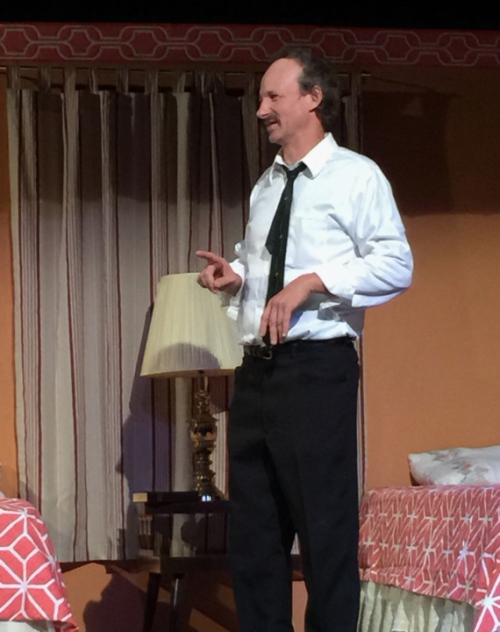
A Critic Reports From The Front Lines of High School Theatre

August 22nd, 2015 § 0 comments § permalink

Les Misérables at Lakeshore College (Photo by Darren Calabrese for The Globe and Mail)

Les Misérables at Lakeshore Collegiate (Photo by Darren Calabrese for The Globe and Mail)

If you haven’t been reading Toronto’s The Globe and Mail every weekend this summer, then you likely haven’t come across J. Kelly Nestruck’s terrific series in which he followed a single high school theatre production of a non-musical adaptation of Les Misérables from start to finish.

It no doubt benefited the youthful-looking Nestruck that he would stand out vastly less among a gaggle of high schoolers than say, me, and it appears to have allowed him unfettered access to the process, the logistics and the emotions that are part of any theatrical production, let alone one in a high school. While Kelly wasn’t undercover at Lakeshore Collegiate Institute, I like to imagine his series as the journalistic equivalent of Cameron Crowe’s original book Fast Times at Ridgemont High, but one set entirely in the drama group.

Because I write so often about crises and conflict in high school theatre, I found Kelly’s series essential, not solely because of one part’s focus on what is “appropriate” for a high school production. It is in my memory the most sustained piece of major mainstream newspaper reporting on high school theatre since Jesse Green wrote about the field for The New York Times in “The Supersizing of the School Play” back in 2005. But Nestruck’s series goes vastly farther than Green’s article in its depth.

Since I am not given to aggregating content, I’d prefer to think of what follows merely as an index, with excerpts that in no way give a full sense of the range of the complete articles and the stories they tell, in the hope that you’ll use this post as a guide to the Globe and Mail’s entire series. (The headline of each section will take you to each separate article.) I think for anyone who cares about theatre – not just high school theatre, but the entire field and it’s future – it’s a must-read.

It’s also my way of asking Kelly to take a bow.

*   *   *

Part 1: A quest to re-discover the magic of theatre, starting in a high-school drama studio

Last fall, approaching my seventh anniversary at the newspaper, I was in crisis about the art form that I had loved since I, myself, was a teenager.

Watching plays at Stratford, or in Toronto, or in Calgary upwards of 200 times a year, I had begun to worry about what I was seeing in the seats around me and on the stages in front of me.

I worried I was writing about an art form still dominated by white directors and playwrights and performers in a country that increasingly was not.

I worried that theatre was becoming an elitist art form whose major institutions were increasingly out of reach of even the middle class, that the core theatre audience was staying white and getting older – and that my profession was swiftly becoming as idiosyncratic and outdated as a mechanic for penny farthings.

Most worrisome of all: I began to lose faith that theatre was worth fighting for. I wondered if the “magic” I had always ascribed to live performance just was a myth I had bought into, and whether more complex and better-told stories – ones that reflect and engage with and interrogate the country and the world we live in – could actually be found on Netflix for a fraction of the cost.

Part 2: Finding a role that fits, on stage and in life

Drama teacher Greg Danakas settles behind a small desk, while 25 students from Grade 10 to 12 gather around him in a circle on the floor. “Let’s read this frikkin’ play!” he says – and you’d never guess the Tim Hortons coffee in front of him was decaffeinated.

“Is anyone Instagramming this?” asks Bradley Plesa, the Grade 12 student who will be playing prisoner-on-the-run Jean Valjean.

Listening to these kids immerse themselves in their characters for the first time, it’s clear how much work – and learning – is ahead of them.

The students pause every page or so as Mr. Danakas defines words such as “cleric” or “consumption” or explains a historical event referenced in the play, like the July Revolution. “It’s a French revolution, not the French Revolution,” Mr. D says – a recurring refrain for the rest of rehearsals.

It’s also clear, however, that Lakeshore’s acting students are up for the challenge. (Unlike me – I reluctantly declined Mr. Danakas’s kind offer to play author Victor Hugo in his dystopian production of the play.)

Part 3: Student actors learn the art of paying your dues

It’s easier for some students at Lakeshore Drama to pay dues than others. Lakeshore, a high school located in south Etobicoke, is not only representative of Toronto’s cultural diversity – but also the city’s economic diversity.

Allan Easton, the school’s new principal, explained the catchment area to me one day over a surprisingly delicious lunch prepared by the culinary-arts students. In the 1980s, Lakeshore was formed by the amalgamation of three schools – an academic-oriented school in a higher-income area, a technical school in a more blue-collar neighbourhood and a third in the centre that was what Mr. Easton calls a “classic public school catering to whoever.”

The demographics of the school still reflect that mix: There are students who live near the water and come from families with incomes that may be significantly six figures, and there are students who live to the east in Toronto public housing. That class disparity is often apparent in the Les Misérables cast – one student contributes to discussions of the play by talking about what she learned on a trip to France, while another shares his experiences growing up in foster care like Cosette.

Many have part-time jobs they struggle to balance with rehearsals – but that hold different importance from person to person. Certain students are saving up to go to expensive universities abroad; others are earning money to help out at home.

Part 4: Censor and sensibility: What’s appropriate for a middle-school matinee?

Mr. Danakas’s most popular production to date was a stage adaptation of Dracula inspired by the 1998 Wesley Snipes movie Blade. It featured 17 vampires who were – in Mr. D’s words – “dressed like prostitutes,” watching the action unfold from scaffolding.

Dracula sold out Lakeshore’s 600-seat auditorium all three nights it played in 2005 – and Kathleen McCabe, the principal then, wrote Mr. D to praise him.

“I am sure that producing a high school play may have limited your true creativity because of the censoring that I imposed on you,” she wrote in the letter, which Mr. D has framed and hung on his office wall. “However, you were able to design an amazing play and keep it on the edge.”

Times have changed, however – and now it’s Mr. Danakas who has to censor himself. “I wouldn’t be able to do Dracula now,” he says with a sigh.

The drama teacher is continuing to deal with fallout from his relatively tame, gender-bending Three Musketeers from last year.

Mr. Danakas had d’Artagnan – who wants to join the Musketeers – played by a female student and decided to deal with the implications of dropping a woman into the jocular world of 17th-century French swordsmen.

Athos, Portho and Artemis gradually gained respect for d’Artagnan, but they behaved chauvinistically toward her in the early scenes. “I thought it was totally harmless, juvenile silliness,” Mr. D says.

That’s not what a couple of local middle-school teachers thought of the groping and crude gestures with épées, however. They pulled their classes out of a matinee due to the sexual slapstick.

Part 5: Set up to fail? Less drama in schools could hurt theatre industry

As opening night of Les Misérables gets closer and closer, more and more people become involved beyond Mr. Danakas’s Acting Class – and more and more elements move outside of his direct control. Cosmetology students are working on the hair and make-up; business students are planning front-of-house operations; and the after-school sewing club is making long, black skirts for all the young women to wear in Mr. D’s non-musical, dystopian take on Victor Hugo’s classic tale.

On top of that, Timothy O’Hare, Lakeshore’s shop teacher, runs an entire for-credit class devoted to the design and construction of the set. I pop by the Toronto high school one morning in early May to see them at work. Instead, I find a handful of students studying or on their phones under the supervision of a substitute teacher, while a documentary about the history of sneakers plays unwatched.

Mr. O’Hare – who is much-loved by his students and doesn’t seem to mind his nickname “Mr. No Hair” – is away with much of the class at the Ontario Technological Skills Competitions. Grade 11 students Lamisa Hasan, Nicholas Latincic and Shamar Shepherd – who all had to stay behind for various reasons – happily leave the doc behind to talk to me about how they collectively designed and built the Les Misérables set.

Part 6: Tale of the red tape: Even in high school, bureaucracy can frustrate art

Allan Easton, the patient and good-humoured new principal at Lakeshore, walks me through some of what is holding up Mr. Danakas’s production. The worry about the fog machine is that it will set off the smoke detectors. The detectors could be bypassed, but then staff would have to be paid to walk around and look for fires – $1,200 in overtime for three nights.

Painting the floor, meanwhile, could be a problem because it might impinge on the skilled trades. “I can’t ever be seen to be taking a union job away from anybody,” Easton explains.

Health and safety concerns also complicate Les Misérables. I remember climbing up on ladders to help hang and focus the lights in my high school auditorium, but Lakeshore’s 1950s-built catwalks are off-limits to all (teachers aren’t even supposed to get up on a ladder, so an adult volunteer did that work on borrowed scaffolding). “Even our caretakers have to have ladder training before they can use a ladder safely,” Easton says. “We’re a very litigious society now.”

As for budgeting, Mr. Danakas used to roughly estimate his ticket revenue, but now sales have to be carefully projected. “ ‘It should be fine,’ isn’t something I can go with any more,” Easton says, with a sympathetic shrug. “Accountability is huge – more than it was in the past. … Taxpayers’ money, right?”

Part 7: Masters of the house: The payoff that makes the gruelling weeks of drama worthwhile

Even at Les Misérables though, it’s clear different audience members want different things. There’s Caroline Buchanan, for instance, described to me as the ultimate drama mom. Not only is her daughter, Samantha Dodds, playing Madame Thénardier, but her partner, Jim Ellis – a 60-year-old management consultant and part-time voice-over artist – has been conscripted to play the role of Victor Hugo.

Ms. Buchanan was one of the first in line to make sure she got good seats – and was primed for a moving experience. “I don’t know why, but it’s very emotional for me,” she says. “There’s so much lead-up – and you see what they all go through. And now it’s here.”

Sara and Alexander Plesa, Bradley and Samantha’s parents, are more skeptical about theatre in general. “I’ll be completely honest, where I’m not the ‘drama mom’ is that school comes first, grades come first and this comes last,” says Ms. Plesa, who works in a civilian role for the Toronto Police and affectionately calls her kids “drama brats.” “I’ll fight with Bradley to the end of time on that – and Mr. Danakas.”

But the Plesas have had a number of personal setbacks over the past year, with Mr. Plesa’s cancer diagnosis, cruelly, coming just as he was on the verge of being hired by the police. Their children’s performances tonight have surprised them – particularly boisterous Bradley’s deeply centred Jean Valjean.

“You wouldn’t know that their life has been the way it has been [lately] by watching that,” Ms. Plesa says. “It’s almost flooring to me: Is that my son?”

Part 8: Exit stage left: Lakeshore Collegiate’s drama students take a final bow

I came to Lakeshore with a naive point of view. I really did want to renew my faith in theatre after becoming frustrated with professional theatre in this country – and rediscover the joy of theatre I had felt as a high school student myself. But you only get to be a teenager once. And what I found when I looked at high school drama through an adult critic’s eyes were things I hadn’t noticed the first time around. I found an acting class that wasn’t fully representative of the racial diversity of its school, and that it was easier for students from certain economic classes to participate than it was for others.

I found a high school theatre with less money and less audience than it used to have, and more hoops to jump through, set up by administrators and unions. I found bureaucracy and I found self-censorship – and I found art’s value being sold with the language of business.

But what I ultimately discovered at Lakeshore is that the dissatisfaction that I’ve been feeling about the professional Canadian theatre I cover as a critic isn’t really about theatre at all, but about the wider society that theatre exists in and reflects. If theatre and democracy have indeed been linked since ancient Greece, then it makes sense that theatre would suffer from the same problems as our democracy – which is also unfair and bureaucratic and filled with leaders who speak to taxpayers instead of citizens.

*   *   *

Again, bravo to everyone – the teachers, the students, the administrators, the parents and the reporter. Bravo.

All excerpts from the series High School Drama by J. Kelly Nestruck from The Globe and Mail, originally appearing between July 3 and August 21, 2015.

Howard Sherman is director of the Arts Integrity Initiative at the New School for Performing Arts.