Kent State Coda: No Black MLK Ever Reached Their “Mountaintop”

November 16th, 2015 § 0 comments § permalink

Robert Branch and Camila Christian in The Mountaintop at Kent State University

Robert Branch and Camila Christian in The Mountaintop at Kent State University

In the many press accounts of director Michael Oatman casting a white man to play Dr. Martin Luther King in Katori Hall’s The Mountaintop, stories have all acknowledged Oatman’s original concept of splitting the role between black and white actors. His intent was, in his words:

“I truly wanted to explore the issue of racial ownership and authenticity.  I didn’t want this to be a stunt, but a true exploration of King’s wish that we all be judged by the content of our character and not the color of our skin,” said Oatman about his non-traditional cast.  “I wanted the contrast . . . I wanted to see how the words rang differently or indeed the same, coming from two different actors, with two different racial backgrounds.”

That narrative has prevailed, even when Katori Hall let it be known that she did not and would not ever approve of a white actor playing King in her play. Just as I had in my original post on this incident, she wondered why the black actor sharing the role was so little in evidence. Even after speaking with Oatman, Hall wrote:

“It’s true that Oatman only fell halfway off the ‘turn-up’ truck; the white actor was indeed sharing the role with another black actor. But the fact that this mystery actor has remained nameless further demonstrates the erasure of the black body in this experiment. Even on the school newspaper’s website, only the white actor’s name is listed.”

As it turns out, the reason this black actor is so scarce is because no black actor performed in the role of Martin Luther King at Kent State. As part of an interview with Oatman, the Akron Beacon Journal reports:

“At Kent State, Oatman originally double cast the King role, with white actor Robert Branch for three performances and a black actor for five shows. When more than one black actor dropped out due to family and other personal issues, Branch, whom Oatman described as one of the best actors he’s ever seen, assumed all eight performances.”

Even if one gives credence to Oatman’s intellectual basis for attempting to split the role, it evaporated along with the unnamed black actor, regardless of Branch’s talent. At that point, the already unjustifiable production should have been irrevocably abandoned, since the entire conceptual underpinning had come undone. What Oatman did was not a half-measure, as Hall was apparently led to believe, as we were all led to believe, but indeed the complete erasure of a black body as she had feared. There was no rationalization left, yet despite the intense press interest since Hall published her essay on TheRoot.com, Oatman at best quietly allowed a myth to be sustained, or at worst actively sought to keep the truth of the production secret to anyone interested, until this interview.

That this fact is virtually an aside in the Beacon Journal’s follow-up, which largely affords an unfettered opportunity for Oatman to advance his reasoning yet again, with nothing but quotes from Hall’s essay as pushback, seems a conscious effort to minimize the facts of the narrative. In citing supportive messages from friends on Oatman’s Facebook page, and noting that there were only a few walkouts as if that made the casting acceptable, the Beacon Journal is complicit in failing to address the willful lack of fidelity to the playwright’s intent. Where are the quotes from Hall’s friends, who were outraged. In addition, by saying at one point of Hall that “she railed,” rather than “she wrote,” there is also an implication that Hall’s thoughts on this issue were somehow not presented in an “acceptable” manner, another unfortunate choice.

So the summary of the Kent State Mountaintop story is: the creative decision was faulty to begin with, ultimately abandoned (no matter what the reason) and possibly kept secret even as scrutiny was focused on the production. Whether by omission or misdirection, Oatman has compounded his troubling creative decision immeasurably.

Though Oatman has said he wouldn’t make this particular choice again, he seems unbowed by the response from Hall and the playwriting community. He told the Journal:

“I think artists get too touchy about this kind of stuff,” he said. “I think whenever you make a controversial decision like this you have to allow the audience their space to react as they’re going to react. That’s what theater is about.”

If a director’s ethical and legal responsibility to other artists is dismissed as being “touchy,” indeed by someone who is primarily a playwright, any questions about Oatman’s judgment in this case should no longer be in question. He finds widely accepted professional practices to be a nuisance, when they are fundamental to the field he works in.

If his goal was to court controversy, Oatman has probably succeeded beyond his wildest dreams, and there may be more yet to come. But if his goal was to illuminate Katori Hall’s play for audiences, it’s quite clear that he failed, even if people applauded. He may have thought originally that what he was doing wasn’t a stunt, but in the end, that’s just what it turned out to be.

Update, November 16, 4:45 pm: In sharing my post on Facebook, Katori Hall prefaced it, in part, with the following statement:

“…When I spoke to Michael Oatman via phone October 27th, he never disclosed the fact that the black actor never went on, even when I questioned the validity of his social experiment of seeing if the ‘words rang differently or indeed the same, coming from two different actors, with two different racial backgrounds.’

I learned that the black actor never went on when Oatman was interviewed Friday night by Don Lemon on CNN. Surprise, surprise.

Many journalists in the media have portrayed me as outraged (The Wrap, NY Daily News, Washington Times, Playbill). I have supposedly ‘fumed’. I have supposedly ‘slammed.’ Shout out to TIME and TheRoot.com who used much more honest language. Yes, I criticized the casting choice and yes I explained my position why….

Yes, it is unfortunate that in 2015, a young black female artist who demands that her work be respected and puts forth a valid and articulate response is characterized as merely throwing a temper tantrum.”

Howard Sherman is the interim director of the Alliance for Inclusion in the Arts and director of the Arts Integrity Initiative at The New School College of Performing Arts School of Drama.

Clarion Call Of Racial Spin By University Fails Students And Theatre

November 16th, 2015 § 6 comments § permalink

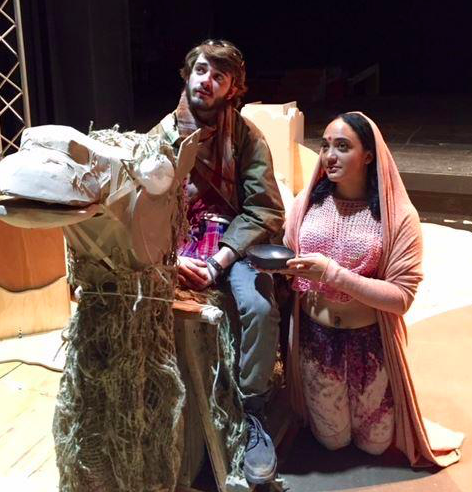
Poster for Jesus in India at Clarion University

Poster for Jesus in India at Clarion University

“What will you learn?” asks the home page of the website of Clarion University in Pennsylvania. In the wake of the school’s handling of the casting of white students in Asian roles in Lloyd Suh’s Jesus in India, and the playwright’s withdrawal of production rights upon learning this fact, it’s unclear at best, disturbing at worst, to consider what Clarion wants students to learn about race and about the arts.

Based on what is appearing in the press, they are learning to blame artists for wanting to see their work represented accurately. They are learning to attack artists when the artists defend their work. They are learning that a desire to see race portrayed with authenticity is irrelevant in an academic setting. They are learning that Clarion seems unaware of the issues that have fueled racial unrest on campuses around the country, most recently with flashpoints at the University of Missouri and Yale University. They are learning that when a community is overwhelmingly white, concerns about race aren’t perceived as valid.

In an essay published in the Chronicle of Higher Education on Friday, Marilouise Michel, professor of theatre and director of the canceled production, wrote, “I have intentionally left out the name of the playwright and the piece that we were working on as I do not wish to provide him with publicity at the expense of the fine and viable work of our students.” What’s peculiar about that statement is that until 1:30 pm that day, when he released a statement, the playwright hadn’t sought for this issue to be public in any way. It was Clarion that had contacted the press, Clarion which had released his correspondence with Michel, and Clarion which used a professional public relations firm to issue a statement about the situation from the university and its president. It reads, in part:

The university claims their intent from the start was to honor the integrity of the playwright’s work, and the contract for performance rights did not specify ethnically appropriate casting. Despite the university’s attempt to give Suh a page in the program to explain his casting objections and a stage speech given by a university representative on the cast’s race, Suh rejected any solutions other then removing the non-Asian actors or canceling the production.

“We have no further desire to engage with Mr. Suh, the playwright, as he made his position on race to our theater students crystal clear,” says Dr. Karen Whitney, Clarion University President. “I personally prefer to invest my energy into explaining to the student actors, stage crew and production team members why the hundreds of hours they committed to bringing ‘Jesus in India’ to our stage and community has been denied since they are the wrong skin color

This insidious inversion of racial justice is profoundly troubling. The play, set in India, has three characters named “Gopal,” “Mahari/Mary,” and “Sushil,” a strong indication of their race. Suh maintains that the university was asked about their plans to cast those roles, and his agent Beth Blickers says no answer was ever given. But when the playwright finally drew a line over racial representation, he was the one who was supposedly denying skin color, when it was Michael’s personal interpretation of the play, against clear evidence and requests, which was ignoring race in the play. So now, one must wonder whether Dr. Whitney will be spending time explaining to the students of color on campus why she is vigorously defending the practice of “brownface” on campus (white actors portraying Indian characters, regardless of whether color makeup is actually employed) and attacking a playwright of color for decrying the practice.

To be clear, there is undoubtedly great disappointment and pain among the students and crew who had been working on the production. Anyone in the arts will surely sympathize with them for having invested time and effort towards a production that they surely undertook with the best of intentions. But they were, most likely unwittingly, made complicit in the act of denying race and denying an artist’s wishes.

In the university’s press release, the extremely small Asian population of the school is noted (at 0.6% of the student body), as it has been previously in many reports. That no Asian students auditioned should not have been surprising, nor should it have been license to substitute actors of others races as a result. Any director who is part of an academic theatre program has a very good idea of what talent may be available, and often productions are chosen accordingly. So it is not the failure of Asian students to audition to blame for the inaccurate racial casting. More correctly it was the decision to produce a play which clearly called for Asian characters and the assessment that race didn’t matter that created this situation – not Lloyd Suh or any student.

In the Chronicle, Harvey Young, chair of the theatre department at Northwestern University, admittedly a more urban school, says the following regarding racial casting on campus:

“That is the magic of the university — to introduce people to a variety of perspectives and points of view.”

But at Northwestern, Mr. Young said, the department uses a variety of strategies to avoid what could be racially problematic casting. The department has hired outside actors to play some roles and serve as mentors to students, reached out to minority groups to let them know about acting opportunities, and staged readings at which only voices are represented.

“The goal is to devise strategies that allow you to engage the work while being aware of whatever limits exist,” Mr. Young said.

In her essay for the Chronicle, Michel wrote, “Perhaps Shakespeare would wince at a Western-style production of The Taming of the Shrew, but he never told us we couldn’t. He never said Petruchio couldn’t be black, as he was in the 1990 Delacorte Theater production starring Morgan Freeman.” This is a specious and rather ridiculous argument, since Shakespeare’s work is not under copyright and can be cast or altered in any way one wishes. While there are certainly examples of actors of color taking on roles written for or traditionally played by white actors – NAATCO’s recent Awake and Sing with an all-Asian cast playing Clifford Odets’s Jewish family, the Broadway revival of Cat on a Hot Tin Roof with a black cast playing Tennessee Williams’s wealthy southern family – they were done with the express approval of the rights holders. That these productions were in New York as opposed to Clarion, Pennsylvania makes no difference as to the author’s rights. What we have not seen is an all-white Raisin in the Sun, either because no one has been foolish enough to attempt it or because the Lorraine Hansberry estate hasn’t allowed it.

Clarion’s press efforts have certainly paid off in the local community, with three news/feature stories in the Pittsburgh Post-Gazette (here, here and here) as well as an editorial, along with two features (here and here) in the Chronicle of Higher Education, in addition to the aforementioned essay. That the Post-Gazette’s editorial sides entirely with Clarion is no surprise, since the university was driving the story; that it fails to take into account any reporting which runs counter to Clarion’s narrative, and indeed repeats them, is shameful, a disservice to the Pittsburgh community. That the Chronicle of Higher Education ran Professor Michel’s essay, another one-sided account of the situation, is problematic, but the headline (whether it is theirs or Michel’s), “How Racial Politics Hurt My Students,” is a clarion call for paranoia about race. It ignores the fact that the problems arose from a failure to respect the work and the playwright, that the issue is based not in politics, but in art, and that the author saw his work being defaced and stood up for it. There have been countless other reports on the situation. That this has engendered vile racist outpourings online, especially in comments sections and on Facebook, and in some press accounts is the result of the university’s irresponsible spin.

Universities are in no way exempted from professional standards when it comes to licensing and producing shows; to claim otherwise is to suggest that campuses are bubbles in which the rules of the real world do not apply. While classrooms are absolutely places for exploration and discovery, theatre productions of complete works for audiences are not just educational exercises. Students need to be taught creative and legal responsibility towards plays (and musicals) and their authors, not encouraged to take scripts as mere suggestions to be molded in any way a director wishes. When it comes to race, this incident and the recent Kent State production of The Mountaintop will now insure that every playwright who cares about the race of their characters will be extremely explicit in their directions, but that doesn’t excuse directors who look for loopholes to justify willfully ignoring indications in existing texts.

It’s my understanding that there has been new contact between Michel and Suh, though I am not party to its nature or content. It’s worth noting that in the third Post-Gazette story, it is reported that “Ms. Michel took to Facebook Saturday to ask “that any negative or mean-spirited posts or contact towards Mr. Suh be ceased. We are both artists trying to serve a specific community and attacking him helps no one.” That’s a responsible position to take, but it should be expanded to include negative posts or contact about the accurate portrayal of race in theatre, since they are flourishing in the wake of this incident.

It is also now time for the university to explain the truth about why the production was shut down, namely a failure to respect the artistic directive of the playwright; insure that this incident and the rhetoric surrounding it hasn’t been a license for anyone to marginalize their students of color; and begin truly addressing equity and diversity on their campus. Regardless of the racial makeup of their community or student body, they need to be setting an example and creating a better environment for all students, not feeding into narratives of racial divisiveness.

Update, November 18, 7 pm: Earlier today, the Dramatists Guild of America released a statement regarding the organization’s position on casting and copyright, signed by Guild president Doug Wright. It reads, in part:

One may agree or disagree with the views of a particular writer, but not with his or her autonomy over the play. Nor should writers be vilified or demonized for exercising it. This is entirely within well-established theatrical tradition; what’s more, it is what the law requires and basic professional courtesy demands.

Howard Sherman is interim director of the Alliance for Inclusion in the Arts and director of the Arts Integrity Initiative at The New School College of Performing Arts School of Drama.


Erasing Race On Stage At Clarion University

November 13th, 2015 § 14 comments § permalink

Rehearsal for Jesus in India at Clarion University

Rehearsal for Jesus in India at Clarion University

“The students are victims,” writes playwright Lloyd Suh, regarding the events that led to his play Jesus in India being canceled a little more than a week before it was to be produced at Clarion University in Pennsylvania. Presumably, anyone learning of students who have been preparing a production for weeks, only to not be able to present it to audiences, would agree with that statement, no matter what they may think of the circumstance surrounding the cancelation, first reported in the Pittsburgh Post-Gazette. It is truly unfortunate. But there are larger issues and perhaps greater lessons at stake.

As many others have reported, Suh wrote earlier this week to Marilouise Michel, professor of theatre in the Department of Visual and Performing Arts at Clarion, asking that either three roles written as Indian characters but cast at Clarion with two Caucasian students and one mixed race student, either be cast with students of color or the production canceled. The university theatre department opted for the latter.

* * *

Regarding the casting of Caucasian students in specifically ethnic roles, Michel said, “I realized that the Jewish characters were from Palestine. In my mind, to truly cast them correctly they would have had to be Palestinian, I guess, and the Indian characters would have to be Indian. But I read Mr. Suh’s program notes from the production at the Magic Theatre in San Francisco, where he specifically states that the play is for anybody, the play is universal. Perhaps I misunderstood what he meant, but I thought I was taking him at his word, so I cast it without thinking what color people were at all. I would have cast a black Jesus if I had the right person for the role. I wasn’t thinking that this was a play about race. When I do plays about race, I try to be extraordinarily sensitive to those issues.”

In a statement, included below in its entirety, Suh speaks specifically to his comment, writing, “Much has been made of an interview I gave years ago in which I used the word ‘universal’ to describe the play. But universal does not and should not mean white, or the privilege of ignoring race. I wish it were not so difficult to accept that an actor of color, playing a character of color, could convey something universal. To understand that white actors should not be the default option for any role. To recognize that people of color are not simply replaceable.”

Regarding casting beyond the specifics of a script, Michel said, “It’s not unusual in college productions to change the gender of a character to offer opportunities to the students that are available.” Asked whether approval for such changes are sought from playwrights or their representatives, she said, “I don’t deal with the contracts. The department chair and the student association deal with the contracts. But should it seem like we’re doing something that’s against the contract, we would definitely address it. I always check with my superiors if I think that’s going to be an issue.” The superior she was referring to was department chair Bob Levy, who declined via e-mail to be interviewed for this piece.

She continued, “We’ve never done it in a play where we thought race was an important issue of the script, or the gender was an important issue of the script. Sometimes the director might address the issue in the program of why it was done. While I hesitate to connect myself to Michael Oatman [director of The Mountaintop at Kent State where a white actor was cast as Martin Luther King], it would be similar in that it’s an academic exercise of, ‘what if?’ which is what we do in acting.”

As for the issue of race in Jesus in India, Michel said, “I don’t feel like it was the focus of the play. I feel like the focus teenagers coming of age and maturing, and that’s what spoke to me about the script and led me to think this would be a wonderful opportunity for the students in my program.”

To Suh, authentic representation of race is essential. He wrote, “I could not allow the play to be performed with white actors in non-white roles before a public audience. This is not a unique position. It is not strange or radical. It is common industry practice that productions of copyrighted plays adhere to the requirements of the text. In addition, as a writer of color in a field where representation and visibility are ongoing struggles, I feel a responsibility to provide opportunities for artists of color to be seen, and to protect that work from distortion in the public eye. The practice of using white actors to portray non-white characters has deep roots in ugly racist traditions. It sends a message, intended or not, that is exclusionary at best, dehumanizing at worst.”

Michel noted that, in planning the production, “I was expecting controversy, but I wasn’t expecting this.” She explained, “In my little small, conservative community I had Jesus saying ‘fuck ‘ over and over. He’s smoking weed, he’s got a girl, he gets a girl pregnant, he screams ‘I pulled out’ at one point. He says ‘My god damn father.” All of which I’m cringing at, thinking, I have to be brave and represent this playwright’s work. We’re going to be pickets by the conservative Christians. I’m getting e-mails from conservative Christians saying their prayers have been answered, implying we got what we deserved. They’re so glad that this play is not going to be produced in our community, because it portrays Jesus as different from the Bible.”

* * *

Clarion University’s Home Page

Clarion University’s Home Page

Clarion University is a small state university in Western Pennsylvania, with a student body of approximately 5,700 students in total, 4,900 being undergraduates, according to data from the National Center for Education Statistics. The school body is 83% white, 7% black, 2% Latino or Hispanic, 2% multiracial and 1% Asian. The Pittsburgh Post Gazette reported the Asian student body as being below 1%, but in real numbers on a campus of 5,700, 1% translates to a total of 57 Asian students. How must they feel in the midst of all this? These numbers do contrast with the representation of diversity implied by the university home page (shown at right) in which the racial representation seems much more broadly spread.

In light of the protests at the University of Missouri and Yale University in recent weeks, the subject of racial representation on campuses is top of mind for many people, and it certainly should extend into performing arts programs. On the one hand, the decision of the theatre program to produce a show set in India with Indian characters is an admirable step towards addressing diversity, but the likely inability to cast roles without racial authenticity calls into question whether the choice would ultimately make students of color feel included.

After what has transpired this week, will Michel think differently when producing works in which there are characters of color? “Well of course,” she replied, “particularly with living playwrights.”

Clarion’s website outlines an array of programs to address gender, racial and disability diversity. But despite the public controversy surrounding Jesus in India, Michel says that she has not spoken with anyone in those programs about what has transpired. “No one has reached out to me at this point,” she said.

* * *

It’s important to know that the planned production of Jesus in India at Clarion transformed the play, which had a few songs, into a full-blown musical. With permission from the playwright, Michel commissioned an original score which ran to 21 songs and underscoring. The playwright and his agent approved the composer, but for this one production, did not seek approval over the material itself. However, that did not extend to other approvals, for which the contract noted that the playwright’s approval was required.

Beth Blickers, Suh’s agent, commented that while she had inquired about the racial casting early on, and was told it was too early to know, but there was considerable communication about the new score.

“I think the music change is the key factor,” said Blickers. “That’s the thing they understood. The issue about ethnicity, they were reasonably oblivious to. They acknowledged that I asked and they belatedly said it wasn’t cast yet and then they forgot.”

Michel said that she had asked several times to confer with Suh, but was told he was unavailable. She said, “I believe that a dialogue early on, it would have come clear what his priorities were, that I wasn’t seeing things the way he was. I don’t disagree with his right to feel the way he does about his work. I just wish I had known, so that either we could have had a meeting of the minds or I wouldn’t have invested my time and my students in this venture.” Blickers said that Suh was wrapped up in other productions and family issues and didn’t have the time to visit Clarion or consult with them.

There has also been considerable discussion online over the timing of Suh’s letter, which he addresses in his statement. Michel says that it is her understanding that the contract was in force as soon as the university signed it and sent a $500 payment, and that since the check was cashed, all was in place. Blickers says that the contract was never received and that while the $500 check was cashed (and is now being returned), the contract was never signed by the playwright, and therefore the contract was not in force. Suh asserts that the first time he realized the play was going into production was via a posting of rehearsal photos on Facebook.

* * *

I have advocated previously about the rights of artists, most often playwrights, to control their work, and on the heels of the controversy over Jesus in India and The Mountaintop, I feel it’s incumbent upon me to restate that university productions are not exempt from copyright law or licensing contracts. While academic exploration in a classroom of a scene from a play which allows an actor to explore a role written for someone of another race may prove valuable, once the work is presented in front of an audience, or in its entirety, whether only to a university-based audience or the general public, the playwright’s wishes must take precedence. I say that from both an ethical and legal standpoint.

As for the idea that race doesn’t always matter or isn’t central to a particular work, if the playwright has indicated characters of a certain ethnicity, that should be adhered to, permission should be sought to make a change, or another work should be chosen. While Jesus in India may be still in manuscript form, and therefore lacking in some of the details an officially published script may contain, the combination of the title and character names of “Gopal,” “Mahari/Mary,” and “Sushil” seem quite specific. To assume that this information isn’t central to the playwright’s vision and the actors chosen to portray them needn’t be specific seems a willful overlooking of the context of the work, even if the race is not explicitly stated in the script or licensing agreement. As I wrote about The Mountaintop, and Katori Hall has done and Suh will now do, this seems to require even more specificity from playwrights, to insure their wishes are followed. This is not an effort to be racially divisive, but rather to insure that roles for artists of color remain in their grasp, in part to address the ongoing inequities in racial roles and racial casting.

“The conversation is how far are we going to take this,” Michel said to me, “with truly understanding all points of view, to not be a part of diminishing anyone’s pain or experience. I don’t want to diminish that, I just want to know how to make it right and tell stories that aren’t just about white girls.”

Given the makeup of the student body at Clarion, I understand the challenge. But the discussion is not so granular as wondering whether only actors of Irish descent should play Irish roles, as Michel asked me rhetorically in reference to an upcoming Clarion production. Instead, it is about insuring that roles written for people of color are never diminished, or to use Katori Hall’s word, “erased.”

And despite the pictures on the school’s website, if the theatre department is to be able to do shows about more than just “white girls,” it seems the university must address broadly diversifying the student body, not just so more plays can be done authentically, but so people of color are indeed not minorities on the campus, but truly well-represented in the school community, thereby enhancing and informing every aspect of campus life.

* * *

Earlier this morning, the official Clarion University Twitter feed contained the following message: “With the cancellation of ‘Jesus in India’ we hope to reflect upon how race and culture should relate to creative works such as these.”

As painful as this experience has been for all concerned, this seems a positive step. If indeed Clarion follows through, I hope they will avail themselves of resources in the theatrical community, who I have little doubt would be willing to travel to western Pennsylvania to participate in that process in a positive and supportive manner. And I’m willing to drive the van.

* * *

FULL STATEMENT FROM LLOYD SUH

Regarding the cancellation of my play JESUS IN INDIA at Clarion University, I hope the following statement clarifies my entire position.

My first contact with Clarion was in January, when Marilouise Michel requested a copy of the play and invited me to work on it with her students. Due to other commitments, I was unable to participate, but I did express willingness to let them use the play for classroom purposes without me.

I didn’t hear anything again until late May, when I was informed they were experimenting with the piece as a musical. It is highly atypical to do such work without direct collaboration from the author, so I asked for more information. In particular, if their exploration was simply for private, in-class use, I was happy to let them do whatever they desired. Although I could not participate directly, I was certainly curious what they might discover. However, if their intention was a full production with a public audience, I asked specifically whether they would be able to honor the general ethnicity of the characters.

I did not hear anything else from anyone at Clarion again until October 30, well into the rehearsal process.

I was not informed that a production was taking place.

I was not informed about any casting activities.

I was not informed about any license agreement granting rights to perform the play. It has since been confirmed to me that while negotiations towards an agreement did occur through my agent, no agreement was ever executed, meaning Clarion’s right to perform the play was, in fact, never granted.

Instead, on October 30, I was asked whether I would be able to Skype with the actors. Usually my response would be of course. However, because I had no idea a production was even taking place, my reaction was What?

So I searched online to find out what was happening, and saw photos that seemed to show two of the Indian characters portrayed by Caucasian actors, in total disregard for my earlier query. My agent immediately wrote to Ms. Michel for clarification. Her response on November 2 acknowledged receipt of our previous question on casting, but in her words:

“When you asked, I hadn’t cast the show, and then I forgot.”

On November 9, after confirming that a fully executed license agreement did not exist, I sent an email to Ms. Michel insisting that she either recast, or cancel the production. I absolutely understand that this has caused anger, confusion and disappointment among the actors and crew that had been hard at work on the piece. I do not take that lightly. The students are victims, and the timing of this mess has raised many questions. But the timing was never in my control.

I could not allow the play to be performed with white actors in non-white roles before a public audience. This is not a unique position. It is not strange or radical. It is common industry practice that productions of copyrighted plays adhere to the requirements of the text. In addition, as a writer of color in a field where representation and visibility are ongoing struggles, I feel a responsibility to provide opportunities for artists of color to be seen, and to protect that work from distortion in the public eye. The practice of using white actors to portray non-white characters has deep roots in ugly racist traditions. It sends a message, intended or not, that is exclusionary at best, dehumanizing at worst.

This includes university theater programs, which are a crucial part of the way professional theater is born. We are witnessing a moment on multiple college campuses where racial tensions are undeniable and extremely dangerous. I cannot grant university programs an allowance on these matters that I would never grant a professional theater.

Much has been made of an interview I gave years ago in which I used the word “universal” to describe the play. But universal does not and should not mean white, or the privilege of ignoring race. I wish it were not so difficult to accept that an actor of color, playing a character of color, could convey something universal. To understand that white actors should not be the default option for any role. To recognize that people of color are not simply replaceable.

It was not my intention to debate this matter in public. I attempted to settle the issue privately, but Clarion’s insistence on involving the press and releasing my personal communication has made this statement imperative. I am now grateful for that opportunity, as I hope this clears the air on my intentions, and the circumstances under which this cancellation has taken place.

* * *

Update, November 16 at 12 pm: I wrote more about the cancelation of Jesus in India at Clarion University, and the school’s public relations campaign against such. Read that post by clicking here.

Update, November 19 at 8 am: While it is only one issue in the discussion of Jesus in India at Clarion, and in my opinion notably subordinate to the central issues of artists’ rights and racial representation, I have continued to explore the topic of whether the play had been properly licensed. After conversations with both parties, as well as licensing companies that regularly contract for non-professional productions regarding common practices, I can say that there were some factors which could have led the theatre faculty at Clarion to believe they had licensed the play.

While the totality of the agreement prepared by Suh’s agency required signatures by both parties, a phrase early in the agreement (“when signed by you” as opposed to, say, “when signed by us both”) could suggest that only an official Clarion signature and a payment was required. Clarion maintains that they nonetheless returned a signed contract and made the required payment, which was accepted; the agency acknowledges receipt of the payment but not the signed contract, which is why a countersigned agreement was never returned to Clarion. Short of legal discovery to reveal all communications between the parties, the discrepancy over the sending and receipt of the agreement cannot be sorted definitively.

It is not uncommon for licensing companies – not authors’ agents – to send agreements to non-professional producers, a term which which encompasses academic productions, that do not require a signature and returned agreement at all. An e-mailed contract is considered the legal “offer” and receipt of payment is considered “acceptance” of all terms. However, that was not the case with this specific agreement, which was never fully executed and therefore not in force.

* * *

Howard Sherman is interim director of the Alliance for Inclusion in the Arts and director of the Arts Integrity Initiative at The New School College of Performing Arts School of Drama.

 

Erasing Race On Stage At Clarion University

November 13th, 2015 § 1 comment § permalink

Rehearsal for Jesus in India at Clarion University

Rehearsal for Jesus in India at Clarion University

“The students are victims,” writes playwright Lloyd Suh, regarding the events that led to his play Jesus in India being canceled a little more than a week before it was to be produced at Clarion University in Pennsylvania. Presumably, anyone learning of students who have been preparing a production for weeks, only to not be able to present it to audiences, would agree with that statement, no matter what they may think of the circumstance surrounding the cancelation, first reported in the Pittsburgh Post-Gazette. It is truly unfortunate. But there are larger issues and perhaps greater lessons at stake.

As many others have reported, Suh wrote earlier this week to Marilouise Michel, professor of theatre in the Department of Visual and Performing Arts at Clarion, asking that either three roles written as Indian characters but cast at Clarion with two Caucasian students and one mixed race student, either be cast with students of color or the production canceled. The university theatre department opted for the latter.

* * *

Regarding the casting of Caucasian students in specifically ethnic roles, Michel said, “I realized that the Jewish characters were from Palestine. In my mind, to truly cast them correctly they would have had to be Palestinian, I guess, and the Indian characters would have to be Indian. But I read Mr. Suh’s program notes from the production at the Magic Theatre in San Francisco, where he specifically states that the play is for anybody, the play is universal. Perhaps I misunderstood what he meant, but I thought I was taking him at his word, so I cast it without thinking what color people were at all. I would have cast a black Jesus if I had the right person for the role. I wasn’t thinking that this was a play about race. When I do plays about race, I try to be extraordinarily sensitive to those issues.”

In a statement, included below in its entirety, Suh speaks specifically to his comment, writing, “Much has been made of an interview I gave years ago in which I used the word ‘universal’ to describe the play. But universal does not and should not mean white, or the privilege of ignoring race. I wish it were not so difficult to accept that an actor of color, playing a character of color, could convey something universal. To understand that white actors should not be the default option for any role. To recognize that people of color are not simply replaceable.”

Regarding casting beyond the specifics of a script, Michel said, “It’s not unusual in college productions to change the gender of a character to offer opportunities to the students that are available.” Asked whether approval for such changes are sought from playwrights or their representatives, she said, “I don’t deal with the contracts. The department chair and the student association deal with the contracts. But should it seem like we’re doing something that’s against the contract, we would definitely address it. I always check with my superiors if I think that’s going to be an issue.” The superior she was referring to was department chair Bob Levy, who declined via e-mail to be interviewed for this piece.

She continued, “We’ve never done it in a play where we thought race was an important issue of the script, or the gender was an important issue of the script. Sometimes the director might address the issue in the program of why it was done. While I hesitate to connect myself to Michael Oatman [director of The Mountaintop at Kent State where a white actor was cast as Martin Luther King], it would be similar in that it’s an academic exercise of, ‘what if?’ which is what we do in acting.”

As for the issue of race in Jesus in India, Michel said, “I don’t feel like it was the focus of the play. I feel like the focus teenagers coming of age and maturing, and that’s what spoke to me about the script and led me to think this would be a wonderful opportunity for the students in my program.”

To Suh, authentic representation of race is essential. He wrote, “I could not allow the play to be performed with white actors in non-white roles before a public audience. This is not a unique position. It is not strange or radical. It is common industry practice that productions of copyrighted plays adhere to the requirements of the text. In addition, as a writer of color in a field where representation and visibility are ongoing struggles, I feel a responsibility to provide opportunities for artists of color to be seen, and to protect that work from distortion in the public eye. The practice of using white actors to portray non-white characters has deep roots in ugly racist traditions. It sends a message, intended or not, that is exclusionary at best, dehumanizing at worst.”

Michel noted that, in planning the production, “I was expecting controversy, but I wasn’t expecting this.” She explained, “In my little small, conservative community I had Jesus saying ‘fuck ‘ over and over. He’s smoking weed, he’s got a girl, he gets a girl pregnant, he screams ‘I pulled out’ at one point. He says ‘My god damn father.” All of which I’m cringing at, thinking, I have to be brave and represent this playwright’s work. We’re going to be pickets by the conservative Christians. I’m getting e-mails from conservative Christians saying their prayers have been answered, implying we got what we deserved. They’re so glad that this play is not going to be produced in our community, because it portrays Jesus as different from the Bible.”

* * *

Clarion University’s Home Page

Clarion University’s Home Page

Clarion University is a small state university in Western Pennsylvania, with a student body of approximately 5,700 students in total, 4,900 being undergraduates, according to data from the National Center for Education Statistics. The school body is 83% white, 7% black, 2% Latino or Hispanic, 2% multiracial and 1% Asian. The Pittsburgh Post Gazette reported the Asian student body as being below 1%, but in real numbers on a campus of 5,700, 1% translates to a total of 57 Asian students. How must they feel in the midst of all this? These numbers do contrast with the representation of diversity implied by the university home page (shown at right) in which the racial representation seems much more broadly spread.

In light of the protests at the University of Missouri and Yale University in recent weeks, the subject of racial representation on campuses is top of mind for many people, and it certainly should extend into performing arts programs. On the one hand, the decision of the theatre program to produce a show set in India with Indian characters is an admirable step towards addressing diversity, but the likely inability to cast roles without racial authenticity calls into question whether the choice would ultimately make students of color feel included.

After what has transpired this week, will Michel think differently when producing works in which there are characters of color? “Well of course,” she replied, “particularly with living playwrights.”

Clarion’s website outlines an array of programs to address gender, racial and disability diversity. But despite the public controversy surrounding Jesus in India, Michel says that she has not spoken with anyone in those programs about what has transpired. “No one has reached out to me at this point,” she said.

* * *

It’s important to know that the planned production of Jesus in India at Clarion transformed the play, which had a few songs, into a full-blown musical. With permission from the playwright, Michel commissioned an original score which ran to 21 songs and underscoring. The playwright and his agent approved the composer, but for this one production, did not seek approval over the material itself. However, that did not extend to other approvals, for which the contract noted that the playwright’s approval was required.

Beth Blickers, Suh’s agent, commented that while she had inquired about the racial casting early on, and was told it was too early to know, but there was considerable communication about the new score.

“I think the music change is the key factor,” said Blickers. “That’s the thing they understood. The issue about ethnicity, they were reasonably oblivious to. They acknowledged that I asked and they belatedly said it wasn’t cast yet and then they forgot.”

Michel said that she had asked several times to confer with Suh, but was told he was unavailable. She said, “I believe that a dialogue early on, it would have come clear what his priorities were, that I wasn’t seeing things the way he was. I don’t disagree with his right to feel the way he does about his work. I just wish I had known, so that either we could have had a meeting of the minds or I wouldn’t have invested my time and my students in this venture.” Blickers said that Suh was wrapped up in other productions and family issues and didn’t have the time to visit Clarion or consult with them.

There has also been considerable discussion online over the timing of Suh’s letter, which he addresses in his statement. Michel says that it is her understanding that the contract was in force as soon as the university signed it and sent a $500 payment, and that since the check was cashed, all was in place. Blickers says that the contract was never received and that while the $500 check was cashed (and is now being returned), the contract was never signed by the playwright, and therefore the contract was not in force. Suh asserts that the first time he realized the play was going into production was via a posting of rehearsal photos on Facebook.

* * *

I have advocated previously about the rights of artists, most often playwrights, to control their work, and on the heels of the controversy over Jesus in India and The Mountaintop, I feel it’s incumbent upon me to restate that university productions are not exempt from copyright law or licensing contracts. While academic exploration in a classroom of a scene from a play which allows an actor to explore a role written for someone of another race may prove valuable, once the work is presented in front of an audience, or in its entirety, whether only to a university-based audience or the general public, the playwright’s wishes must take precedence. I say that from both an ethical and legal standpoint.

As for the idea that race doesn’t always matter or isn’t central to a particular work, if the playwright has indicated characters of a certain ethnicity, that should be adhered to, permission should be sought to make a change, or another work should be chosen. While Jesus in India may be still in manuscript form, and therefore lacking in some of the details an officially published script may contain, the combination of the title and character names of “Gopal,” “Mahari/Mary,” and “Sushil” seem quite specific. To assume that this information isn’t central to the playwright’s vision and the actors chosen to portray them needn’t be specific seems a willful overlooking of the context of the work, even if the race is not explicitly stated in the script or licensing agreement. As I wrote about The Mountaintop, and Katori Hall has done and Suh will now do, this seems to require even more specificity from playwrights, to insure their wishes are followed. This is not an effort to be racially divisive, but rather to insure that roles for artists of color remain in their grasp, in part to address the ongoing inequities in racial roles and racial casting.

“The conversation is how far are we going to take this,” Michel said to me, “with truly understanding all points of view, to not be a part of diminishing anyone’s pain or experience. I don’t want to diminish that, I just want to know how to make it right and tell stories that aren’t just about white girls.”

Given the makeup of the student body at Clarion, I understand the challenge. But the discussion is not so granular as wondering whether only actors of Irish descent should play Irish roles, as Michel asked me rhetorically in reference to an upcoming Clarion production. Instead, it is about insuring that roles written for people of color are never diminished, or to use Katori Hall’s word, “erased.”

And despite the pictures on the school’s website, if the theatre department is to be able to do shows about more than just “white girls,” it seems the university must address broadly diversifying the student body, not just so more plays can be done authentically, but so people of color are indeed not minorities on the campus, but truly well-represented in the school community, thereby enhancing and informing every aspect of campus life.

* * *

Earlier this morning, the official Clarion University Twitter feed contained the following message: “With the cancellation of ‘Jesus in India’ we hope to reflect upon how race and culture should relate to creative works such as these.”

As painful as this experience has been for all concerned, this seems a positive step. If indeed Clarion follows through, I hope they will avail themselves of resources in the theatrical community, who I have little doubt would be willing to travel to western Pennsylvania to participate in that process in a positive and supportive manner. And I’m willing to drive the van.

* * *

FULL STATEMENT FROM LLOYD SUH

Regarding the cancellation of my play JESUS IN INDIA at Clarion University, I hope the following statement clarifies my entire position.

My first contact with Clarion was in January, when Marilouise Michel requested a copy of the play and invited me to work on it with her students. Due to other commitments, I was unable to participate, but I did express willingness to let them use the play for classroom purposes without me.

I didn’t hear anything again until late May, when I was informed they were experimenting with the piece as a musical. It is highly atypical to do such work without direct collaboration from the author, so I asked for more information. In particular, if their exploration was simply for private, in-class use, I was happy to let them do whatever they desired. Although I could not participate directly, I was certainly curious what they might discover. However, if their intention was a full production with a public audience, I asked specifically whether they would be able to honor the general ethnicity of the characters.

I did not hear anything else from anyone at Clarion again until October 30, well into the rehearsal process.

I was not informed that a production was taking place.

I was not informed about any casting activities.

I was not informed about any license agreement granting rights to perform the play. It has since been confirmed to me that while negotiations towards an agreement did occur through my agent, no agreement was ever executed, meaning Clarion’s right to perform the play was, in fact, never granted.

Instead, on October 30, I was asked whether I would be able to Skype with the actors. Usually my response would be of course. However, because I had no idea a production was even taking place, my reaction was What?

So I searched online to find out what was happening, and saw photos that seemed to show two of the Indian characters portrayed by Caucasian actors, in total disregard for my earlier query. My agent immediately wrote to Ms. Michel for clarification. Her response on November 2 acknowledged receipt of our previous question on casting, but in her words:

“When you asked, I hadn’t cast the show, and then I forgot.”

On November 9, after confirming that a fully executed license agreement did not exist, I sent an email to Ms. Michel insisting that she either recast, or cancel the production. I absolutely understand that this has caused anger, confusion and disappointment among the actors and crew that had been hard at work on the piece. I do not take that lightly. The students are victims, and the timing of this mess has raised many questions. But the timing was never in my control.

I could not allow the play to be performed with white actors in non-white roles before a public audience. This is not a unique position. It is not strange or radical. It is common industry practice that productions of copyrighted plays adhere to the requirements of the text. In addition, as a writer of color in a field where representation and visibility are ongoing struggles, I feel a responsibility to provide opportunities for artists of color to be seen, and to protect that work from distortion in the public eye. The practice of using white actors to portray non-white characters has deep roots in ugly racist traditions. It sends a message, intended or not, that is exclusionary at best, dehumanizing at worst.

This includes university theater programs, which are a crucial part of the way professional theater is born. We are witnessing a moment on multiple college campuses where racial tensions are undeniable and extremely dangerous. I cannot grant university programs an allowance on these matters that I would never grant a professional theater.

Much has been made of an interview I gave years ago in which I used the word “universal” to describe the play. But universal does not and should not mean white, or the privilege of ignoring race. I wish it were not so difficult to accept that an actor of color, playing a character of color, could convey something universal. To understand that white actors should not be the default option for any role. To recognize that people of color are not simply replaceable.

It was not my intention to debate this matter in public. I attempted to settle the issue privately, but Clarion’s insistence on involving the press and releasing my personal communication has made this statement imperative. I am now grateful for that opportunity, as I hope this clears the air on my intentions, and the circumstances under which this cancellation has taken place.

* * *

Update, November 16 at 12 pm: I wrote more about the cancelation of Jesus in India at Clarion University, and the school’s public relations campaign against such. Read that post by clicking here.

Update, November 19 at 8 am: While it is only one issue in the discussion of Jesus in India at Clarion, and in my opinion notably subordinate to the central issues of artists’ rights and racial representation, I have continued to explore the topic of whether the play had been properly licensed. After conversations with both parties, as well as licensing companies that regularly contract for non-professional productions regarding common practices, I can say that there were some factors which could have led the theatre faculty at Clarion to believe they had licensed the play.

While the totality of the agreement prepared by Suh’s agency required signatures by both parties, a phrase early in the agreement (“when signed by you” as opposed to, say, “when signed by us both”) could suggest that only an official Clarion signature and a payment was required. Clarion maintains that they nonetheless returned a signed contract and made the required payment, which was accepted; the agency acknowledges receipt of the payment but not the signed contract, which is why a countersigned agreement was never returned to Clarion. Short of legal discovery to reveal all communications between the parties, the discrepancy over the sending and receipt of the agreement cannot be sorted definitively.

It is not uncommon for licensing companies – not authors’ agents – to send agreements to non-professional producers, a term which which encompasses academic productions, that do not require a signature and returned agreement at all. An e-mailed contract is considered the legal “offer” and receipt of payment is considered “acceptance” of all terms. However, that was not the case with this specific agreement, which was never fully executed and therefore not in force.

* * *

Howard Sherman is interim director of the Alliance for Inclusion in the Arts and director of the Arts Integrity Initiative at The New School College of Performing Arts School of Drama.

Casual References To Race In Theatre Reviews Prove Troubling

November 11th, 2015 § 2 comments § permalink

Joe Bannister and Leon Annor in As You Like It at the National Theatre (Photo by Johan Persson)

Joe Bannister & Leon Annor in As You Like It at the National Theatre (Photo: Johan Persson)

Four words. Why do four words bother me so much?

After all, they appear in one review of an As You Like It production at the National Theatre in London that I’m highly unlikely to ever see. So why are these four words – which appear in a parenthetical clause, by the way – still on my mind a week after the review, by Dominic Cavendish in The Telegraph, was published? Well, I guess we should start with the four words in question.

“Man mountain black actor.”

Have I taken these words out of context, in order to emphasize them? I have certainly extracted them from a much longer sentence, but that’s because they are so fleeting in the overall review as to pass by unnoticed many readers. Here’s the full sentence:

“A match is set up for Orlando against the wrestler Charles (man-mountain black actor Leon Annor in shiny gold cape) – this test of mettle is conducted on crash-mats with lots of flashing lights, pounding rock-music and moronic chanting by the spectators.”

My first question is, simply, does the actor’s race matter? None of the other actors are identified by their race in the review, although there are other actors of color (or to cite the UK term, “BAME actors,” referring to Black, Asian and minority ethnic) in the production. Is there any legitimate reason for calling out this one actor’s race, since it is not being discussed as germane to any interpretation of the production or the particular scene. It is, so far as I can tell, casual and irrelevant. Which makes it stand out to me all the more.

Combined with “black,” does “man mountain” mean to imply that the character is in some way more dangerous or threatening? It could certainly be read that way. Would that have been mentioned if Annor was white? Of the more than a dozen reviews I read, many of which don’t mention Annor at all, his size is only mentioned by Matt Trueman for Whatsonstage.com, who simply notes that the actor is “large,” without any racial identification. Another critic, Quentin Letts in the Daily Mail, made note of a “plump shepherdess” in the production, which could prompt its own questions about whether size mattered at all in referring to an actress, but he didn’t see any need to point out that she is white. So I think it’s fair to say that Cavendish is alone in choosing to call Annor the equivalent of “a giant black man,” a construct which I would hope would set off alarms of caution to any writer or editor on either side of the Atlantic. Though in this case, it obviously didn’t.

Set on the path of investigation by these four words, I did find one other review that touched upon the race of the actors in this production. On Londonist.com, Franco Milazzo wrote, “The colourblind casting of Wringer is a masterstroke, his austere tone providing just the right level of gravity.” His reference is to Leo Wringer, a BAME actor, as Duke Frederick, and it’s fairly puzzling as well, even though it’s laudatory. After all, if Milazzo acknowledges the casting as colorblind, why bring it up at all, and why bring it up specifically when referring to a black actor, rather than a white one? Is it possible that when Milazzo speaks of “austere tone” he is referring to skin tone? That certainly seems to be part of the construct. But I hope it’s an accident.

In the examples I’ve cited, “austere tone” and “man mountain” might not be worth mentioning on their own, but when combined with the only references to race, both implied and explicit, they seem to me wholly gratuitous, even if they were done without any deep thought as to their implications. But it is the likelihood that they were casual statements by white critics about actors of color that I find so worrisome, since nowhere along the path from writer to editor to copy editor to publication did anyone apparently suggest that these mentions or constructions might be offensive, reinforcing racial division.

I think it’s important for me to note that I was questioned about my use of the phrase “female directors” just a week ago, when writing about the casual disregard of Pam MacKinnon in the headline of a story in which she was the main subject. It was raised because I made mention of MacKinnon as “one of New York’s most recognized female directors,” which wasn’t casual, yet even in the context of an essay about equality could give the impression of setting women apart from men in a subordinate way. In hindsight, perhaps it wasn’t a necessity that I address gender at that point, and it may well have undermined the main point I was discussing. I did not remove the reference because, even with a note about such an edit after the fact, I felt it would have been dishonest. But I acknowledge that my own intent may not have come across clearly, and therefore failed.

My exploration of racial references in reviews of As You Like It in the UK are in no way meant to be attacks on the British arts press or to suggest we don’t face the same problems in the US media. Cavendish’s review simply happened to say what in my opinion was the wrong thing at the right time. That is to say, I saw it at a moment when I am on ever more heightened alert to what some define as micro-aggressions by the members of the arts press, who are hardly alone in needing to grapple with their language choices surrounding the subjects of race, gender, and disability, to name but three. There are times, especially given the limited amount of space afforded to arts coverage, when mentioning race can be at best superfluous and at worst insidious.

I find myself reverting to a sentiment that I’ve expressed before about the arts, which is that we have the opportunity, and in my opinion the mandate, to model a better world on stage, on screen and behind the scenes. To achieve that, we also need those who cover the arts to be our partners in those efforts, so that there is consistent messaging not only within the work itself but in discussions, considerations and reporting on the work, writing which reflects equality and eradicates bias, be it subtle or overt, at every turn.

Howard Sherman is the interim director of the Alliance for Inclusion in the Arts and director of the Arts Integrity Initiative at The New School College of Performing Arts School of Drama.
 

A Seattle Theatre Critic Flies Past An Ethical Boundary

November 2nd, 2015 § 3 comments § permalink

A great deal has been written about the diminishment of arts journalism in general, and criticism in particular. Editors want to focus more only on big name productions, or celebrities, as budgets are continually cut and positions and space are pared back.

So it’s really sad when you find a critic doing their utmost to diminish the perception of critics and criticism entirely of their own volition. While I wouldn’t suggest that this is a regular occurrence, a particularly egregious aberration has emerged out of Seattle in recent days. A critic has posted on Craig’s List about his regular availability of a spare ticket to the city’s many cultural venues, making the following offer:

I am compiling a list of people who would like to purchase these single great seats for the performances. I plan to sell the ticket, and the price will less than half of the face value. In addition, your input might well be reflected in my review.

He goes on to write:

If you’re interested in participating, respond with your name and email address. I will then reply with my blog address (to prove that this is a real offer and give you an idea of what I’ve reviewed in the past few months) and the first list of upcoming events.

Thanks for considering this proposition and helping me to keep these seats from being empty in the future.

While some commenters on Facebook have provided links to who they believe this critic is, I am holding back from linking because I haven’t got absolute proof. But whoever this guy is, he seems blithely unaware of – or unconcerned by – the ethical and possibly legal boundaries he has crossed.

Here’s the complete listing:

Craig’s List image


The profiteering critic

The profiteering critic

I could write at great length about why this is wrong, but I hope it would seem obvious. The short version is that this bozo is being afforded complimentary tickets for his use as a critic and if he doesn’t need more than a single seat, he simply shouldn’t take the second one. It is not his role to fill that second seat, and it’s certainly not his right to profit from selling that seat, even at a discount, regardless of whether he’s being paid to write or not. I have seen some critics offer their second ticket – gratis – to their readers on social media, which seems an inventive way of reaching out to their own audience and to audience members for the theatre. But no money changes hands.

So whoever this is, I hope that the theatre community in Seattle blackballs him. I hope he isn’t given tickets by anyone ever again. I hope the theatres don’t feel they somehow need him. If, as it appears, he writes for The Huffington Post, I hope they withdraw that platform from him, because even with the very broad range of unpaid writers at HuffPo (an ethical debate for another day), he’s not doing that site any favors in the credibility department either.

Dude, not that I have any authority here, but as a former publicist, general manager and executive director, I’d say you’ve forfeited your rights to complimentary tickets. If you want to write about theatre, then you can buy a seat. If there’s any justice, your free ride is over.

P.S. This “offer” is under “men seeking women,” so there may be even more to the deal than meets the eye. Maybe that’s why he’s always got an extra ticket, too.

Update, November 2, 6:15 pm: The Craig’s List posting was removed within one hour of this post going live.

Update, November 2, 7:30 pm: Seattle’s weekly The Stranger has written about this situation, insuring it will spread throughout the Seattle arts community.


Howard Sherman is director of the Arts Integrity Initiative at The New School College of Performing Arts School of Drama.


A Seattle Theatre Critic Flies Past An Ethical Boundary

November 2nd, 2015 § 0 comments § permalink

A great deal has been written about the diminishment of arts journalism in general, and criticism in particular. Editors want to focus more only on big name productions, or celebrities, as budgets are continually cut and positions and space are pared back.

So it’s really sad when you find a critic doing their utmost to diminish the perception of critics and criticism entirely of their own volition. While I wouldn’t suggest that this is a regular occurrence, a particularly egregious aberration has emerged out of Seattle in recent days. A critic has posted on Craig’s List about his regular availability of a spare ticket to the city’s many cultural venues, making the following offer:

I am compiling a list of people who would like to purchase these single great seats for the performances. I plan to sell the ticket, and the price will less than half of the face value. In addition, your input might well be reflected in my review.

He goes on to write:

If you’re interested in participating, respond with your name and email address. I will then reply with my blog address (to prove that this is a real offer and give you an idea of what I’ve reviewed in the past few months) and the first list of upcoming events.

Thanks for considering this proposition and helping me to keep these seats from being empty in the future.

While some commenters on Facebook have provided links to who they believe this critic is, I am holding back from linking because I haven’t got absolute proof. But whoever this guy is, he seems blithely unaware of – or unconcerned by – the ethical and possibly legal boundaries he has crossed.

Here’s the complete listing:

Craig’s List image


The profiteering critic

The profiteering critic

I could write at great length about why this is wrong, but I hope it would seem obvious. The short version is that this bozo is being afforded complimentary tickets for his use as a critic and if he doesn’t need more than a single seat, he simply shouldn’t take the second one. It is not his role to fill that second seat, and it’s certainly not his right to profit from selling that seat, even at a discount, regardless of whether he’s being paid to write or not. I have seen some critics offer their second ticket – gratis – to their readers on social media, which seems an inventive way of reaching out to their own audience and to audience members for the theatre. But no money changes hands.

So whoever this is, I hope that the theatre community in Seattle blackballs him. I hope he isn’t given tickets by anyone ever again. I hope the theatres don’t feel they somehow need him. If, as it appears, he writes for The Huffington Post, I hope they withdraw that platform from him, because even with the very broad range of unpaid writers at HuffPo (an ethical debate for another day), he’s not doing that site any favors in the credibility department either.

Dude, not that I have any authority here, but as a former publicist, general manager and executive director, I’d say you’ve forfeited your rights to complimentary tickets. If you want to write about theatre, then you can buy a seat. If there’s any justice, your free ride is over.

P.S. This “offer” is under “men seeking women,” so there may be even more to the deal than meets the eye. Maybe that’s why he’s always got an extra ticket, too.

Update, November 2, 6:15 pm: The Craig’s List posting was removed within one hour of this post going live.

Update, November 2, 7:30 pm: Seattle’s weekly The Stranger has written about this situation, insuring it will spread throughout the Seattle arts community.

She Has A Name: Casually Diminishing Women In Theatre

November 1st, 2015 § 0 comments § permalink

A few weeks ago, the headline of a review rubbed me the wrong way.

I didn’t have an issue with the review itself, by Charles McNulty for The Los Angeles Times. But the headline for the piece, which covered the new Broadway productions of Old Times and Fool For Love, read as follows, “Clive Owen and Sam Rockwell hit Broadway in ‘Old Times’ and ‘Fool for Love’ with different results.”

Why was the headline only about men, I thought. Admittedly, I hadn’t seen either production at that point, but I was familiar with the plays, and knew that the character Rockwell plays in Fool is at least evenly matched with the role played by Nina Arianda, and Owen shares the stage in a triangle with characters played by Eve Best and Kelly Reilly. My theatre-centric brain took this headline as gender inequity.

Thinking on it, I can see why the men might have gotten the headline mentions, since both have done television and film work, with Owen currently in the second season of The Knick. But neither are exactly bankable stars who “open” movies. Best and Arianda are “only” Tony Award winners, which may mean less in the entertainment hierarchy these days than electronic media work, especially in the major paper of the city that is the center of television and film business.

That said, Best appeared in 51 episodes of Nurse Jackie, though she’s not the lead, as Owen is on The Knick, but she did that series for much longer on Showtime than Owen has been doctoring on Cinemax. Admittedly, Owen was making his Broadway debut, and Rockwell was only making his second appearance, making their gigs slightly rarer than Arianda and Best each taking their third Broadway turns. I decided this wasn’t a clear cut case of advancing men over women, despite my own perception of implied unequal worth among the players along gender lines.

But this male favoritism sprang to mind again just this morning, when I saw this headline on a theatre story on NorthJersey.com, a website that includes coverage from The Record and other New Jersey outlets: “The woman directing Al Pacino in David Mamet’s new play.”

Headline from The Record

Now I knew instantly that the piece was about Pam MacKinnon because it’s my business to know who’s working on what show, but also because Pam has quickly become one of New York’s most recognized female directors, for such works as Clybourne Park (for which she had received an Obie) and Who’s Afraid of Virginia Woolf? (for which she won a Tony). Yet the headline was all about the big, male names, even though neither of them had spoken to The Record’s Robert Feldberg. Only Pam had done so.

Pam MacKinnon

Pam MacKinnon

Sure, you can chalk it up to celebrity, to what might get the most clicks online, but once again it was a case of choosing male names over female, and in this case the article was about “the woman.” I don’t fault the writer, but an editor and perhaps someone at the copy desk, who figured they’d go with male fame, rather than the female subject of the story.

Obviously it’s not possible to say from the two headlines I’ve cited to say that there’s a widespread pattern here, but I would suggest to readers who care about this issue that they should be on the lookout for such casual disregard of women in the theatre and call it out (or let me know; I’m starting a list) whenever it appears. Yes, it’s a very small-bore, incremental game of standing vigilant, but if indeed there’s a pattern, then it has to be broken at every opportunity.

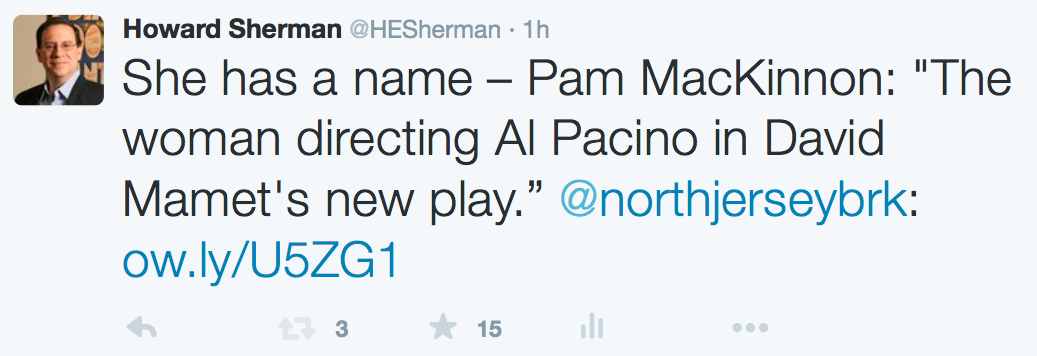
Before I wrote this post, I called out The Record on its headline on Twitter as follows, at 10:30 am:

Now I can’t know for certain there’s any cause and effect, but 25 minutes later, after multiple favorites and retweets of my message, The Record altered its headline to “Director’s hard work on ‘China Doll’ pays off.” It appears they got the message – though presumably the original headline is what’s in the print edition. It’s also worth noting that the headline was changed without any acknowledgement, so in the long memory of the internet, the male-centric headline never happened. That’s dishonest.

Revised headline in The RecordBut even in an effort to ameliorate their insensitivity, it seems The Record still can’t bring itself to give the “Director” a name. So I’ll say it once again: it’s Pam MacKinnon. Remember it and use it, because without it, the record is incomplete and the paper’s bias is showing.

Howard Sherman is director of the Arts Integrity Initiative at The New School College of Performing Arts School of Drama.

She Has A Name: Casually Diminishing Women In Theatre

November 1st, 2015 § 1 comment § permalink

A few weeks ago, the headline of a review rubbed me the wrong way.

I didn’t have an issue with the review itself, by Charles McNulty for The Los Angeles Times. But the headline for the piece, which covered the new Broadway productions of Old Times and Fool For Love, read as follows, “Clive Owen and Sam Rockwell hit Broadway in ‘Old Times’ and ‘Fool for Love’ with different results.”

Why was the headline only about men, I thought. Admittedly, I hadn’t seen either production at that point, but I was familiar with the plays, and knew that the character Rockwell plays in Fool is at least evenly matched with the role played by Nina Arianda, and Owen shares the stage in a triangle with characters played by Eve Best and Kelly Reilly. My theatre-centric brain took this headline as gender inequity.

Thinking on it, I can see why the men might have gotten the headline mentions, since both have done television and film work, with Owen currently in the second season of The Knick. But neither are exactly bankable stars who “open” movies. Best and Arianda are “only” Tony Award winners, which may mean less in the entertainment hierarchy these days than electronic media work, especially in the major paper of the city that is the center of television and film business.

That said, Best appeared in 51 episodes of Nurse Jackie, though she’s not the lead, as Owen is on The Knick, but she did that series for much longer on Showtime than Owen has been doctoring on Cinemax. Admittedly, Owen was making his Broadway debut, and Rockwell was only making his second appearance, making their gigs slightly rarer than Arianda and Best each taking their third Broadway turns. I decided this wasn’t a clear cut case of advancing men over women, despite my own perception of implied unequal worth among the players along gender lines.

But this male favoritism sprang to mind again just this morning, when I saw this headline on a theatre story on NorthJersey.com, a website that includes coverage from The Record and other New Jersey outlets: “The woman directing Al Pacino in David Mamet’s new play.”

Headline from The Record

Now I knew instantly that the piece was about Pam MacKinnon because it’s my business to know who’s working on what show, but also because Pam has quickly become one of New York’s most recognized female directors, for such works as Clybourne Park (for which she had received an Obie) and Who’s Afraid of Virginia Woolf? (for which she won a Tony). Yet the headline was all about the big, male names, even though neither of them had spoken to The Record’s Robert Feldberg. Only Pam had done so.

Pam MacKinnon

Pam MacKinnon

Sure, you can chalk it up to celebrity, to what might get the most clicks online, but once again it was a case of choosing male names over female, and in this case the article was about “the woman.” I don’t fault the writer, but an editor and perhaps someone at the copy desk, who figured they’d go with male fame, rather than the female subject of the story.

Obviously it’s not possible to say from the two headlines I’ve cited to say that there’s a widespread pattern here, but I would suggest to readers who care about this issue that they should be on the lookout for such casual disregard of women in the theatre and call it out (or let me know; I’m starting a list) whenever it appears. Yes, it’s a very small-bore, incremental game of standing vigilant, but if indeed there’s a pattern, then it has to be broken at every opportunity.

Before I wrote this post, I called out The Record on its headline on Twitter as follows, at 10:30 am:

Now I can’t know for certain there’s any cause and effect, but 25 minutes later, after multiple favorites and retweets of my message, The Record altered its headline to “Director’s hard work on ‘China Doll’ pays off.” It appears they got the message – though presumably the original headline is what’s in the print edition. It’s also worth noting that the headline was changed without any acknowledgement, so in the long memory of the internet, the male-centric headline never happened. That’s dishonest.

Revised headline in The RecordBut even in an effort to ameliorate their insensitivity, it seems The Record still can’t bring itself to give the “Director” a name. So I’ll say it once again: it’s Pam MacKinnon. Remember it and use it, because without it, the record is incomplete and the paper’s bias is showing.

Howard Sherman is director of the Arts Integrity Initiative at The New School College of Performing Arts School of Drama.

 

Yellowface Bait-And-Switch With ‘Madama Butterfly’ In Fargo

October 30th, 2015 § 1 comment § permalink

From the Fargo Moorhead Opera website

From the Fargo Moorhead Opera website

As I write, if you visit the website of the Fargo Moorhead Opera, you’ll find an evocative image of a beautiful young Asian woman used in conjunction with the company’s production of Madama Butterfly, playing this weekend in North Dakota. However, upon reading a feature story in yesterday’s Fargo Inforum about the production, you’ll learn that the lead actress in the show itself isn’t the woman who appears in the ads, and isn’t Asian at all, but rather a Caucasian of German extraction. So what’s the deal with the false advertising?

Mathew Edwardsen and Carla Thelen Hanson in Fargo Moorhead Opera’s Madama Butterfly (photo by Carrie Snyder)

Mathew Edwardsen and Carla Thelen Hanson in Fargo Moorhead Opera’s Madama Butterfly (photo by Carrie Snyder)

I can think of any number of reasons why a marketing image might not match exactly what appears on stage – the cost of an original photo shoot vs. stock photography, the availability of performers sufficiently in advance of rehearsals to create the image for a months long campaign, and so on. But in the case of the Fargo Moorhead Opera, what they’ve done, whether intentionally or not, is a case of bait-and-switch, wherein they have sold what appears to be an authentically cast production of Madama Butterfly, but will be presenting one which traffics in yellowface. Why is an Asian face appropriate for their advertising, but not for their stage?

In the wake of controversies in Seattle and New York over yellowface productions of The Mikado, I don’t think I need to explain once again why the practice of casting Caucasian actors as Asian characters is offensive to the Asian community and an insult to anyone who seeks genuine diversity in performance. After all, people can and have read about the issue in recent weeks from Leah Nanako Winkler, Ming Peiffer, Rehana Lew Mirza, Nelson Eusebio and Desdemona Chiang, among others. I’ve had my say on the subject as well.

Any remotely reasonable rationalization about the chasm between FMO’s marketing and production of Butterfly goes out the window when the company’s general director David Hamilton talks about his views on the subject of casting roles with racial authenticity with Inforum.

“I don’t want to be limited who I can cast because I want the best performer for the role,” says David Hamilton, general director of the Fargo-Moorhead Opera. “We don’t have the luxury of unlimited choices to bring to Fargo.”

Hamilton says he hasn’t heard any rumblings about the FM Opera’s selection.

“Opera is about the voice and I want the best voice I can find to sing their role,” Hamilton says.

The “best performer for the role” argument is often deployed when casting in theater or opera has obviously failed to employ racial authenticity. It particularly fails for Hamilton and the FMO when one learns that the last time the company did Madama Butterfly, an Asian-American performer played the role. So the company has already shown that it can cast the role authentically.

That Hamilton “hasn’t heard any rumblings” about the casting, which I take care to note is a paraphrase and not a direct quote, may be because opera companies so frequently fail to cast for racial authenticity. It’s only this year that the Metropolitan Opera abandoned using blackface for their production of Otello – yet retained a Caucasian actor in the role. That Hamilton is unaware of any unhappiness over his casting could be a result of the circles in which he travels, and therefore hardly representative of anything more than his acquaintances, or perhaps it’s because Fargo has only a 3% Asian population. But whatever the reason, lack of protest doesn’t mean racial insensitivity is therefore condoned. Even in a community with a 90% white population, accurate representations of race matter.

As for the “opera is about the voice” argument, I must confess that this has always befuddled me. If opera were only concerts in tuxedos, or recordings, I might be prepared to grant the form more leeway. But once you have people in costumes and on sets, there is more to the performance than simply sound; what the audience sees is part of the experience. While there are many aspects of Madama Butterfly – and its descendent, Miss Saigon – that are deeply troubling to Asian-Americans, as both works trade in and perpetuate Asian stereotypes, if the work is to be done, at least let it be done with the most respect possible. That means Asian performers playing Asian characters. If there truly aren’t enough qualified Asian performers to meet the FMO standards, then that is a direct result of companies failing to cast artists of color often enough, and perhaps also a failing on the part of training programs – though if artists of color can’t get roles, that might be deterring them from pursuing operatic careers, in a vicious cycle.

“We know it’s not real, but we don’t care,” Hamilton told Inforum. “You have to suspend disbelief. … Under all that geisha makeup, who would know?” Well, I know, Mr. Hamilton, and Inforum readers know, since the reporter who wrote the story, John Lamb, made the effort to present an opposing viewpoint from Chelsea Pace, an assistant professor of movement in the department of theater arts at North Dakota State University. I think many other people are going to find out.

While it’s late in the game to have any effect on this weekend’s production, I hope David Hamilton and the board of directors of the Fargo Moorhead Opera are going to start hearing “rumblings” that they can’t and shouldn’t ignore, as a message to the FMO and other opera companies about demonstrating genuine respect and appreciation not only for vintage Eurocentric music traditions, but for all people who make up this country, as well as the performing community and its audiences – and potential audiences. That goes for the Metropolitan Opera as well, which is doing Madama Butterfly this season with two performers sharing the title role, only one of whom is Asian. Even half measures are not enough.

If you’d like to share your thoughts on this topic with Fargo-Moorhead Opera general director David Hamilton, you can write to him at director@fmopera.org.

Howard Sherman is the interim director of the Alliance for Inclusion in the Arts.