What Does “Hamilton” Tell Us About Race In Casting?

December 3rd, 2015 § 23 comments § permalink

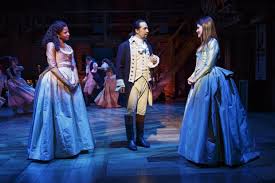
Renee Elise Goldsberyy, Lin-Manuel Miranda and Philippa Soo in Hamilton (Photo by Joan Marcus)

Renée Elise Goldsberry, Lin-Manuel Miranda and Phillipa Soo in Hamilton (Photo by Joan Marcus)

In the wake of the recent casting controversies over Katori Hall’s The Mountaintop and Lloyd Suh’s Jesus in India, there have been a number of online commenters who have cited Lin-Manuel Miranda’s musical Hamilton as a justification for their position in the debate. What’s intriguing is that Hamilton has been offered up both as evidence of why actors of color must have the opportunity to play both characters or color and characters not necessarily written as characters of color – but it has also been used to say that anything goes, and white actors should be able to play characters of color as well.

In the Broadway production of Hamilton, the characters are historical figures who were all known to have been white, but they are played by actors of many races and ethnicities, notably black, Latino and Asian. My position on non-traditional (or color-blind or color-specific) casting is that it is not a “two-way street,” and that the goal is to create more opportunities for actors of color, not to give white actors the chance to play characters of color.

As it happens, I had an interview scheduled with Miranda last week, the night before Thanksgiving. Race wasn’t the subject at all, however. We were speaking about his experiences in, and views on, high school theatre, for Dramatics magazine, a publication of the Educational Theatre Association (ask a high school thespian for a copy). But when I finished the main interview, and had shut off my voice recorder, I asked Miranda if he would be willing to make any comment regarding the recent casting situations that had come to light. He was familiar with The Mountaintop case, but I had to give him an exceptionally brief précis of what had occurred with Jesus in India. He said he would absolutely speak to the issue, and I had to hold up my hand to briefly pause him as he rushed to start speaking, while I started recording again.

“My answer is: authorial intent wins. Period,” Miranda said. “As a Dramatists Guild Council member, I will tell you this. As an artist and as a human I will tell you this. Authorial intent wins. Katori Hall never intended for a Caucasian Martin Luther King. That’s the end of the discussion. In every case, the intent of the author always wins. If the author has specified the ethnicity of the part, that wins.

“Frankly, this is why it’s so important to me, we’re one of the last entertainment mediums that has that power. You go to Hollywood, you sell a script, they do whatever and your name is still on it. What we protect at the Dramatists Guild is the author’s power over their words and what happens with them. It’s very cut and dry.”

This wasn’t the first time Miranda and I have discussed racial casting. Last year, we corresponded about it in regard to high school productions of his musical In The Heights, and his position on the show being done by high schools without a significant Latino student body, which he differentiated from even college productions.

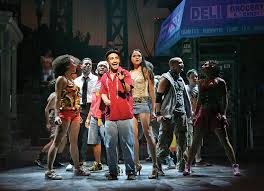
Lin-Manuel Miranda, Karen Olivo and the company of In The Heights (Photo by Joan Marcus)

Lin-Manuel Miranda, Karen Olivo and the company of In The Heights (Photo by Joan Marcus)

“The joy of In The Heights runs both ways to me,” he wrote me in early 2014. “When I see a school production with not a lot of Latino students doing it, I know they’re learning things about Latino culture that go beyond what they’re fed in the media every day. They HAVE to learn those things to play their parts correctly. And when I see a school with a huge Latino population do Heights, I feel a surge of pride that the students get to perform something that may have a sliver of resonance in their daily lives. Just please God, tell them that tanning and bad 50’s style Shark makeup isn’t necessary. Latinos come in every color of the rainbow, thanks very much.

“And I’ve said this a million times, but it bears repeating: high school’s the ONE CHANCE YOU GET, as an actor, to play any role you want, before the world tells you what ‘type’ you are. The audience is going to suspend disbelief: they’re there to see their kids, whom they already love, in a play. Honor that sacred time as educators, and use it change their lives. You’ll be glad you did.”

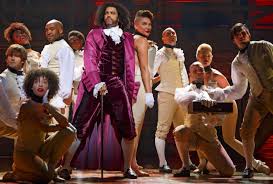
Daveed Diggs and the company in Hamilton (Photo by Joan Marcus)

Daveed Diggs and the company of Hamilton (Photo by Joan Marcus)

Anticipating the flood of interest in producing Hamilton once the Broadway production and national tours have run their courses, I asked Miranda whether the acting edition of the script of Hamilton will ultimately be specific about the cast’s diversity, and whether, either at the college level or the professional level, he would foresee a situation where white actors were playing leading roles.

“I don’t have the answer to that. I have to consult with the bookwriter, who is also me,” he responded. “I’m going to know the answer a little better once we set up these tours and once we set up the London run. I think the London cast is also going to look like our cast looks now, it’s going to be as diverse as our cast is now, but there are going to be even more opportunities for southeast Asian and Asian and communities of color within Europe that should be represented on stage in that level of production.

“So I have some time on that language and I will find the right language to make sure that the beautiful thing that people love about our show and allows them identification with the show is preserved when this goes out into the world.”

Authorial intent, y’all. Authorial intent.

Howard Sherman is interim director of the Alliance for Inclusion in the Arts and director of the Arts Integrity Initiative at The New School College of Performing Arts.


What Does “Hamilton” Tell Us About Race In Casting?

December 3rd, 2015 § 4 comments § permalink

Phillipa Soo, Lin-Manuel Miranda and Renée Elise Goldsberry in Hamilton (Photo by Joan Marcus)

Phillipa Soo, Lin-Manuel Miranda and Renée Elise Goldsberry in Hamilton (Photo by Joan Marcus)

In the wake of the recent casting controversies over Katori Hall’s The Mountaintop and Lloyd Suh’s Jesus in India, there have been a number of online commenters who have cited Lin-Manuel Miranda’s musical Hamilton as a justification for their position in the debate. What’s intriguing is that Hamilton has been offered up both as evidence of why actors of color must have the opportunity to play both characters or color and characters not necessarily written as characters of color – but it has also been used to say that anything goes, and white actors should be able to play characters of color as well.

In the Broadway production of Hamilton, the characters are historical figures who were all known to have been white, but they are played by actors of many races and ethnicities, notably black, Latino and Asian. My position on non-traditional (or color-blind or color-specific) casting is that it is not a “two-way street,” and that the goal is to create more opportunities for actors of color, not to give white actors the chance to play characters of color.

As it happens, I had an interview scheduled with Miranda last week, the night before Thanksgiving. Race wasn’t the subject at all, however. We were speaking about his experiences in, and views on, high school theatre, for Dramatics magazine, a publication of the Educational Theatre Association (ask a high school thespian for a copy). But when I finished the main interview, and had shut off my voice recorder, I asked Miranda if he would be willing to make any comment regarding the recent casting situations that had come to light. He was familiar with The Mountaintop case, but I had to give him an exceptionally brief précis of what had occurred with Jesus in India. He said he would absolutely speak to the issue, and I had to hold up my hand to briefly pause him as he rushed to start speaking, while I started recording again.

“My answer is: authorial intent wins. Period,” Miranda said. “As a Dramatists Guild Council member, I will tell you this. As an artist and as a human I will tell you this. Authorial intent wins. Katori Hall never intended for a Caucasian Martin Luther King. That’s the end of the discussion. In every case, the intent of the author always wins. If the author has specified the ethnicity of the part, that wins.

“Frankly, this is why it’s so important to me, we’re one of the last entertainment mediums that has that power. You go to Hollywood, you sell a script, they do whatever and your name is still on it. What we protect at the Dramatists Guild is the author’s power over their words and what happens with them. It’s very cut and dry.”

This wasn’t the first time Miranda and I have discussed racial casting. Last year, we corresponded about it in regard to high school productions of his musical In The Heights, and his position on the show being done by high schools without a significant Latino student body, which he differentiated from even college productions.

Lin-Manuel Miranda, Karen Olivo and the company of In The Heights (Photo by Joan Marcus)

Lin-Manuel Miranda, Karen Olivo and the company of In The Heights (Photo by Joan Marcus)

“The joy of In The Heights runs both ways to me,” he wrote me in early 2014. “When I see a school production with not a lot of Latino students doing it, I know they’re learning things about Latino culture that go beyond what they’re fed in the media every day. They HAVE to learn those things to play their parts correctly. And when I see a school with a huge Latino population do Heights, I feel a surge of pride that the students get to perform something that may have a sliver of resonance in their daily lives. Just please God, tell them that tanning and bad 50’s style Shark makeup isn’t necessary. Latinos come in every color of the rainbow, thanks very much.

“And I’ve said this a million times, but it bears repeating: high school’s the ONE CHANCE YOU GET, as an actor, to play any role you want, before the world tells you what ‘type’ you are. The audience is going to suspend disbelief: they’re there to see their kids, whom they already love, in a play. Honor that sacred time as educators, and use it change their lives. You’ll be glad you did.”

Daveed Diggs and the company of Hamilton (Photo by Joan Marcus)

Daveed Diggs and the company of Hamilton (Photo by Joan Marcus)

Anticipating the flood of interest in producing Hamilton once the Broadway production and national tours have run their courses, I asked Miranda whether the acting edition of the script of Hamilton will ultimately be specific about the cast’s diversity, and whether, either at the college level or the professional level, he would foresee a situation where white actors were playing leading roles.

“I don’t have the answer to that. I have to consult with the bookwriter, who is also me,” he responded. “I’m going to know the answer a little better once we set up these tours and once we set up the London run. I think the London cast is also going to look like our cast looks now, it’s going to be as diverse as our cast is now, but there are going to be even more opportunities for southeast Asian and Asian and communities of color within Europe that should be represented on stage in that level of production.

“So I have some time on that language and I will find the right language to make sure that the beautiful thing that people love about our show and allows them identification with the show is preserved when this goes out into the world.”

Authorial intent, y’all. Authorial intent.

Howard Sherman is interim director of the Alliance for Inclusion in the Arts and director of the Arts Integrity Initiative at The New School College of Performing Arts.

What Is Being Taught About The Director-Playwright Relationship?

December 2nd, 2015 § 0 comments § permalink

Jonathan Larson’s Rent at Eastern Tennessee State University (Photo by Larry Smith)

Jonathan Larson’s Rent at Eastern Tennessee State University (Photo by Larry Smith)

I assume most people, either as a child heard, or as a parent deployed, the timeworn phrase, “If someone told you to jump off the Brooklyn Bridge, would you do it?” My parents had a variant along the same lines: “Just because other people do it doesn’t make it right.”

I am reminded of this phrase as it seems every week lately I hear about another instance of a theatre director altering a script or overriding an author’s clear intent; the recent run of examples has been with college-affiliated productions. I wonder whether the people responsible have had others set the wrong example, and they felt they could just join in, or if they just started doing it and, since they were never challenged or caught, kept it up.

The most prominent incidents have been with Katori Hall’s The Mountaintop, at a community theatre affiliated with Kent State University’s Department of Pan-African Studies, and with Lloyd Suh’s Jesus in India at Clarion University. In both of those cases, the issue was the casting of roles written as characters of color.

In a markedly less fraught situation which didn’t generate any major headlines, a production of Rent at Eastern Tennessee State University, just before Thanksgiving, had to cancel one day of a five-day run because the show’s licensing house learned of a scene that had been cut without approval. The lost day was used to restore the scene in question, as reported by the campus newspaper, The East Tennessean.

In its coverage, the paper quoted Patrick Cronin, the production’s director and the Program Director of Communication and Performance at the school, as to what had taken place.

“I have directed hundreds of shows, and made many cuts before,” Cronin said. “So, I did the same with the street scenes [in ‘Rent’] because we did not have enough actors to make those scenes interesting.”

At the end of the article, Cronin was again quoted:

“I have a young cast who were able to add six pages of material in two days,” Cronin said. “I am just grateful that we got the show on and that we caught the mistake I had made.”

While the school paper didn’t draw attention to the inconsistency, it’s worth noting that Cronin said that what he did was a mistake, but earlier on he had said it was consistent with what he’d done numerous times before. Secondly, it’s not Cronin who caught the mistake, but someone at the school familiar enough with what had been taking place in the rehearsal room – and with copyright and licensing law – to contact Music Theatre International and give them a heads up about the unauthorized alteration. Finally, isn’t it interesting to note that a solution was found to the supposedly problematic scene, in almost no time at all.

Some might accuse me of conflating the first two examples, which turn on the issue of race in casting, with the third, which was the excision of a scene. But I’d argue that they’re all of a piece, because they involve directors either misinterpreting works or placing their own sensibility above that of the author, be it for practical, aesthetic or intellectual reasons. While I don’t have press reports I can bring forward, I can say that since I began writing on this topic, I have been told numerous anecdotes about shows in academic settings that have been altered for any number of reasons, all without approval.

So I have to wonder: are some theatre programs and theatrical groups at the college level advancing the belief that scripts can be altered at will, or elements ignored? Are schools teaching both the legal and ethical implications of artists’ rights and copyright law, not just to playwrights but to all of those who study theatre? Have bad practices begotten yet further bad practices? Are there professors and program directors who believe that anything produced on a campus falls under the fair use exemption for educational purposes under the copyright laws?

Lest anyone think I’m advocating for slavish recreations of original productions or less than fruitful collaborations on new works, I should state that I most assuredly am not. I want to see directors, whether students or faculty (and, for that matter, professionals as well), have the opportunity to undertake creative productions that will challenge the artists involved and the audiences they attract. I want to see works reinvented, but in ways which reveal something new that is supported by the text, rather than overriding it. That said, I am troubled by a sense that in some cases (I’m not saying that this applies to every production at every school) something approaching film’s auteur theory, in which the director of a movie is seen as its primary author, is filtering into theatre at the pre-professional level in a way which diminishes or disregards the importance and rights of authors.

I have a genuine desire to know the answers to some of the questions I’ve asked above. I’d be interested in those answers not only from faculty but from students both past and present. What is being taught about the relationship between playwright and director, regardless of whether the latter is present in rehearsals, available via computer or phone, otherwise engaged, or even dead but still protected by copyright? I ask because I think we all have a lot to learn. I’d like to hear from you, either on the record or confidentially; you can write to me here.

Oh, since I started with timeworn phrases, let me finish with one as well, which believe it or not I’ve heard more than a few times over my career: “Better to ask for forgiveness than to ask for permission.” These are not, I hope you’ll agree, words to live by.  Even if some seem to.

Howard Sherman is director of the Arts Integrity Initiative at The New School College of Performing Arts.

What Is Being Taught About The Director-Playwright Relationship?

December 2nd, 2015 § 8 comments § permalink

Jonathan Larson’s Rent at Eastern Tennessee State University (Photo by Larry Smith)

Jonathan Larson’s Rent at Eastern Tennessee State University (Photo by Larry Smith)

I assume most people, either as a child heard, or as a parent deployed, the timeworn phrase, “If someone told you to jump off the Brooklyn Bridge, would you do it?” My parents had a variant along the same lines: “Just because other people do it doesn’t make it right.”

I am reminded of this phrase as it seems every week lately I hear about another instance of a theatre director altering a script or overriding an author’s clear intent; the recent run of examples has been with college-affiliated productions. I wonder whether the people responsible have had others set the wrong example, and they felt they could just join in, or if they just started doing it and, since they were never challenged or caught, kept it up.

The most prominent incidents have been with Katori Hall’s The Mountaintop, at a community theatre affiliated with Kent State University’s Department of Pan-African Studies, and with Lloyd Suh’s Jesus in India at Clarion University. In both of those cases, the issue was the casting of roles written as characters of color.

In a markedly less fraught situation which didn’t generate any major headlines, a production of Rent at Eastern Tennessee State University, just before Thanksgiving, had to cancel one day of a five-day run because the show’s licensing house learned of a scene that had been cut without approval. The lost day was used to restore the scene in question, as reported by the campus newspaper, The East Tennessean.

In its coverage, the paper quoted Patrick Cronin, the production’s director and the Program Director of Communication and Performance at the school, as to what had taken place.

“I have directed hundreds of shows, and made many cuts before,” Cronin said. “So, I did the same with the street scenes [in ‘Rent’] because we did not have enough actors to make those scenes interesting.”

At the end of the article, Cronin was again quoted:

“I have a young cast who were able to add six pages of material in two days,” Cronin said. “I am just grateful that we got the show on and that we caught the mistake I had made.”

While the school paper didn’t draw attention to the inconsistency, it’s worth noting that Cronin said that what he did was a mistake, but earlier on he had said it was consistent with what he’d done numerous times before. Secondly, it’s not Cronin who caught the mistake, but someone at the school familiar enough with what had been taking place in the rehearsal room – and with copyright and licensing law – to contact Music Theatre International and give them a heads up about the unauthorized alteration. Finally, isn’t it interesting to note that a solution was found to the supposedly problematic scene, in almost no time at all.

Some might accuse me of conflating the first two examples, which turn on the issue of race in casting, with the third, which was the excision of a scene. But I’d argue that they’re all of a piece, because they involve directors either misinterpreting works or placing their own sensibility above that of the author, be it for practical, aesthetic or intellectual reasons. While I don’t have press reports I can bring forward, I can say that since I began writing on this topic, I have been told numerous anecdotes about shows in academic settings that have been altered for any number of reasons, all without approval.

So I have to wonder: are some theatre programs and theatrical groups at the college level advancing the belief that scripts can be altered at will, or elements ignored? Are schools teaching both the legal and ethical implications of artists’ rights and copyright law, not just to playwrights but to all of those who study theatre? Have bad practices begotten yet further bad practices? Are there professors and program directors who believe that anything produced on a campus falls under the fair use exemption for educational purposes under the copyright laws?

Lest anyone think I’m advocating for slavish recreations of original productions or less than fruitful collaborations on new works, I should state that I most assuredly am not. I want to see directors, whether students or faculty (and, for that matter, professionals as well), have the opportunity to undertake creative productions that will challenge the artists involved and the audiences they attract. I want to see works reinvented, but in ways which reveal something new that is supported by the text, rather than overriding it. That said, I am troubled by a sense that in some cases (I’m not saying that this applies to every production at every school) something approaching film’s auteur theory, in which the director of a movie is seen as its primary author, is filtering into theatre at the pre-professional level in a way which diminishes or disregards the importance and rights of authors.

I have a genuine desire to know the answers to some of the questions I’ve asked above. I’d be interested in those answers not only from faculty but from students both past and present. What is being taught about the relationship between playwright and director, regardless of whether the latter is present in rehearsals, available via computer or phone, otherwise engaged, or even dead but still protected by copyright? I ask because I think we all have a lot to learn. I’d like to hear from you, either on the record or confidentially; you can write to me here.

Oh, since I started with timeworn phrases, let me finish with one as well, which believe it or not I’ve heard more than a few times over my career: “Better to ask for forgiveness than to ask for permission.” These are not, I hope you’ll agree, words to live by.  Even if some seem to.

Howard Sherman is director of the Arts Integrity Initiative at The New School College of Performing Arts.


The Stage: How Broadway can reclaim Broadway by taking to the streets

November 27th, 2015 § 0 comments § permalink

Photo by Howard Sherman

Photo by Howard Sherman

They are, to many, the scourge of Times Square and the theatre district. I refer not to the prostitutes and three-card monte hustlers of 25 years ago. They’ve long since been exiled to the outer reaches of our tourism mecca.

Now, thanks to the pedestrian plazas created along Broadway between 47th and 42nd Streets under our former mayor Michael Bloomberg, visitors and theatregoers often must run a gauntlet of unauthorized Marvel superheroes, Sesame Street characters, and cartoons come to life in order to reach their destination. Oh, and I can’t forget the desnudas, the topless women whose bodies are painted in patriotic red, white and blue.

“Elmo Eats His Hand” (Photo by Howard Sherman)

“Elmo Eats His Hand” (Photo by Howard Sherman)

It wasn’t so long ago that the only regular character in Times Square was the blonde-tressed, muscularly defined Naked Cowboy, posing on traffic medians with tourists for tips while clad in nothing but a cowboy hat, a guitar, boots and a double layer (per news reports) of tighty-whitie undershorts. But the greater pedestrian spaces in the new plazas allowed the situation to mushroom, into roving hordes of often ratty knock-off characters aggressively soliciting passers-by to pose for photos and then compensate them with tips.

Over the summer, the situation reached a fever pitch of outrage, particularly towards the desnudas, with a series of affronted front pages in the New York Daily News. This led politicians to posture about how they proposed to limit this activity, ranging from impinging on free speech rights to tearing up the still-unfinished plazas themselves. As someone who works in the heart of Times Square, I tend to look at the characters – both those in costume and those in public office – with a sense of bemusement. The only people I truly feel for are parents trying to keep their children away from these low-rent facsimiles, who tend to remove their character heads (or don robes) whenever someone doesn’t seem ready to shell out for a photo, destroying many a toddler’s dreams.

“Iron Man and Bunnies” (Photo by Howard Sherman)

“Iron Man and Bunnies” (Photo by Howard Sherman)

It is a little hard to call the situation a quality of life issue in an area largely devoid of residential property, but it can be annoyance when you’re late to a meeting and have to dodge Hello Kitty beckoning with open arms in order to make it to the next crosswalk. I confess that it has always surprised me that Disney (which controls not only their classic characters, but also those of Marvel and Pixar) hasn’t chosen to exert its copyright in order to drive away these scofflaws. I’m sure it has its reasons, and there are certainly non-Disney characters in the mix.

But I’d like to suggest, on a major tourism weekend in New York (our Thanksgiving holiday) that the theatre community has it in its power to seriously disrupt this cycle, peaceably, while reclaiming Times Square as a theatrical centre at the same time. My proposal is based on something already taking place, albeit at a simpler level.

It’s not uncommon for shows to field street teams of people to pass out flyers to promote their nearby productions in the plazas as well. Some may only sport T-shirts emblazoned with logos, but some go the extra mile creatively – Chicago, for example, sends out black-clad women wearing red stockings who strike Fosse-eque poses while proffering a leaflet.

I would suggest that even shows that don’t engage in this type of marketing could contribute to upgrading the character situation in Times Square by hiring people to walk the zone fully and professionally costumed as Jean Valjean, Elphaba and the Phantom, to name but three. Sans flyers and paid not by the tourists but by the shows – and perhaps also out of pooled funds from the Broadway League, the Times Square Alliance and the NYC visitors bureau – they could be compensated at an hourly rate and wear prominent badges saying “no tips accepted”.

“Elvis and Chewie” (Photo by Howard Sherman)

“Elvis and Chewie” (Photo by Howard Sherman)

Posing for photos, never breaking character, directly competing with the more mercenary band currently at large, they would undermine the freelance players by offering a cleaner, safer, more professional alternative. This would allow Broadway to reclaim Broadway, while overwhelming Instagram and Facebook with theatrically-based tourist photos. They wouldn’t even have to show up every day; just enough and irregularly enough to make the current situation unprofitable for the pushy opportunists.

Of course, this won’t drive away the desnudas, unless a revival of Hair or Oh, Calcutta! decides to get in on the action. But for all of those who miss the tawdry Times Square of old, maybe a few desnudas provide a nostalgic link to the bad old days. And if people leave New York with a selfie that includes someone nearly naked along with, say, one of Andrew Lloyd Webber’s cats, maybe that will only help sell the city, and the theatre as well.


This column originally appeared in The Stage newspaper.

Bad Apple Fails to Censor High School’s “Bad Seed”

November 20th, 2015 § 5 comments § permalink

The Bad Seed at Portage High School

The Bad Seed at Portage High School (Photo by Sarah Farthing-Hudson)

I am delighted to report that all of the smoking, drinking, drugging and sexual references will be intact – tonight, tomorrow and Sunday – in the production of Maxwell Anderson’s 1950s psychodrama The Bad Seed at Portage High School in northwestern Indiana. This may seem entirely unremarkable, except that just 11 days ago, students were still being instructed to strike out lines in their scripts and change stage directions to purge the production of all such content. Even the presence of an ashtray wasn’t going to be permitted.

Mind you, I’m not specifically celebrating cigarette smoking, drug use, alcohol consumption or sexual activities among teens, but rather their ability to portray these activities in a script some six decades old. More importantly, I want to congratulate the students for responding in the best possible– and effective – way when they were instructed to censor the script, knowing full well that no approval had been sought from the licensing house or the author’s estate.

I caught wind of this situation last Wednesday morning, when NWI Times published a story about Portage Thespians appearing at a school board meeting the night before, to express their dismay over the editing they had been instructed to undertake. Per the newtimes.com account, the school board chair professed to know nothing about any censorship, and she asked the superintendent to investigate.

I received the article via Facebook within an hour of it appearing online in Indiana, and I quickly undertook to track down the students who had so responsibly brought the issue to the school board. By noontime, after some social media searching, I was in communication with several students who had been part of the appeal at the board meeting. I quickly learned that the school superintendent had asked to meet with the students after school that very day. I offered some general counsel about broaching the subject at that meeting, and then simply waited for a report as to how things were proceeding.

The Bad Seed at Portage High School 2

The Bad Seed at Portage High School (Photo by Sarah Farthing-Hudson)

Imagine my surprise when, just a few hours later, I learned from the students online that The Bad Seed would be performed intact. Students tweeted happily about erasing crossed out lines from their scripts. All was well. The next day, the nwitimes confirmed the news in a followup story.

When situations like this arise at other schools in the future, those committed to the ethically and legally correct path of producing plays as written would do well to remember the words of Portage superintendent. “The director is encouraged to do the show and given the support to use his best judgment to do what is right for the students,” wrote superintendent Richard Weigel once the situation was resolved. He’d already said, in a statement, “From my perspective, the purpose of theater is to provide insights into characters that reflect different ways of thinking. Theater provides an opportunity for our students to reflect on those characters, not become those characters.”

More importantly, people should emulate students like Lydia Gerike, Sara Dailey and Valerie Plinovich (all named by the NWI Times), who spoke out with clarity and integrity in support of the play and their exploration of it. They didn’t need any coaching from anyone, it seems. They knew just what to do to put the situation right.

Mind you, it’s never come entirely clear who demanded the changes to the script, but it seems reasonably safe to assume that it happened somewhere above the drama program’s director and below the level of the superintendent. Infer what you will about who in the school hierarchy might have been behind the effort.

Calm, rational, righteous heads set thing right in Portage, so that homicidal Rhoda Penmark can wreak havoc tonight, tomorrow night and at Sunday’s matinee. I applaud the Portage Thespians from afar. I may not have occasion to be in touch with any of them again. But they deserve credit, along with their superintendent and school board, for making sure things happened as they should, with the play performed as written and students freed to explore characters and habits not necessarily their own. Now all of those involved just need to keep their eyes open for any subsequent homogenization of Portage High School productions, to make sure that the censorship doesn’t happen before future plays are chosen, and the unknown bad seed in this censorship story doesn’t succeed in the long run by foisting bland material on the next wave of shows and students.

So the only thing left to say to the Portage Thespians, as is only appropriate for a show like The Bad Seed, is: knock ‘em dead, kids.

Howard Sherman is director of the Arts Integrity Initiative at The New School College of Performing Arts School of Drama.


The Stage: From Broadway to the White House and back again

November 20th, 2015 § 0 comments § permalink

The White House

The White House

There’s been a song running through my head for the past week, prompted by a series of press releases I’ve received. Anyone on a press list will tell you, notices from publicists flooding your inbox don’t normally move one to song.

The tune in question is “Bobby and Jackie and Jack” from Stephen Sondheim’s Merrily We Roll Along. If you don’t know the song, it’s a cabaret number devised by the lead characters, spoofing the cultural array offered up by the Kennedy White House in the early 1960s. I’ve always been taken with the line, “We’ll have Bernstein play next on the Bechstein piano/And Auden read poems and stuff.” There’s lots of material like that.

The Sondheim wordplay is on my mind because there has been a steady drumbeat of cultural interest by the Obama White House in recent weeks, though not remotely for the first time. Without being political or trumpeting national pride, I have to say this makes me rather happy.

A number of Broadway shows were in Washington DC on Monday to tape Broadway at the White House for broadcast next week by TLC, one of our countless cable channels, on our Thanksgiving holiday. It features Michelle Obama as a special guest, with performances from several Broadway shows including On Your Feet, An American in Paris (in poignant timing), School of Rock and Fun Home. On Wednesday, the White House hosted a livestream salute to the Americans With Disabilities Act in its 25th year, which included a performance by the cast of Spring Awakening, which reached Broadway after being developed by the company Deaf West in a tiny theatre in Los Angeles.

This is all on top of New York City’s traffic-stopping special performance of the musical Hamilton two weeks ago, with the Obamas in attendance, in a high-price-ticket fundraiser for the Democratic National Committee. The event was widely known about and seen thanks to news reports about the president’s onstage remarks. And it’s worth noting that this was the second time the Obamas, who have visited Broadway regularly throughout his terms, have seen Lin-Manuel Miranda’s look at early US history (although Miranda’s alternate was on the first time they went).

Sondheim’s ribbing of the Kennedys notwithstanding, it’s incredibly affirming for every theatre geek in the country to know that the form of culture we participate in and love finds favour in the highest corridors of power. To be sure, some might make the charge that theatre is an elitist art if they’re trying to tear down the politicians who attend, but TLC wisely made the taping of their show part of a daylong event for students from arts programs in public schools around the country. Who can argue with that? As for Spring Awakening, the stream was free for all to see.

Diehards like me cling to moments when theatre is recognised by the wider culture. I’m happy to tell you that in the 1950s, the sitcom I Love Lucy sent Lucy and Ricky to Frank Loesser’s The Most Happy Fella, while more recently South Park featured Stephen Schwartz and Andrew Lloyd Webber in a brilliantly absurdist episode. There is symbolic power in politicians sitting in the dark watching the performing arts live, because it’s going to reach some portions of the population who might just decide to check this stuff out for themselves.

As Broadway is showcased before our political leaders and donors, it’s worth noting that even though some of the aforementioned shows originated with subsidised companies, there’s a vast array of theatre that isn’t defined by commercial success. Maybe before leaving office the Obamas might stop in at one or more of those companies. Or invite them to their home for the holidays.

This column originally appeared in The Stage newspaper in London.

Anna Deavere Smith: “I Want People To Be Driven To Action”

November 17th, 2015 § 0 comments § permalink

“I come at this more like a lawyer, who would say that everybody has a right to a fair trial. Or a journalist, or a priest, who would hear the confession.”

– Anna Deavere Smith

On November 7, I had the opportunity to interview Anna Deavere Smith as part of the third annual “Stage The Change: Theatre As A Social Voice” conference, a day-long event of panels and workshops for high school and college students, a collaboration between the Happauge Public Schools and The Tilles Center at LIU Post. Smith is the creator and performer of such acclaimed “documentary theatre” works as Fires in the Mirror, Twilight: Los Angeles 1992, and Let Me Down Easy. What follows is an edited and somewhat condensed portion of that conversation, aimed at the students in attendance.

HOWARD SHERMAN: No one typically has their own theater: you have to find a place to perform, to convince people to let you do this work. How did you create opportunities for yourself originally?

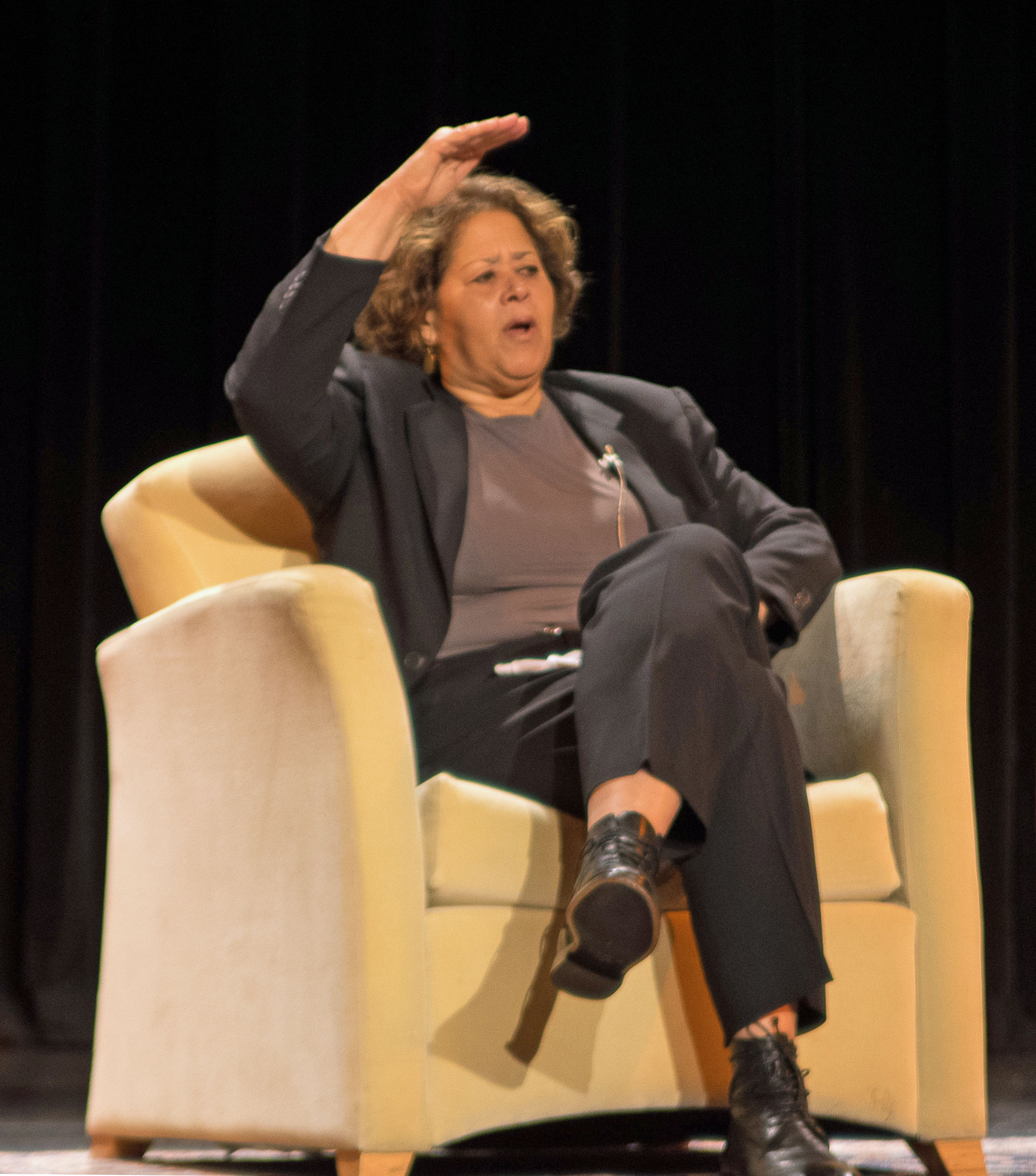
Anna Deavere Smith

Anna Deavere Smith at LIU Post

ANNA DEAVERE SMITH: I was really trying to learn some things, which is what started me interviewing people in New York in 1980. Just people I saw on the street, or people I saw like the lifeguard where I swam. Then I paired actors with people. So the first one of these that I made had an actor for each person. I just rented a loft in downtown in Tribeca before Tribeca was hip. It was just broken down, sort of old factories, and abandoned places.  There were these lofts that were put together with empty spaces with wooden floors. That was the first one that I made. I made it by charging actors to take a workshop and they would perform as a result of the workshop, but really it was just enough to cover the cost. I don’t know if actors are still like that, but people are always looking for someway to perform.

HES: Was the initial work about exploring characters or subjects?

ADS: It was just characters.

HES: How long do you take to interview people when you’re working on a piece?

ADS: It depends on the piece. The piece that I’m working on now is about young people, younger than you all, that don’t make it through school. And they end up in the criminal justice system. I started working on that in 2013, but I’ve spent maybe a total of three months, spread out, and I’ve done about 150 interviews to start working on that play. It’s called Notes From The Field: Doing Time in Education. For Let Me Down Easy, I interviewed over 300 people, on three continents, so it took some time, but in the middle of that time, I was occasionally doing more performances and gathering more information as I refined the play.

HES: When you moved from characters to subjects, what galvanized you to shifting the work towards something topical?

ADS: What happened was, I really didn’t have a place to do this in the theater. No theater hired me well into the process. Who did hire me was universities, who in the 1980’s were revising many things about their curriculum, mostly to make more space for literature, ideas, works of art by people of different colors than white – of women, as well as people of different expressions of sexuality than heterosexuality. So I would say that in the 1980’s, across the board in this country what we call the canon, what is the traditional thing we learn, changed dramatically. The conservatory, the playwrights were looking at scripts by either dead or living white males and even someone like a white male like Sam Shepard, and even his work was considered extremely avant-garde. The only woman you would find is Lillian Hellman. You know, maybe Lorraine Hansberry.

The ‘80’s were the time where that really shook up, but what that meant was, that at these universities and at these colleges people were very refined, Smith College, a place like that, or Princeton, there were very, very difficult things about people getting along on campus. I was hired by Princeton to write a piece about the fact that they had only had women for 20 years. Think of the history of Princeton. Princeton exists long enough that men from the South brought their slaves to school with them for a very, very long time. These traditions are very hard to change. So 20 years of women, they asked me to come and make a piece. There were some very difficult things happening on campus, some women had had some sexual assaults and yet the alumni, didn’t want to make the lamps any brighter because they felt it would kill the romance of the campus. Two of the eating clubs – they didn’t have fraternities – still would not accept women. After that, they were forced to do so. Places hired me and it was really to mirror them in transition, to mirror back to them the difficulty they were having in transition. There were a group of women professors in the theater across the country having to deal with new things going on among women or even the fight women were having getting into university. That’s what really made my work become socially oriented.

HES: Why the choice to move from bringing in actors to portray each of these people? Why the choice to have these people, instead of having different people play these different roles, to take them all into yourself?

ADS: Again, it was a very practical reason. I couldn’t imagine how to pay everyone. The first time I got away with it because people were so eager to have a reason to perform. They were like me, they were hardly ever getting cast, they were happy to have a reason to have agents and other people come and see them, and to be working. So they paid me to do a workshop and put that together. So I figured that’s not going to work very long. The notion of getting a grant was way out of my – I couldn’t do that.

But then I remembered that as a kid, I was a mimic. So I thought, well I’ll just do all the parts myself, until I can figure out how to raise money. Then when I could figure out how to raise money, and invited actors to do it, they didn’t really like my process. I think it would be different now. This whole idea of documentary theater, it’s taken off in a big way. When I first started presenting the work to actors, they didn’t like it because they felt so much of the idea of acting training, and maybe these young people today have this idea and maybe not, was the idea of inner truth.

I don’t believe my inner truth is necessarily relevant to the cowboy you saw there [in a video screened at the event]. I’m trying to figure out his inner truth! Things that I’ve learned about language have lead me to understand and believe, and try to exemplify, is that his inner truth, whether he’s telling the truth or not, does live in how he sees. So I’m not into this inner truth stuff. I don’t like the word truth. That’s a moral judgment and it’s a very heavy idea. In those days, I’ve always taught acting since 1973, you know we have these students who would go to conservatory to hear notes from all these teachers. My colleagues would do stuff like yell at people for acting. “You’re lying!” Of course they’re lying, they’re acting.

HES: When actors play roles that aren’t necessarily likable or honest, you often hear the talk about finding some part of them to like. Do you need to like the people and do you even like the people you end up interviewing?

ADS: Well, I love everybody I interview. In my Ted talk, I performed a woman who sat on her bedside while her boyfriend killed her daughter. Murder, that’s murder, she’s an accomplice to murder. And I met her in a penitentiary in Maryland. I come at this more like a lawyer who would say that everybody has a right to a fair trial. Or a journalist, or a priest, who would hear the confession, most likely of the person who did the most despicable thing. And I think of people in terms of their fate in life.

Anna Deavere Smith

Anna Deavere Smith at LIU Post

I think a person who does a very despicable thing like the women who let her child be killed is trapped not only in prison but in her own crisis of what she did when she recognizes what she did, when she sees that reality. And so I think I have a bit of humility about these things. I do believe that in the grace of God, I do believe in old fashion acting techniques, Stanislavski, the father of modern acting, way back in the 19th century. People behave according to their circumstances and how they adjust to those circumstances.

So I don’t know what it would be like for me to live in an environment where I was acquiring drugs, selling drugs, addicted to drugs, was in a relationship with a man who beat me, beat my children, and for whatever reason I learned to understand that as normal. And that would lead me to be so high that I would allow that to happen to my child. My job is to imagine those circumstances and then to find a way to illuminate that for whatever reason.

Maybe the thing I would be trying to illuminate is drug addiction. Maybe I would be trying to illuminate what it does mean for women to live in abusive relationships, right? So I see that person as living a life that is at first unimaginable to me, and then my job is to imagine it. I think as actors, we have chance to do big projects like that. If I were a doctor, I could choose, am I going to be an internist? Am I going to want to do big operations? Am I going to be a surgeon of cancer? You know, I could choose how big I want my project to be. I do think the project of portraying someone who seems to be unlikable, or you know if you meet somebody in your school whose perfectly likable, a cheerleader, but you don’t like her, then the project is how do I get myself to be able to imagine her circumstances and to imagine living in her shoes? Then my project is really living in their words. For me, again, the bigger the project, the better, the bigger leap I have to make, the more I get to exercise my muscles as an artist.

HES: When you set out to do a project, do you always know exactly what you want to explore? Or do you start having conversations and find the subject or the focus that you’re going to take on it?

ADS: I don’t have a take, and my take evolves. For example, my new project is about what some people call the school to prison pipeline. I don’t know if you’ve heard about this at all or you’re starting to hear about it, I started to hear about in 2011, and I’d never heard about it. So the idea is poor kids of color are unfairly disciplined, some of you might have seen this video that has kind of gone viral of a girl in South Carolina who won’t turn her cell phone off and then they bring the cop in and he throws her around in the chair. We see these things.

Say, for example, I started out, with the idea of images in my mind like hearing about a five year old in Florida who was handcuffed, this kind of thing. But the more I looked at it, the more I see that the thing that causes young people to end up in juvenile hall or in these kinds of circumstances are even more complicated than school discipline. So now I would never call it the school to prison pipeline. I don’t know quite what I would call it, but I’d call it something else that allows the project to be seen as about a series of things that make it hard for young people to be in our education system.

HES: You are now, of course, widely known in the theater community and many communities for the work that you do. Has it become easier to gain access to people to interview them or are people now more aware of how you might portray them? And does that, in some ways, make people more guarded?

ADS: Well I think most of the people I interview have never heard of me. At all.  And if they have, it’s because they saw me on a television show called Nurse Jackie. Maybe.

Anna Deavere Smith in Let Me Down Easy

Anna Deavere Smith in Let Me Down Easy

I am very aware that my theater is in a very small portion of America. That is the kind that these young people are here to think about, work on, theater about social change. It’s not a big Broadway show. Only one of my works went to Broadway. A lot of people don’t know about my theater work. But what has happened, as you know, these young people would certainly, I mean there doing selfies all the time and filming each other all the time, people are much less inhibited, they don’t care anymore. I used to travel with a tape recorder about that size, now you know I can use my phone, now I bring a camera in, nobody cares!

I think as a society – I’ve been doing this for a long time – as a society we’ve changed in terms of our sense of being public. And we sign a release, some of them don’t even look at it. I encourage them to, take your time, cross out anything you don’t like. But I think it’s also because of all of this stuff, reality television. When I started there wasn’t even Oprah, you know what I mean? All these things that make people feel like, ‘Well I’m a star! I’m telling my tale!’

HES: Can theater create social change or does it begin to go back to your word, mirror social change?

ADS: Well I certainly believe it can be a part of sparing the time and I think it rides that wave, it pushes us farther.

I would say that there are many things on television that had to do with change, even the show I was on Nurse Jackie has to do with something in the human condition which is not a movement. But many people on the street came up to me and told me how much the character Jackie meant to them in their recovery from addiction. Tony Kushner did a lot to help us in a time where we were thinking about the AIDS crisis to well before gay marriage and all that. So I think we that are interested in change are not making the change alone at all. But if we are on the moment of trying to expose something that’s going on, and people come to the theater, it gives them an opportunity to look through in a different way than they see in a newspaper. It causes some people’s hearts to be changed and it can be a conversion. It can cause a conversion in terms of behavior for some folks.

HES: You speak to people in all walks of life. And you sometimes speak to really, really important leaders. What is it like to be an artist who has the ability to speak beyond just the work that you create?

ADS: The irony is that all of you are learning how to perform but the kind of performance that you’re doing, if you’re performing on behalf of social change, at some point is indicating to the viewer this is not a show. I’ve called you here because this is real. I’ve called you. I need to catch you attention. You might not have noticed it on the paper. You might not have noticed it on the news. You may not know. You’ve heard people talk about bullying but you may not really, if you don’t have a child, who’s being bullied, you may not really know. So I would like you to, you heard about it for a little bit of time on CNN 360 or something but I would like you to come in here with your whole heart and mind and visit it with me. Right? So there is this way that when you take on social change, it gets real. Right?

So I think that’s the way one ends up in the company of academics, the President of the United States, governors, chief justices, or justices of the supreme court, are many of the kinds of people that I’ve had the chance to speak with. It’s because of that reality and because we are all in those realms trying to address those realities. And luckily there are many government leaders who do see the value of art as one way of causing people to tend to these issues.

HES: You talk about truth, you talk about reality. You talked about journalism. Is what you do a form of documentary?

ADS: Well, people say that. I suppose it has aspects of that. However the part that is not documentary is that it is my persona, not the persona of the persons. So there’s already that other thing going on. So it’s not really a photograph, right? It has been adjusted and altered, so the fact of the aesthetic part of it is relative. I mean I’m not the cowboy, so maybe there’s something interesting about an African American woman older than this cowboy with assumed different political views, maybe there’s another suggestion about the fact that I’m not him. I think that suggestion is about asking the audience to reach outside their own known world to consider the point of view of someone else or the life of someone else.

HES: Is there a way you would suggest to people how they might approach getting to this work for the first time?

ADS: Interview your little sister. You know, interview the lady next door. The main thing is to talk to somebody you’re really curious about and to see what you have to do to get them to talk. Do they become interesting and more interesting than you thought while you were talking to them? I would say that’s a way to start.

HES: And when you interview people, are you just doing audio or are you doing video?
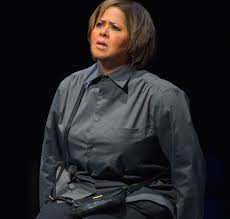
Anna Deavere Smith in The Pipeline Project

Anna Deavere Smith in The Pipeline Project

ADS: I’m doing video now. I would like to [put it online] largely because, by the time we’re finished with what I call the “Pipeline Project,” I’ll have at least 200 interviews. I’m only going to perform for an hour and a half on stage. Think of all that material that is never seen. Right? Characters. I think the work could be of use to folks who would like to either now or years from now like to look back on this moment in American history and look at this crisis. So that’s why to put the work out there to be of use.

HES: In an age of what you say selfies and social media, where people are so much more exposed and there are people who desire to be exposed, do you want people when they see your work to think that they are seeing you or do you want to be completely behind your character, the people that you play?

ADS: I’d be more concerned that I don’t want them to think that I’m Mrs. Akalitus from Nurse Jackie. I had a student of mine – I teach at NYU – and one of the graduate students told me that his mother had said, “I just saw your professor on television and I thought you said she was intelligent.”

I see my identity as for rent, and I want them to hear what the people have to say. I want them to hear what I heard. But I hope I don’t get in the way of that. I hope that my presence doesn’t get in the way of that but I know that my presence is there.

HES: The Pipeline Project has played out in Berkeley, California. You said to me that it’s going to have a few performances in Baltimore. Do you want it to have more or do you reach a point where you feel like I’ve done this piece?

ADS: I would like this piece to have more because I feel that the people are ever so compelling and that I want to keep refining them. I know more now about how to do these portrayals than I ever had, and that’s what happens to all of us, we gather information. I have that thing like a baby who knows it’s time to crawl. Your mother’s wondering when is he or she going to crawl? When is he going to walk? And they’re walking and that inner urge that we all have as humans, trying to ride a bike, trying to do something. I do have this great feeling to keep doing this project. To keep refining these portrayals. To keep trying to make the lens that I’m using to look at this large enough that it could be of use to the public.

HES: Obviously you go to a lot of different places to conduct your interviews, but you also perform in a number of different places. What is the experience if you know that one or more of the people that you’re portraying is in the house when you’re doing the show?

ADS: I’m nervous about it, I do invite them all. I want them to see it. And you know, I hope that they are not too self conscious or upset. I don’t think people tell me the truth about what they see. But it is important to me that they are invited and that their families are there.

HES: Very often, writers who are writing a conventional script, a writer who is sitting at the computer, creating the story, are sort of going towards wanting you to think something, wanting you to come out with a thing, or a group of things. Do you want people to come away with a particular thing?

ADS: This generation here is probably the first generation in a very long time, certainly in my lifetime, who actually comes to school to look at artistic practice for social change. This is the first time I’ve ever heard of this happening in high school. It’s usually Guys and Dolls or West Side Story or whatever the latest thing is, right? A Chorus Line. You get to be in the show! Right?

There’s always this concern that if you apply yourself like this, that you’re being didactic, or being political, right? So the people running for President want you to think something. ‘I’m the baddest of the bad and I’m the one that you should elect,’ right?

I want people to be driven to action. I want them to write a check to make something better for a kid somewhere. I want them to become involved in early childhood if they can. I want them to think about these kids, [about] who they want to elect as President of the United States. I want them to think about these kids when they decide who the mayor is in their town.

I want them to think differently about a kid who is walking by in the “iconic” hoodie with his pants down quite low in the back, because that’s what I want to consider. These kids who we lock up might not all be as dangerous as we think, in fact they’re very, very vulnerable to some profound inequities in society that make living pretty dangerous where they live. I want people who can do stuff to do stuff even if it’s, ‘I’ll walk a kid to school who has to cross a gang line’ or drive them or whatever. I want people to move up and do things the way that people did things when I grew up in the Civil Rights Movement. It’s that kind of moment in American history where people went outside of their normal doing to do a little bit more. I feel that we are really in a moment in our history where we need that to happen.

*  *  *

Howard Sherman is director of the Arts Integrity Initiative at The New School for Performing Arts School of Drama. Thanks to Briana Rice for editorial assistance with this post.
 

Kent State Coda: No Black MLK Ever Reached Their “Mountaintop”

November 16th, 2015 § 0 comments § permalink

Robert Branch and Camila Christian in The Mountaintop at Kent State University

Robert Branch and Camila Christian in The Mountaintop at Kent State University


In the many press accounts of director Michael Oatman casting a white man to play Dr. Martin Luther King in Katori Hall’s The Mountaintop, stories have all acknowledged Oatman’s original concept of splitting the role between black and white actors. His intent was, in his words:

“I truly wanted to explore the issue of racial ownership and authenticity.  I didn’t want this to be a stunt, but a true exploration of King’s wish that we all be judged by the content of our character and not the color of our skin,” said Oatman about his non-traditional cast.  “I wanted the contrast . . . I wanted to see how the words rang differently or indeed the same, coming from two different actors, with two different racial backgrounds.”

That narrative has prevailed, even when Katori Hall let it be known that she did not and would not ever approve of a white actor playing King in her play. Just as I had in my original post on this incident, she wondered why the black actor sharing the role was so little in evidence. Even after speaking with Oatman, Hall wrote:

“It’s true that Oatman only fell halfway off the ‘turn-up’ truck; the white actor was indeed sharing the role with another black actor. But the fact that this mystery actor has remained nameless further demonstrates the erasure of the black body in this experiment. Even on the school newspaper’s website, only the white actor’s name is listed.”

As it turns out, the reason this black actor is so scarce is because no black actor performed in the role of Martin Luther King at Kent State. As part of an interview with Oatman, the Akron Beacon Journal reports:

“At Kent State, Oatman originally double cast the King role, with white actor Robert Branch for three performances and a black actor for five shows. When more than one black actor dropped out due to family and other personal issues, Branch, whom Oatman described as one of the best actors he’s ever seen, assumed all eight performances.”

Even if one gives credence to Oatman’s intellectual basis for attempting to split the role, it evaporated along with the unnamed black actor, regardless of Branch’s talent. At that point, the already unjustifiable production should have been irrevocably abandoned, since the entire conceptual underpinning had come undone. What Oatman did was not a half-measure, as Hall was apparently led to believe, as we were all led to believe, but indeed the complete erasure of a black body as she had feared. There was no rationalization left, yet despite the intense press interest since Hall published her essay on TheRoot.com, Oatman at best quietly allowed a myth to be sustained, or at worst actively sought to keep the truth of the production secret to anyone interested, until this interview.

That this fact is virtually an aside in the Beacon Journal’s follow-up, which largely affords an unfettered opportunity for Oatman to advance his reasoning yet again, with nothing but quotes from Hall’s essay as pushback, seems a conscious effort to minimize the facts of the narrative. In citing supportive messages from friends on Oatman’s Facebook page, and noting that there were only a few walkouts as if that made the casting acceptable, the Beacon Journal is complicit in failing to address the willful lack of fidelity to the playwright’s intent. Where are the quotes from Hall’s friends, who were outraged. In addition, by saying at one point of Hall that “she railed,” rather than “she wrote,” there is also an implication that Hall’s thoughts on this issue were somehow not presented in an “acceptable” manner, another unfortunate choice.

So the summary of the Kent State Mountaintop story is: the creative decision was faulty to begin with, ultimately abandoned (no matter what the reason) and possibly kept secret even as scrutiny was focused on the production. Whether by omission or misdirection, Oatman has compounded his troubling creative decision immeasurably.

Though Oatman has said he wouldn’t make this particular choice again, he seems unbowed by the response from Hall and the playwriting community. He told the Journal:

“I think artists get too touchy about this kind of stuff,” he said. “I think whenever you make a controversial decision like this you have to allow the audience their space to react as they’re going to react. That’s what theater is about.”

If a director’s ethical and legal responsibility to other artists is dismissed as being “touchy,” indeed by someone who is primarily a playwright, any questions about Oatman’s judgment in this case should no longer be in question. He finds widely accepted professional practices to be a nuisance, when they are fundamental to the field he works in.

If his goal was to court controversy, Oatman has probably succeeded beyond his wildest dreams, and there may be more yet to come. But if his goal was to illuminate Katori Hall’s play for audiences, it’s quite clear that he failed, even if people applauded. He may have thought originally that what he was doing wasn’t a stunt, but in the end, that’s just what it turned out to be.

Update, November 16, 4:45 pm: In sharing my post on Facebook, Katori Hall prefaced it, in part, with the following statement:

“…When I spoke to Michael Oatman via phone October 27th, he never disclosed the fact that the black actor never went on, even when I questioned the validity of his social experiment of seeing if the ‘words rang differently or indeed the same, coming from two different actors, with two different racial backgrounds.’

I learned that the black actor never went on when Oatman was interviewed Friday night by Don Lemon on CNN. Surprise, surprise.

Many journalists in the media have portrayed me as outraged (The Wrap, NY Daily News, Washington Times, Playbill). I have supposedly ‘fumed’. I have supposedly ‘slammed.’ Shout out to TIME and TheRoot.com who used much more honest language. Yes, I criticized the casting choice and yes I explained my position why….

Yes, it is unfortunate that in 2015, a young black female artist who demands that her work be respected and puts forth a valid and articulate response is characterized as merely throwing a temper tantrum.”

Howard Sherman is the interim director of the Alliance for Inclusion in the Arts and director of the Arts Integrity Initiative at The New School College of Performing Arts School of Drama.


Clarion Call Of Racial Spin By University Fails Students And Theatre

November 16th, 2015 § 0 comments § permalink

Poster for Jesus in India at Clarion University

Poster for Jesus in India at Clarion University

“What will you learn?” asks the home page of the website of Clarion University in Pennsylvania. In the wake of the school’s handling of the casting of white students in Asian roles in Lloyd Suh’s Jesus in India, and the playwright’s withdrawal of production rights upon learning this fact, it’s unclear at best, disturbing at worst, to consider what Clarion wants students to learn about race and about the arts.

Based on what is appearing in the press, they are learning to blame artists for wanting to see their work represented accurately. They are learning to attack artists when the artists defend their work. They are learning that a desire to see race portrayed with authenticity is irrelevant in an academic setting. They are learning that Clarion seems unaware of the issues that have fueled racial unrest on campuses around the country, most recently with flashpoints at the University of Missouri and Yale University. They are learning that when a community is overwhelmingly white, concerns about race aren’t perceived as valid.

In an essay published in the Chronicle of Higher Education on Friday, Marilouise Michel, professor of theatre and director of the canceled production, wrote, “I have intentionally left out the name of the playwright and the piece that we were working on as I do not wish to provide him with publicity at the expense of the fine and viable work of our students.” What’s peculiar about that statement is that until 1:30 pm that day, when he released a statement, the playwright hadn’t sought for this issue to be public in any way. It was Clarion that had contacted the press, Clarion which had released his correspondence with Michel, and Clarion which used a professional public relations firm to issue a statement about the situation from the university and its president. It reads, in part:

The university claims their intent from the start was to honor the integrity of the playwright’s work, and the contract for performance rights did not specify ethnically appropriate casting. Despite the university’s attempt to give Suh a page in the program to explain his casting objections and a stage speech given by a university representative on the cast’s race, Suh rejected any solutions other then removing the non-Asian actors or canceling the production.

“We have no further desire to engage with Mr. Suh, the playwright, as he made his position on race to our theater students crystal clear,” says Dr. Karen Whitney, Clarion University President. “I personally prefer to invest my energy into explaining to the student actors, stage crew and production team members why the hundreds of hours they committed to bringing ‘Jesus in India’ to our stage and community has been denied since they are the wrong skin color

This insidious inversion of racial justice is profoundly troubling. The play, set in India, has three characters named “Gopal,” “Mahari/Mary,” and “Sushil,” a strong indication of their race. Suh maintains that the university was asked about their plans to cast those roles, and his agent Beth Blickers says no answer was ever given. But when the playwright finally drew a line over racial representation, he was the one who was supposedly denying skin color, when it was Michael’s personal interpretation of the play, against clear evidence and requests, which was ignoring race in the play. So now, one must wonder whether Dr. Whitney will be spending time explaining to the students of color on campus why she is vigorously defending the practice of “brownface” on campus (white actors portraying Indian characters, regardless of whether color makeup is actually employed) and attacking a playwright of color for decrying the practice.

To be clear, there is undoubtedly great disappointment and pain among the students and crew who had been working on the production. Anyone in the arts will surely sympathize with them for having invested time and effort towards a production that they surely undertook with the best of intentions. But they were, most likely unwittingly, made complicit in the act of denying race and denying an artist’s wishes.

In the university’s press release, the extremely small Asian population of the school is noted (at 0.6% of the student body), as it has been previously in many reports. That no Asian students auditioned should not have been surprising, nor should it have been license to substitute actors of others races as a result. Any director who is part of an academic theatre program has a very good idea of what talent may be available, and often productions are chosen accordingly. So it is not the failure of Asian students to audition to blame for the inaccurate racial casting. More correctly it was the decision to produce a play which clearly called for Asian characters and the assessment that race didn’t matter that created this situation – not Lloyd Suh or any student.

In the Chronicle, Harvey Young, chair of the theatre department at Northwestern University, admittedly a more urban school, says the following regarding racial casting on campus:

“That is the magic of the university — to introduce people to a variety of perspectives and points of view.”

But at Northwestern, Mr. Young said, the department uses a variety of strategies to avoid what could be racially problematic casting. The department has hired outside actors to play some roles and serve as mentors to students, reached out to minority groups to let them know about acting opportunities, and staged readings at which only voices are represented.

“The goal is to devise strategies that allow you to engage the work while being aware of whatever limits exist,” Mr. Young said.

In her essay for the Chronicle, Michel wrote, “Perhaps Shakespeare would wince at a Western-style production of The Taming of the Shrew, but he never told us we couldn’t. He never said Petruchio couldn’t be black, as he was in the 1990 Delacorte Theater production starring Morgan Freeman.” This is a specious and rather ridiculous argument, since Shakespeare’s work is not under copyright and can be cast or altered in any way one wishes. While there are certainly examples of actors of color taking on roles written for or traditionally played by white actors – NAATCO’s recent Awake and Sing with an all-Asian cast playing Clifford Odets’s Jewish family, the Broadway revival of Cat on a Hot Tin Roof with a black cast playing Tennessee Williams’s wealthy southern family – they were done with the express approval of the rights holders. That these productions were in New York as opposed to Clarion, Pennsylvania makes no difference as to the author’s rights. What we have not seen is an all-white Raisin in the Sun, either because no one has been foolish enough to attempt it or because the Lorraine Hansberry estate hasn’t allowed it.

Clarion’s press efforts have certainly paid off in the local community, with three news/feature stories in the Pittsburgh Post-Gazette (herehere and here) as well as an editorial, along with two features (here and here) in the Chronicle of Higher Education, in addition to the aforementioned essay. That the Post-Gazette’s editorial sides entirely with Clarion is no surprise, since the university was driving the story; that it fails to take into account any reporting which runs counter to Clarion’s narrative, and indeed repeats them, is shameful, a disservice to the Pittsburgh community. That the Chronicle of Higher Education ran Professor Michel’s essay, another one-sided account of the situation, is problematic, but the headline (whether it is theirs or Michel’s), “How Racial Politics Hurt My Students,” is a clarion call for paranoia about race. It ignores the fact that the problems arose from a failure to respect the work and the playwright, that the issue is based not in politics, but in art, and that the author saw his work being defaced and stood up for it. There have been countless other reports on the situation. That this has engendered vile racist outpourings online, especially in comments sections and on Facebook, and in some press accounts is the result of the university’s irresponsible spin.

Universities are in no way exempted from professional standards when it comes to licensing and producing shows; to claim otherwise is to suggest that campuses are bubbles in which the rules of the real world do not apply. While classrooms are absolutely places for exploration and discovery, theatre productions of complete works for audiences are not just educational exercises. Students need to be taught creative and legal responsibility towards plays (and musicals) and their authors, not encouraged to take scripts as mere suggestions to be molded in any way a director wishes. When it comes to race, this incident and the recent Kent State production of The Mountaintop will now insure that every playwright who cares about the race of their characters will be extremely explicit in their directions, but that doesn’t excuse directors who look for loopholes to justify willfully ignoring indications in existing texts.

It’s my understanding that there has been new contact between Michel and Suh, though I am not party to its nature or content. It’s worth noting that in the third Post-Gazette story, it is reported that “Ms. Michel took to Facebook Saturday to ask “that any negative or mean-spirited posts or contact towards Mr. Suh be ceased. We are both artists trying to serve a specific community and attacking him helps no one.” That’s a responsible position to take, but it should be expanded to include negative posts or contact about the accurate portrayal of race in theatre, since they are flourishing in the wake of this incident.

It is also now time for the university to explain the truth about why the production was shut down, namely a failure to respect the artistic directive of the playwright; insure that this incident and the rhetoric surrounding it hasn’t been a license for anyone to marginalize their students of color; and begin truly addressing equity and diversity on their campus. Regardless of the racial makeup of their community or student body, they need to be setting an example and creating a better environment for all students, not feeding into narratives of racial divisiveness.

Update, November 18, 7 pm: Earlier today, the Dramatists Guild of America released a statement regarding the organization’s position on casting and copyright, signed by Guild president Doug Wright. It reads, in part:

One may agree or disagree with the views of a particular writer, but not with his or her autonomy over the play. Nor should writers be vilified or demonized for exercising it. This is entirely within well-established theatrical tradition; what’s more, it is what the law requires and basic professional courtesy demands.

Howard Sherman is interim director of the Alliance for Inclusion in the Arts and director of the Arts Integrity Initiative at The New School College of Performing Arts School of Drama.