This is the note from Kimberly Kaye at Theatermania that preceded my op-ed:
When TheaterMania launched its Bros on Broadway series in October 2012, theatre pundit and arts administrator Howard Sherman reached out to Creative Director Kimberly Kaye via Twitter to say he would be “monitoring” the feature and internet responses to it. After the debut of the TheaterMania’s fourth “Bro” this week, Sherman reconnected, stating he would like to “weigh-in” on the reviews and the controversy around them. Below are Sherman’s thoughts. They belong solely to the author, who received no payment or compensation for his work.
* * * *A number of years ago, I took my two best friends since junior high to a play I was publicizing. They weren’t by any means theatrical novices, having previously been taken by their parents or dragged by me, but they were far from regular theatergoers. (In the past several decades, I can’t recall them ever buying theatre tickets of their own accord.) The show I took them to, a modern romantic comedy, had a brief moment where the leading lady was topless; it was natural within the play and not gratuitous. As we waited for others to file out after the show concluded, my friend Stephen leaned across our friend Mike to inform me I had failed to get good seats. “What are you talking about?” I asked. “If we’d been on the other side of the theatre,” Stephen explained, “we would have had a much better view when she had her top off.“Yes, my old friend is a “bro,” and was one before the term even existed. So Stephen, and Mike as well, are factors that explain, in part, why I didn’t erupt in aesthetic umbrage when TheaterMania introduced its “Bros on Broadway” feature a few weeks back, even though many who know or read me might have expected me to do so. When your best friends are bros, you learn to accept. Frankly, I was a bit surprised by the anger provoked by the first “Bros” piece, and indeed might have missed the article entirely had I not spotted online brickbats being thrown at TheaterMania Creative Director Kimberly Kaye (who I follow on Twitter, but do not know in real life). I reached out to her that day online, to offer a bit of moral support, since it’s never easy to be on the receiving end of public verbal assaults. I’ve been there, so I know.I said at the time that, while my instinct was to be dismissive of the piece, I would adopt a wait-and-see attitude. Would “Bros on Broadway” be a means of ridiculing theatre and those who choose not to attend it in one insulting unit? Only after a few columns appeared would I make any judgment.In the meantime, I pondered the premise. It’s not as if TheaterMania had suddenly jettisoned a theatre critic in favor of bro-mmentators; this was an add-on to their existing theatre coverage. TheatreMania is a commercial venture, and (shockingly) there are other sites that ply the same territory. The new series was certainly unique. While fraternity membership and sports fandom seemed to be recurring resume points for the bros, TheaterMania wasn’t trooping out rejects from The Jersey Shore to pontificate about Chekhov. And the whole “bro” concept is sort of a joke in and of itself, as simultaneously popularized and satirized in the character of uber-bro Barney Stinson [Neil Patrick Harris] on the sitcom How I Met Your Mother, so why get all serious?
With four pieces to date, I can now say that “Bros on Broadway” is not the end of theatre criticism as we know it. It is merely another iteration of “citizen criticism” that has burgeoned since the advent of blogs and social media. The premise may have already been copied by another outlet (D Magazine’s “The Broducers “), but I don’t see The New York Times subsuming their arts coverage into the sports section yet, so I don’t think it’s a snowballing trendsetter either.
I’d even argue that “Bros on Broadway” is beneficial to the field of theatre. Within the circles of arts professionals there is always the risk of “talking to ourselves.” That is to say, believing that we are our audience, when nothing could be further from the truth. Getting a true sense of what the man (or woman) on the street may think of the work to which we’re dedicated only makes us better at our jobs, allowing us to understand the perceptions of those not immersed in our world. It’s a good thing for the die-hard theatre buffs to see our cherished, insular world through someone else’s eyes–eyes that don’t line up in freezing temperatures at the TKTS booth.
People far more intelligent than myself have written about how our society is more fractured than ever, facilitated by self-selecting social media circles and DVRs that allow us to only watch what we want. Indeed, if we reached out more astutely to the bros of the world, maybe theatre wouldn’t be the niche pursuit that it is.
Although it’s catchy, I wonder (hope?) that perhaps the “Bros on Broadway” title may prove limiting in the long run. After all, surely there are women who’ve never been to the theatre before, and I’d like to hear from them as well. I’d also like to see first-timers taken to off and off-off-Broadway, or regional theatre, since Broadway is only the tip of the iceberg of American theatre. But fundamentally, I love the idea of introducing new people to the theatre and learning their reactions. In turn, perhaps they’ll look at those of us who are, now and forever, “theatre geeks,” in a new light.
And this all reminds me: it’s time for me to drag Stephen and Mike to the theatre again real soon. It’s good for them to get out of the house and into a dark room.
P.S. If you’re just dying to know the name of the play and half-dressed actress described in the first paragraph, you just might be a bro.
See the story as it appeared on Theatermania here.
Many people, and I count myself among them, often find themselves trying to quantify the totality of theatre activity in the United States and, within that, to delineate differences between the various sectors: commercial, not for profit, educational, amateur and so on. While absolute figures may prove elusive, there are a handful of studies that provide a reasonably good picture of professional production, lending perspective to any discussion about the reach of theatre in America.
While the methodologies may vary, and the TCG report isn’t 100% inclusive and includes extrapolation, looking at the two is very informative as a means of comparing and contrasting these two sectors, which inexplicably to me seem to be always addressed discretely, rather than as parts of a whole.
Here’s the main snapshot:
2010-2011 Season
Commercial
Not-for-Profit
(B’way League)
(TCG)
Revenue
$1,884,000,000
$2,040,000,000
Attendance
25,630,000
34,000,000
Productions
118
14,600
# of performances
20,680
177,000
I was surprised to find that in terms of revenue, the two sectors are quite close; the NFPs edge commercial production by $36 million (for the purpose of this summary, I have merged earned and contributed income in the NFPs). Attendance between the two shows the NFPs ahead by a bit over $8 million, which is almost 33%. But the real difference is in the number of productions, which demonstrate that the production pace in NFP theatre is vast compared to the commercial arena, and the total number of performances almost eight times greater.
Obviously caveats quickly arise: most of the NFP production is in houses of 500 seats or less, while that’s the minimum size in the commercial world, where theatres can reach over 3,000 seats. It takes only a handful of productions in commercial to generate nearly equal revenue to the entire NFP sector; that’s because a single production might play throughout the season, either on Broadway or on tour, while each NFP might produce a half-dozen shows in a year. Though production figures aren’t available, the budget of a single commercial musical might fund a mid-sized LORT theatre for two seasons, let alone countless storefront or LOA companies for years.
But what’s perhaps most interesting is that, operating under the reasonable assumption that each show has one director, one set designer, on lighting designer, one costume designer and one sound designer, those working in those fields are employed almost entirely by the NFP companies, since there are so very few opportunities in commercial theatre. Indeed, its not uncommon for the same designer in the select group that secure Broadway shows to do two or three in a season, and for those same designs to go out on tour, so when it comes to individuals, that count of 118 grows even smaller.
In terms of the aggregate economic force of Broadway, the League’s numbers show that Broadway and commercial touring generates significant income from a relatively small amount of shows. The TCG numbers show a more granular reach, with thousands of productions just edging the commercial world to reach a similar figure. But it’s the NFPs that are providing the vast majority of theatrical employment.
Let’s look at another measure of employment, specifically when it comes to actors. I think it’s a safe assumption to say that with musicals dominating commercial production, the cast size of an average show must surely outpace those found in resident theatre. Drawing upon employment data from Actors Equity for the same 2010-11 season, here’s the snapshot:
AEA Employment
2010-2011 Season
Work Weeks
Earnings
Production contract
B’way & tours
73,505
$183,184,564
LORT
59,982
$52,583,175
Developing Theatre
46,116
$6,344,839
Chicago Area
7,438
$4,252,738
Bay Area Theatre
1,290
$644,749
Total NFP
114,826
$63,825,501
There’s obviously a staggering difference in compensation for performers in the two sectors, since with 40,000 fewer work weeks, the commercial productions yielded almost three times the earnings for its actors as the NFP companies provided. While certainly star salaries may have had something to do with this, it’s more likely because production contract minimum typically exceeds the top salary at any of our not-for-profit companies.
So what have we found? Resident, not for profit theatres provide the foundation for the vast amount of theatrical activity in the United States, employing the lion’s share of the artists and presumably staffs as well, and playing to about 30% more patrons. When it comes to overall sector income, the two are extremely close (although the inclusion of more of Equity’s smaller contracts might tip this slightly further). But for those fortunate enough to secure employment as actors or stage managers in commercial productions, the compensation far outstrips what’s paid by resident companies.
Next time you want to make a generalization about the difference between commercial and not-for-profit theatre, here’s your broad-based data to draw from. But there’s lots more where this came from, and I urge everyone in the field to review it, to understand both the divergences and similarities, and to better understand American theatre not as an array of silos, but as a whole.
As previously indicated, revenue for NFP companies is inclusive of both box office and contributed income, since both are required to achieve the level of production represented within; commercial theatre may have some amount of sponsorship income, but it wasn’t broken out in the Broadway League survey, nor did I treat capitalization as income.
There are almost two dozen AEA contracts not represented in the actor workweek summary, because I am not familiar enough with each contract to properly categorize it. The contracts included represent almost 2/3 of all AEA employment. It’s worth noting, by the way, that the Disney World-AEA contract covers 5% of all AEA annual work weeks, but does not factor in here.
While the Broadway League has assembled its numbers for 2011-12, and as I was writing, AEA indicated that their figures for that period would be released imminently, 2010-2011 remained the period of comparison because that is the most recent TCG data available. It should be noted that once every seven years, the League has to compile its data into a 53, instead of 52, week season; 2010-11 was such a year, so the comparison of the data is imprecise, giving a quantitative edge to the commercial numbers.
In the past five Broadway seasons, there have been seven productions of plays by David Mamet, making him in all likelihood the single most produced playwright on Broadway in that period, and certainly the most produced living playwright. That’s a pretty remarkable achievement, especially when you consider that Mamet has only had 15 Broadway productions in his career. Three of those 15 were American Buffalo productions, while another three were Glengarry Glen Ross.
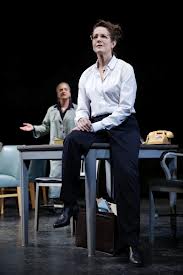
Patti LuPone and Debra Winger in “The Anarchist”
But the impending closing of his newest play, The Anarchist, only two weeks after its opening, gives Mamet another record: this marks the third Broadway season in which there have been two Mamet productions on Broadway, with one in each pair closing prematurely. For the record: the autumn of 2008 saw both Speed-the-Plow and American Buffalo (the latter closing in a week, while the former saw three lead actors in a single role, though it completed its limited run); 2009 paired Oleanna and Race (the revival lasting less than two months, while the new play enjoyed a sustained run); and now we have The Anarchist closing while Glengarry Glen Ross is selling well during a limited run comprised equally of previews and regular performances.
Critical reaction certainly hastened the demise of the fast closers, but shows – especially those with stars, as has been the case with all recent Mamet productions – can manage to outpace critical opinion. But stars haven’t been infallible insurance with Mamet; a production of A Life in the Theatre, with the estimable Patrick Stewart and TV star T.R. Knight was seen briefly in 2010, the sole Mamet entry that season.
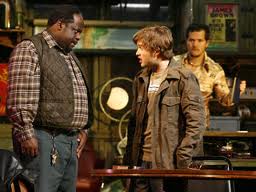
Cedric the Entertainer, Haley Joel Osment & John Leguizamo in “American Buffalo”
We can argue the merits of David Mamet as a playwright, or the quality of the various productions, but this spate of openings (and closings) certainly suggests that Mr. Mamet has imposed on our hospitality a bit longer than might be advisable. When the typical Broadway season only sees 40 new productions a year, two a season from the same playwright is not an insignificant amount – and in the case of Glengarry, it has only been seven years since the last production.
It may well be that Mamet is overexposed, and familiarity is breeding contempt in some quarters. What’s unfortunate in this spate of commercial programming is that some of Mamet’s less produced work – say the nihilistic Edmond or the ribald Sexual Perversity in Chicago, neither ever seen on Broadway – have yet to surface in major New York revivals, and as someone who has never been fortunate enough to see either on stage, I’d welcome them.
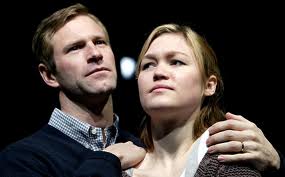
Aaron Eckhart and Julia Stiles in “Oleanna”
When Edward Albee’s stock rose after a season at Signature Theatre and the Vineyard production of Three Tall Women in the mid-90s, it triggered a wave of Albee revivals, mixed with new work, on Broadway and Off, allowing a new generation to see virtually every major work by our most esteemed living playwright, after a period of disfavor. There’s nothing wrong with David Mamet getting the same treatment (though he never experienced the fallow period that Albee did in the 80s), and I even delight in the idea that such a retrospective can take place in the commercial arena. But the Albee “festival” was spread out over some 19 years by the time we got to The Lady From Dubuque (and we’re unlikely to ever see The Man Who Had Three Arms).
Maybe our Mamet feast likewise needs a bit more time to digest between courses, so that we might be inclined to savor them more when they come. Speaking with a marketing and sales agenda, rather than an aesthetic one, I must haul out a cliché: absence, as they say, does make the heart grow fonder.
The Broadway League released the results of its annual demographic survey of audiences yesterday, and as always, it’s a useful snapshot of the Broadway audience, whatever your philosophical view of Broadway may be. The percentage of tickets purchased by tourists (those residing outside of the tri-state area) inched up to 63.4% of all tickets sold (a slight rise from the prior year’s 61.7, but showing that roughly two out of every three Broadway tickets are purchased by visitors, not locals. 18.4% of all tickets were purchased by international tourists, which means that nearly 20% of all ticket sales are to foreign residents, while a bit more than 40% are to U.S. travelers. This shouldn’t be terribly surprising, since a variety of surveys show that Broadway is the number one attraction for visitors to New York.
Although the news yesterday was about the demographics, a number of outlets treated the release as if it were the first announcement about Broadway’s audience during the 2011-12 season, when in fact the League issued a release on revenues and attendance on May 29, two days after the official close of the season as they define it (roughly June 1 to May 30 each year). Indeed, if you looked to The Hollywood Reporter, Entertainment Weekly or Deadline, you would have thought the League just managed to finish tallying the season that ended six months ago, as the demographics (admittedly inside pool) took a back seat to dollars and bodies.
The 2011-12 season marked a record high dollar gross for Broadway shows, at $1.13 billion, with total paid attendance of 12.33 million. While direct comparisons are slightly skewed, because for statistical reasons, the prior year had 53 weeks instead of 52, the figures were consistent with recent trends, with growth in revenues outpacing the growth in number of paid tickets. Yes, thanks to the innovation of VIP or premium tickets, the finite universe of theatres and seats manages to make more money with every passing year, because Broadway has fully embraced the simple economic principle of supply and demand.
You can expect that yesterday’s announcement will be followed in roughly four weeks time by the sales and capacity figures for the calendar year 2012 (as opposed to the theatrical season, creating a second opportunity for headlines sliced from the same data). So with percentages and numbers floating around, I decided to explore, on a top-line basis, how much of the Broadway wealth is being spread around, and how much of it is attributable to only a few shows.
Based on the tally drawn from IBDB.com, a total of 72 productions played, in whole or part, during the 2011-12 season, ranging from long-running hits like Phantom of the Opera to special limited events like Hugh Jackman: Back on Broadway. Of those, 41 were new productions, and it’s worth keeping in mind that there are only 40 Broadway theatres. Given that long runners occupy a portion of the designated real estate, this quickly reveals how many shows were coming and going throughout the year (as is the case every year), some intentionally (star vehicles that were planned for only 16 week stints), some not (Bonnie and Clyde).
So, I wondered, what were most people seeing? Utilizing data collated by The Broadway League, I pulled out the results of revenues and paid attendance for five shows, opting for those I thought might be the most popular. Here’s the results:
Show
Gross $
Paid Attendance
Phantom
45,574,189
567,537
Spider-Man
79,013,711
726,849
Wicked
91,024,950
728,950
The Lion King
87,912,528
686,429
Book of Mormon
72,228,118
452,898
Five show total
375,753,496
3,162,663
B’way Season Total
1,139,000,000
12,330,000
33.0%
25.7%
So what do we find? That out of 72 possible productions, five shows yielded 33% of the gross revenues for the Broadway season and 25% of the audience. That’s an awful lot of firepower in only five theatres. And given the nature of the shows and the length of some of the runs, I think it’s a fair assumption that those eight million tourists who attended Broadway last year bought a good number of the three million tickets sold by these shows.
What about Mary Poppins? What about Jersey Boys? I could have swapped either of them with Phantom and the results would have been almost identical. Why five shows – why not all seven? Simply for the optics of how a handful of shows can dominate Broadway, and five is somehow more effective than seven, to my mind at least.
When it comes to grosses, the presence of Book of Mormon has a significant impact: even though its paid attendance is smaller than any of the five shows selected, you can see that its gross is disproportionately high (it had an average ticket price of $159 in this period, compared to $80 for Phantom). But it isn’t an anomaly, it’s what you learn on the first day of Econ 101: the logical result of a smaller house, a hit show and premium pricing. We’re likely to see more shows follow this model as time goes on, as a “tight” ticket seems to only build demand.
All of this data goes to show that, when the theatergoing public thinks about Broadway, they’re likely defining it through the handful of shows that dominate at any given time, since those are the ones that most people see and those are the ones minting the money – and they are, as we’ve always surmised, the long-running hit musicals. And for all of the statistical benchmarks that make for success in headlines, the rising tide is not floating all boats — it’s concentrated in the hands of a very few hits, which have a disproportionate cut of the Broadway pie.
It’s hardly surprising to learn about a hit Off-Broadway show moving to Broadway. It’s been happening for years, both with shows that began at not-for-profit companies or as commercial ventures. Open small, get great reviews and sales, move beyond the confines of a much smaller theatre to reap the recognition and rewards of a Broadway berth, which then secures a long life for the show in regional, international and amateur and school markets.
In most cases, the Off-Broadway to Broadway transfers happen pretty quickly, to seize upon momentum. If they don’t happen in the same theatrical season (vaguely defined by awards timelines), then they turn up the following year. The lag-time between the Playwrights Horizons production of Clybourne Park and its Broadway run was longer than the norm (with numerous regional productions blooming in the gap).
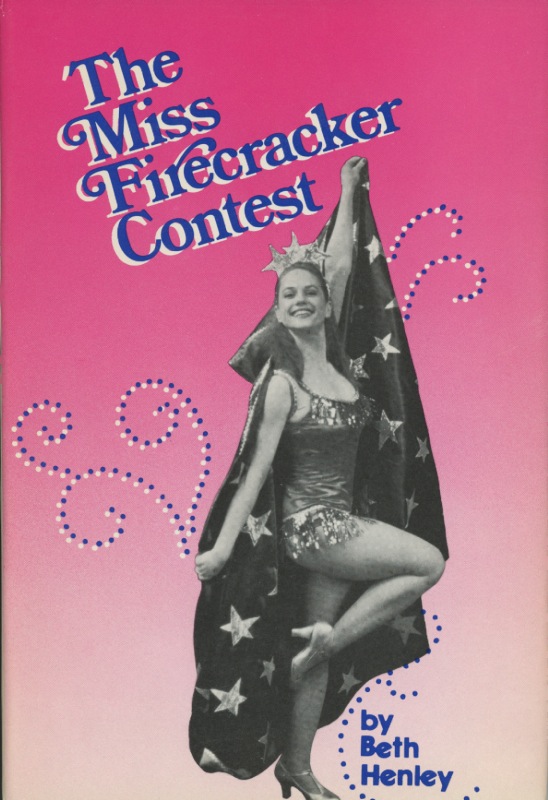
But when Beth Henley’s The Miss Firecracker Contest was announced for Broadway this spring, it joined a subset of shows that took protracted paths to the Great White Way. In the case of Miss Firecracker, it took more than 25 years – and it also marks Henley’s Broadway return after a hiatus of 30 years, ashocking gap for a major author.
This ultra-late path to Broadway is a slow-building trend to be sure, but in the past dozen or so years, some 20 shows that met with acclaim and countless productions after their Off-Broadway success have turned up on Broadway for the first time. In most cases, by the time they get there, they’re considered part of the theatrical repertoire to the extent that they’re revivals making their Broadway debut. In many cases, the Off-Broadway hits spawned movie versions, without a Broadway imprimatur.
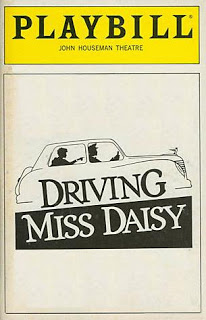
Some of the examples: Margaret Edson’s Wit, Athol Fugard’s The Road to Mecca, David Mamet’s Oleanna, Donald Margulies’ Collected Stories, Terrence McNally’s Frankie and Johnny in the Claire de Lune, Alfred Uhry’s Driving Miss Daisy, Caryl Churchill’s Top Girls, Robert Harling’s Steel Magnolias, Richard Greenberg’s Three Days of Rain and Eric Bogosian’s Talk Radio. Even the musical Little Shop of Horrors finally made its way from downtown to uptown, but after a hiatus of more than two decades.
What’s driving this stealth trendlet? There are several factors. One is simply that over time, even without Broadway status, the shows have grown so much in recognition that they’re not necessarily the risky prospects they once were (Wit, for example, sought a Broadway house back in the day, but no one would book it). Though most weren’t star vehicles in days gone by, a number were star-makers; Miss Firecracker launched Holly Hunter to stardom, just as Daisy did for Morgan Freeman; now that they’re recognized as having roles stars covet, which explains Vanessa Redgrave and James Earl Jones in the recent Daisy run. And with the aforementioned recognition that has built up, especially after film adaptations, the titles are simply more “marketable,” meaning producers don’t have the same uphill climb that they might with a wholly new work – although the fact that the movies are so indelibly etched that shows compete with those, rather than original productions.
Another key factor is that the environment that enabled shows like these to run for several years commercially Off-Broadway has largely evaporated. That’s not to say there are no commercial play productions Off-Broadway, but the prevailing wisdom is now that you can only succeed financially by taking a hit from The Atlantic or The Public to Broadway; that the economics simply don’t favor an intra-Off move.
I don’t have any particular reservations about this practice, since it’s typically one or two shows a year at most. It is worth noting that the majority of these plays had very small casts and required minimal scenery; by enlarging them to the scale of a Broadway house, there’s always the risk that the intimacy which may have helped them become hits in the past may be lost along the way.
What would prove truly exciting would be if producers looked beyond the iconic Off-Broadway successes and explored works which, for one reason or other, didn’t have long runs and didn’t move anywhere, despite being praised in their day. I bet a quick read of Theatre Worlds (or my Playbill collection) from the 80s and 90s could turn up a number of forgotten gems. It’s worth remembering that John Guare’s The House of Blue Leaves, originally produced Off-Broadway, only found its place in the canon of major works after the Lincoln Center Theater revival in the 80s; Sam Shepard’s True West suffered from a troubled production at The Public in its New York debut, only to be a hit less than 10 years later when the Steppenwolf production came to town, though in that case, again Off-Broadway.
When Miss Firecracker was announced yesterday, I spotted several comments in my Twitter feed from those who were pleased for the opportunity to see the play on stage for the first time, and indeed it’s less of a known quantity than most of the shows I’ve cited. Their comments reminded me that I’ve been around long enough that these are, for me, unquestionably revivals, as I saw many of the original productions. I recall going into Miss Firecracker unaware of Holly Hunter and walking out with a serious crush; when I saw Rosemary Harris in The Road To Mecca last year, I often confused people by mentioning having seen Julie Harris in the same role in a regional production almost 20 years ago.
So today’s Broadway is now, on occasion, a home for yesterday’s Off-Broadway hits. There’s a certain irony baked into that, as well as a longing for the bygone Off-Broadway environment, but I’ll look on the bright side: these plays are proof that you don’t always need Broadway to be a success. But that opens up new questions as well: what other shows might be rediscovered, and 20 years from now, will today’s Off-Broadway prove to have been comparably fertile?
I have yet to see Pinter in the Pinter or Sondheim in the Sondheim. I have, however, seen Ayckbourn in the former and, incongruously, Pee Wee Herman in the latter. For anyone confused, I am referring to the recently renamed Harold Pinter Theatre in London’s West End and Broadway’s Stephen Sondheim Theatre. I applaud the naming of these venues, and I am equally enthusiastic about the Caryl Churchill Theatre that will open in Surrey next year. They are manifestations of a topic I find myself musing upon: using theatre naming as a means of promoting the awareness of theatrical history.
On the one hand, the name of every Broadway and West End theatre carries history, since the venue name will be associated perpetually with famous productions that played there. However, names are not exactly fixed in stone. While Broadway’s Belasco and New Amsterdam may stretch back to a century ago, the current Helen Hayes Theatre is the second building to honor “the first lady of the American Theatre”; the original (which had two names before Hayes) was torn down some 30 years ago. Edward Albee’s Who’s Afraid Of Virginia Woolf? premiered at the Billy Rose Theatre 50 years ago; today, that same theatre is the David T. Nederlander, named for a member of the family that now owns it.
The point is that theatre names are somewhat fluid, and the rationale behind their naming, past and present, can have a variety of motivations. It was certainly the style, once upon a time, for the impresario who built the theatre to name it after himself, but in New York, there has been an intermittently enlightened approach that has resulted in such venues as the Lunt- Fontanne Theatre (named for the husband and wife acting duo in 1958) and the August Wilson Theatre (renamed in 2005, just after the pioneering African American playwright passed away, the building’s sixth name). Among Broadway’s 40 theatres, two are named for legendary critics, the Brooks Atkinson and the Walter Kerr, and a third for newspaper caricaturist Al Hirschfeld, no small recognition for the fourth estate.
Other theatres are named for more practical reasons: when the not-forprofit Roundabout Theatre Company reclaimed a theatre on 42nd Street, part of the restoration and its ongoing funding was secured through a long term sponsorship that named the new venue the American Airlines Theater. Purists were dismayed, but to my mind, it was not affront, since it reestablished a working theatre where none had been for decades.
But I return to the Wilson, the Lunt-Fontanne, the Sondheim, the Hayes, because to me they are exemplars. Maybe, just maybe, patrons seeing shows in those theatres might take the time to find out about these storied names, both bygone and current. Perhaps programmes or websites can provide not just the history of the theatre, but of its namesake. Could our theatre capitals take the opportunity to make themselves billboards for theatre history with more judicious naming? In New York, what of a George Abbott, a Comden and Green, a Wendy Wasserstein Theatre? And they need not be posthumous. Harold Prince, one of the most influential figures in New York theatre from the 1950s to today, might be thusly honoured (even if he has had, at one time, not one but two theatres named for him in Philadelphia). In London, what of Ayckbourn, Stoppard, or Ralph Richardson?
This is not a decision that can be achieved through public opinion, since the authority rests with the owners of the buildings themselves. But perhaps while theatres retain the truly memorable, essential names, the more generic ones can become theatrical history markers. By way of example, both New York and London have Lyceums that might be better off personalized, if preservation regulations allow it. Since theatre is not a religious rite, why do London and New York both have St James Theatres if he was the patron saint of furriers and chemists?
Some theatres’ historic names have been proven outdated, the figures they were named for more fleeting than expected. Perhaps we must change these pieces of the theatre’s history in order to better promote theatre history and commemorate it for subsequent generations.
Life and safety are most important. A place to live comes next. Then jobs, business, livelihoods. In the wake of the storm that just slammed New Jersey and New York, these are the priorities, first and foremost.
But it’s my nature to turn to thoughts theatrical, and there’s no question that every manner of live performance in the affected areas will feel a strong and lingering impact in the days and weeks, perhaps months, to come. Even venues that were spared any direct damage from the storm will have to grapple with having artists, staffs and audiences cut off from theatres for days or even weeks; the minds of ticketholders and potential ticket buyers are not focused on their next evening out, but instead on the priorities of my first paragraph.
Yes, we all heard that Broadway was shut down on Sunday night and has yet to announce the reopening of shows as I write. But Broadway is just the tip of the iceberg, the headline that efficiently communicated, pre-storm, that New York was hunkering down. Off and Off-Off Broadway, theatres outside of Manhattan, and outside of New York all shut down as well. Rehearsals, tech, workshops, showcases, readings – all were hit, from Virginia northward, and westward too.
On the internet, snide remarks on Sunday and even Monday played off of “The show must go on,” as if heeding safety alerts and protecting patrons were somehow a dereliction of duty, instead of a prudent decision to insure that no one took undue risks. These are the same people who are probably complaining about lack of mail service today.
The immediate suspension of productions will no doubt have a financial impact on every venue, commercial or not-for-profit. Movies may get more attention, but they are fixed art; perhaps their theatrical runs may be curtailed by loss of marketing momentum, but they won’t cease to be. TV ratings may take a hit because of major markets without power, but reruns, Netflix, Hulu and the like will make certain that programs don’t go unseen.
In theatres throughout the region, shows that were already at financial risk may see their demise hastened; shows in previews or rehearsal may see their production schedules altered and face challenges in luring audiences, even after transportation returns to normal, because focus and priority won’t be on entertainment. Even successfully running shows will take a sustained hit.
This is a natural disaster, not terrorism. But as the ripple effects of 9/11 went far from ground zero, for an extended period of time, this storm will pass but its memory and its impact will linger. Theatres in the mid-Atlantic and northeast will have to convince audiences to return once again, and it won’t be about conquering justified fears, but conquering physical and financial realities which will impede that process. It will take a long time to get past this.
As a final word, precisely because the relighting of Broadway, when it occurs, will again capture headlines, I’d like to remind everyone who cares about live performance that the performances and companies at greatest risk are those that are not as high profile, those without extensive financial resources, those that operate from small venues in locations somewhat less traveled. Yes, the relighting of Broadway houses has an impact on the many industries that benefit from the influx of audience members to those shows, but that same situation is played out in microcosm at every performance venue, in every neighborhood affected.
Let’s do all we can to help our families, our neighbors and those we don’t even know heal and rebuild. But when each of us is able, let’s also look to the arts, so often an afterthought in the minds of so many, and make sure that we can gather together in theatres large and small very soon, and support with our labor, our money and our presence this area of endeavor, at once an artistic pursuit and a vital industry.
“Broadway” is an industry that not only produces theatre events in mid-town New York City, but it’s also the primary engine and idea factory of American theatre, and arguably, theatre worldwide.”
I’m sorry, but I can’t read a statement like that and keep silent.
The above quote is taken from a blog by Jim McCarthy, CEO of Goldstar and one of three organizers of TEDx Broadway, which will take place this January for the second year. Jim organizes the event along with producer Ken Davenport and Damian Bazadona of Situation Interactive. I attended last year’s event and furiously live-blogged it; there was some very interesting conversation that day and what struck me about it was how little it spoke specifically to Broadway and how much of the content spoke to issues of theatre as a whole. But as much as I’ve enjoyed meeting Jim and communicating with him subsequent to last year’s event, my response to his premise is at least dismay, if not outright offense.
I have spent my career in not-for-profit theatre organizations, the last of which, the American Theatre Wing, is inextricably linked with The Tony Awards, an honor for work in the Broadway theatre, clearly defined as 40 theatres on the island of Manhattan. The Wing gave me a ringside seat at the workings of Broadway, but never for a moment did I forget that I was running a not-for-profit organization, nor did I ever declare or think myself to have “gone Broadway,” despite the jokes of my friends and the assumptions of many in the broader theatre community. My love and dedication is to theatre, all of it, and Broadway is only one segment of a very wide-ranging art form. It is predominantly, but not exclusively, commercial. While its individual productions, running for years, playing in other countries and across the U.S. on tours and licensed productions, may reach the widest audience for individual shows, there are literally countless theatrical productions in this country every year far beyond Broadway’s annual average of perhaps 38.
That is why I take exception to falsely subsuming American Theatre under the banner of Broadway: because Jim has it backwards. Broadway is part of The American Theatre, but the majority of American Theatre is not Broadway.
There’s a second misleading statement in the quote from Jim, because Broadway simply is not “the idea factory of American theatre.” Very few productions reach Broadway without having first been developed and produced in not-for-profit theatre. This even holds true for British and Irish imports, which emerge from the subsidized sectors there onto platforms of ever-greater success. I’m not saying that Broadway never originates valuable new work, but I’d lay odds that more than half of the productions each year have achieved success after benefiting at some point from the efforts of not-for-profit companies.
Because I view Broadway as a part of the American Theatre, I neither love nor hate it as an entity; frankly, it’s a collection of theatres and productions, not a singular body. I have seen great work on Broadway, just as I have in small resident companies. Broadway is one model of producing, one that can yield great rewards for its investors and artists, but one which also benefits from the vestigial patina that remains from the days when it was indeed the primary source of theatre in America. Yet the coalescing and expansion of the resident theatre movement in the 1960s (there were regional theatres decades before that) fundamentally altered the balance of American theatre. While every aspect of theatre is perpetually challenged by economics, it is the not-for-profits, here and abroad, that now lead artistically; Broadway benefits from scale, from history and from its proximity to the majority of the country’s cultural media being so close by.
I don’t think I’m saying anything radical here, but it’s a message that bumps up against the tide of immutable conventional wisdom, because the mystique of Broadway is so powerful. Having worked alongside the Broadway League on The Tony Awards, in a mutually beneficial partnership, I have watched their increasingly strong efforts to brand Broadway, to make audiences internationally ever more aware of it, to unify its constituents, and to hone its image. They face a challenge, because “Broadway” is not a trademark, it cannot be controlled the way a corporate brand can, so they fight an uphill battle at times, while at others they reap the rewards of being the theatrical equivalent of Hollywood’s “dream factory.”
I learned last year that only official TED events can cover “topics,” while the offshoot TEDx conferences must be “geographic.” Indeed, the TEDx Broadway organizers told me of their challenges convincing the TED organization that Broadway is a locale, not a discipline, so they could hold their event; “TEDx Theatre” would not have passed muster. In that usage, I understand their rationale.
But they mislead their potential audience by using Broadway as a catch-all phrase; some of the NFP folks might stay away thinking it’s not for them, which is actually a shame. I support what Jim, Ken and Damian are doing with TEDx Broadway and if I haven’t made myself persona non grata with this piece, I hope to attend again this year. But let’s not confuse positioning and marketing with facts, especially since we’ve long been told how essential truth in marketing is to success. Let’s remember that Broadway actually prides itself on its exclusivity and grant them that, without judgment or rancor. But as for The American Theatre, there’s vastly more to it than just Broadway, and the theatrical idea factory is not restricted to 40 theatres in Manhattan by any stretch of the imagination. Period.
Every January, the media run features on how to lose those holiday pounds. As schools let out for the summer, the media share warnings about damage from the sun and showcase the newest sunscreens. In Thanksgiving, turkey tips abound.
For theatre, September reveals two variants of its seasonal press staple, either “Stars Bring Their Glamour To The Stage,” or, alternately, “Shortage of Star Names Spells Soft Season Start.” Indeed, the same theme may reappear for the spring season and, depending upon summer theatre programming, it may manage a third appearance. But whether stars are present or not, they’re the lede, and the headline.
The arrival of these perennial stories is invariably accompanied by grousing in the theatre community about the impact of stars on theatre, Broadway in particular, except from those who’ve managed to secure their services. But this isn’t solely a Broadway issue, because as theatres — commercial and not-for-profit, touring and resident — struggle for attention alongside movies, TV, music, and videogames, stardom is currency. Sadly, a great play, a remarkable actor or a promising playwright is often insufficient to draw the media’s gaze; in the culture of celebrity, fame is all.
But as celebrity culture has metastasized, with the Snookis and Kardashians of the world getting as much ink as Denzel and Meryl, and vastly more than Donna Murphy or Raul Esparza, to name but two, the theatre’s struggle with the stardom issue is ever more pronounced. Despite that, I do not have a reflexive opposition to stars from other performing fields working in theatre.
Before I go on, I’d like to make a distinction: in the current world of entertainment, I see three classifiers. They are “actor,” “celebrity,” and “star.” They are not mutually exclusive, nor are they fixed for life. George Clooney toiled for years as a minor actor in TV, before his role on ER made him actor, celebrity and star all in one. Kristin Chenoweth has been a talented actor and a star in theatre for years, but it took her television work to make her a multi-media star and a celebrity. The old studio system of Hollywood declared George Hamilton a star years ago, but he now lingers as a celebrity, though still drawing interest as he tours. Chris Cooper has an Oscar, but he remains an actor, not a star, seemingly by design. And so on.
So when an actor best known for film or TV does stage work, it’s not fair to be discounting their presence simply because of stardom. True stardom from acting is rarely achieved with an absence of talent, even if stardom is achieved via TV and movies. Many stars of TV or film have theatre backgrounds, either in schooling or at the beginning of their career: Bruce Willis appeared (as a replacement) in the original Off-Broadway run of Fool For Love before he did Moonlighting or Die Hard; I saw Bronson Pinchot play George in Who’s Afraid of Virginia Woolf? while he was a Yale undergraduate (the Nick was David Hyde Pierce); Marcia Cross may have been a crazed denizen of Melrose Place and a Desperate Housewife, but she’s a Juilliard grad who did Shakespeare before achieving fame. But when Henry Winkler is announced in a new play, three decades after his signature television show ended, despite his Yale School of Drama education and prior stage work, all we hear is that “The Fonz” will be on Broadway.
The trope of “stars bringing their luster to the theatre” is insulting all around: it implies that the person under discussion is more celebrity than actor and it also suggests that there is insufficient radiance in theatre when no one in the cast has ever been featured in People or Us. By the same token, there’s media that won’t cover theatre at all unless there’s a name performer involved, so ingrained is celebrity culture, so theatre sometimes has to look to stars if it wishes to achieve any broad-based awareness. But the presence of stars on stage is nothing new, be it Broadway or summer stock; we may regret that theatre alone can rarely create a star, as it could 50 years ago, but we must get over that, because the ship has sailed.
There’s certainly a healthy skepticism when a star comes to the theatre with no stage background, and it’s not unwarranted. But I think that there are very few directors, artistic directors or producers who intentionally cast someone obviously unable to play a role solely to capitalize upon their familiarity or fame. In a commercial setting, casting Julia Roberts proved to be box office gold, even if she was somewhat overmatched by the material, but she was not a ludicrous choice; at the not-for-profit Roundabout, also on Broadway, Anne Heche proved herself a superb stage comedienne with Twentieth Century, following her very credible turn in Proof, before which her prior stage experience was in high school. Perhaps they might have tested the waters in smaller venues, but once they’re stars, its almost impossible to escape media glare no matter where they go.
The spikier members of the media also like to suggest, or declare, that when a famous actor works on stage after a long hiatus, or for the first time, it’s an attempt at career rehabilitation. This is yet another insult. Ask any actor, famous or not, and they can attest to theatre being hard work; ask a stage novice, well-known or otherwise, and they are almost reverent when they talk about the skill and stamina required to tell a story from beginning to end night after night after night. Theatre is work, and what success onstage can do is reestablish the public’s – and the press’s –recognition of fundamental talent. Judith Light may have become a household name from the sitcom Who’s The Boss, but it’s Wit, Lombardi and Other Desert Cities that have shown people how fearless and versatile she is. That’s not rehabilitation, it’s affirmation.
I should note that there’s a chicken-and-egg issue here: are producers putting stars in shows in order to get press attention, or is the media writing about stars because that’s who producers are putting in shows? There’s no doubt that famous names help a show’s sales, particularly the pre-sale, so in the commercial world, they’re a form of (not entirely reliable) insurance. And Broadway is, with a few exceptions, meant to achieve a profit. But it’s also worth noting that star casting, which most associate with Broadway, has a trickle down effect: in New York, we certainly see stars, often younger, hipper ones, in Off-Broadway gigs, and it’s not so unusual for big names to appear regionally as well, cast for their skills, but helping the theatres who cast them to draw more attention. Star casting is now embedded in theatre – which is all the more reason why it shouldn’t be treated as something remarkable, even as we may regret its encroachment upon the not-for-profit portion of the field. But they have tickets to sell too.
Look, it’s not as if any star needs me to defend them. The proof is ultimately found onstage; it is the run-up to those appearances that I find so condescending and snide. It shouldn’t be news that famous people might wish to work on stage, nor should any such appearance be viewed as crass commercialism unless it enters the realm of the absurd, say Lady Gaga as St. Joan. If stars get on stage, they should be judged for their work, and reviewed however positively or negatively as their performance may warrant.
I’m not naive enough to think attention won’t be paid to famous people who tread the boards, and I wish it needn’t come at the expense of work for the extraordinary talents who haven’t, for one reason or another, achieved comparable fame. I don’t need a star to lure me to a show, but I’m not your average audience member. Perhaps if the media didn’t kowtow to the cult of celebrity, if they realized how theatre is a launch pad for many, a homecoming for others, and a career for vastly more, theatre might be valued more as both a springboard for fame and a home for those with the special gift of performing live. So when the famous appear in the theatre, let’s try to forget their celebrity or stardom, stop trying to parse their motives, and try, if only for a few hours, to appreciate them solely, for good or ill, as actors.
This past Saturday morning, I willingly went into Times Square. Why did I go? Because I had decided I wanted to see One Man, Two Guvnors again before it closes at the end of this week, and to avail myself of the discount seats at the TKTS booth. Why do I use the word “willingly”? Because, to be honest, I do my best to avoid Times Square if at all possible.
This certainly hasn’t always been the case. As a child on our family’s annual day trip into New York, seeing Times Square was a part of the ritual, as much for my parents as it was for myself and my siblings. That trip involved theatre only once; we were mostly sightseers, gazing in windows of stores in which we would never shop.
As a teen, traveling via train to Grand Central Station, entering Times Square was a sign that my goal, the theatres that lay on its far side, were very close. I am old enough to remember a billboard that puffed smoke to simulate a steaming hot cup of coffee; I am old enough to have seen Blade Runner in its initial release and marveled at the impossible vision of a future in which video images several stories high covered the exterior of buildings. But as someone who never understood the allure of standing in Times Square waiting for the ball to drop in New Year’s Eve, for whom colored signs took a backseat to the colored marquees on the side streets, Times Square was an eternal guidepost, never a true destination. As an adult, who in my 40s worked one block south of Times Square and had to traverse it at all hours of the day and night, Times Square became an unpleasant, tourist-clogged obstacle for which I had increasingly less patience.
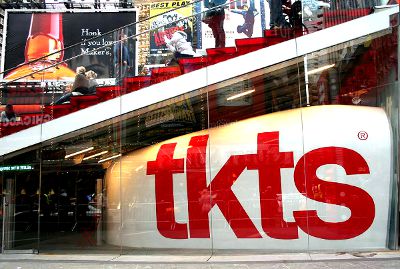
However, the TKTS booth, at the northern end of the area, has always been a gateway for me, as it was this weekend. Going back almost to its debut, the booth has been an essential part of my theatergoing and, this past Saturday, after acquiring tickets with exceptional speed, I decided to play tourist for a bit, trying to take in Times Square as I might have once upon a time.
The video screens everywhere still do amaze me, since, as a Blade Runner aficionado, I continue to feel that Times Square is the future come to life, ahead of schedule. That some of these screens have become interactive, which was initially enthralling, has lost its allure for me, especially since they mean pushing through or going around the gaggles of sightseers, standing still, who seem endlessly fascinated to be able to wave at themselves on a giant screen. Yet I imagine that seeing these screens for the first time, or as the parent of a child taking in this experience, they remain a marvel.
A vestige of the past, at the Times Square Visitors Center
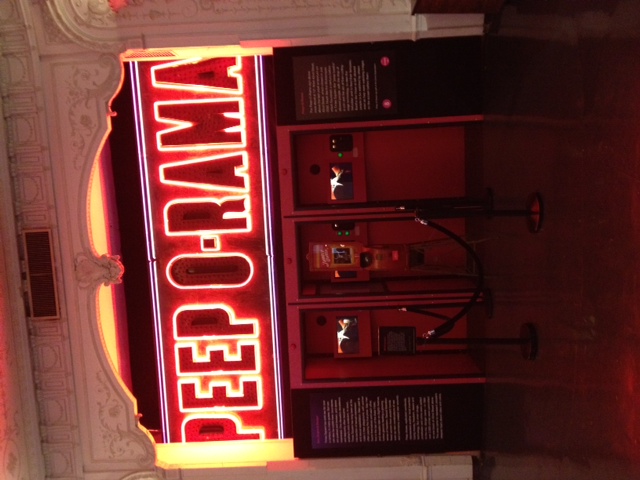
I wandered into the Times Square Visitors Center, which has been in place for years, but seemingly uncertain of its purpose, except as an acceptable public restroom. Though it now serves as a souvenir shop and ticket vending location, it also features some theatrical displays (costumes “in the style” of ones worn in famous shows), and small dioramas and video screens with Broadway history. Since New York has no theatre museum, even these small displays appeal, less for myself to whom they are nothing new, but for those who may wander in and get a bit of insight into how theatre gets on stage. The Visitors Center more successfully turned me tourist with the opportunity to gaze, from only a few feet’s distance, at one of the Swarovski crystal-laden “balls” that descend annually to welcome the new year; TV has never conveyed its size or intricacy fully; it reminded me of a long-ago visit to see the Tournament of Roses floats from a similar distance. I particularly loved the Visitors Center tribute to the scuzzy Times Square I remembered, where walking from 7th to 8th Avenues on 42nd Street was to be avoided at all costs. Its method: three peep show booths showing video loops of that bygone era, with a giant neon “Peep Show” glowing above them. I applaud whoever conceived of this reminder, insuring that amidst the retails outlets, the true past of Times Square was not completely whitewashed away.
Back into the light, I crossed back to the environs of the TKTS booth, curious about the blue-shirted, self-proclaimed “Your Broadway Genius”-es who hovered just off the curb of Duffy Square, in contrast to the red shirted TDF employees who helped those figuring out the intricacies of the booth. I sensed a color war.
I approached one of the geniuses to see what insight he was dispensing, with his iPad in hand. Learning that he too was selling theatre tickets, I noticed the telltale Square attachment on his iPad and asked whether he could actually sell theatre tickets right there, and was told he could; certainly wandering ticket outlets from any location is the wave of the future for those untethered to a computer. What Broadway shows did he have on offer? As it turned out, the answer was none. The Broadway Geniuses offered only three shows – Voca People, Rent and Avenue Q, Off-Broadway attractions all. The same shows were available only feet away at the booth, so it would appear that the Geniuses were attempting to siphon off business that might otherwise go through the long-established, not-for-profit official venue. As I am not a tourist, I was not fooled, but I do wonder how many people are taken in by these misleading, opportunistic off-brand vendors, who I later saw accosting people merely sightseeing, not unlike the ever-present touts asking, “Do you like comedy?,” in an effort to lure in new patrons for a nearby comedy show. While I admired the technology, their aggressive pitch and inaccurate branding put me off.
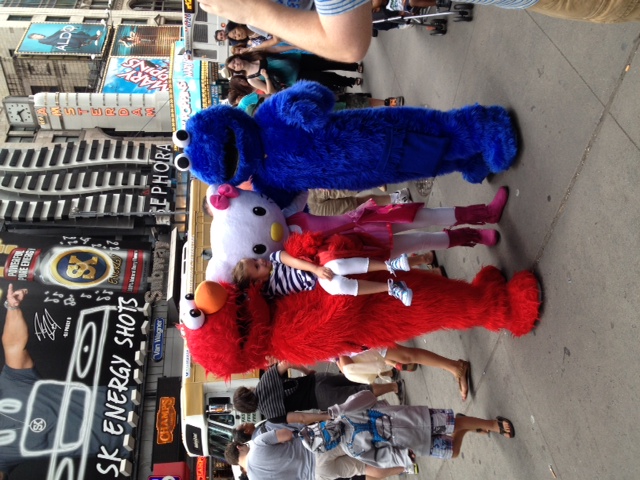
The blue-shirted geniuses are hardly the only commercial opportunists wandering Times Square. In less than an hour I saw the following characters ambling along, taking money in order to be photographed with and by visitors: Mickey Mouse, Minnie Mouse, Elmo (red), Elmo (blue?), SpongeBob SquarePants, Toy Story’s Woody, The Naked Indian, a stumpy Elvis impersonator, Hello Kitty, Alvin the Chipmunk, a Smurf (I can’t tell them apart), the Statue of Liberty, and an elderly man in a psychedelic bikini. I know these figures to be entirely unauthorized and I frankly worry about who is inside them, freely embracing unsuspecting tourists for a price; I also worry about turf wars, since it wasn’t uncommon to see several Elmos of varying hues in a single block. To those who say Times Square now feels like a theme park, these plush figures add to the perception, ever if they are an infestation, rather than an enhancement. Curiously, I did not see the now legendary, more “authentic” Naked Cowboy; perhaps he was on vacation.
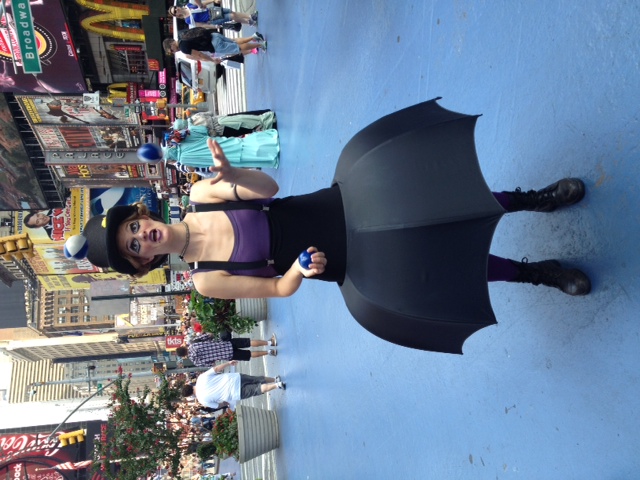
Three-ball juggling has replaced three-card monte in today’s Times Square.
There were yet more characters traversing Times Square in endless loops, with a different and more official purposes: young men and women “flyering” for Broadway shows. Dressed in costumes appropriate to the productions they represent, I saw a cheerleading duo from Bring It On, a red-stockinged, exuberant faux Fosse dancer for Chicago, several very polite rock dudes for Rock of Ages, umbrella skirted jugglers for Zarkana and a sole lackadaisical pirate for Peter and the Starcatcher. The cheerleaders in particular were happily posing, and jumping, for pictures with tourists; I admired the energy that they and the Chicago chorine brought to their task and wondered whether Times Square might be even more engaging if the plushies were banished and motivated representatives from Broadway shows both present and past peopled the territory, as Broadway branding and show marketing. I must confess, I would love to see faux Marthas and fake Georges drunkenly accosting tourists to hand them flyers for the upcoming Who’s Afraid of Virginia Woolf? revival, but that’s my own improbably fantasy.
Another loop up back to the TKTS booth revealed a claque of uncostumed flyer distributors, taking a rest, it seemed, but graciously offering to help visitors regardless of what they were apparently paid to promote. A young man holding a fan of flyers for Newsical was counseling a woman on the best show for a six-year-old while the other flyer guys were making up song titles for an imagined Brokeback Mountain musical. They were a scruffy but gentle lot, with a noticeably collegial spirit among them all; no doubt they saw each other often.
Just off Times Square, in Shubert Alley, a youthful marketing team was hawking the attractions of a Cadillac and offering a free Playbill t-shirt for anyone who filled out an information form (think of them as the Glengarry leads). On that day, placed between two theatres without tenants (the Shubert and the Booth), they seemed a bit overeager and undervisited; I was effusively urged to fill out a form and take a t-shirt even though I assured them I had no need of a car. Clearly they were trying to meet goals that their location didn’t appear to support.
As showtime approached, a small brass band set up at the corner of 45th Street, launching into “When The Saints Go Marching In.” Moments later, a couple walked past me, the woman singing and bopping her head along to the tune, clearly talking on a party spirit that was at odds with my usual grumbling about a crowded Times Square.
By the end of my visit, I saw that hustlers had not been vanquished from Times Square, they had merely been transformed from three-card monte experts to ratty-looking comic figures, but I also saw genuine entertainment and the potential for so much more. While I may not rush to walk through, let alone spend time in, Times Square again so soon, I saw opportunity for true brand-building for theatre and for New York amidst the haphazard assemblage of diversions.
The Theatre Development Fund’s TKTS booth in Times Square.
But nothing impressed me so much as the very first thing I had seen that morning. As I waited in a very short line to acquire theatre tickets at TKTS, I began talking with one of the line attendants, a chatty man, maybe my age, named Daryl, who spoke enthusiastically of shows and asked me about ones I had seen. We were interrupted when a family of three – father, mother and son of perhaps 10 years of age – left the sales window and the son, who appeared to have been born with Down Syndrome, walked up to Daryl, threw his arms as far around him as possible, and squeezed him with a hug, which Daryl reciprocated. Then, the mother approached and kissed Daryl on the cheek, and finally the father shook Daryl’s hand, before the wandered off.
I do not know what interaction I had missed, I saw only the genuine and moving results. Can that happen for each and every person who passes through Times Square? Of course not. But as the businesses, the theatres and the city seek to attract ever more visitors, perhaps they need to learn more about what Daryl offered, sans costumes, sans flyers, sans displays, sans script. Because I feel quite certain that for that family, and for me, Daryl was the star attraction of Times Square that day.