In reporting on the dispute between Ars Nova and Howard Kagan, a lead producer of Natasha, Pierre and the Great Comet of 1812, both The New York Times and the New York Post have seemingly reduced the dispute, at times, to three words or two words, respectively. They’re not wrong about this being triggered by “a mere three words” in the language of the Times report. But there’s really something deeper going on that such diminishment does not fully convey.
For those who have not read about this situation previously, here’s a precis. Ars Nova, a small company well known for staging inventive new works, including not only Great Comet, but Jollyship The Whiz-Bang, Small Mouth Sounds and the current Underground Railroad Game, among others, staged the premiere of Great Comet in 2012. With Howard and Janet Kagan leading the producing team, along with Paula Marie Black, the show transferred to a tent, dubbed Kazino, under the High Line in 2013, later moving to an empty lot on 45th Street near Eighth Avenue. It then was produced at American Repertory Theatre in late 2015 before the current Broadway production began previews at the Imperial Theatre last week, for a mid-November opening.
According to reports, Ars Nova learned two weeks ago that instead of receiving its contractually agreed upon billing on the title page of the Great Comet Playbill, which was to read “the Ars Nova production of,” only their name appeared, as the last in a list of above the title producers, albeit on its own line and immediately before the title of the show. The bulk of the producers were shown in a fairly standard block arrangement, with American Repertory Theatre also afforded its own line after that block, and before Ars Nova. The Kagans appear in first position. The title page also contains language, in much smaller type at the bottom of the page, stating “Originally commissioned, developed, and world premiere produced by Ars Nova,” accompanied by similar language noting ARTS’s contributions.
To date, Howard Kagan and the Great Comet production have issued no statement regarding the billing change, and Ars Nova has only issued a general statement and shared information with the Times. However, the Times report affirms the contractual language that Ars Nova says has been breached, and the company’s managing director, Renee Blinkwolt, says that Kagan began to seek a billing change on October 9, but no such alteration was agreed upon. Press representatives from both Ars Nova and The Great Comet have declined to answer any questions from Arts Integrity.
“The Great Comet” at Kazino in 2013
The implication that this dispute over billing is somehow petty, because it involves only three small words, including “the” and “of,” belies the importance of such a credit to a not-for-profit organization, especially one as small as Ars Nova. While the company may have built a strong reputation in a relatively short period of time, Great Comet is their first show to reach Broadway, and the number of people who will see it nightly will outstrip the number of people who could see any show in their home theatre on 54th Street in a week. This could result in more people taking an interest in seeing work at their home base, in addition to raising their profile in the funding community. Because the current billing now equates them with ART, and denies them a possessory credit, their primary role in fostering and premiering the work is diminished, with any lost impact unknown.
One can only guess at Kagan’s rationale for the unilateral change in the credit. But perhaps given the show’s growth and transformation from Ars Nova to Kazino to ART to Broadway, Kagan feels that the show has developed far beyond what was first seen at Ars Nova, and that with his leadership and financing, it is a transformed production. But ultimately, that doesn’t matter. There is – so far as we know – a contract in force, Kagan was unable to renegotiate it, and neither he nor the current production have the legal right to ignore its terms, regardless of how large or small the alteration.
The Times report included mention of potential legal action by Ars Nova, noting that the theatre’s attorney, “accus[ed] Mr. Kagan personally of breaching his fiduciary duty as an Ars Nova board member by threatening to initiate “a smear campaign in the press in order to irreparably harm Ars Nova’s reputation” as well as by harming its gala.” In a seemingly retaliatory step, the production scheduled its recording session opposite the Ars Nova gala, where the Kagans were to be honored and the Great Comet cast was to perform.
The matter of fiduciary responsibility is not small. While most often thought of as a financial responsibility, the term is really more expansive. According to law.com, a fiduciary is “a person (or a business like a bank or stock brokerage) who has the power and obligation to act for another (often called the beneficiary) under circumstances which require total trust, good faith and honesty.” Board members of corporations, not-for-profit or otherwise, have a fiduciary responsibility to that organization, and it is understood (and often spelled out in writing) that they will operate in that entity’s best interests.
In not-for-profit management, it has become increasingly common for conflict of interest policy to be included in board guidelines, and even for board members to annually sign a disclosure form delineating any possible conflicts of interest. Whether Ars Nova has such a policy or not, the conflict as it is publicly known suggests that by putting any aspect of the commercial production ahead of the interests of Ars Nova, a breach may indeed have occurred.
Howard Kagan is hardly the first board member of a not-for-profit to play a role in taking a production from a company in which they are involved into the commercial arena. Whether as producers or investors, it’s often a matter of pride for board members to participate in the future life of a project. But such relationships require greater scrutiny by the board of directors or trustees (regardless of the term used) to insure such conflicts of interest don’t arise. Even if there is an annual questionnaire, even if it is properly vetted by a board committee empowered to do so, circumstances can arise which change the equation. It is incumbent on board members to disclose even the potential of such situations as they emerge, as well as for boards to seek out such information.
Brittain Ashford and Denée Benton in “The Great Comet” at American Repertory Theatre in 2015 (Photo by Gretjen Helene)
It’s worth noting that this is not unique to board members. In the case of Great Comet, the company’s artistic director, Jason Eagan, is fifth billed on the production, alongside Jenny Steingart, president and co-founder of Ars Nova; Eagan himself is also listed as a board member of the organization. This presents yet another somewhat incestuous relationship between Ars Nova and the Broadway Great Comet, even if it is clear from his public stance that Eagan is clearly acting first and foremost in the interest of defending the company position, rather than the wants or needs of the Broadway run. The Times noted that board members with financial interest in Great Comet were recused from discussion of these issues.
There is also a fiduciary responsibility for the lead producers of Broadway productions, since they have managerial control of the limited liability corporation established to produce any given show. Depending upon the outcome of the current dispute and the legal expenses which accrue to the production, other producers and investors might wonder at the wisdom of the approach that has been taken, since it adds expense that might otherwise have been used to benefit the production, or be returned to those who have a financial interest in the show.
While in Michael Paulson’s Times report, he notes, “The dispute does not affect the financial agreement between the commercial producers and the nonprofit,” that’s somewhat premature. Even with participation in the gross weekly box office receipts, the Times story came out one day after the first preview was performed. No financial distributions would have been made until at least yesterday, and for a show in its first week, even that would be extremely fast. It remains to be seen whether the conflict extends to other contractual terms as well.
This is an evolving situation and hopefully the original contract between Ars Nova and Kagan will be honored, unless the parties come to mutually agreeable new terms. But even if this is all resolved today, it will remain an object lesson for not-for-profit boards and companies about the pitfalls that arise when shows move into commercial production, with key players at the original company taking leadership and financial roles. While it no doubt starts with the best of intentions on everyone’s part, conflicts can arise. Only with disclosure and scrutiny can all parties ultimately come out winners.
Update, October28, 2016: The New York Timesreported early this evening that Ars Nova has filed complaints with the American Arbitration Association and the New York State Court over the denial of its contractual billing and Howard Kagan’s breach of fiduciary duty as a member of the board of directors of Ars Nova. It included quotes from a statement by the producer of Great Comet on Broadway:
Ms. Blinkwolt [managing director at Ars Nova] said the two sides had attempted to reach a compromise that would settle the dispute, but those talks broke down.
In a statement, the producers of the show expressed their respect and gratitude for the nonprofit and said they were surprised to hear that the nonprofit had filed suit because they thought the talks were continuing and had made great progress.
The producers said “our understanding is that we are still in discussions. We continue to work toward a swift resolution of this matter for the sake of everyone involved in the show, and we hope that those discussions can continue privately.”
A Facebook post signed by “Jason, Renee and the Gang at Ars Nova,” also posted this evening, read in part:
It has truly taken a village to get The Great Comet to land on Broadway. If you were to remove the contributions of any one partner along the way, we couldn’t be in previews on Broadway today. And yet with no explanation, the proper recognition of our contribution has been taken away. We believe that the show currently on Broadway started at Ars Nova. That it grew and grew and grew until it was a big, beautiful Broadway musical. That narrative – that the show people are seeing on Broadway is, at its core, the show that started at Ars Nova, is extremely valuable to Ars Nova’s past, present and future, and is communicated to the tens of thousands of people seeing The Great Comet on Broadway each week only through our title page billing.
With seemingly no other alternatives to seeking remedy for this lost value, our Board voted unanimously last night to file suit for breach of contract to compel the commercial producers of The Great Comet to honor their contractual obligation to bill the show as “The Ars Nova Production Of.” We are devastated that it has come to this, but steadfast in our belief that the billing we are owed is both valuable and deserved.
This post will be updated as circumstances warrant.
The final scene of March of the Falsettos & Falsettoland at Hartford Stage, 1991 (Photo by T. Charles Erickson)
When I speak about it with people who saw it, the phrase that comes up most often is, “It was life-changing.”
When I speak about it with people who have read about it, but didn’t see it, the question that inevitably arises is, “What was the ‘coup de theatre’?”
When I speak about it with people who knew nothing of it, they profess surprise that it existed.
I’m speaking of the Hartford Stage production of March of the Falsettos & Falsettoland, the first time the two shows were produced as a single evening. Directed and choreographed by the marvelous Graciela Daniele, the shows were playing exactly 25 years ago as I write this, in a 41 performance run in Hartford Stage’s 489 seat theatre in October and early November of 1991. At most, 20,049 people saw the production; it was at least a few hundred less because, to the best of my recollection, the previews weren’t sold out.
I was the theatre’s public relations director at the time, and it was one of the more ecstatic times in my career. From the moment that artistic director Mark Lamos informed us we would be doing the show, I was thrilled. Though I did not see the original March of the Falsettos in 1981, I played the vinyl cast recording (owned by one of my college roommates, in those pre-digital days) incessantly in my junior year (1982-83), almost as a nightly ritual. When Falsettoland debuted at Playwrights Horizons in 1990, I made sure not to miss it.
I have to credit Bill Finn and James Lapine’s musicals with helping to form my perception of gay life. I was a straight, cisgender kid from a Connecticut suburb in an era and area when one didn’t encounter adults who were out, let alone high school students. I don’t remember any particular fear of or enmity toward gay students on my part, and I hope my memory is correct, but I also don’t ever remember the topic coming up until I got to college.
The humor and sincerity of March, from the opening of “Four Jews in a Room Bitching” to the simple closing of “Father to Son” left me wanting to march along with Marvin and Whizzer and Jason (and Mendel and Trina and Cordelia and Dr. Charlotte) because love, as far as I was concerned, was love. I sang that message over and over in my off-campus room, embedding it in my everyday life as I came to know and love gay men and lesbians as my world expanded through theatre. I should probably give a small shout out as well to The Rocky Horror Picture Show, which broke down barriers about sexuality and gender fluidity for straight suburban kids as much as anything we encountered in the late 70s.
It may be difficult to understand today, but producing a musical about a man who leaves his wife for another man, yet attempts to retain family ties, was still an edgy step outside of a major city in 1991. The politics of “outing,” naming someone as gay in the media even when they had not declared themselves to be so, was hotly debated. Gay-Straight Alliances hadn’t really reached northern Connecticut, only 120 miles from New York City, though AIDS certainly had: my first landlord in Hartford died from it in the late 80s.
In marketing the show, the direction I was given was not to confront the subject matter directly, but only to entice people enough to want to see it, and allow the story to reach them once they were in the door. It didn’t hurt that at the time, subscription tickets filled some 75% of the total seating capacity for the run. A lot of people were coming no matter what I did.
Because we had begun using marketing tag lines, aping film advertising, I cobbled together something to the effect of, “It’s about parents, children, love, sex, baseball and bar mitzvahs.” Our graphic imagery in ads was utterly abstract, saying nothing overt at all. Because this was in many ways an experiment, the show’s title remained the unwieldy March of the Falsettos & Falsettoland; the condensing came later.
I knew something special was going on when I would visit the rehearsal hall, whether to track down an actor for a program bio or to accompany a journalist who was doing an interview during a lunch break or at the end of the day. What struck me most was that whoever was in the room during a rehearsal was, as far as Graciela Daniele was concerned, part of the rehearsal. I remember her calling out questions to me as I sat on the sidelines; curious about bar mitzvahs, she became the only person to ever listen to the audio recording of my own bar mitzvah (including me). There were no barriers in Grazie’s space – only inclusion.
Once the show was in the theatre, audiences responded very favorably, with cheering and weeping. If there were letters of complaint over the subject matter, I either never knew of them or have long forgotten them. One staff member, while out to his friends and co-workers, was so moved after seeing a preview that he promptly came out to his family, as he proudly told us all. On matinee days, many of us would slip into the theatre at certain times for particularly memorable moments: we were often there together as Barbara Walsh, as Trina, nailed “I’m Breaking Down” in March; we were there for the final moments of Falsettoland, perpetually moved as Adam Heller, as Mendel, sang, “Lovers come and lovers go/lovers live and die fortissimo/this is where we take a stand.” We endlessly laughed over the anecdote told by Evan Pappas and Roger Bart, as Marvin and Whizzer, of a student matinee when the lights came up on the pair in bed and one student announced rather loudly, “Ooh, they’re gonna get some.”
The whole experience became heightened when Frank Rich, then the chief theatre critic of The New York Times, rendered his verdict.
“It was a secret, until now, that the two ‘Falsetto’ shows, fused together on a single bill, form a whole that is not only larger than the sum of its parts but is also more powerful than any other American musical of its day.
For this discovery, audiences owe a huge thanks to the Hartford Stage. Under the artistic direction of Mark Lamos, it has the guts to produce these thorny musicals together at a time when few nonprofit theaters are willing to risk aggravating dwindling recession audiences by offering works that put homosexual passions (among many other passions in the ‘Falsetto’ musicals’ case) at center stage.”
With unstinting praise, he went on to note:
“She [Daniele] has brought off an inspired, beautifully cast double bill that is true to its gay and Jewish characters — and to the spirit of the original James Lapine productions — even as it presents the evening’s densely interwoven familial and romantic relationships through perspectives that perhaps only a woman and a choreographer could provide.”
Of course, the box office exploded, selling out the remainder of the run within a day. House seats, which I instituted as a practice a Hartford Stage for the first time when I came to the theatre and were only rarely needed, were in high demand. And the talk began of Broadway.
That talk continued for several months, but without going into what were protracted and emotionally trying times, the Hartford production, as we all know, did not go to Broadway. It was Lapine’s original that returned to New York, with the core original cast members – except that Barbara Walsh, our Trina, joined that production. As a result, the Hartford Falsettos became the stuff of legend, and regional theatre legends tend to fade with time. But over lunch with Evan Pappas a few weeks ago, our first in quite some time, he noted that 25 years on, he still meets people who saw the show in Hartford, and tell him stories about how it changed their lives.
I suspect productions of March, of Falsettoland, of Falsettos, have been changing lives for a very long time, whether directed by James Lapine, Graciela Daniele, or any of the many other directors who have brought that story to the stage. I was privileged to have seen Grazie’s production as often as I wished; I’ve seen the previous Lapine productions several times and will see the new one in a couple of weeks.
I couldn’t be happier that it’s back on Broadway, though the show will always echo in my head with Grazie’s vision, with Evan, Barbara, Adam, Roger, Joanne Baum, Andrea Frierson and the twins who shared the role of Jason, Etan and Josh Ofrane. I only wish that Fun Home were still running, because how marvelous would it have been to have two stories on Broadway about family life, love, and pain, set in roughly the same era but written years apart, exploring the thrill of first love and the need for absolute acceptance of gay parents and children.
Oh, the “coup de theatre’? I haven’t forgotten. I saved it for the end, just as Grazie did, though I tipped my hand with the photo at the start of this essay.
The term, as applied to the Hartford production, comes from Frank Rich’s review. He wrote, “For her finale, Ms. Daniele exploits the spatial dimensions at her disposal with an overwhelming coup de theatre (not to be divulged here) that first reduces an audience to sobs and then raises it to its feet.”
After a quarter century, let me divulge.
March of the Falsettos & Falsettoland at Hartford Stage, 1991 (Photo by Jennifer W. Lester)
Grazie and set designer Ed Wittstein chose to completely open up the vast stage at Hartford to its walls, using no set pieces other than interchangeable cubes – and a bed. The lyrics were scrawled randomly on the entire floor (visible due to the theatre’s arena-like seating), and across the Broadway theatre-sized back wall. To be honest, in shades of black, grey and white, they largely disappeared, allowing audience members to concentrate wholly on the handful of people singing intimate stories, with no distraction.
But at the very end of the show, as Mendel intoned the final lines, a small square suddenly appeared through the drop that masked the rear wall. On it was simply the name: “Whizzer.” Then the drop was revealed to be a scrim as the entire back wall dissolved into a ghostly section of the AIDS quilt. A lever was tripped, rather loudly, and the front drop wafted slowly to the floor, fully and clearly revealing the quilt for just a moment before the lights went out, and the show ended.
While the quilt at Hartford Stage was not part of the real quilt, it replicated panels from that extraordinary expression of loss that once covered the National Mall in Washington. Because members of the company had been asked if they had family and friends who they had lost and wished to see included, audience members who worked in theatre quickly discovered they knew people on the Hartford quilt facsimile. While much of the audience was in tears, those who saw the names of those they loved and lost were often overcome.
Beautiful, sad, simple, funny and transcendent. That was the Hartford March of the Falsettos & Falsettoland. I have always understood and accepted that I am spending my life in a world that is forever fading into memory. But if I could ever go back in time to see just one more performance of any show I worked on, it would be March of the Falsettos & Falsettoland. At least it’s still playing in my head 25 years on, and once again, I’m in tears over its beauty as I write, and proud that I had a connection to it. I wish you’d seen it, and if you did, I suspect you know exactly how I feel.
Scene from the musical Marathon of Hope (screen grab from Drayton Entertainment YouTube video)
If you look at photos or video from Marathon of Hope, a new musical that just premiered in Waterloo, Canada, about an hour outside Toronto, something seems off.
The musical is based on the life story of Terry Fox, a young Canadian man who in 1980, after losing a leg to cancer, undertook a country-wide run to raise money for and bring attention to cancer research. He did not complete his effort, because his cancer metastasized to his lungs and he died in 1981. His life is the stuff of legend in Canada, with schools, athletic centers and sculptures standing as memorials to him, and ongoing fundraising to fight cancer in his name. His story has been told in two separate TV movies, in 1983 and 2005.
So what’s wrong with the images?
It looks like the on-stage Terry Fox, especially when seen in running shorts, has three legs. One limb appears to be flesh and bone, the second is shrouded in a black legging and the third is a prosthesis. The images reveal that in telling the story of a man who is certainly one of the best known Canadian athletes and advocates with a disability, Drayton Entertainment, the producer of the musical, has cast a non-disabled actor. The prosthesis is a stand-in for the real one that Fox used to make his run; the black-clad one is an effort to disguise the presence of one of the actor’s own limbs.
The list of actors with disabilities portraying characters with disabilities on stage, TV and film is stunningly brief, despite Harold Russell’s dual Oscar win in 1947 for The Best Years of Our Lives. Deaf West’s Big River and Spring Awakening, with Deaf and disabled actors, were significant milestones on Broadway, but they remain the exception to the rule. Yet the decision to have a non-disabled actor play Terry Fox seems creatively and historically derelict (though it should be noted that Fox’s family approves of and supports the musical).
Drayton doesn’t seem unaware of the casting imperative for the show, making note of their efforts to seek talent in the amputee community. Their announcement of the show’s cast includes this statement.
Given the scope of this particular project, in addition to its regular audition process, the not-for-profit theatre company initiated a nationwide search for the role of Terry Fox through open call video auditions.
The organization also reached out to the National Amputee Centre and 35 prosthetic and orthotic centres throughout Ontario, along with the Amputee Coalition of Canada and Amputees Amplified. Additional leads were generated through Casting Workbook, an industry group providing full service casting software.
There’s no question that these are good efforts to have made. But speaking for the Alliance for Inclusion in the Arts, where I am interim director, the countless artists with disabilities for whom we advocate, and the hundreds we have in our files for just such casting needs, Drayton didn’t go far enough, based on the final casting of the show.
While national pride could have been an issue in a story so dear to Canadians’ hearts, Drayton may not have reached beyond Canadian borders. Within minutes of learning about Marathon of Hope and its casting yesterday, my colleagues at Inclusion were able to list several male actors in their 20s who are amputees – including Anthony Michael Lopez and Evan Ruggiero (Ruggiero’s musical skills landed him a spot on Ellen). There are other actors who fit the requirements of the role in the Inclusion files, but without public websites or Facebook pages, we’re not able to name them so publicly (Drayton never contacted Inclusion, though we often consult with Canadian as well as UK companies).
Is it possible that Drayton reached out to these performers? Certainly. As it happens, both are working on stage this fall: Ruggiero as the title role in The Toxic Avenger for the Pittsburgh CLO and Lopez in New York Theatre Workshop’s Othello. But the fact is, when telling a story about disability, about a person whose disability was so central to his fame, to not cast the role with an actor with a disability denies one message of the show and insults professional actors who are indeed capable of playing the role. Talent searches among non-professionals may sometimes prove fruitful, but there’s no guarantee. For a show such as Marathon of Hope, if an appropriate actor isn’t immediately available, the show should be delayed until they are.
Pretending to disability under the mask of “theatricality” is no solution – even if it is part of the long, frustrating history of ignoring actors with disabilities. This point was not lost on J. Kelly Nestruck, critic for The Globe and Mail in Toronto, who wrote in his review of the production:
Carroll’s casting has angered some activists who feel that this is an example of “cripping up.” For me, the larger problem is that Mustakas’s production (which also features a pair of able-bodied child actors playing disabled characters) has not found room for disability anywhere in his aesthetic.
This is a musical whose main goal is to inspire – as unabashedly as Fox did. And instead, it sends a message that while a young man with one leg may be able to run 5,373 kilometres, there is no room for anyone with atypical abilities in musical theatre.
It’s worth noting that when the 1983 TV movie The Terry Fox Story was made, an actor who was a real-life amputee played the role. When the story was told again in 2005, the filmmakers cast a non-amputee, and used digital airbrushing to replace one of his legs. Regrettably, technological advancements in filmmaking trumped lived experience. Of course, that’s not possible on stage.
Whatever the future may hold for Marathon of Hope, it has the potential to make a strong statement not only about Terry Fox’s achievements, but also about the avenues open to performers with disabilities. In its present form, it has opted only to advance the former story, while disguising the latter – not once, but three times, per Nestruck – because the producers and creative team did not fully commit to every facet of the story they sought to tell.
There’s a very large tree that has been traveling around the Dallas-Fort Worth region in Texas. There’s no need to worry, as the tree hasn’t acquired independent mobility and become sentient, but rather, it has made major appearances in two theatrical productions in the area in a short span of time. Designed originally by Bob Lavallee for the Trinity Shakespeare Festival production of A Midsummer Night’s Dream at Texas Christian University, it just finished a run center stage in Camelot at Lyric Stage.
As Mark Lowry reported on his TheaterJones site, the tree would have been headed for the dumpster after the end of the run of Dream, had not Steven Jones, producer at the Lyric, asked if he could use it as part of the set for Camelot. Lavallee consented, provided he received credit. However, he declined to adapt his whole set for the Lyric production.
But as Lowry noted, other scenic pieces from Dream found their way into the production of Camelot as well, albeit with some new scenic painting and set dressing, with the overall set credited to Cornelius Parker. This suggests two problems. The first is whether Lyric had the right to use, or whether Trinity Shakespeare had any right to provide, anything but the tree in connection with Camelot. The second is the fact that Cornelius Parker doesn’t exist – the name is a pseudonym for Steven Jones.
“Camelot” at Lyric Stage (photo by Michael C. Foster
There’s no mention made of a contract, only an agreement and a payment for use of the tree; Lavallee is not a member of United Scenic Artists, so he doesn’t have union backing to help work out the situation. But it seems that the appearance of additional scenic elements from Dream in Camelot goes beyond the agreement, regardless of how they were used or disguised in their second appearance. Unless Jones indulged himself in some unauthorized dumpster diving in arranging for the tree and the other elements to be transported to Lyric Stage, it appears that Lavallee has an issue with both Lyric Stage and Trinity Shakes, since the latter, in supervising the load out of the tree, presumably had some staff overseeing what went on the truck, and more was allowed to go than what was agreed to.
Jones’s use of a pseudonym to disguise his own role as the coordinator of scenic elements for the production – using the word designer may be ill-advised here depending upon how much of Lavallee’s work actually appeared – seems a deliberate attempt to disguise the provenance of the work, when only the tree itself was credited to Lavallee, by agreement. While Lowry reports that Jones has used the pseudonym once before, for a set he devised using pieces in the theatre’s stock (notably Funny Girl and The King and I), the obfuscation is troubling. While Jones chalks it up as, “I didn’t want to take credit for it,” it’s impossible not to wonder whether the genesis was less modesty than an understanding that he didn’t really design either show, but was deploying the designs of others. In any event, it’s misleading the audience and the press, who operate under the assumption that what appears in their programs is truthful.
As a corollary here, some might invoke authors who have written under pseudonyms (Stephen King writing as Richard Bachman, for example, or Joyce Carol Oates as Rosamond Smith). It’s important to recognize that those authors opted to put false names on their own work. In King’s case, the subterfuge didn’t last long, and was in part because his publishers were concerned about flooding the market with new works from the prolific novelist; for Oates, it was an effort to distinguish between the different modes, and even genres, in which she writes. When the Coen Brothers edit their films under the false name of Roderick Jaynes, again, it’s their choice for their own work, and their names already appear repeatedly in the credits of their film.
Going beyond the case of the Trinity Shakespeare/Lyric Stage tree and other scenic elements, this case points up a continuing challenge for designers regarding credit when their work is incorporated, especially when the use is partial but significant, into other productions. If a scenic designer creates distinctive scenic elements that are newly built for a given production, is that designer due credit and/or compensation when they are used – whether at the same theatre for a different show, or by another theatre and show entirely? If a costume designer creates, say, their own unique take on the Ascot scene in My Fair Lady, and then those costumes appear in the Prince’s ball scene in a production of Cinderella, what is the original designer due? How does copyright come into play?
Many theatres maintain costume and scenic stocks, so they are not constantly building new pieces Some theatres may operate rental houses or sell their costumes to independent costume rental houses. So when does the design recognition end? It’s a sticky wicket with no easy answers, but it’s particularly complicated when a design is credited to one person – real or fictitious – and it contains a noteworthy portion of designs that are actually the work of someone else.
This isn’t meant to say that the use of stock items should be abolished, because that’s truly wasteful and for some companies would make productions economically unfeasible. There are legitimate cases to be made for shows being drawn from stock, or collaging pieces from other productions in order to create what is essentially a new overall design. It’s just to say that perhaps there’s more credit (and perhaps royalty) due than is currently given, especially at the professional level.
As for Cornelius Parker, fictitious designer, hopefully his ignominious career is at an end. However Lyric Stage designs, devises or assembles its productions in the future, they should own up to the truth of it, and not pretend to more creativity than they may be putting on their stage.
As theatre buffs know, there are two major musicals drawn from Joseph Moncure March’s The Wild Party, which debuted in New York within months of one another: the Michael John LaChiusa-George C. Wolfe version which played on Broadway in the spring of 2000, and Andrew Lippa’s version, which played Off-Broadway at Manhattan Theatre Club from February to April of that year. Drawn from the same source material, they inevitably have many roles in common.
Julia Murney as Queen and Taye Diggs as Black in Andrew Lippa’s The Wild Party at Manhattan Theatre Club
One of the many roles shared by both shows is “Black,” first played by Taye Diggs in Lippa’s retelling of the story (and by Yancey Arias in the LaChiusa-Wolfe version). So there was significant pushback earlier this month when the Yale Dramatic Association, widely known as the Dramat, announced the cast for their fall production of the Lippa’s Wild Party, where the character is specifically identified as black. A white woman had been cast as Black.
The Dramat should not be confused with the Yale Repertory Theatre. The Rep is a professional company that also includes the work of Yale School of Drama graduate students onstage and off. The Dramat is an undergraduate club which actually predates the Rep by more than 50 years. While there is a great deal of undergraduate theatre at Yale, with many of the residential colleges each fostering their own dramatic groups, the Dramat, so far as student-run theatre at Yale goes, is perceived as the major player school-wide.
As reported by Joey Ye writing in the Yale Daily News, approximately 75 students auditioned for the Dramat’s Wild Party, with only nine students of color trying out. Two students of color were cast. While the Dramat’s club leaders indicated that they had done outreach to the performing communities of color at Yale, their efforts had limited success. Ye quoted the student producer saying that the Dramat had decided to proceed with the show, with a white female student as Black, after the director “re-visioned the entire show with the people we had in the room.”
Ye noted that the Dramat has only produced two works by artists of color in its history, one earlier this year and one in 1995. While that doesn’t speak to roles specifically requiring performers of color, or productions which may have cast students of color in roles traditionally played by white performers, it suggests, as students did in Ye’s initial report, that the Dramat has not historically been perceived as a group that embraced students of color.
On Tuesday, Ye reported again for the Yale Daily News about The Wild Party, writing that the Dramat had made the decision to reopen auditions and to recast the role of Black. Two other roles will also be recast, because two students chose to leave the production as a result of the uproar.
We also know that the circumstances surrounding casting represent a much larger problem, extending beyond this particular production and the Dramat as an organization. There are serious, systemic challenges to meaningful progress toward diversity and inclusion. Over the past week, members of the community have raised questions about effective forms of outreach, the audition room environment, the balance between pre-professional and educational programs, and the dispensing of information about auditions and opportunities for those outside of the theater community. These are difficult questions, and each merits its own in-depth discussion, which we are committed to pursuing in collaboration with the larger Yale community, as we all strive for a better, more inclusive space.
The standard contracts provided to student productions, as well as amateur and professional companies, typically contains language about making no changes to the gender or race of characters without prior permission from the licensing house on behalf of the authors. Drew Cohen, president of Music Theatre International, which represents The Wild Party, responded to an inquiry from Arts Integrity as to whether the company had played a role in the Dramat’s decision. While citing MTI’s policy of confidentiality regarding its customer communications, Cohen noted, “I do not know what prompted the group to hold new auditions.”
Contacted separately, author Andrew Lippa responded:
“I have had no hand in the casting at Yale (other than being the playwright!). I applaud these student producers’ efforts to recast their production per the character description in the script. I have always, and will always, support and defend the rights of living dramatic writers (and all plays still protected by copyright) in all casting decisions.
“I look forward to seeing (and celebrating) these students and their production of my show.”
The Yale Dramat has announced that their spring ’17 show will be Jackie Sibblies Drury’s We Are Proud to Present a Presentation About the Herero of Namibia, Formerly Known as Southwest Africa, From the German Südwestafrika, Between the Years 1884-1915. The original cast at Soho Rep in 2012 included three black actors and three white actors, in Sibblies’s backstage exploration of racial roles in the creation of a play drawn from African history.
Update, September 22, 11:45 am: This post has been edited to more clearly reflect Lippa’s intent that the role of Black in his version is to be played by a black actor, as it has been in its original production and in the Encores Off-Center concert.
This post will be updated should there be significant further developments.
Howard Sherman is director of the Arts Integrity Initiative and interim director of the Alliance for Inclusion in the Arts.
To start at the end, or at least where we are today: Michele Roberge, executive director of the Carpenter Performing Arts Center on the campus of California State University, has resigned, effective yesterday. Why? Because the school’s president, Jane Close Conoley, insisted upon the cancelation of Roberge’s booking of the comedy N*gger Wetb*ck Ch*nk, a show that has toured extensively for more than a decade to performing arts centers on and off college campuses. In fact, it played to a sold out house of more than 1,000 seats last year at the Carpenter Center. When Conoley raised a red flag earlier this year, Roberge made it known that if Conoley forced the cancelation, she would resign on principle. And so when the axe fell, she did.
Like any show that has been touring for more than a decade, N*gger Wetb*ck Ch*nk, which was written by Steven T. Seagle and Liesel Reinhart with the men who originally performed it, Rafael Agustin, Allan Axibal, and Miles Gregley (who are respectively black, Latinx and Asian) has a raft of reviews and feature stories available on their website attesting to the work’s broad appreciation. Despite its seemingly inflammatory title, Charles McNulty, reviewing it in 2007 for The Los Angeles Times, called it “wholesome entertainment,” going on to write, “Yes, racial slurs and profanity can sometimes be good for you – especially when they’re deployed to make a point about the pervasiveness of prejudice and its denigrating unabridged dictionary.” Other coverage has included a feature in The New York Times and an extended interview with National Public Radio’s Michele Norris.
When N*W*C was planned for last year at the Carpenter Center, Conoley, responding to concerns expressed by Naomi Rainey, president of the local branch of the NAACP, defending the piece, writing:
It is my hope that this performance will elicit conversation about issues of race, prejudice and inequality that the NAACP works so hard to confront. As president, it is my goal to push the envelope on matters of race and prejudice to ensure The Beach remains a safe haven for freedom of expression on this vitally important topic.
So why can’t the production be seen again? In lieu of an interview request or the opportunity to respond to questions via e-mail, Conoley writes:
Last year I welcomed the same performance to the Carpenter Center. My thoughts then were that it would generate thought-provoking conversations about race relations. The university and ASI subsidized students so that many were able to attend for free. I personally visited with many of our student cultural organizations to prepare them to use the performance as a prompt for meaningful discussions. Faculty members and student services staff members supported special activities before and after the performance.
Following the performance I evaluated whether or not it achieved that goal. Involved faculty and staff members and students shared feedback that the performance did not lead to the desired conversations. They further expressed a desire to find another performance vehicle to generate deep and much needed discussions about race and ethnicity.
When approached again to support NWC as a centerpiece of campus conversations, I indicated that while the performance could certainly go on as planned, I would not replicate the campus support I’d made available last year and did not have faculty or staff interested in doing curriculum planning around the performance.
I did not intend my decision as a form of censorship. As an academic, my decision was based on my evaluation of the academic value of the performance for our students. The Carpenter Center could have hosted the show without additional involvement from the University, but chose not to.
Conoley’s characterization of the Carpenter Center directly conflicts with Roberge’s telling. In a letter sent to donors and patrons of the Center, she wrote, “President Conoley required us to cancel our upcoming performance of N*gger Wetb*ck Ch*nk. I could not accept this egregious form of censorship.” According to Roberge, the instruction to cancel the show was delivered to her by the dean of the College of the Arts, Roberge’s direct supervisor, at Conoley’s direction.
In her resignation letter, dated late August, Roberge wrote to the dean of the College of the Arts, Cyrus Parker-Jeannette, saying:
The decision by President Conoley to cancel our upcoming performance of N*gger Wetb*ck Ch*nk runs counter to my steadfast belief in the protection of freedom for artists and my personal integrity as a performing arts presenter. This is an egregious act of censorship, especially ironic as it targets the home of The B-Word Project.
The B-Word Project: Banned ,Blacklisted and Boycotted, was a specially funded initiative held at the Carpenter Center in 2011-2012 focusing on censored works. It featured seminars and performances on the topic, and included the so-called “NEA Four” – Karen Finley, John Fleck, Holly Hughes, and Tim Miller – whose 1990 grant applications for support from the National Endowment for the Arts were personally vetoed by NEA chairman John Frohnmeyer, contravening the NEA’s practice of peer review. It also included work from Bill T. Jones’s dance company. Roberge describes all of the work as “very sexual.”
Conoley was not president, or part of the CSULB community, during The B-Word Project.
* * *
Regarding last year’s concerns about N*W*C from the NAACP, Roberge noted in an interview on Thursday that, “Nobody picketed. Nobody protested. In fact there was nary a peep from the NAACP when we announced this year’s show.”
Speaking about her original decision to present N*W*C said she conferred with the dean of the College of the Arts. “We wanted to spark conversations about race,” she says, “and it did that, beautifully.”
In the wake of the first presentation, Roberge says that there were some who didn’t believe the n-word should be heard on campus and didn’t feel it was the Carpenter Center’s place to open up a conversation about race. She notes “other racially charged incidents on campus which absolutely had nothing to do with the show,” and her belief that this heightened concerns regarding racial issues on campus. Referring to President Conoley, Roberge say, “I think those incidents frightened her.”
Roberge notes, “In conversation with the artists, we offered to postpone the show until after the election, and offer a lot of contextualizing educational activities – panel discussions with the ethnic chairs, films, lectures – so that interested students could attend those and have more of a context for how this show came about. But the president was not interested in that and said, ‘No, I don’t want the show.’”
Roberge says that over the summer, the dean of the College of the Arts was instructed by the president to speak with nine people, both on and off campus about N*W*C. “I was instructed not to speak with anyone about it,” she says. “The dean spoke with me about it and told me that all nine advised the president not to do the show. Nobody advocated for the show and they would not allow me to tell my side of the story and only one of them is nominally involved in the arts.”
Has Roberge ever been required to submit her programming for approval to anyone in the university administration? “The answer is no,” she says. “I was hired to curate the presented season at the Carpenter Center and oversee all of the rental activity as well. That being said, while I don’t have to get approval from anybody, every year when I have the season ready to go to our marketing director I schedule a meeting with the dean of the College of the Arts, who’s my boss, and I tell her about every show that I want to bring, so that she’s not surprised by anything. When we did N*gger Wetb*ck Ch*nk for the first time last year, I was very clear early in the process that this is what I wanted to do and she was 100% behind it.”
Asked whether there’s any policies regarding freedom of expression on campus, Roberge professed to know of none, adding, “There are no campus policies that limit freedom of expression.” She also references the presence of The Center for First Amendment Studies on the CSULB campus.
Please let it be known that we believe in the need for change as advocated by the Black Lives Matter movement and stand in solidarity with their commitment to achieving freedom and justice for all black lives.
We cannot ignore, however, that this occurrence also stands as critical juncture in the path of free speech on the campus of a public educational institution in perhaps our most liberal state. The same act of censorship that today may seem to protect a community may be used next time as justification to silence a community in desperate need of a voice.
* * *
Returning to President Conoley’s statement that she did not intend her decision as a form of censorship, but rather as a result of the academic value of the performance for students, it’s important to note that Roberge was not faculty, but staff. Her role was not primarily to program for academic purposes, but to find work that would appeal to the campus community and the Long Beach community at large. If academic import is the criteria, one wonders what the pedagogical rationale is for such presentations as Four by Four: A Tribute to The Beach Boys, The Four Seasons and The Bee Gees or illusionist Jason Bishop, both on the Carpenter Center schedule this year. Or what about This is Americana! Live Comedy Slide Show Performance Celebrating Classic and Kitschy American Life & Style! Rather, it seems that the academic reasoning is being deployed specifically to silence N*W*C.
It seems clear that N*W*C did provoke conversations about race, but those that affected its now-canceled return engagement were held behind closed doors, and while students were off-campus. Will the nine people consulted about N*W*C hold sway over other bookings at the Carpenter Center in the future? Will Conoley now decide to personally sign off on programming? Will a search for Roberge’s successor be hindered by what has taken place over this show, or will the choice be made in such a way to drive all programming to the middle of the road, rather than engaging in the kind of envelope-pushing Conoley professed to support in her letter to the NAACP last July?
Having refused interviews from every media outlet that has requested them, up to and including the Los Angeles Times, Conoley is walling herself off behind statements rather than engaging and explaining her rationale. We don’t even know whether she saw the show. She made a decision and while citing conversations but not sharing them in any detail, imposed it with little transparency, and sees little need to defend it further. As the final authority on that campus, she directed conversations about the work of the Carpenter Center to take place without the participation of the center’s director, and so far as anyone knows, she did not consult with cultural experts directly familiar with the production from off-campus or the many other universities where the show has played. Yes, campus conversations about race have evolved since the show was first produced, but was that the root of the problem?
As it stands, Conoley has lost a 14-year veteran of the university who stood up for her principles, while silencing perhaps the most provocative performance of the season, which happens to be a theatrical work by artists of color around issues of color. She has done so without a full explanation of her concerns and reasoning. She may not want to be seen as a censor, but it’s hard not to arrive at that conclusion.
Russell Harvard and Susan Pourfar in David Cromer’s production of Nina Raine’s “Tribes” (photo by Craig Schwartz)
“Unfortunately, no deaf actors showed up to the auditions.”
The statement above was made yesterday in a public statement to the Deaf and hard of hearing community by Leslie Charipar, artistic director of Theatre Cedar Rapids in Iowa. It was issued in response to complaints that Charipar has received from the Deaf community at large about the theatre’s upcoming production of Nina Raine’s Tribes, which TCR has cast with hearing actors in the roles of Billy, who is deaf, and Sylvia, a young woman raised by Deaf parents who is now going deaf. The statement is in response to what Charipar calls “questions, complaints, rants, and vitriol against our production.”
The statement about “showing up” is not a unique one, as it has been used by various theatres in a variety of circumstances, when they say they are unable to cast roles authentically for race, ethnicity and disability, but forge ahead with a show regardless. It places the onus on people whose lived experience mirrors or approximates that of the role in question, blaming them for not “showing up” and, ostensibly, then absolves the producer for proceeding with casting solely from the pool of those who did, regardless of the specific requirements of the role.
Now it’s worth noting, as Charipar points out in her statement, that TCR is a community theatre. It casts locally and no actors are compensated. Indeed, many positions at TCR are volunteer, but based on online evidence, they’ve built a thriving company dating back 90 years. They offer ten productions a year ranging from Sister Act to The Flick, as well as programs for children and teens. The company is sufficiently sophisticated to operate on a budget that totals over $3 million annually in expenses; even if one removes the in-kind contribution of $750,000 for its venue, it’s still over a $2 million operation.
Having been entirely unaware of the company or issues surrounding its production of Tribes until Charipar’s statement began to be shared widely on social media, it’s difficult to assess all of the communication that has taken place to date. There are certainly many comments about the issue on the company’s Facebook page, though none there that I saw rose to the level of rants or vitriol, only passionate statements on behalf of the Deaf community and authenticity in casting. Certainly with a statement like Charipar’s being issued, surely a great deal of communication of all kinds led up to it. It’s important to acknowledge that some of the commenters I did see appeared to be making the assumption that TCR was a company that is hiring actors, rather than casting local amateurs, and which could have gone beyond their immediate community, engaging an actor from outside their metropolitan area.
But coming back to the statement about Deaf actors not showing up, Charipar writes, “It is our policy at TCR to cast from the pool of actors who auditioned. That is the only fair way to cast…that is the purpose of auditions.” She also writes, “I know that at least one organization that advocates on behalf of the deaf community was contacted to let them know that we were holding auditions for a show with a role for a deaf actor.”
Regardless of whether the theatre is amateur or professional, TCR is a major creative and entertainment resource for the Cedar Rapids community. Having produced Dreamgirls with a black cast, having cast an actress of Korean heritage as Christmas Eve in Avenue Q, it would seem to be incumbent upon them to make all necessary efforts to at least find a deaf actor for the role of Billy in Tribes. That means going beyond their usual policy of just casting who shows up, but really making a concerted effort to reach out to the Deaf community in their region.
TCR did put out a casting notice for late August auditions indicating that they were seeking, in their words, “two hearing impaired actors in their 20s, one male who can speak and sign, and one female who can speak and sign, or be able to perform with a hearing impaired accent.” But with performances beginning in October, presumably with rehearsals in September, they didn’t allow any extra time in the event that Deaf or hard of hearing actors didn’t materialize. If they had been committed to authentic casting, they might have worked further ahead of their usual schedule, and made their call for Deaf actors more vigorously.
The results of their casting call obviously led Charipar to the following questions in her statement:
“My question to you is: with no deaf actor in the role of Billy, should we just not do the play, thereby ending any conversation that this play or the controversy of our casting might bring? Or is it more valuable to do the play with the actors available so that we can talk about the issues confronting the deaf community?”
But earlier in the statement, Charipar made clear her priorities:
“It was a decision made in service to the show we have committed to do, to the audience who has already purchased tickets to this particular show, and to the actors who showed up to audition.”
Despite the artistic director’s intention to begin a conversation about the issues of the play, TCR neglected the real concerns of the very community they sought to explore through the theatre’s work. This is contrary to a central tenet held by many Deaf and disabled activists, “Nothing about us without us,” which is to say that they should be included whenever and wherever their lives are being explored or affected.
Since Charipar posed rhetorical questions, let me pose my own:
Did TCR have ASL interpreters available at auditions and did it announce that interpreters would be present?
If an insufficient number of black actors had auditioned for Dreamgirls, or no Asian actors had auditioned for Avenue Q, would TCR have proceeded with those productions using only the people who showed up? Does TCR differentiate between respect for communities of color and the Deaf and disability communities?
Did TCR find hearing actors who sign, or will they need to engage an ASL consultant to train the actors who were cast (or, if being strictly accurate to the British setting, BSL)? If it’s the latter, does TCR understand that they will be asking the actors required to sign to perform in another language without actually speaking or comprehending that language, since ASL is not English?
If there is an ASL or BSL consultant, who presumably works closely with individuals who are deaf or a broader Deaf community, what does that person think about training people to pretend to deafness?
Has TCR made arrangements for open-captioned or sign interpreted performances, to ensure that no Deaf members of their community are excluded from experiencing the show, if they are willing to accept the casting?
The Theater Cedar Rapids production of Tribes is clearly going forward after weighing opinions for and against producing the play without authentically casting the role of Billy or Sylvia. That’s their right. But returning to the theme of having a conversation about the issues raised in the play, it’s fair to say that Theatre Cedar Rapids is already engaged in that conversation, though perhaps not in the way that they intended and not as soon as they intended. That’s the right of the Deaf community and those who support them.
Let’s hope that the result of this conversation is some real learning not simply at TCR, but in Cedar Rapids at large, about the Deaf and disabled community, and the many barriers that exist to their participation in the arts both as professionals and amateurs. This shouldn’t simply be a fleeting speed bump for TCR on the road to doing things the way they’ve always been done.
Update, September 14, 2016: Theatre Cedar Rapids has postponed their production of Tribes. In a statement, artistic director Leslie Charipar wrote, “In light of conversation among and feedback from the Deaf community and after a great deal of conversation and soul-searching with TCR staff, Tribes director David Schneider, and the cast of Tribes, TCR has decided to postpone our production of Tribes until we can gain the support of the Deaf community and collaborate with them in finding d/Deaf actors to play the deaf roles as well as ensure that we are portraying the deaf experience in an authentic and respectful way.”
Howard Sherman is the interim director of the Alliance for Inclusion in the Arts.
In recent years, it’s been suggested that some companies and organizations have intentionally caused upset through a statement or product, only to quickly recant, for the express purpose of getting two press “hits” out of one incident, in the process demonstrating their responsiveness to their customers or the population at large. As a one-time publicist, admittedly in the lower-stakes world of not-for-profit theatre, I’ve never been entirely convinced that this is a valid or even calculated strategy, or that it benefits the “offender” in any way. Of course, in the current presidential election we’ve watched one candidate make incendiary and offensive statements and receive great press attention and outrage for doing so. The result there is that it appeals to a certain portion of the voting population and, while the candidate may “walk back” or “recalibrate” his statements, actual apologies are exceptionally rare.
Watching this sort of “offend-apologize” dynamic when it comes to the arts can be instructive, whether it’s the Old Navy t-shirts that crossed out “artist” in favor of “astronaut” or “president,” or the AT&T campaign that urged people to watch football at the theatre. In the former case, the product was dropped; in the latter, AT&T expressed their love for the “thespian community,” saying they meant “no disrespect,” but the ads actually continued after that.
The just-finished Labor Day weekend saw two examples of affronts to the arts community. The better known example was the Wells Fargo “Teen Day” campaign, which used “ballerina” and “actor” as the abandoned pursuits of teens, in favor of current interests as “botanist” and “engineer.” While the Wells Fargo campaign did allow for something else to come along in the future, the fact that it didn’t offer anything but the arts as being in the past yielded an avalanche of outcry, and as awareness peaked on Saturday, Wells Fargo offered an apology late in the afternoon (east coast time).
Somewhat less noticed was the dismay over a casting notice from San Francisco mainstay Beach Blanket Babylon, shared online by monologist Mike Daisey, which stated that while “historically we have used performers whose facial features make them appear conventionally Caucasian,” “all ethnicities are welcome to audition.” They generously noted that “If you don’t [fit their description], your voice and stage presence could change our minds.” This is tantamount to saying, “white people preferred, but hey, people of color, if you go above and beyond, you may get a shot.”
To those who say that artists have the right to cast whom they choose, I will absolutely agree, but doing so in a way that is patently discriminatory is not OK. It’s all the more puzzling since the notice, so far as it was disseminated by Daisey, doesn’t actually describe any characters (performers double, triple, quadruple and more in BBB) – and the show has clearly hired artists of color in the past. But BBB pulled the casting notice within a day and issued their own apology.
The Wells Fargo and BBB apologies are worth looking at closely, because there’s a distinction between them. The bank’s mea culpa read, “Wells Fargo is deeply committed to the arts, and we offer our sincere apology for the initial ads promoting our September 17 Teen Financial Education Day. They were intended to celebrate all the aspirations of young people and fell short of that goal. We are making changes to the campaign’s creative that better reflect our company’s core value of embracing diversity and inclusion, and our support of the arts. Last year, Wells Fargo’s support of the arts, culture and education totaled $93 million.” Note the phrases “sincere apology” and “making changes to better reflect our company’s core value.”
Whether you think the ads should have ever gotten through in the first place, the statement is reasonably definitive. There’s no waffling. I know I won’t be alone in watching for new materials, although there are currently flyers with the old language in Wells Fargo outlets around Manhattan and presumably the country. Will they all be recycled today and new ones rushed to offices around the country? After all, Teen Day is less than two weeks away.
What you find on the Bleach Blanket Babylon site instead of their casting notice
The apology from BBB is rather less absolute. “We apologize to anyone who may have been offended,” it reads, “by the audition notice that was posted on our website. Beach Blanket Babylon was founded on the principle of poking fun but never offending anyone and we hold these principles true today. We have removed the audition notice from our site and promise to be more sensitive in the future.” This statement deploys the worst kind of “non-apology apology,” in that it is only sorry that some people were offended. It doesn’t actually take ownership for what it did, and places responsibility on those who were upset. Are they sorry for what they wrote, for the sentiments expressed, or only sorry that it bothered some people?
Even though BBB says they’ll try to be “more sensitive,” all they’re really saying is that they won’t be so boneheaded in the future. That this took place in a city that has been at the forefront of diversity is particularly startling. Just because BBB pulled the notice quickly over a holiday, and because it wasn’t quite the national cause celebre that Wells Fargo’s gaffe became, doesn’t mean they should be allowed to skate on this.
The “we’re sorry if you’re offended” construction is oft-floated, and I’ve had it thrown at me directly in my role at the Alliance for Inclusion in the Arts. When a prominent critic wrote about Martin McDonagh’s The Cripple of Inishmaan in the recent Broadway revival, they repeatedly used the word “cripple,” which is deeply offensive to people with disabilities, throughout their review, and not simply when referring to the title of the play. When I conveyed the fact that the term was an affront to many, and that even the character in the play objects to it, I was told that since the play used the word, so could the critic. “I’m sorry if any of your group was offended,” was the response, as if I was representing some fringe opinion, ignoring the millions of people with disabilities in the country who might see things my way.
The BBB notice has a corollary in a recent casting notice from City Center’s “Encores!,” for its upcoming “concert version” of The Golden Apple. While the construct of Encores! shows being concerts, as opposed to relatively simple, quickly rehearsed productions, is largely in the past, one might think that it still affords the opportunity to cast with less concern for appearances than the average full production. But when “Encores” posted a casting notice that repeatedly emphasized they were “not looking for heavy character actresses,” they were called out quickly thanks to actor Kirsten Wyatt (saying “Pretty sure #Encore is saying no fat checks. Fat men – feel free to audition”). Again, an apology, with the offending phrases removed, but it was impossible not to be aware of the bias at play.
The Wells Fargo, AT&T and Old Navy disrespect isn’t exactly new, and while some claim it may be inadvertent, it belies an attitude towards the arts that says they’re dispensible, or easily treated as the butt of jokes. It’s fair to acknowledge that ads are intended first and foremost to sell a product, not to be arts advocacy. But let’s remember that Misty Copeland’s Under Armour spot was a sensation precisely because it championed an artist not as some silly nerd, but a paragon of skill. It’s a shame the Madison Avenue folks can’t get the message about valuing the arts more generally. It’s still too much about the cool kids making the arts nerds the butt of their jokes.
As for these casting notices that seem blithely unaware or uninterested in the offense they give, that’s even more shameful. We hear a great deal about the arts being a big tent and embracing talent first and foremost, yet casting notices seem to periodically reveal fundamentally exclusionary sentiments. Perhaps its better to hear about them than not, so they can be called out for what they are, but if the result is simply to cause producers, casting directors and the like to employ better language to mask their intent, the field isn’t exactly advancing, is it? If we expect others to portray our field with respect, admiration and value, we need to do better too.
Update, September 7, 7 am: Late yesterday afternoon (west coast time), Beach Blanket Babylon issued a second apology regarding their casting notice, more detailed and definitive than the first. It appears below.
O-ho the Wells Fargo Wagon is-a comin’ down the street, and apparently it’s not interested in doing business with kids who aspire to the arts, their parents, their teachers, or arts organizations.
In promotional materials for their Teen Day on September 17 (because after all what kid doesn’t wasn’t to take time on a weekend to spend time at the bank), Wells Fargo has mounted a campaign that seems overtly dismissive of careers in the arts. While both they and I acknowledge that young people’s career interests may evolve over time, it seems strange that “yesterday’s” careers are ballerina and actor, while today’s careers are engineer and botanist. Clearly Wells Fargo is at least sufficiently self-aware not to have proposed banker as a present or future option.
On one flyer for Teen Day, Wells Fargo appear to compound their disdain by opining, “Your teen may not know what they want to be, but they know it will be something special.” Are careers in the arts, already left behind by the bank, not special? I know lots of actors, and I can say that the vast majority of them are pretty darn special. I suspect the same holds true for ballerinas.
By showing arts professions as professions which are to be put into the past, Wells Fargo has weirdly chosen to echo Old Navy’s misguided toddler onsie option from late 2015, where they changed the word “artist” in the phrase “young aspiring artist” to, giving buyers a choice, “astronaut” or “president.” That bit of salesmanship worked so well that Old Navy pulled the shirts within days and apologized for the offense.
So what to make of Wells Fargo leaving arts careers in the dust? It could mean that they’re not particularly interested in having a piece of the arts impact on the economy nationally, because surely even a portion of the annual “$135.2 billion of economic activity—$61.1 billion by the nation’s nonprofit arts and culture organizations in addition to $74.1 billion in event-related expenditures by their audiences,” according to Americans for the Arts, is small potatoes to the big shots at Wells Fargo. Wells Fargo is implying that it also is willing to leave on the table, once again citing Americans for the Arts, the “this economic activity supports 4.13 million full-time jobs and generates $86.68 billion in resident household income.”
Needless to say, I seriously doubt there are any banks that are uninterested in any legitimate segments of the market, since here in New York City there appear to be competing branches of major financial institutions on every street corner, hoping passersby will ultimately park their money there. So why make arts careers the example of what must be abandoned on the way to maturity? After all, before becoming an arts administrator, I once dreamed of being a “cowboy doctor,” giving that exotic pursuit up for the more mundane, steady world of entertainment.
While it is, admittedly, a holiday weekend, I wrote to multiple communications executives at Wells Fargo seeking comment on their campaign. As I post, I’ve not heard back from Oscar Suris, EVP of Corporate Communications; Arati Randolph at Corporate News, Enterprise Content, Executive Communications and New Media; Mark Folk, Head of Corporate Media Relations Corporate and Financial; Holly Rockwood, Marketing/Advertising (though an auto-reply message indicated she would not be checking e-mail); or New York state PR representative AnnMarie McDonald.
Should I hear from them, or if this should reach them through other means, I would like to point out that while careers in the arts take great commitment and often great sacrifice, young people aspiring to that work would in fact benefit from early financial education. Instead of shunting them aside for the engineers and botanists, especially in major urban markets, Wells Fargo might do well to market directly to them.
Even though Wells Fargo was immortalized in song in the Broadway musical The Music Man, an honor I can’t recall being bestowed on Citibank or TD Bank by any musical, it fails to recognize that its glib marketing is rapidly spreading on social media and alienating an entire market segment that actually cares about musicals, ballets, and the like. At the same time, it’s unlikely anyone is looking at their Teen Day promotions and saying, “Oh, good, Wells Fargo isn’t letting children entertain thoughts about arts careers. Kids, save time on September 17 for a field trip. That’s the bank we want”
While the bank’s Wild West heritage is now only a stagecoach image in their marketing, it’s one that over the past 24 hours, has lost its allure for countless friends, business associates and members of the arts community at large. Even were I to spot an actual vintage wagon comin’ down the street, I wouldn’t give it a second look. After all, I was a teen who dreamed of working in the arts and, four decades later, I still am. So after this dismissive, condescending campaign, I’m quite certain that the Wells Fargo wagon has absolutely nothing special just for me.
P.S. By the way, less than two weeks ago, Wells Fargo was fined $3.5 million dollars for misleading practices in connection with student loans. Should they be dispensing any advice about financial management to teens right now at all?
Update, September 3, 5 pm: Shortly after this post went live, I received an e-mail from Christina Kolbjornsen, SVP, Head of Marketing Communications in Wells Fargo’s Corporate Communications, responding to my prior inquiries and asking whether we should communicate via e-mail or voice. Because I was scheduled to conduct an interview on a separate subject, I sent Ms. Kolbjornsen a series of questions about the Teen Day campaign and the response to it, and received the following reply:
Wells Fargo is deeply committed to the arts, and we offer our sincere apology for the initial ads promoting our September 17 Teen Financial Education Day. They were intended to celebrate all the aspirations of young people and fell short of that goal. We are making changes to the campaign’s creative that better reflect our company’s core value of embracing diversity and inclusion, and our support of the arts. Last year, Wells Fargo’s support of the arts, culture and education totaled $93 million.
Daveed Diggs and the ensemble of Hamilton (photo by Joan Marcus)
I am not a betting man, but if you are reading this column, I would wager that you’ve already listened to the Hamilton original cast recording. Yet given this publication’s UK reader base, and the relatively small number of people who have actually seen Hamilton in comparison to the number of albums sold, I’m also willing to bet that a great number of you haven’t yet seen the show.
I raise this issue not to once again lionize or even analyze Hamilton, but rather to raise the fact that the success of the Hamilton recording, a virtually complete version of the show’s through-sung score, means that a great many people who ultimately see Hamilton will do so while being very familiar with the full text. It’s quite possible they’ll be able to sing along.
To those who say that this has often been true for cast recordings, I would counter that few shows have been recorded so fully. Yes, many people know a musical’s songs before seeing it, and I know of many people who specifically prefer to listen to a score before seeing a show (though I’ve never understood the need). However, for most musicals, songs aren’t all there is. There are, of course, exceptions, such as Les Miserables and Jesus Christ Superstar, but I wonder whether those recordings were as widely heard as Hamilton prior to the shows being seen.
As the second Hamilton company prepares to begin performances in Chicago later this month, and other engagements are announced, it’s fair to say that the story will hold few surprises. Sure, there’s a brief neck-breaking moment that has no auditory presence, but even the story’s final chapter is pretty much a given to those who secure the golden tickets. As for Burr shooting Hamilton, that’s in most US history textbooks, and we probably wouldn’t have a show without it.
This textual familiarity affords a rare opportunity for making an important distinction too often lost on many theatregoers, and certainly on the casual ones, namely the difference between a play (or musical) as text and in production. The foreknowledge not only of the story, but of the very words of the piece, means that what will be new (video clips notwithstanding) is the direction, the set, the lights, the costumes and so on. Even people familiar with pictures and videos of the original Broadway cast will be embracing its physicality for the first time, without the “distraction” of trying to keep up with what is being sung. Yes, some will register vocal variances from the recording, especially with almost all of the original cast gone. Still, the primary focus will be on the non-auditory elements, as what they may have previously imagined is made flesh before them.
Some might be tempted to say that this holds true for Shakespeare plays, given how widely read, taught and seen his ‘greatest hits’ already are. I would counter that, yes, for regular theatregoers there is the opportunity to ultimately compare how productions differ over time, long after we’ve learned when Hamlet will stab Polonius, but I doubt that many people have ever seen Hamlet for the first time only after having committed the majority of the script to memory.
Many modern musicals, when staged indelibly the first time out, tend to form a template by which all subsequent productions – I refer not to companies stemming from the original, but later regional, university and amdram productions – model themselves. It wasn’t until John Doyle’s Sweeney Todd that that show was freed from the visual spirit of Harold Prince’s original staging; Cats is in the process of having its 1980s design re-imprinted on US audiences even as we speak.
So while we are in the full flush of Hamilmania, and long before its theatre audience numbers manage to equal or surpass its cast recording listeners, the show can be a teaching tool, not simply to students but to the public at large. The brains of countless fans have partitioned an area just for the recording masterminded by Lin-Manuel Miranda and Alex Lacamoire, but their visual imagination is still free until they see the work of Thomas Kail and his team. In that space, and for that time, theatregoers have the chance to explore and ultimately understand what it means to realise a production.
And I, having been fortunate enough to have seen Hamilton three times so far, already look forward to how another set of creative artists will reinterpret the show many years from now. If I live that long.


 In marketing the show, the direction I was given was not to confront the subject matter directly, but only to entice people enough to want to see it, and allow the story to reach them once they were in the door. It didn’t hurt that at the time, subscription tickets filled some 75% of the total seating capacity for the run. A lot of people were coming no matter what I did.


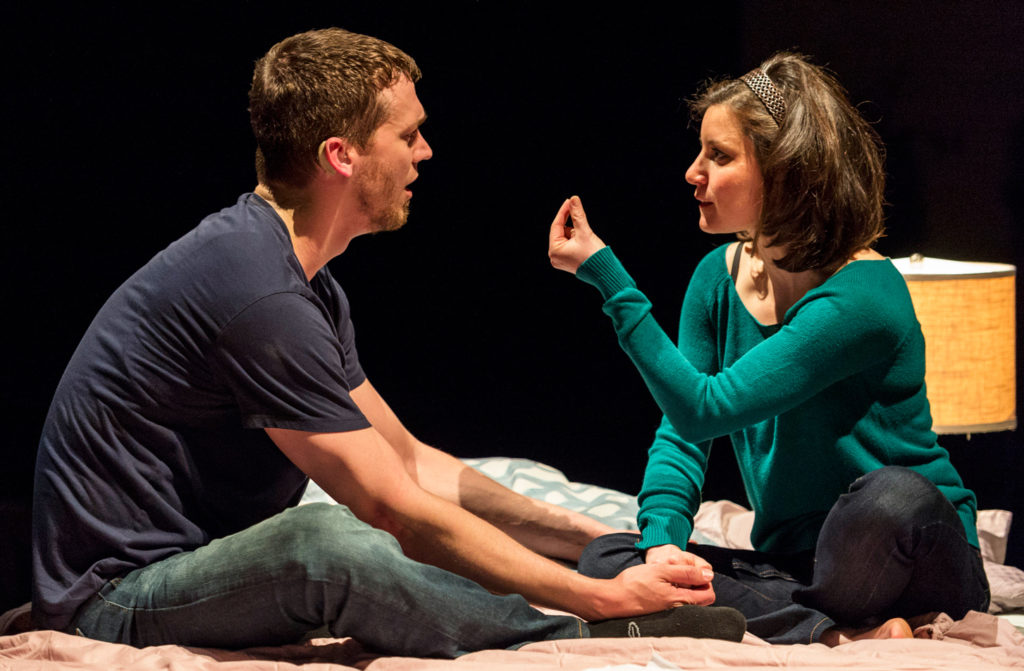


 In promotional materials for their Teen Day on September 17 (because after all what kid doesn’t wasn’t to take time on a weekend to spend time at the bank), Wells Fargo has mounted a campaign that seems overtly dismissive of careers in the arts. While both they and I acknowledge that young people’s career interests may evolve over time, it seems strange that “yesterday’s” careers are ballerina and actor, while today’s careers are engineer and botanist. Clearly Wells Fargo is at least sufficiently self-aware not to have proposed banker as a present or future option.
 Needless to say, I seriously doubt there are any banks that are uninterested in any legitimate segments of the market, since here in New York City there appear to be competing branches of major financial institutions on every street corner, hoping passersby will ultimately park their money there. So why make arts careers the example of what must be abandoned on the way to maturity? After all, before becoming an arts administrator, I once dreamed of being a “cowboy doctor,” giving that exotic pursuit up for the more mundane, steady world of entertainment.


