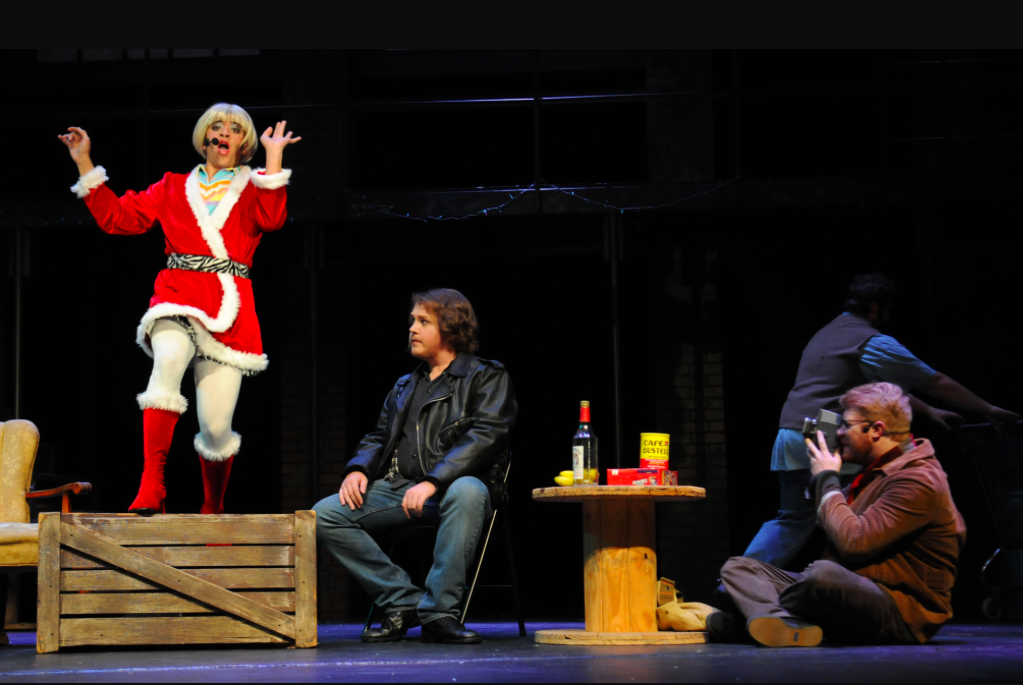
Jonathan Larson’s Rent at PACT in Tullahoma TN (photo by Howard Sherman)
I honestly wish I could figure out what makes one blog post a roaring success, and another a blip on the radar. Certainly the topic under discussion has some impact, but readership seems just as likely to be affected by the title, a photo, the Facebook algorithm, the timing of a tweet, what else is happening in the world, and so on. In short, I have no idea.
In looking over my most-read posts of 2015, I do know which ones took a great deal of research and time, and which were dashed off in under an hour. I know which ones were written after a great deal of consideration, and which were wholly reactive to something I read or heard. They don’t necessarily correlate to readership at all.
I am surprised by the way in which my most-read posts were grouped in the latter half of the year, with seven coming since October 29. Is there any correlation with the fact that I began regularly working out of The New School Drama offices starting in early October, in my new role as director of the Arts Integrity Initiative? I think it’s just coincidence, but it’s possible that the new environment meshed with some significant incidents to yield my most successful writing.
While it may seem paradoxical to offer up my most-read work once again, I have no doubt that there are plenty of people who didn’t read one or more of these when they were first posted, and perhaps there are a few people who would like to catch up with them now. You’ll note I’m not providing them in order of popularity, because it’s not a contest, but I can say that even within these ten, there’s a differential of some 10,000 views.
I had spoken with the leadership of the PACT community theatre in Tullahoma, Tennessee when they first began experiencing resistance to their production of Rent, but they decided that they’d prefer to try to address the opposition on a local basis. But ten days before performances were to begin, they learned of a letter in opposition to the show that was being circulated to the local clergy, and felt it was time for me to take up their cause and make it a national issue. I traveled to Tullahoma for the opening night, where I was welcomed by numerous members of the community, including the mayor, but the opposition had failed and the show played to an enthusiastic crowd. A prayer circle outside the theatre, in quiet protest of the production, drew only four people, including the two pastors who had been most opposed to the show.
Words Players Theatre found itself in the midst of a firestorm when several bog posts, mine among them, questioned their practice of soliciting plays for production with their teen actors, but saying that the director had the final word over the show, contrary to the tenets of The Dramatists Guild. I stand by what I wrote at the time, but I was troubled by the degree of vehemence that some directed at the company, which didn’t necessarily seems the best way to educate students, their parents and the company’s leadership about respect for scripts in production. I ultimately wrote a second post, trying to walk back some of the rhetoric that surrounded this situation, not just mine, by the way.
I was far from the only person to speak out against the archaic, stereotypical use of yellowface in a production of the New York Gilbert and Sullivan Players production of The Mikado, but I was among the first, with my blog post going online alongside two others on Tuesday, September 15. The groundswell of reaction grew very quickly in subsequent days, and advocates against the practice of yellowface awoke three days later to find, with great surprise, that the production had been canceled. NYGASP says they will return with a reconceived Mikado that’s appropriate to 21st century America. Perhaps I’ll be writing about that in 2016.
It took three weeks after the production closed for word of Katori Hall’s Olivier Award-winning play being produced with a white actor as Martin Luther King to find its way to general awareness, but once it did, it brought great scrutiny to this production, at a community theatre based out of Kent State University’s Department of Pan-African Studies. What was even more remarkable, and remains still less known, is that the concept of having white and black actors each do four performances as Dr. King never happened – the white actor played the role for the entire run.
I wasn’t exactly mystified as to why an interview with Pam MacKinnon carried a headline that mention her collaborators Al Pacino and David Mamet, both more famous, but it didn’t seem right that the person the paper actually spoke with was subordinated in this way. Intriguingly, not long after I posted my piece, the headline was altered, removing Mamet and Pacino – but it still didn’t mention MacKinnon by name. I was intrigued to discover that in coming up with a headline, I had birthed a Twitter hashtag: #SheHasAName.
Critic offers his extra complimentary press ticket for sale, via the personals section. This one pretty much wrote itself. But I have to say that I quickly came to regret the tone of this piece, because I let myself succumb to snark precisely because it was so easy in this case. I should have stuck to the facts and let the story speak for itself. My feelings about what this critic did (or tried to do) haven’t changed, but I should have done better.
Coming on the heels of the Mountaintop situation at Kent State, this dispute over racial representation in a college production of Jesus In India at Clarion University led to playwright Lloyd Suh pulling the rights to the show. There was a backlash against Suh from those who didn’t understand, or didn’t wish to understand, what it means to have white actors, even students, playing characters of color. Statements from university figures to the press only fed the uproar. But it has led to multiple offline conversations between Suh and the professor who was directing the show, and between the professor and me as well. Suh and I will be visiting the KCACTF Region 2 festival in a few weeks where we’ll meet for the first time and discuss the issue with the college students and their professors in attendance.
After the heated dialogues that both The Mountaintop and Jesus in India engendered, on social media, in comments sections and in direct correspondence, I was moved to wonder aloud about how the playwright-director dynamic was being addressed in college training programs, both undergraduate and graduate. It prompted yet more comments and e-mails, and frankly helped me to learn a great deal more and provide the basis for further exploration. The post became the basis for a panel added to the KCACTF Region 3 festival, and I’ll be headed to Milwaukee to participate in the conversation right after the first of the year.
With Hamilton being cited as a reason why white actors should be permitted to play characters of color, I took the opportunity of a previously scheduled and wholly unrelated interview to ask the show’s writer-composer-star Lin-Manuel Miranda for his take on race on stage, both in his own work and the work of others. He was, as always, thoughtful and eloquent, during his dinner break on a two-show day.
When a community/semi-professional theatre in Connecticut staged a production that looked startlingly like a professional production that had been stage nearby three years earlier, it was an opportunity to address the issue of appropriation from other productions and what constitutes originality in directing and design. While the company in question suspended performances within 24 hours, and have subsequently restaged the show on a new set, the outpouring of anecdotes (and expressions of frustration) about productions that have slavishly copied others came pouring out. I expect to write more on this subject.
While it didn’t make the list of my ten most read posts, top on my list of posts that I wish had been more widely read is this one. Written on a day when a combination of medications for an infection laid me low and found me laying on my sofa most of the day, an array of tweets and comments roused me to string together a few sentences which were probably my only coherent thoughts until the drugs wore off. Even if you don’t read the whole post, take a look at the italicized midsection, which is what I actually wrote that day; the rest is subsequent framing.
Truth be told, this was one of my ten most read posts of 2015, but that has little to do with what I actually wrote and everything to do with the video I’d discovered and embedded, once again with framing material that isn’t essential to enjoying the video. My greatest contribution was a snappy title. But if you haven’t seen it and need a laugh at year end, this vid’s for you.
* * *
My thanks to everyone who read, commented, shared, tweeted or wrote to me in connection with my writing this year, and special thanks to those who brought situations to my attention so that I could explore them and share them even more broadly. You all have my very best wishes for a safe, happy, arts-filled 2016.
Howard Sherman is director of the Arts Integrity Initiative at The New School College of Performing Arts and interim director of the Alliance for Inclusion in the Arts.
Brian D’Arcy James, Andrew Rannells and Jonathan Groff perform at Ham4Ham
If you’re a dedicated fan of the musical Hamilton, or if you follow me on social media, you may well have come across the streetside #Ham4Ham show videos I’ve been sharing since late July. As I write, they’ve collectively been viewed on YouTube about 890,000 times – and that doesn’t include views of the same videos that have been uploaded directly to Facebook. So without doing a careful count, I can truthfully say the videos have been seen over 1.1 million times.
As a result, I have been labeled a Hamilton “superfan” on social media, and I’ve been interviewed by a handful of media outlets. I’ve been credited as “Ham4Ham documenter” in Entertainment Weekly. I even get recognized by people in the crowd when I show up to record the shows. But I’ve also found that there’s a lot of curiosity and outright confusion about what I’m doing there, so I’ve decided to satisfy the questioners and settle any uncertainty by asking myself questions I’ve actually been asked about my continuing presence at the #Ham4Ham shows – and a few no one has asked.
Why do you do it?
I started recording the shows in late July, before there hadn’t been much press specifically about #Ham4Ham shows, because I thought it would make for a blog post at some point, and also be material for my weekly column in London’s The Stage newspaper. That said, both the blog post and Stage column mention ran in early August.
But it’s now December. Why are you still showing up?
During previews, #Ham4Ham shows were happening daily, sometimes even twice a day. In the final weeks of previews, I was trying to get there pretty consistently, in the hope of coming up with a few great videos. But once the regular run began and Ham4Ham dropped to twice or perhaps three times a week, I found it had become a habit and, being a creature of habit in many things, I just keep going.
How do you manage to get to every one?
I don’t. I’ve missed dozens. I didn’t go for the first two weeks, and I’ve had week-long trips to California and England, as well as assorted conflicts. Because I do in fact have to work, and have a personal life, I’m not there all the time.
So how many times have you been to #Ham4Ham shows?
But there are only 42 videos online right now. Why are you holding out?
That’s because I screwed up the recording once, on Halloween. I managed to start recording and accidently hit stop, without realizing it, about halfway through. I felt like an idiot. Fortunately my friend Laura Heywood (aka BroadwayGirlNYC) was also there that day, so there’s still good video readily available.
Do you work for the show?
Absolutely not. I’m doing this entirely on my own. In fact, I’ve decided that if anyone connected with the show ever calls me and specifically asks me to record something, I’ll stop altogether. I am not part of the show’s marketing and communications plan. If I shoot a video, I know full well that they may use it, but so can anyone else.
Do you know what the performance is going to be before it happens?
The night before Thanksgiving, I did an interview with Lin-Manuel for Dramatics magazine (look for it in February or March) and he did tell me what he had planned for that weekend. Once Lin tweeted me to say that he wouldn’t be at the show but that there would be “a lot” of people performing. That turned out to be the Broadway Inspirational Voices. But other than those instances, I don’t know anything more than what anyone can learn from reading Lin’s Twitter feed.
How can we believe you?
If I knew what was going to happen, I would have been in a much better position when Alexander from the Big Apple Circus did his juggling act. The only reason that turned out reasonably OK is because of camera zoom.
What kind of equipment do you use?
My iPhone. That’s it. I have a really nice DSLR that shoots video, but I’ve never learned how to use the video function. So I’m going the simple route.
Why won’t you use an even better camera if you have one?
Maybe I’ll try to learn how it all works during the holiday break. But you have to understand, I’d been shooting #Ham4Ham videos for a couple of weeks before I realized I ought to figure out how to get them off of my phone. I’d never posted to YouTube prior to that. It took me even longer to discover how to upload HD video. But let’s hear it for the iPhone.
How many times have you won the lottery?
Never. I don’t usually enter. I’m there for the Ham4Ham show. I’ve only entered a couple of times, when I’ve had friends in tow.
But you have seen Hamilton, right?
I’ve seen it twice, once at The Public and once on Broadway. I’d enjoy seeing it again, no doubt. Maybe for my birthday (hint, hint). And my eldest niece is dying to see it, so maybe I can figure out taking her.
Do you have any advice for people who want to shoot their own videos at Ham4Ham?
Always shoot horizontally – vertical only looks good on your phone. Hold your phone or camera with two hands, to keep it steady – you’d be surprise how hard it is to hold steady for four or five minutes. Get there about 45-50 minutes ahead of time for a decent spot – but remember that people are shooed off the sidewalk, so plant your toes as close to the curb as possible. Don’t sing along, laugh hysterically, scream Daveed’s name excitedly, and so on, because you’ll likely shake your camera in the process and you will be the loudest thing on your video.
Are you doing this to build your social media profile?
I admit that I’d love it if more people learned about my advocacy work as a result of this, but my sense is that people are watching because of Hamilton and not many find their way to my actual work. Sigh.
Have you monetized your YouTube stream?
No. I don’t own the rights to anything in the videos – the performances, the song rights, etc. I shouldn’t even try to profit from them.
Do you hear much from fans?
I see a lot of people posting how happy the videos make them. The most frequent comments seem to be a variant of people either “dying” or “dead” as a result of watching. I’d just like to say that I have an alibi, and no jury would convict me.
Do people say anything to you directly?
People have been unbelievably warm and appreciative in writing to me about my videos. It’s lovely.
But c’mon, why do you really keep doing this? You’ve ducked the main question.
When I wrote the blog post that was the reason I started, I wrote about the extraordinary generosity of Lin-Manuel in creating the Ham4Ham show, which is entirely his doing. It’s not part of the production’s marketing plan, and given how the show is selling, they hardly need more promotion. I’ve kept this up because I’m not a performer myself (anymore), but if Lin, the Hamilton company, and people from many other shows can be kind enough to offer this up, it seems the least I can do is to try to preserve these one-of-a-kind moments for posterity, and help them to be seen by more than just the crowd on 46th Street. This is my act of generosity, and I like to think that these videos will be watched for a long time to come. Just like Hamilton.
* * *
Counting down my top five #Ham4Ham videos to date on YouTube (keeping in mind that these are just from those I’ve recorded, and other videos by various other people have even more views than some of these – plus views of direct uploads to Facebook aren’t counted):
Amber Riley, Shanice Williams and company in The Wiz. (Photo by Virginia Sherwood/NBC)
Last week, more than 11 million people in the US watched a live broadcast of the musical The Wiz, an adaptation of The Wizard of Oz that came almost 30 years before Wicked. Created for a black cast, it won best musical at the Tony Awards in 1975. The Wiz (2015 edition) was the third annual live musical from producers Craig Zadan and Neil Meron, following The Sound of Music in 2013 and Peter Pan last year. The Wiz was, by consensus, vastly superior to the previous two, and I happen to agree; in fact, I tweeted that opinion only 75 minutes into the three-hour broadcast. As has always been the plan, The Wiz production is now expected to run on Broadway in the 2016-17 season, although it’s unlikely the stage version will manage to field a cast like the broadcast did. Among the performers were Mary J Blige, Queen Latifah, Ne-Yo and, in a cameo role, Common.
Mind you, the early days of US television, when most broadcasts were live, were filled with adaptations of plays, and some distinguished works first written for TV, like Horton Foote’s The Trip to Bountiful or Rod Serling’s Requiem for a Heavyweight were later adapted for both the stage and as films. Remarkably, what seems to be driving the new popularity of live staged TV are social media, which value the immediacy of sports, awards broadcasts and, yes, theatre, because as they unfold in real time – with all of the spontaneity and potential for gaffes intact – they create the opportunity for shared experiences online. Indeed, audience members can chat away with one another throughout these shows without disrupting anyone else; they can even let their cellphone rings without causing an interruption in the performance.
This blurring of the stage and screen is happening at an accelerating pace in a variety of ways. While NT Live has forged new paths for the streaming of theatre to cinemas around the world (though they’re only really live in the UK and nearby time zones), the US has been much slower to adopt the model, due in part to more restrictive, and therefore expensive, union agreements. That said, just last night, the Off-Broadway production of the intimate musical Daddy Long Legs was streamed live online for viewing anywhere, which is an important development that will surely be closely watched as a test case. Can the embrace of video technology add value to a property or production even when it’s offered up gratis?
This week has also seen the daily release of new videos from the second series of My America short films from Centerstage in Maryland, where artistic director Kwame Kwei-Armah has been exploring the intersection of film and theatre by commissioning original short plays from an array of writers. The new series has been shot guerrilla-style on sites where racial violence has taken place, essential spots in the new civil rights movement. But it blurs the traditional lines between the mediums by shooting plays in real-life settings specifically for video viewing; it’s theatre that won’t play in a theatre.
Just as the word television is becoming more a term for a specific viewing appliance, as opposed to the content itself, what we consider theatre may have to evolve as well. Purists will say that The Wiz was a Broadway text and score produced for video, not theatre – in no small part because there was no audience present – and that despite the credentials of the participating authors, My America is essentially a film series.
But perhaps we should be worrying less about the labels and looking more at impact: The Wiz may have inspired an interest in theatre among young people who may never be able to attend the show’s promised Broadway run; the Daddy Long Legs stream may help promote a chamber piece into the musical theatre repertory; live audiences could not have attended a play performed outside the burned out chemist shop that went up in flames during the Baltimore riots.
And in the US, it’s worth noting that the largest national audience for musical sequences from Broadway shows isn’t on the annual Tony Awards broadcast – it’s found in the first hour of the broadcast of the venerable Thanksgiving Day Parade from New York, which is seen by more than 20 million people. Just because it’s not performed in a theatre, does it stop being theatre?
There’s been a great deal of discussion in the past couple of months about the rights of playwrights, the legal protections of copyright and licensing agreements, the prerogative of directors to freshly interpret a writer’s work and so on. But none of this should suggest that writers are the only theatre artists whose work is to be respected and protected. This holds true, variously on legal and ethical grounds, for all creative artists in theatre.
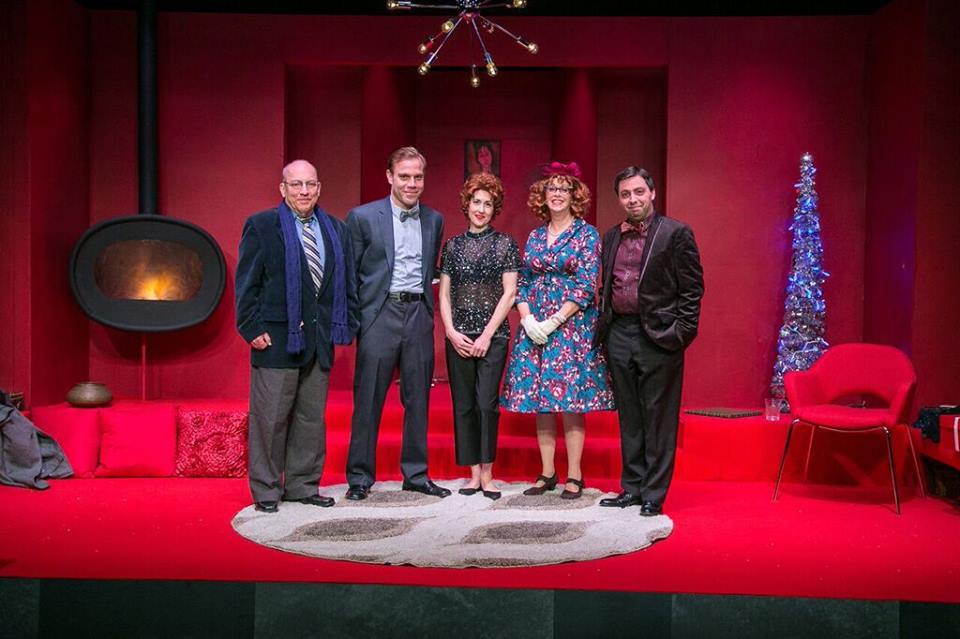
The cast of Bell Book & Candle at TheatreWorks New Milford (Photo by Richard Pettibone)
This is brought to the fore currently by a production of John van Druten’s supernatural comedy Bell, Book and Candle at the company TheatreWorks in New Milford, Connecticut, running into January. Theatreworks is a non-Equity company that pays its actors a stipend for appearing in productions; whether they are a community theatre, semi-professional or professional non-Equity is subject that could be debated, but that’s not where my focus is fixed.
Instead, I’m looking at photos of Bell, Book and Candle, and though I haven’t seen the production at TheatreWorks, the photos seem strangely familiar. Why? Because the set appears to be a fairly slavish recreation of a production of Bell Book and Candle that was co-produced by Long Wharf Theatre and Hartford Stage three years ago. That production was directed by Darko Tresnjak and designed by Alexander Dodge. Incidentally, it is 30 miles from New Milford to Long Wharf, and 40 miles from New Milford to Hartford Stage.
Kate MacCluggage in Bell, Book and Candle at Long Wharf Theatre (photo by T. Charles Erickson)
The similarities are striking, and having discovered that I’m connected to many of the creative team and cast of the Long Wharf/Hartford Stage production on Facebook, I can say that they think so too. Indeed, while I don’t think it’s appropriate to publish people’s Facebook posts when I can’t be sure what’s private and what’s public, I will quote simply the first word of Tresnjak’s initial post on this subject: “Grrrrrr.”
There is no copyright protection for the work of directors (though the ethics of replication should be taken into account by all theatre artists), but designs can be copyrighted, and so the appropriation of Dodge’s work (created in collaboration with Tresnjak for his production) by TheatreWorks director and designer Joseph Russo without permission has crossed a line. While the costumes in the New Milford production are reminiscent of those designed by Fabio Toblini for the prior Connecticut production, they are not replicas. Anyone undertaking a Google search will also discover another set of similar photos from a Bell, Book and Candle at The Old Globe in San Diego in 2007, but that’s understandable: it was also directed by Tresnjak and designed by Dodge.
It is incumbent upon directors to produce a script according to the approved version by the playwright, yet it is also incumbent upon them to create their production anew, through their own conception, their cast and their design, to name but a few key elements. Now to be fair, there’s a blurry line when it comes to iconic shows, often musicals. Productions of A Chorus Line rarely stray far from the original, particularly Theoni V. Aldredge’s costumes, and as an avowed Sweeney Todd fan, every production I saw for years was in some way an homage to the Hal Prince directed original, and to Eugene Lee’s scenic design, until John Doyle broke the mold with his Watermill production that eventually came to Broadway.
But unless both Joe Russo and Alexander Dodge either have vivid personal memories of the original 1950 Broadway production of BB&C and/or they both lifted their ideas from photos of George Jenkins’s original Broadway designs (which likely were only photographed in black and white), it’s pretty safe to say that Russo took “his” design ideas from Dodge, without permission. That’s not an homage, that’s copying.
Given the online conversation over the past 11 hours, word of concern has reached Joseph Russo and Theatreworks. At 10:30 this morning, the following was posted to Theatreworks’ public Facebook page:
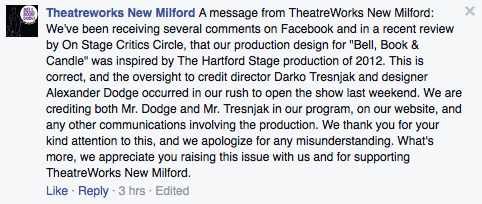
Dear friends of TheatreWorks: we’ve been receiving several comments on Facebook and in a recent review by OnStage Critics Circle, that our production design for “Bell, Book & Candle” was inspired by The Hartford Stage production of 2012. This is correct, and the oversight to credit director Darko Tresnjak and designer Alexander Dodge occurred in our rush to open the show last weekend. We are crediting both Mr. Dodge and Mr. Tresnjak in our program, on our website, and any other communications involving the production. We thank you for your kind attention to this, and we apologize for any misunderstanding. What’s more, we appreciate you raising this issue with us and for supporting TheatreWorks New Milford.
This statement misses the point entirely. It’s not that Tresnjak and Dodge should have been credited – their work should never have been taken in the first place. That Russo acknowledges the debt his production owes to the Long Wharf/Hartford Stage original confirms exactly how he came by his directorial and design concept, but his statement neither excuses or resolves the issue. I suspect unions have already been contacted by the artists involved in the source production.
Chronicling this incident is not meant to demonize TheatreWorks, who are at least in the process of owning up to what they’ve done. They still must go farther than their statement, which glosses over the issue and ignores the essential problem. How Tresnjak and Dodge choose to settle this issue remains to be seen, and they deserve satisfaction for any claims that may be forthcoming; that their original work was done at major theatres, and the copying was at a small one, should be irrelevant to the conversation. TheatreWorks has hopefully learned an important lesson, and through them, perhaps others will as well.
This does provide an excellent example about respect for every creative element in every production, and while examples don’t often come to light, there has been litigation over the appropriation of key elements from Urinetown (the original Broadway production) by another company, to name a prominent precedent, demonstrating that this practice is not confined to small, quasi-professional companies, but to professional productions as well.
To those who have expressed to me in recent weeks their concern that in directing productions they don’t want to be hamstrung by excessive faithfulness to published scripts, and therefore original productions, this is a perfect example of why doing so isn’t in anyone’s best interests. Respecting an author’s intent is not the same as creating a Xerox copy – or a 19th generation copy – of the original or another notable production. It’s about how does every director and their team at every level – academic, amateur and professional – imagine a play anew without subverting the playwright’s wishes (unless permission is granted to do so), making their own discoveries along the way.
Update, December 9, 2:30 pm:The Facebook post from TheatreWorks referred to above was online as of 11:30 am as this post was being prepared, but was subsequently removed. However, the same post still appears, for the time being, in the comments section of a review of the production on the Facebook page of the online On Stage magazine.
Update, December 9, 8 pm: Earlier today, several hours after this piece was first posted, I spoke briefly with Darko Tresnjak, who I know casually. He spoke of being “freaked out” at discovering the remarkable similarities between his production of Bell, Book and Candle and the nearby production in New Milford. Tresnjak noted that it had come on the heels of discovering that a Swedish production of A Gentleman’s Guide To Love And Murder (Tresnjak won a Tony for directing the Broadway production) had copied Linda Cho’s costume designs, noting they replicated specifics which were in no way indicated in the text and must have been gleaned from photos and videos online. He also described to me particular choices he had made with his designers on BB&C, which were quite distinct from the show’s original Broadway production and in no way indicated in the printed script.
“I don’t want to be petty, but I’m upset,” said Tresnjak. He said he was speaking out because, “It’s just not right. If you let it happen, it will happen.”
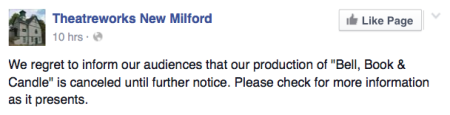
Update, December 10, 9 am: TheatreWorks has canceled performances of Bell, Book and Candle until further notice. It was announced on their Facebook page at midnight.
Update, December 17, 4 pm:Bell, Book and Candle is now scheduled to resume performance tomorrow night at TheatreWorks, according to the following letter which appears on the company’s website:
Dear Patrons and Friends of TheatreWorks,
We want to express our sincere apologies for the cancellation of some of the performances of Bell, Book & Candle.
As most of you know, TheatreWorks New Milford is almost 50 years old. We are a small, not-for-profit, non-professional theatre and our mission is not to make a profit, but to provide a service to the community of New Milford and surrounding areas. Our Board of Directors are all volunteers. We therefore must place a good deal of trust in our directors and designers to provide the best possible productions.
Joseph Russo, the director of this production, has directed a number of productions at TheatreWorks in recent years. He indicated that he saw the production of Bell, Book & Candle at Hartford Stage in 2012, which inspired him to stage it at TheatreWorks.
In his zeal to mount this production, Joe designed and built a set which contained major elements that were extremely similar to those used at Long Wharf/Hartford Stage. He was unaware that these actions constituted an infringement. Those of us at TheatreWorks who are responsible for the artistic decisions were unaware of these similarities until we received notification from Long Wharf Theatre and Hartford Stage.
The Board of Directors of TheatreWorks takes full responsibility for this oversight, and we have taken the following actions:
1) Our production has been completely re-staged and re-designed, under the direction of actor/director Matt Austin and will reopen on Friday, December 18th for an 8PM performance.
2) Mr. Russo has voluntarily resigned from the Board, and has sent an apology to Hartford Stage, Long Wharf Theatre, Alexander Dodge and Darko Tresnjak, the latter two being the respective designer and director of The Hartford Stage/Long Wharf production of Bell, Book & Candle.
3) TheatreWorks has also personally apologized to all of the aforementioned injured parties.
4) We are putting in place a new policy to review all of the design elements and staging of every future production before the production begins rehearsals.
The Board would like to extend a special thanks to our cast of Bell, Book & Candle, who were integral in the re-mounting of this production. In addition, we would like to thank Mr. Dodge, Mr. Tresnjak, Michael Stotts, General Manager of Hartford Stage, and Joshua Borenstein, General Manager of Long Wharf Theatre for their graciousness, understanding and forgiveness throughout this situation.
Again, we are very sorry for this incident. It has been a hard lesson for us, yet we are very grateful for having learned it. We are also grateful for all of your patience, support and kindness throughout.
Thank you again, and we hope you can join us as we re-open Bell, Book & Candle on December 18th as a humbler and wiser organization.
Respectfully,
The Board of Directors of TheatreWorks New Milford
Correction: An earlier version of this post misidentified the designer of the original production of Sweeney Todd. It now appears correctly in the text.
Howard Sherman is director of the Arts Integrity Initiative at The New School College of Performing Arts.
Bell Book and Candle at Long Wharf Theatre (Photo by T. Charles Erickson)
There’s been a great deal of discussion in the past couple of months about the rights of playwrights, the legal protections of copyright and licensing agreements, the prerogative of directors to freshly interpret a writer’s work and so on. But none of this should suggest that writers are the only theatre artists whose work is to be respected and protected. This holds true, variously on legal and ethical grounds, for all creative artists in theatre.
This is brought to the fore currently by a production of John van Druten’s supernatural comedy Bell, Book and Candle at the company TheatreWorks in New Milford, Connecticut, running into January. Theatreworks is a non-Equity company that pays its actors a stipend for appearing in productions; whether they are a community theatre, semi-professional or professional non-Equity is subject that could be debated, but that’s not where my focus is fixed.
Instead, I’m looking at photos of Bell, Book and Candle, and though I haven’t seen the production at TheatreWorks, the photos seem strangely familiar. Why? Because the set appears to be a fairly slavish recreation of a production of Bell Book and Candle that was co-produced by Long Wharf Theatre and Hartford Stage three years ago. That production was directed by Darko Tresnjak and designed by Alexander Dodge. Incidentally, it is 30 miles from New Milford to Long Wharf, and 40 miles from New Milford to Hartford Stage.
Bell Book and Candle at Theatreworks New Milford
The similarities are striking, and having discovered that I’m connected to many of the creative team and cast of the Long Wharf/Hartford Stage production on Facebook, I can say that they think so too. Indeed, while I don’t think it’s appropriate to publish people’s Facebook posts when I can’t be sure what’s private and what’s public, I will quote simply the first word of Tresnjak’s initial post on this subject: “Grrrrrr.”
There is no copyright protection for the work of directors (though the ethics of replication should be taken into account by all theatre artists), but designs can be copyrighted, and so the appropriation of Dodge’s work (created in collaboration with Tresnjak for his production) by TheatreWorks director and designer Joseph Russo without permission has crossed a line. While the costumes in the New Milford production are reminiscent of those designed by Fabio Toblini for the prior Connecticut production, they are not replicas. Anyone undertaking a Google search will also discover another set of similar photos from a Bell, Book and Candle at The Old Globe in San Diego in 2007, but that’s understandable: it was also directed by Tresnjak and designed by Dodge.
It is incumbent upon directors to produce a script according to the approved version by the playwright, yet it is also incumbent upon them to create their production anew, through their own conception, their cast and their design, to name but a few key elements. Now to be fair, there’s a blurry line when it comes to iconic shows, often musicals. Productions of A Chorus Line rarely stray far from the original, particularly Theoni V. Aldredge’s costumes, and as an avowed Sweeney Todd fan, every production I saw for years was in some way an homage to the Hal Prince directed original, and to Eugene Lee’s scenic design, until John Doyle broke the mold with his Watermill production that eventually came to Broadway.
But unless both Joe Russo and Alexander Dodge either have vivid personal memories of the original 1950 Broadway production of BB&C and/or they both lifted their ideas from photos of George Jenkins’s original Broadway designs (which likely were only photographed in black and white), it’s pretty safe to say that Russo took “his” design ideas from Dodge, without permission. That’s not an homage, that’s copying.
Given the online conversation over the past 11 hours, word of concern has reached Joseph Russo and Theatreworks. At 10:30 this morning, the following was posted to Theatreworks’ public Facebook page:
Dear friends of TheatreWorks: we’ve been receiving several comments on Facebook and in a recent review by OnStage Critics Circle, that our production design for “Bell, Book & Candle” was inspired by The Hartford Stage production of 2012. This is correct, and the oversight to credit director Darko Tresnjak and designer Alexander Dodge occurred in our rush to open the show last weekend. We are crediting both Mr. Dodge and Mr. Tresnjak in our program, on our website, and any other communications involving the production. We thank you for your kind attention to this, and we apologize for any misunderstanding. What’s more, we appreciate you raising this issue with us and for supporting TheatreWorks New Milford.
This statement misses the point entirely. It’s not that Tresnjak and Dodge should have been credited – their work should never have been taken in the first place. That Russo acknowledges the debt his production owes to the Long Wharf/Hartford Stage original confirms exactly how he came by his directorial and design concept, but his statement neither excuses or resolves the issue. I suspect unions have already been contacted by the artists involved in the source production.
Chronicling this incident is not meant to demonize TheatreWorks, who are at least in the process of owning up to what they’ve done. They still must go farther than their statement, which glosses over the issue and ignores the essential problem. How Tresnjak and Dodge choose to settle this issue remains to be seen, and they deserve satisfaction for any claims that may be forthcoming; that their original work was done at major theatres, and the copying was at a small one, should be irrelevant to the conversation. TheatreWorks has hopefully learned an important lesson, and through them, perhaps others will as well.
This does provide an excellent example about respect for every creative element in every production, and while examples don’t often come to light, there has been litigation over the appropriation of key elements from Urinetown (the original Broadway production) by another company, to name a prominent precedent, demonstrating that this practice is not confined to small, quasi-professional companies, but to professional productions as well.
To those who have expressed to me in recent weeks their concern that in directing productions they don’t want to be hamstrung by excessive faithfulness to published scripts, and therefore original productions, this is a perfect example of why doing so isn’t in anyone’s best interests. Respecting an author’s intent is not the same as creating a Xerox copy – or a 19th generation copy – of the original or another notable production. It’s about how does every director and their team at every level – academic, amateur and professional – imagine a play anew without subverting the playwright’s wishes (unless permission is granted to do so), making their own discoveries along the way.
Update, December 9, 2:30 pm:The Facebook post from TheatreWorks referred to above was online as of 11:30 am as this post was being prepared, but was subsequently removed. However, the same post still appears, for the time being, in the comments section of a review of the production on the Facebook page of the online On Stage magazine.
Update, December 9, 8 pm: Earlier today, several hours after this piece was first posted, I spoke briefly with Darko Tresnjak, who I know casually. He spoke of being “freaked out” at discovering the remarkable similarities between his production of Bell, Book and Candle and the nearby production in New Milford. Tresnjak noted that it had come on the heels of discovering that a Swedish production of A Gentleman’s Guide To Love And Murder (Tresnjak won a Tony for directing the Broadway production) had copied Linda Cho’s costume designs, noting they replicated specifics which were in no way indicated in the text and must have been gleaned from photos and videos online. He also described to me particular choices he had made with his designers on BB&C, which were quite distinct from the show’s original Broadway production and in no way indicated in the printed script.
“I don’t want to be petty, but I’m upset,” said Tresnjak. He said he was speaking out because, “It’s just not right. If you let it happen, it will happen.”
Update, December 10, 9 am: TheatreWorks has canceled performances of Bell, Book and Candle until further notice. It was announced on their Facebook page at midnight.
Correction: An earlier version of this post misidentified the designer of the original production of Sweeney Todd. It now appears correctly in the text.
Howard Sherman is director of the Arts Integrity Initiative at The New School College of Performing Arts.
Early last week, the New York City Landmarks Preservation Committee gave its blessing to a plan to elevate Broadway’s famed Palace Theatre by 29ft in order to make way for street-level and below-ground retail in the heart of Times Square and to redevelop the hotel that already rises above the venue.
There are still several hurdles for the plan to clear before it’s a completely done deal, but a timetable setting out the project’s completion by the end of 2019 was also announced, in a report that first appeared in The Wall Street Journal.
The Palace is a fabled location, less as a legitimate theatre venue than for its origins as a premier vaudeville house. To ‘play the Palace’ means to have truly arrived in showbusiness terms.
Judy Garland famously performed there multiple times in the 1950s and 1960s, as did other name performers such as Danny Kaye and Jerry Lewis. Since it was bought by the Nederlander Organization in 1965, the Palace has been home to such theatrical hits as the original productions of Sweet Charity, Applause, La Cage aux Folles, The Will Rogers Follies and the current production of An American in Paris.
Like any theatre, it has also had its share of flops, including the musical Cyrano, a version of Frankenstein that I loved as a teen, and (amusingly) both Henry, Sweet Henry and Home Sweet Homer.
It’s important to note that while the interior of the Palace is landmarked, and therefore must be preserved, the exterior is not. Giant signage adorns the outside. Because the theatre is accessed via a lengthy entryway, its street-level frontage on Seventh Avenue is quite limited, sandwiched between the hotel entry on one side and a change bureau and a McDonalds on the other.
Opposition to the plan, citing the Palace’s historic and iconic status, remains, and it will likely grow louder as the final regulatory steps are taken. While I certainly want to see the theatre preserved, and by regulation it must be, I’m not joining the chorus of those who oppose the venue’s potentially elevated status.
This is because the project – driven first and foremost by commerce, I know – has the potential to rethink aspects of the theatregoing experience for the next century.
As Broadway theatres have begun to pass the 100-year mark, it’s impossible not to wonder how these tourist draws will fare over the long term. As ticket prices continue to rise and make Broadway into an increasingly luxury brand, the beloved but antique interiors may seem increasingly problematic to patrons: steep staircases, small lobbies and tight bathrooms come quickly to mind. This holds true for backstage as well, since the theatres weren’t conceived with modern technology in mind.
The Palace project has the potential to alleviate some of the front-of-house frustrations and make the Broadway theatregoing experience more consistent with that one might find at venues less than half its age. With new venues such as the Culture Shed, the performance spaces at Pier 55 and, maybe one day, the Ground Zero Arts centre on the horizon in New York, the patron experience on Broadway may stand in even sharper relief. Those of us who love the connection to days of theatre past may be willing to overlook some of the inconveniences that come with historic venues, but one cannot help but wonder about subsequent generations, and theatres shouldn’t become deterrents to seeing productions.
The Palace plans outline significant new space for audience and pre-show events, more akin to one what might find at newly built regional houses, as well as more support space backstage. I trust there will be new bathrooms. While great care must be taken with the jacking-up of the theatre, there is also a significant photographic record to guide replication should any pieces be inadvertently damaged in the process.
While exterior landmarking and past air-rights sales will likely prevent the same process from occurring at many other Broadway houses, the Palace may yet prove itself to be a new model of retaining the very best of our historic theatres while adapting to a newer era of entertainment and audience expectation.
There is risk, to be sure, but there’s also potential. If the view of the stage from my seat remains unchanged whether I’m at street level (in the stalls) or 29ft above it, if the beauty of the hall is preserved, then the lifting of the Palace isn’t going to get much of a rise out of me.
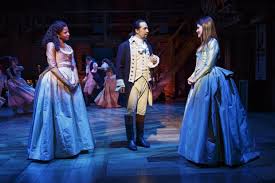
Renée Elise Goldsberry, Lin-Manuel Miranda and Phillipa Soo in Hamilton (Photo by Joan Marcus)
In the wake of the recent casting controversies over Katori Hall’s The Mountaintop and Lloyd Suh’s Jesus in India, there have been a number of online commenters who have cited Lin-Manuel Miranda’s musical Hamilton as a justification for their position in the debate. What’s intriguing is that Hamilton has been offered up both as evidence of why actors of color must have the opportunity to play both characters or color and characters not necessarily written as characters of color – but it has also been used to say that anything goes, and white actors should be able to play characters of color as well.
In the Broadway production of Hamilton, the characters are historical figures who were all known to have been white, but they are played by actors of many races and ethnicities, notably black, Latino and Asian. My position on non-traditional (or color-blind or color-specific) casting is that it is not a “two-way street,” and that the goal is to create more opportunities for actors of color, not to give white actors the chance to play characters of color.
As it happens, I had an interview scheduled with Miranda last week, the night before Thanksgiving. Race wasn’t the subject at all, however. We were speaking about his experiences in, and views on, high school theatre, for Dramatics magazine, a publication of the Educational Theatre Association (ask a high school thespian for a copy). But when I finished the main interview, and had shut off my voice recorder, I asked Miranda if he would be willing to make any comment regarding the recent casting situations that had come to light. He was familiar with The Mountaintop case, but I had to give him an exceptionally brief précis of what had occurred with Jesus in India. He said he would absolutely speak to the issue, and I had to hold up my hand to briefly pause him as he rushed to start speaking, while I started recording again.
“My answer is: authorial intent wins. Period,” Miranda said. “As a Dramatists Guild Council member, I will tell you this. As an artist and as a human I will tell you this. Authorial intent wins. Katori Hall never intended for a Caucasian Martin Luther King. That’s the end of the discussion. In every case, the intent of the author always wins. If the author has specified the ethnicity of the part, that wins.
“Frankly, this is why it’s so important to me, we’re one of the last entertainment mediums that has that power. You go to Hollywood, you sell a script, they do whatever and your name is still on it. What we protect at the Dramatists Guild is the author’s power over their words and what happens with them. It’s very cut and dry.”
This wasn’t the first time Miranda and I have discussed racial casting. Last year, we corresponded about it in regard to high school productions of his musical In The Heights, and his position on the show being done by high schools without a significant Latino student body, which he differentiated from even college productions.
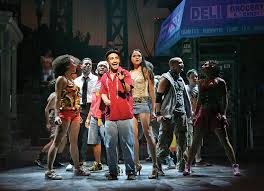
Lin-Manuel Miranda, Karen Olivo and the company of In The Heights (Photo by Joan Marcus)
“The joy of In The Heights runs both ways to me,” he wrote me in early 2014. “When I see a school production with not a lot of Latino students doing it, I know they’re learning things about Latino culture that go beyond what they’re fed in the media every day. They HAVE to learn those things to play their parts correctly. And when I see a school with a huge Latino population do Heights, I feel a surge of pride that the students get to perform something that may have a sliver of resonance in their daily lives. Just please God, tell them that tanning and bad 50’s style Shark makeup isn’t necessary. Latinos come in every color of the rainbow, thanks very much.
“And I’ve said this a million times, but it bears repeating: high school’s the ONE CHANCE YOU GET, as an actor, to play any role you want, before the world tells you what ‘type’ you are. The audience is going to suspend disbelief: they’re there to see their kids, whom they already love, in a play. Honor that sacred time as educators, and use it change their lives. You’ll be glad you did.”
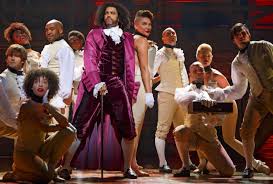
Daveed Diggs and the company of Hamilton (Photo by Joan Marcus)
Anticipating the flood of interest in producing Hamilton once the Broadway production and national tours have run their courses, I asked Miranda whether the acting edition of the script of Hamilton will ultimately be specific about the cast’s diversity, and whether, either at the college level or the professional level, he would foresee a situation where white actors were playing leading roles.
“I don’t have the answer to that. I have to consult with the bookwriter, who is also me,” he responded. “I’m going to know the answer a little better once we set up these tours and once we set up the London run. I think the London cast is also going to look like our cast looks now, it’s going to be as diverse as our cast is now, but there are going to be even more opportunities for southeast Asian and Asian and communities of color within Europe that should be represented on stage in that level of production.
“So I have some time on that language and I will find the right language to make sure that the beautiful thing that people love about our show and allows them identification with the show is preserved when this goes out into the world.”
Authorial intent, y’all. Authorial intent.
Howard Sherman is interim director of the Alliance for Inclusion in the Arts and director of the Arts Integrity Initiative at The New School College of Performing Arts.
Phillipa Soo, Lin-Manuel Miranda and Renée Elise Goldsberry in Hamilton (Photo by Joan Marcus)
In the wake of the recent casting controversies over Katori Hall’s The Mountaintop and Lloyd Suh’s Jesus in India, there have been a number of online commenters who have cited Lin-Manuel Miranda’s musical Hamilton as a justification for their position in the debate. What’s intriguing is that Hamilton has been offered up both as evidence of why actors of color must have the opportunity to play both characters or color and characters not necessarily written as characters of color – but it has also been used to say that anything goes, and white actors should be able to play characters of color as well.
In the Broadway production of Hamilton, the characters are historical figures who were all known to have been white, but they are played by actors of many races and ethnicities, notably black, Latino and Asian. My position on non-traditional (or color-blind or color-specific) casting is that it is not a “two-way street,” and that the goal is to create more opportunities for actors of color, not to give white actors the chance to play characters of color.
As it happens, I had an interview scheduled with Miranda last week, the night before Thanksgiving. Race wasn’t the subject at all, however. We were speaking about his experiences in, and views on, high school theatre, for Dramatics magazine, a publication of the Educational Theatre Association (ask a high school thespian for a copy). But when I finished the main interview, and had shut off my voice recorder, I asked Miranda if he would be willing to make any comment regarding the recent casting situations that had come to light. He was familiar with The Mountaintop case, but I had to give him an exceptionally brief précis of what had occurred with Jesus in India. He said he would absolutely speak to the issue, and I had to hold up my hand to briefly pause him as he rushed to start speaking, while I started recording again.
“My answer is: authorial intent wins. Period,” Miranda said. “As a Dramatists Guild Council member, I will tell you this. As an artist and as a human I will tell you this. Authorial intent wins. Katori Hall never intended for a Caucasian Martin Luther King. That’s the end of the discussion. In every case, the intent of the author always wins. If the author has specified the ethnicity of the part, that wins.
“Frankly, this is why it’s so important to me, we’re one of the last entertainment mediums that has that power. You go to Hollywood, you sell a script, they do whatever and your name is still on it. What we protect at the Dramatists Guild is the author’s power over their words and what happens with them. It’s very cut and dry.”
This wasn’t the first time Miranda and I have discussed racial casting. Last year, we corresponded about it in regard to high school productions of his musical In The Heights, and his position on the show being done by high schools without a significant Latino student body, which he differentiated from even college productions.
Lin-Manuel Miranda, Karen Olivo and the company of In The Heights (Photo by Joan Marcus)
“The joy of In The Heights runs both ways to me,” he wrote me in early 2014. “When I see a school production with not a lot of Latino students doing it, I know they’re learning things about Latino culture that go beyond what they’re fed in the media every day. They HAVE to learn those things to play their parts correctly. And when I see a school with a huge Latino population do Heights, I feel a surge of pride that the students get to perform something that may have a sliver of resonance in their daily lives. Just please God, tell them that tanning and bad 50’s style Shark makeup isn’t necessary. Latinos come in every color of the rainbow, thanks very much.
“And I’ve said this a million times, but it bears repeating: high school’s the ONE CHANCE YOU GET, as an actor, to play any role you want, before the world tells you what ‘type’ you are. The audience is going to suspend disbelief: they’re there to see their kids, whom they already love, in a play. Honor that sacred time as educators, and use it change their lives. You’ll be glad you did.”
Daveed Diggs and the company of Hamilton (Photo by Joan Marcus)
Anticipating the flood of interest in producing Hamilton once the Broadway production and national tours have run their courses, I asked Miranda whether the acting edition of the script of Hamilton will ultimately be specific about the cast’s diversity, and whether, either at the college level or the professional level, he would foresee a situation where white actors were playing leading roles.
“I don’t have the answer to that. I have to consult with the bookwriter, who is also me,” he responded. “I’m going to know the answer a little better once we set up these tours and once we set up the London run. I think the London cast is also going to look like our cast looks now, it’s going to be as diverse as our cast is now, but there are going to be even more opportunities for southeast Asian and Asian and communities of color within Europe that should be represented on stage in that level of production.
“So I have some time on that language and I will find the right language to make sure that the beautiful thing that people love about our show and allows them identification with the show is preserved when this goes out into the world.”
Authorial intent, y’all. Authorial intent.
Howard Sherman is interim director of the Alliance for Inclusion in the Arts and director of the Arts Integrity Initiative at The New School College of Performing Arts.
Jonathan Larson’s Rent at Eastern Tennessee State University (Photo by Larry Smith)
I assume most people, either as a child heard, or as a parent deployed, the timeworn phrase, “If someone told you to jump off the Brooklyn Bridge, would you do it?” My parents had a variant along the same lines: “Just because other people do it doesn’t make it right.”
I am reminded of this phrase as it seems every week lately I hear about another instance of a theatre director altering a script or overriding an author’s clear intent; the recent run of examples has been with college-affiliated productions. I wonder whether the people responsible have had others set the wrong example, and they felt they could just join in, or if they just started doing it and, since they were never challenged or caught, kept it up.
In a markedly less fraught situation which didn’t generate any major headlines, a production of Rent at Eastern Tennessee State University, just before Thanksgiving, had to cancel one day of a five-day run because the show’s licensing house learned of a scene that had been cut without approval. The lost day was used to restore the scene in question, as reported by the campus newspaper, The East Tennessean.
“I have directed hundreds of shows, and made many cuts before,” Cronin said. “So, I did the same with the street scenes [in ‘Rent’] because we did not have enough actors to make those scenes interesting.”
At the end of the article, Cronin was again quoted:
“I have a young cast who were able to add six pages of material in two days,” Cronin said. “I am just grateful that we got the show on and that we caught the mistake I had made.”
While the school paper didn’t draw attention to the inconsistency, it’s worth noting that Cronin said that what he did was a mistake, but earlier on he had said it was consistent with what he’d done numerous times before. Secondly, it’s not Cronin who caught the mistake, but someone at the school familiar enough with what had been taking place in the rehearsal room – and with copyright and licensing law – to contact Music Theatre International and give them a heads up about the unauthorized alteration. Finally, isn’t it interesting to note that a solution was found to the supposedly problematic scene, in almost no time at all.
Some might accuse me of conflating the first two examples, which turn on the issue of race in casting, with the third, which was the excision of a scene. But I’d argue that they’re all of a piece, because they involve directors either misinterpreting works or placing their own sensibility above that of the author, be it for practical, aesthetic or intellectual reasons. While I don’t have press reports I can bring forward, I can say that since I began writing on this topic, I have been told numerous anecdotes about shows in academic settings that have been altered for any number of reasons, all without approval.
So I have to wonder: are some theatre programs and theatrical groups at the college level advancing the belief that scripts can be altered at will, or elements ignored? Are schools teaching both the legal and ethical implications of artists’ rights and copyright law, not just to playwrights but to all of those who study theatre? Have bad practices begotten yet further bad practices? Are there professors and program directors who believe that anything produced on a campus falls under the fair use exemption for educational purposes under the copyright laws?
Lest anyone think I’m advocating for slavish recreations of original productions or less than fruitful collaborations on new works, I should state that I most assuredly am not. I want to see directors, whether students or faculty (and, for that matter, professionals as well), have the opportunity to undertake creative productions that will challenge the artists involved and the audiences they attract. I want to see works reinvented, but in ways which reveal something new that is supported by the text, rather than overriding it. That said, I am troubled by a sense that in some cases (I’m not saying that this applies to every production at every school) something approaching film’s auteur theory, in which the director of a movie is seen as its primary author, is filtering into theatre at the pre-professional level in a way which diminishes or disregards the importance and rights of authors.
I have a genuine desire to know the answers to some of the questions I’ve asked above. I’d be interested in those answers not only from faculty but from students both past and present. What is being taught about the relationship between playwright and director, regardless of whether the latter is present in rehearsals, available via computer or phone, otherwise engaged, or even dead but still protected by copyright? I ask because I think we all have a lot to learn. I’d like to hear from you, either on the record or confidentially; you can write to me here.
Oh, since I started with timeworn phrases, let me finish with one as well, which believe it or not I’ve heard more than a few times over my career: “Better to ask for forgiveness than to ask for permission.” These are not, I hope you’ll agree, words to live by. Even if some seem to.
Howard Sherman is director of the Arts Integrity Initiative at The New School College of Performing Arts.
Jonathan Larson’s Rent at Eastern Tennessee State University (Photo by Larry Smith)
I assume most people, either as a child heard, or as a parent deployed, the timeworn phrase, “If someone told you to jump off the Brooklyn Bridge, would you do it?” My parents had a variant along the same lines: “Just because other people do it doesn’t make it right.”
I am reminded of this phrase as it seems every week lately I hear about another instance of a theatre director altering a script or overriding an author’s clear intent; the recent run of examples has been with college-affiliated productions. I wonder whether the people responsible have had others set the wrong example, and they felt they could just join in, or if they just started doing it and, since they were never challenged or caught, kept it up.
In a markedly less fraught situation which didn’t generate any major headlines, a production of Rent at Eastern Tennessee State University, just before Thanksgiving, had to cancel one day of a five-day run because the show’s licensing house learned of a scene that had been cut without approval. The lost day was used to restore the scene in question, as reported by the campus newspaper, The East Tennessean.
“I have directed hundreds of shows, and made many cuts before,” Cronin said. “So, I did the same with the street scenes [in ‘Rent’] because we did not have enough actors to make those scenes interesting.”
At the end of the article, Cronin was again quoted:
“I have a young cast who were able to add six pages of material in two days,” Cronin said. “I am just grateful that we got the show on and that we caught the mistake I had made.”
While the school paper didn’t draw attention to the inconsistency, it’s worth noting that Cronin said that what he did was a mistake, but earlier on he had said it was consistent with what he’d done numerous times before. Secondly, it’s not Cronin who caught the mistake, but someone at the school familiar enough with what had been taking place in the rehearsal room – and with copyright and licensing law – to contact Music Theatre International and give them a heads up about the unauthorized alteration. Finally, isn’t it interesting to note that a solution was found to the supposedly problematic scene, in almost no time at all.
Some might accuse me of conflating the first two examples, which turn on the issue of race in casting, with the third, which was the excision of a scene. But I’d argue that they’re all of a piece, because they involve directors either misinterpreting works or placing their own sensibility above that of the author, be it for practical, aesthetic or intellectual reasons. While I don’t have press reports I can bring forward, I can say that since I began writing on this topic, I have been told numerous anecdotes about shows in academic settings that have been altered for any number of reasons, all without approval.
So I have to wonder: are some theatre programs and theatrical groups at the college level advancing the belief that scripts can be altered at will, or elements ignored? Are schools teaching both the legal and ethical implications of artists’ rights and copyright law, not just to playwrights but to all of those who study theatre? Have bad practices begotten yet further bad practices? Are there professors and program directors who believe that anything produced on a campus falls under the fair use exemption for educational purposes under the copyright laws?
Lest anyone think I’m advocating for slavish recreations of original productions or less than fruitful collaborations on new works, I should state that I most assuredly am not. I want to see directors, whether students or faculty (and, for that matter, professionals as well), have the opportunity to undertake creative productions that will challenge the artists involved and the audiences they attract. I want to see works reinvented, but in ways which reveal something new that is supported by the text, rather than overriding it. That said, I am troubled by a sense that in some cases (I’m not saying that this applies to every production at every school) something approaching film’s auteur theory, in which the director of a movie is seen as its primary author, is filtering into theatre at the pre-professional level in a way which diminishes or disregards the importance and rights of authors.
I have a genuine desire to know the answers to some of the questions I’ve asked above. I’d be interested in those answers not only from faculty but from students both past and present. What is being taught about the relationship between playwright and director, regardless of whether the latter is present in rehearsals, available via computer or phone, otherwise engaged, or even dead but still protected by copyright? I ask because I think we all have a lot to learn. I’d like to hear from you, either on the record or confidentially; you can write to me here.
Oh, since I started with timeworn phrases, let me finish with one as well, which believe it or not I’ve heard more than a few times over my career: “Better to ask for forgiveness than to ask for permission.” These are not, I hope you’ll agree, words to live by. Even if some seem to.
Howard Sherman is director of the Arts Integrity Initiative at The New School College of Performing Arts.