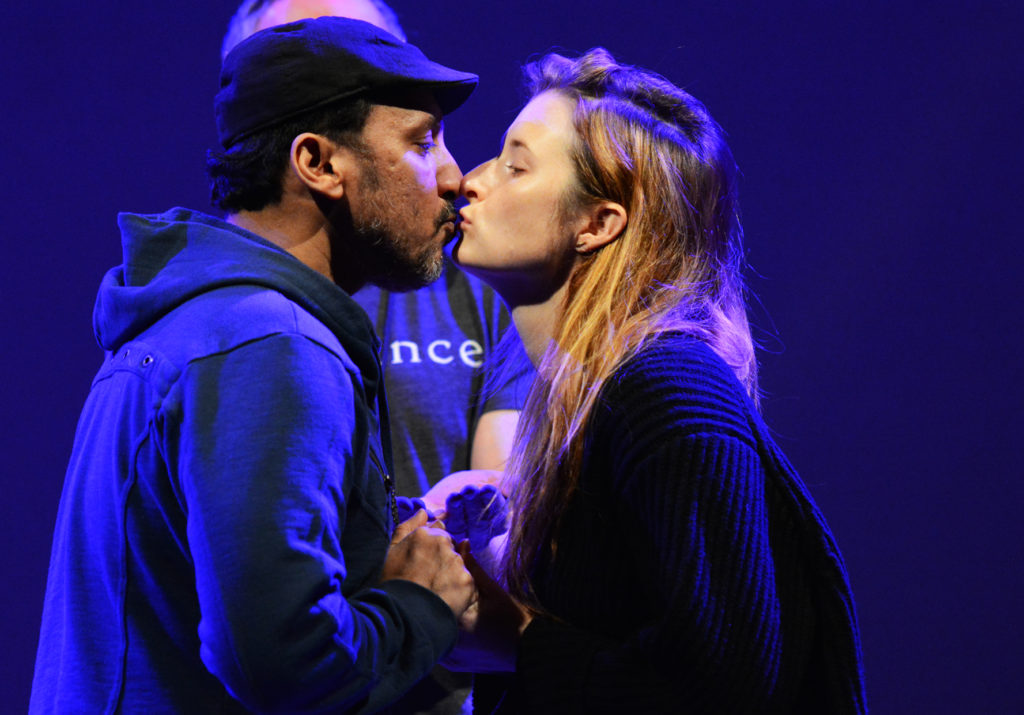
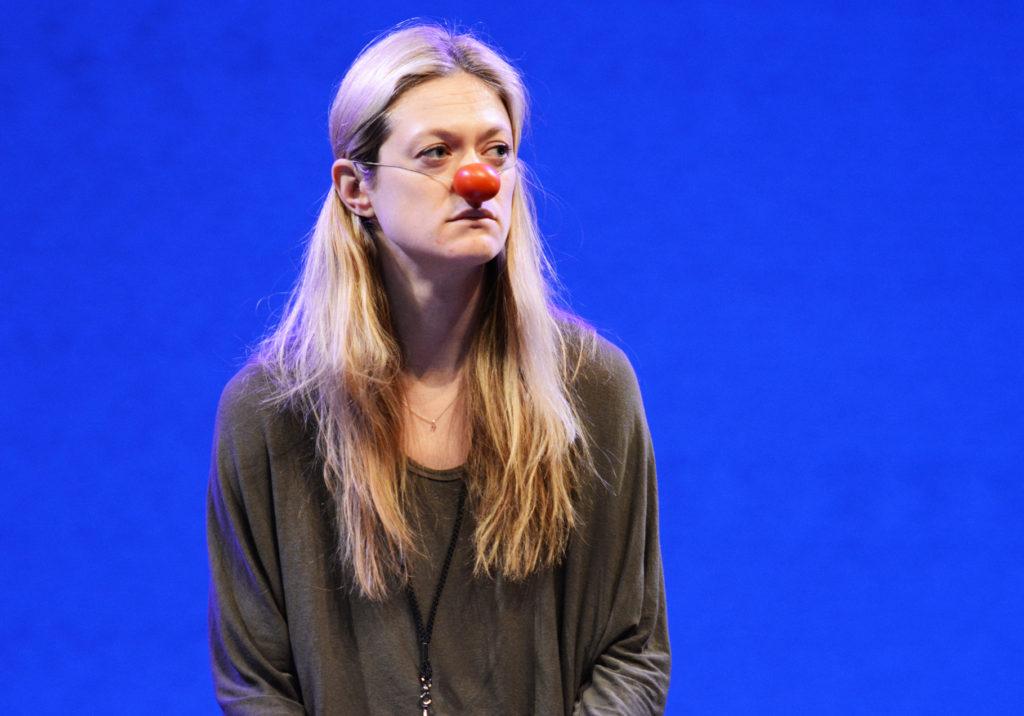
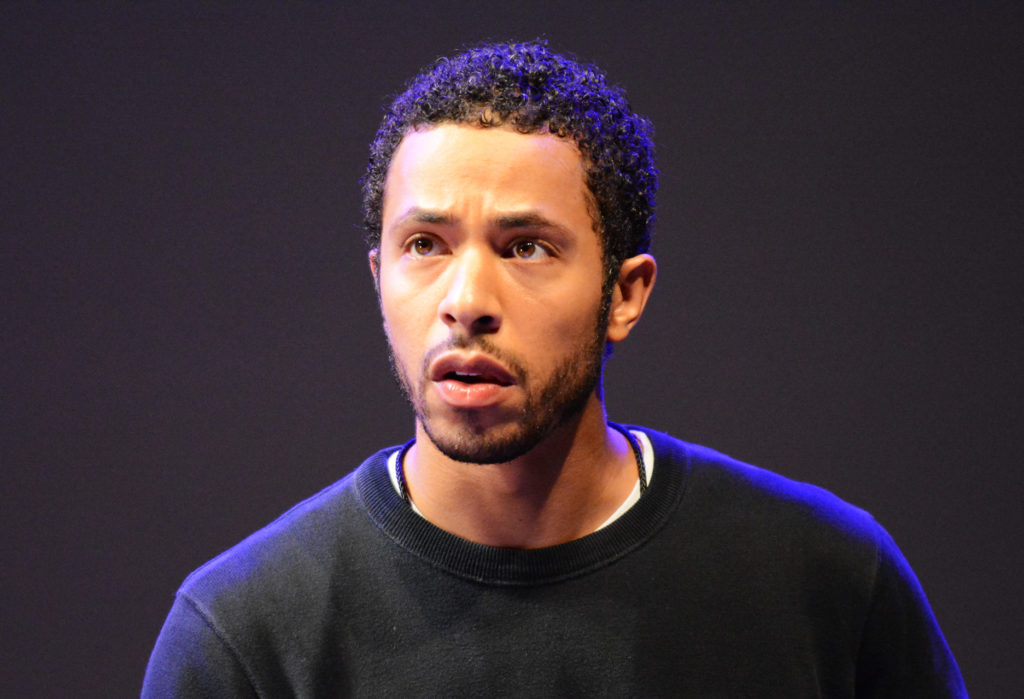
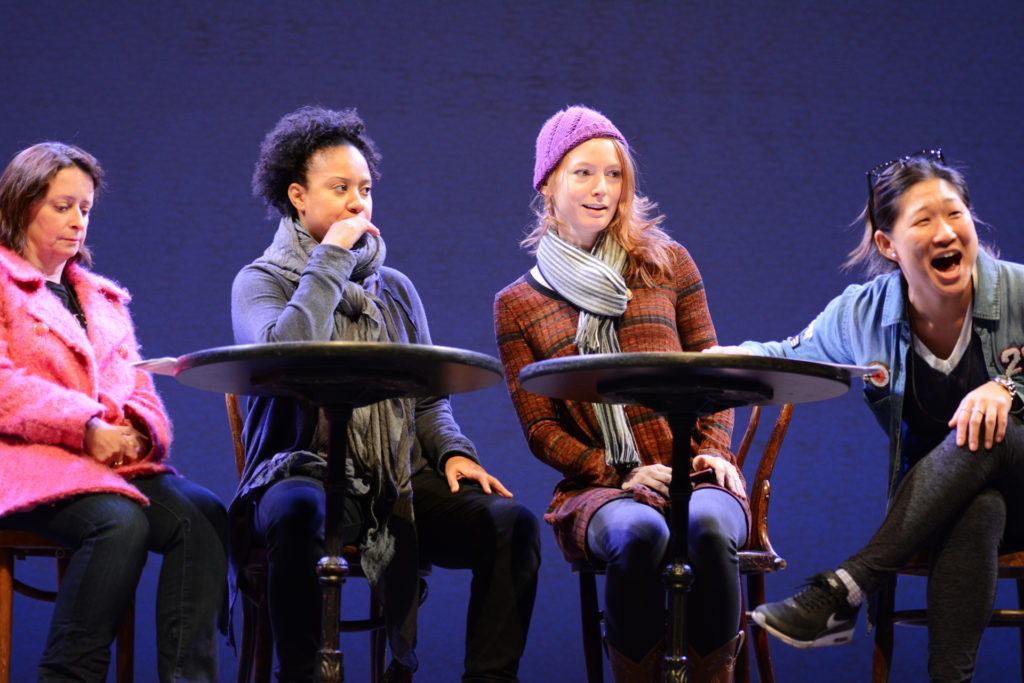
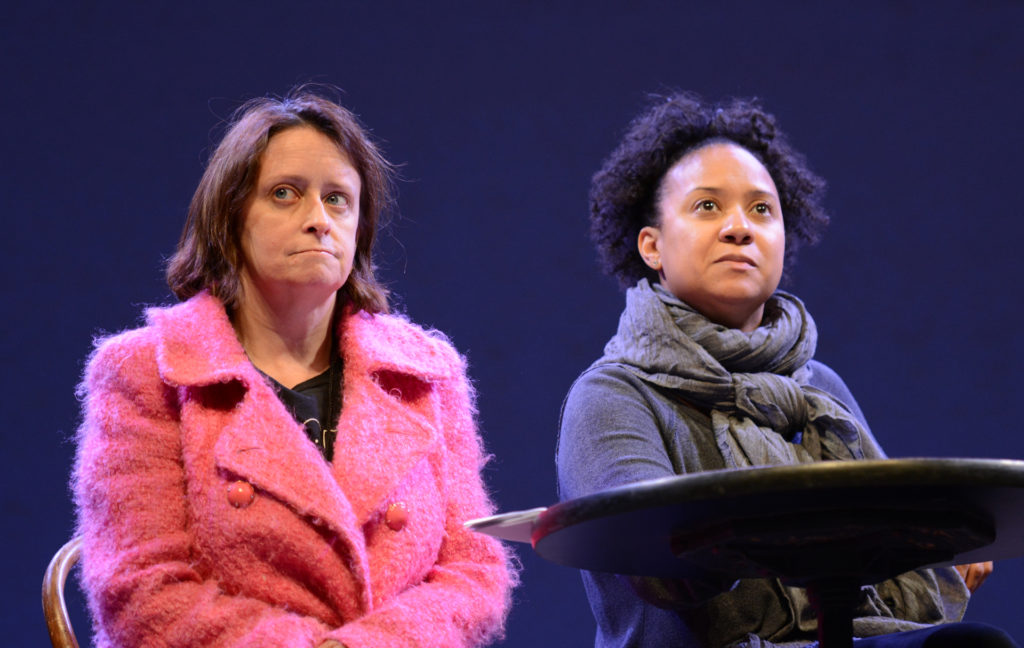
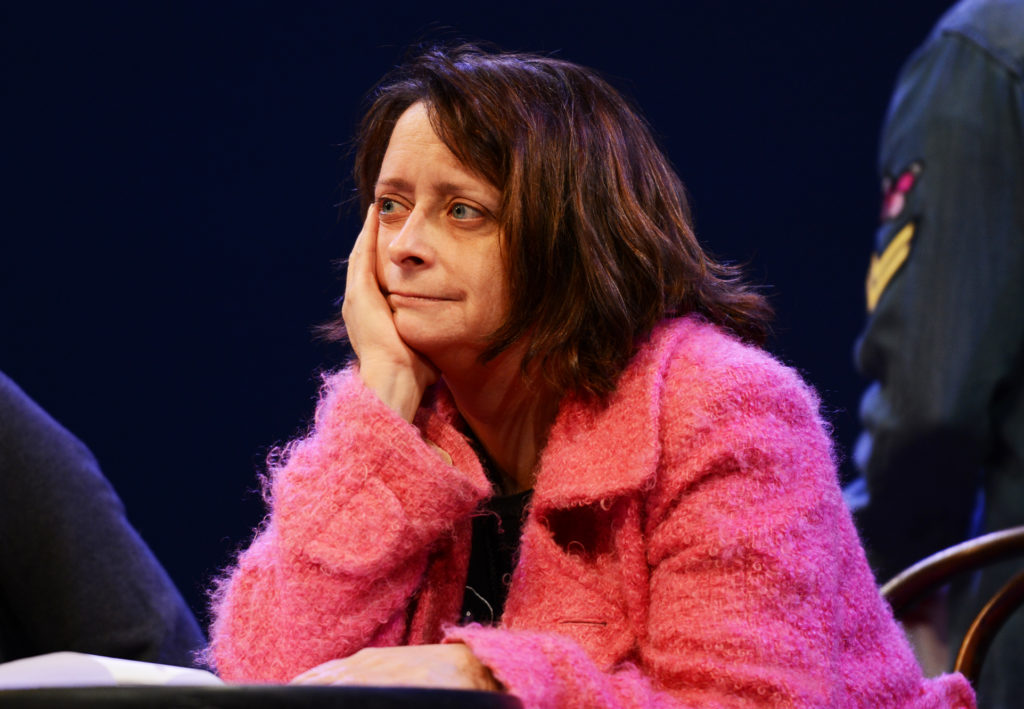
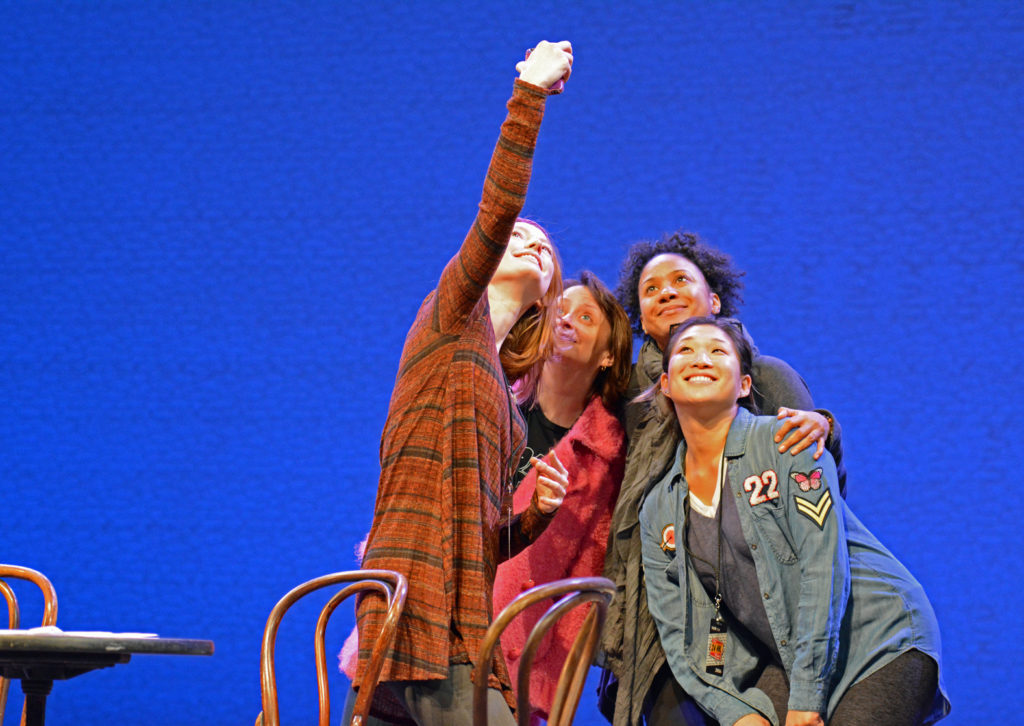
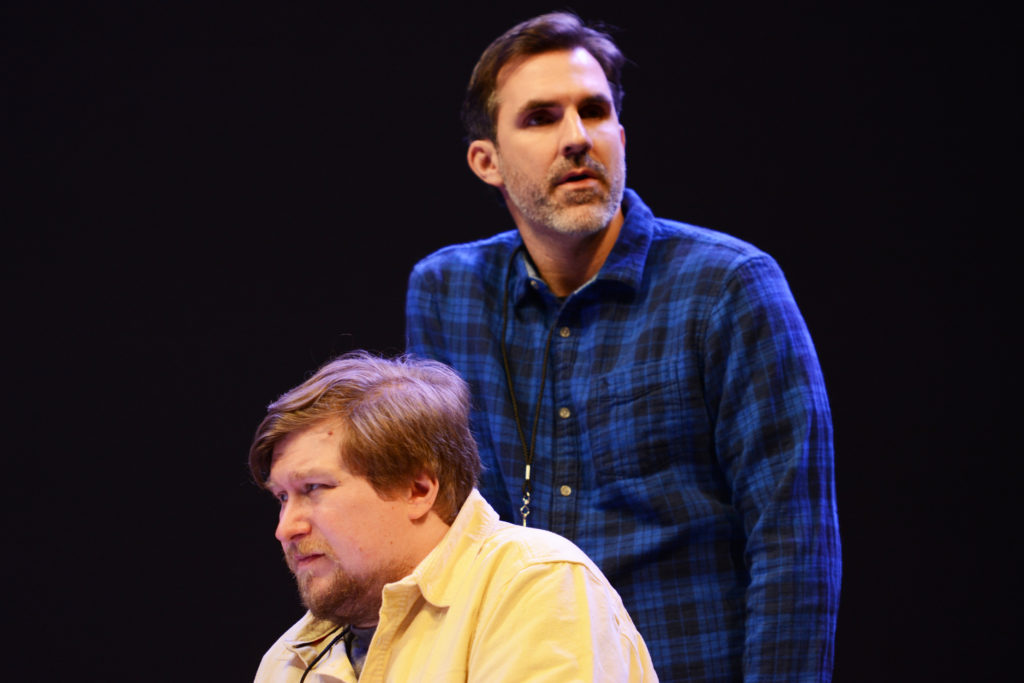
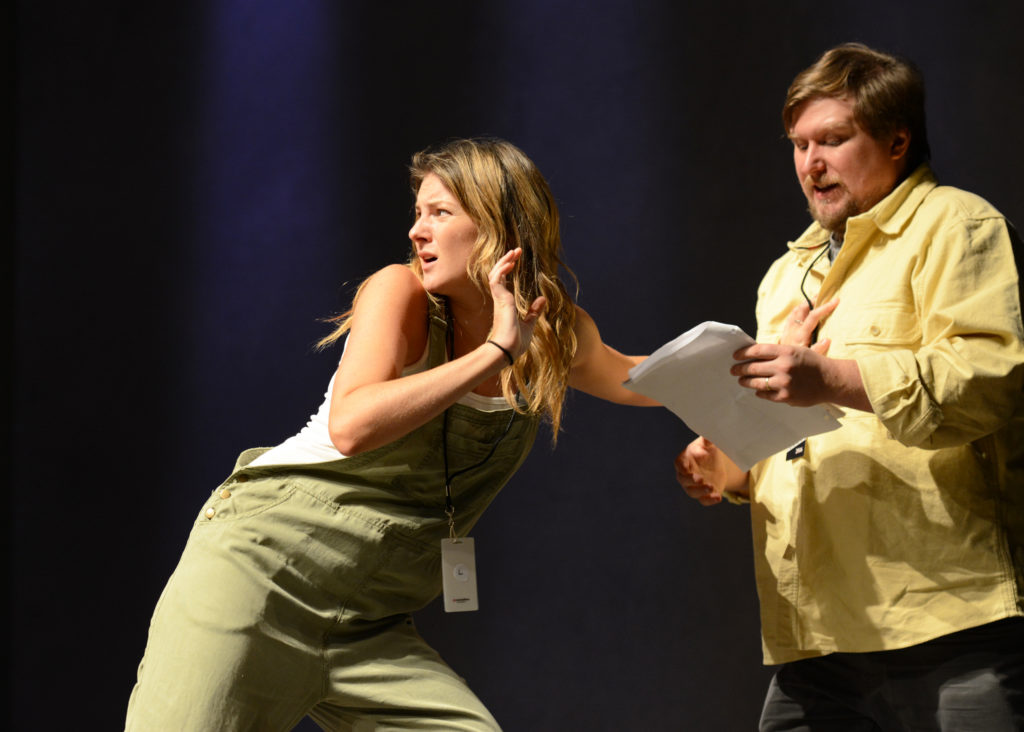
Having spent 13 of the past 21 hours embedded at the American Airlines Theatre with The 24 Hour Plays, I’m reaching my natural state of exhaustion, without the participatory exhilaration of pending performance to boost my energy. But here are images from the latter group of plays on tonight’s bill, once again with the caution that these may not be the costumes, props or lighting that will end up on stage in just two hours time.
The best laid plans: any effort to write meaningfully about being embedded with The 24 Hour Plays will have to wait. All I can manage to do is process some of the many photos I’ve taken – and share them with you even in advance of the performance.
Mind you, these are rehearsal photos, with actors wearing their own clothes, some temporary costumes and some outfits that will appear on stage this evening at 8. The lighting was in constant flux as spacing rehearsals took place regardless of whether the lights were on or off, swirling disco lights or a dedicated single instrument. So these aren’t reflective of what will be seen, but of works in progress, possibly never seen like this again.
Having long been intrigued by the 24 hour play concept, it was a stroke of fortune that when I affiliated with The New School a year ago, I was provided with office space that is shared with the official 24 Hour Plays. While we occupy the same small spot, we’re not affiliated. That said, it’s impossible for us to not know what the other is up to much of the time. In proximity, I saw possibility.
Beginning at 9 pm on November 13 and continuing until roughly the same time on the 14th, I’ve been afforded access to every bit of The 24 Hour Plays on Broadway process, to report and photograph as I see fit. At this point, late morning on the 14th, it’s quite clear that I had no idea what I was tackling, in terms of numbers, time, space, and so on. It’s overwhelming. Photographing rehearsals taking place in three different buildings? Read-throughs taking place as other shows, barely read through, are on stage doing spacing rehearsals? Writing live blog posts and editing photos while keeping up? And I certainly didn’t have the stamina to stay through the night as casts were chosen and plays were written.
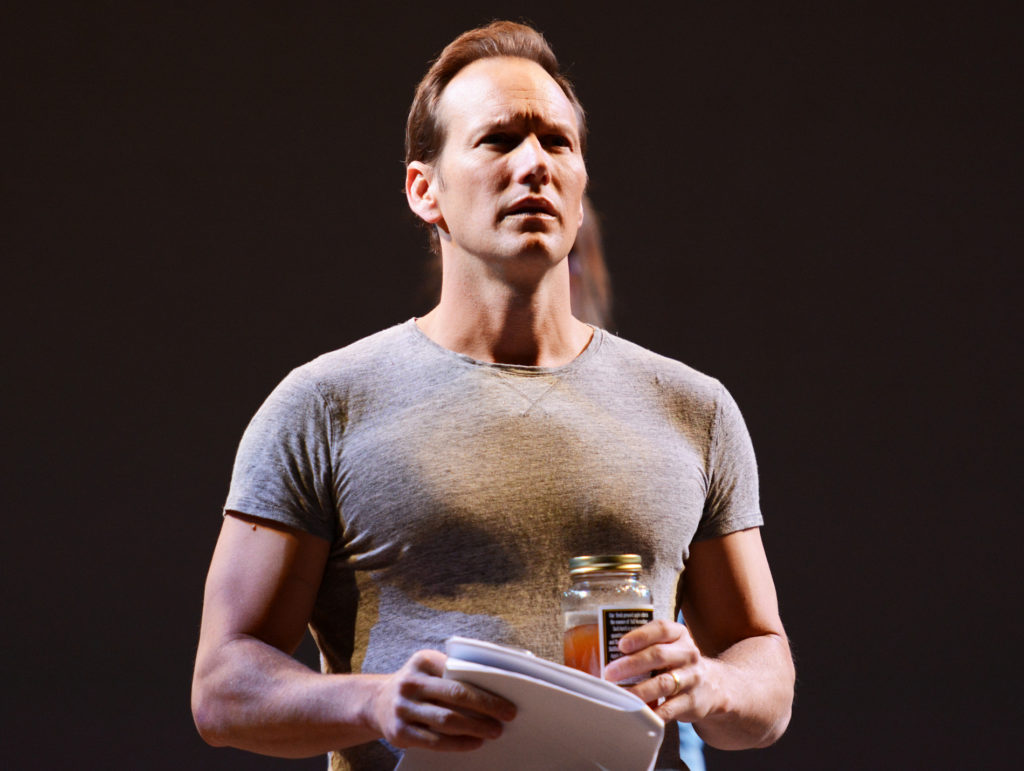
Patrick Wilson
So this first post covers only the meet and greet on Sunday evening: meetings of old friends, actors approaching other actors who they’ve always admired but never met, staff getting necessary details to facilitate the compressed production schedule.
During the meet and greet, each actor, director and playwright introduced themselves, but they had also been asked to bring a item or two to contribute to the production, and a piece of clothing as well. They were also asked if they had any special talents they’d like to use, as well as anything they’ve never done on stage but have always wanted to do. Here’s a highly selective sample of images and comments from the meet and greet, but in the order in which they were spoken.
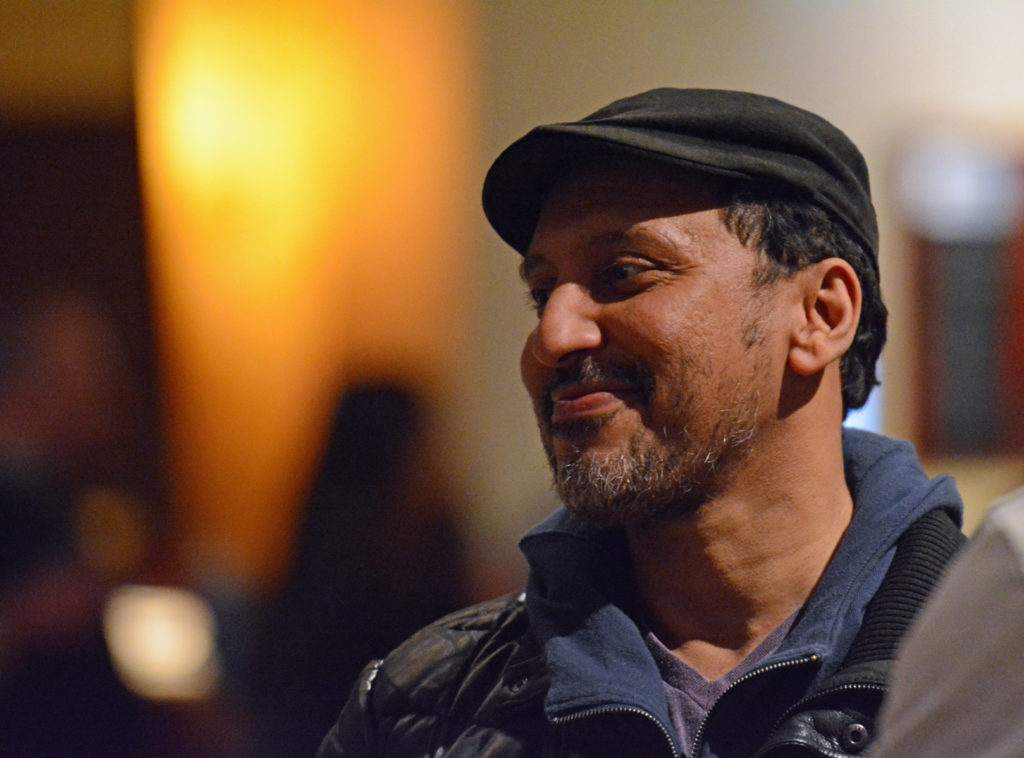
Aasif Mandvi
Justin Bartha, actor: “I can do an OK Jerry Seinfeld.”
Jason Biggs, actor: “I’m shite at accents.”
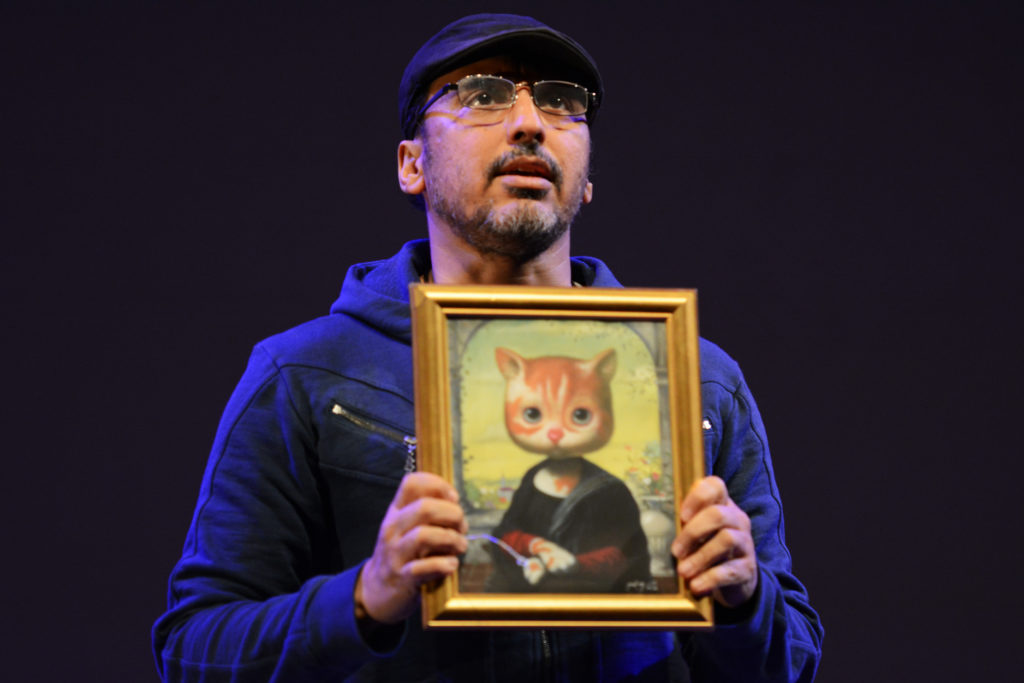
David Krumholtz, actor, contributed a framed image of the Mona Lisa with a cat head.
Hansol Jung
Joanna Christie, actor: “I just want to shout expletives.”
Paul Schneider, actor: “I’ll make you better by dancing.”
David Greenspan, actor: “I can jump rope for 20 minutes straight.”
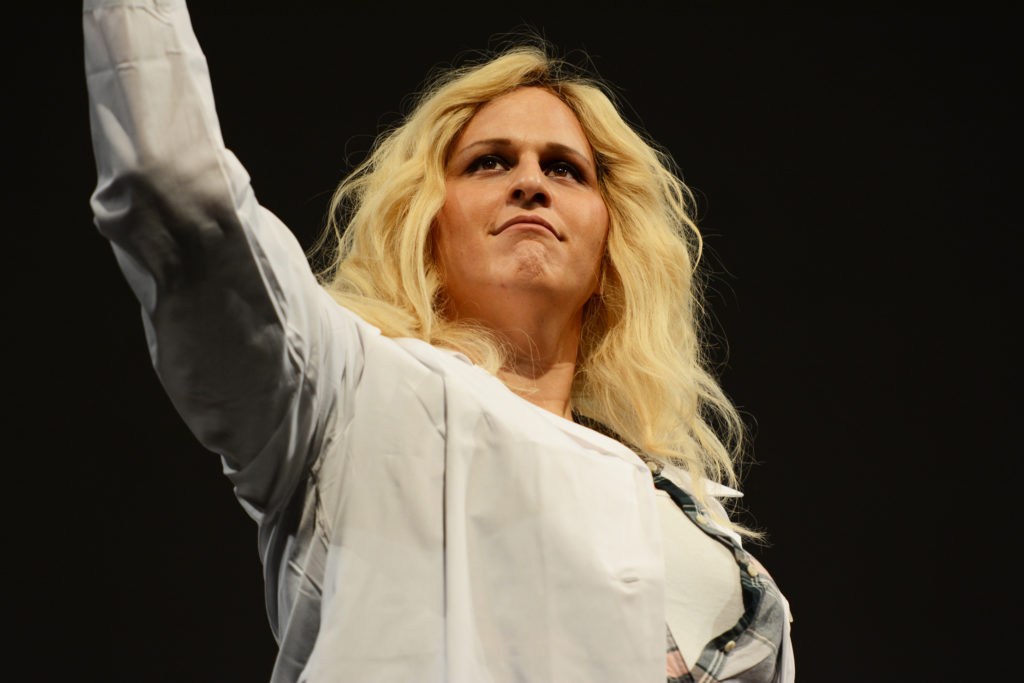
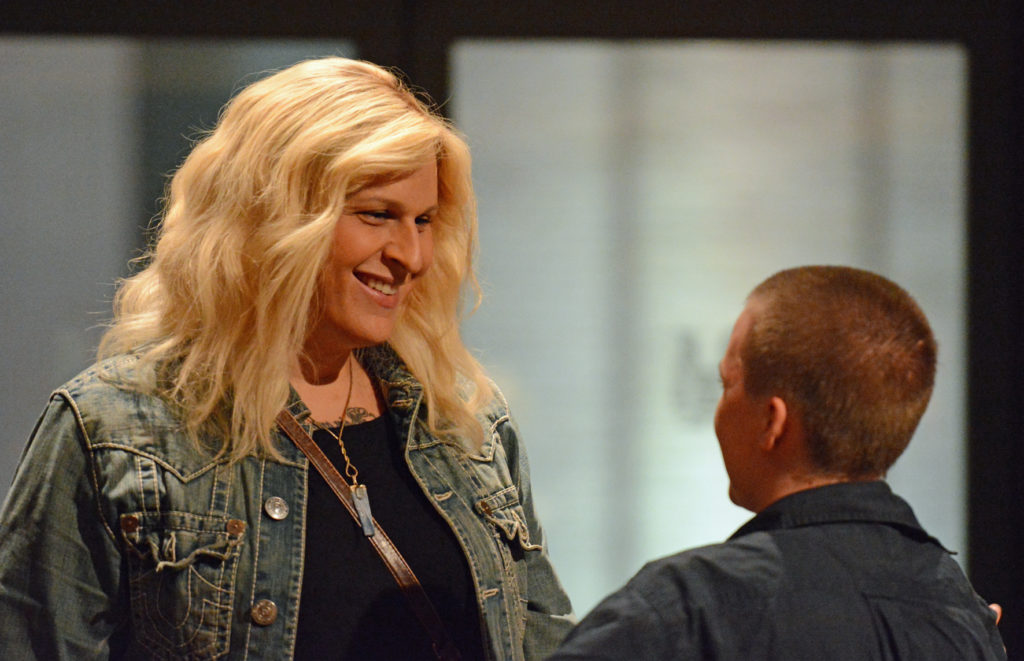
Shakina Nayfack
Michael Chernus, actor: “I’ve never played drunk, but I’m afraid of that.”
Marin Ireland, actor “I’ll take what you throw at me.”
Bess Wohl, playwright: “I didn’t know about bringing a costume, so…nudity.”
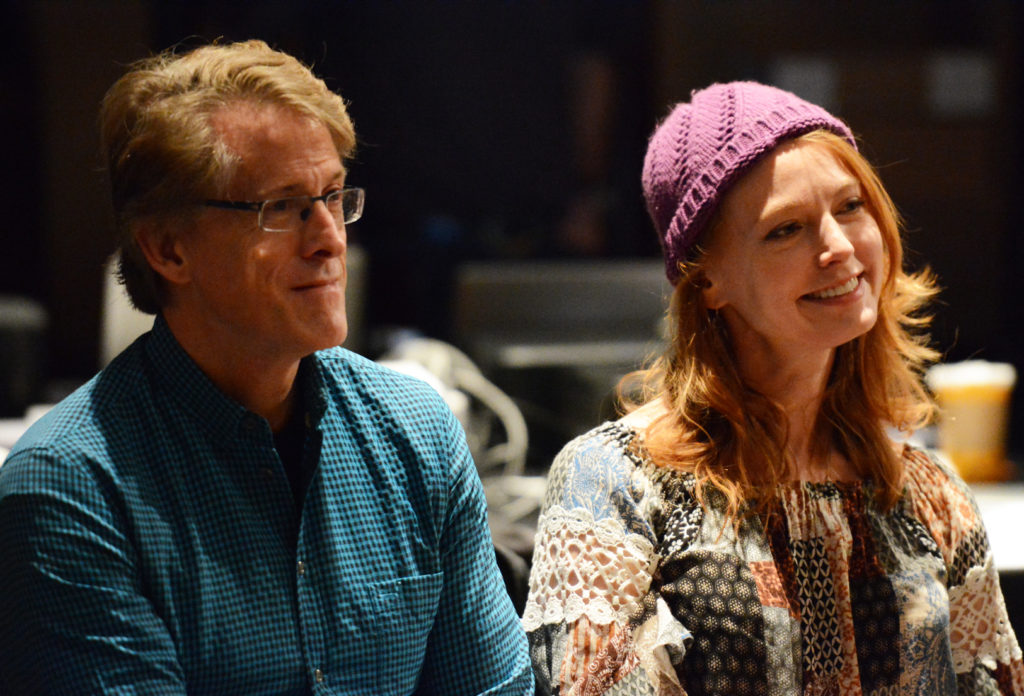
Dick Scanlan and Alicia Witt
Hugh Dancy, actor: “I’m not a bad whistler.”
Shakina Nayfack, actor: “I’m a trans woman, but I’d like to just play a woman.”
Olivia Washington, actor: “I can make shapes with my tongue.”
Christopher Oscar Peña, Patricia McGregor and David Diggs
Ukweli Roach, actor, brought a “Max onesie” from Where The Wild Things Are.
Alicia Witt, actor: “I can do whatever you throw at me.”
Warren Leight, playwright: “I was here 10 days after 9/11. We’re in the right place tonight.”
Julie White
Carolyn Cantor, director, brought a pair of angel wings.
Rachel Dratch, actor: “If you need a big dramatic moment, I’m not your woman.”
David Lindsay-Abaire, playwright, brought a giant prop meat cleaver and an evil clown mask.
Warren Leight
Genevieve Angelson, actor: “I’m really good at giving a bat mitzvah girl a speech – ‘You haftorah was amazing!’”
Grace Gummer, actor: “I brought a guitar, but I can’t play it.”
Anson Mount, actor: “I’ve always wanted to play Joel Osteen…he is smooth. Or Rasputin.”
Anson Mount and Jenna Ushkowitz
Jenna Ushkowitz, actor: “I can do a baby sound with my voice.”
Julie White, actor: “I’ve worked with a lot of fake babies.”
Michael Cerveris, actor: “I’d like to get to the end of the play with the girl, ideally alive.”
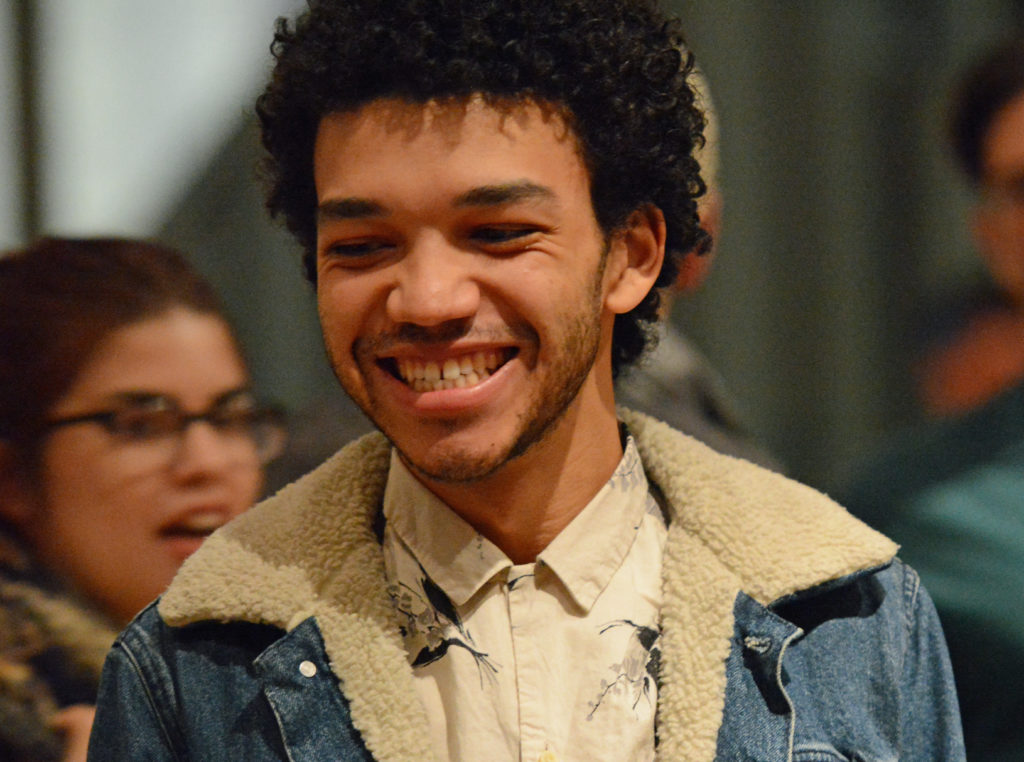
Justice Smith
Justice Smith: “I’d like to play a sociopath who falls in love, or an old person in a young person’s body.”
Christopher Oscar Peña, playwright, brought a Marge Simpson rubber duckie.
Patricia McGregor, director, brought an hour-old piece of fried chicken.
Olivia Washington
Daveed Diggs, actor: “I fall really well.”
For rehearsal photos of plays by Warren Leight, Christopher Oscar Peña and Jonathan Marc Sherman, click here.
For rehearsal photos of plays by Hansol Jung, David Lindsay-Abaire and Bess Wohl, click here.
How to describe how I’ve felt this week? In approximate order: anxious, worried, heartsick, afraid, resolved, exhausted, embraced. But it wasn’t until this morning that I felt something that made me break into a wide grin, while sitting alone in an office watching YouTube.
It is well known by now that I am a Hamilton partisan, and exist unofficially at the fringes of show’s orbit due to my near-obsessive recordings of the outdoor #Ham4Ham shows. As a result, people constantly share articles and videos about Hamilton with me – and even with those and the ones I see on my own, I’m sure there are plenty I miss.
So when I clicked play this morning, on a video sent by a friend I’ve known since we started going to religious school at age five or six, I expected something sweet and well meaning, but probably a bit forced and amateurish. Yet as I said, I started smiling and then downright grinning as it played. And that’s no small achievement, because the video was obviously set within a synagogue, and I have had a complex and difficult relationship with my faith since I was young, and it was exacerbated by my mother’s death 12 years ago.
Whatever my intellectual feelings may be about my extensive religious training, I remember so many of the prayers and songs and, at times of loss, I still take comfort in the ritual and the words, both in Hebrew and in English. So this resetting of “Adon Olam,” the closing hymn at many Jewish services, to the tune of “You’ll Be Back,” was so unexpected and well-done that my only response was surprised joy.
Now I understand that many people who see this might say, ‘Well, I’m not Jewish’ or ‘I don’t speak Hebrew,’ and want to move on. Well the fact is, while I can repeat Hebrew words that have been recited to and by me for decades, I don’t speak Hebrew either. On those occasions now when I do find myself at a service, typically for bar and bat mitzvahs and for funerals, I have to look at the English translation every time if I want to know what I’m saying.
Here’s a bit of what “Adon Olam” says:
The Lord of the Universe who reigned
before anything was created.
When all was made by his will
He was acknowledged as King.
And when all shall end
He still all alone shall reign.
He was, He is,
and He shall be in glory.
And He is one, and there’s no other,
to compare or join Him.
Without beginning, without end
and to Him belongs dominion and power.
To use the melody of King George’s song from Hamilton puts a new spin on the prayer and on the power of a King as seen in the musical. It creates an intersection of the ancient and the present, words of unknown Jewish authorship that are centuries old with the music of a truly humane and talented Latinx man from in the heights, Lin-Manuel Miranda.
In sending the video my way, my friend asked that I share it with Lin. I will, but I want to share it with all of you too. Shalom. Peace.
P.S. Thanks to Jane Lipka Helfgott for sending this my way, kudos to Cantor Azi Schwartz, and mazel tov to Zoe Cosgrove on her bat mitzvah.
I wish that I could write a play, but I haven’t the talent. I wish that I could compose a musical score, but I haven’t the gift. I wish that I could dance, but I have neither the freedom in my body nor the discipline to train. I can sing, a bit, but only well enough to entertain myself on long car rides. So because of my deep admiration for the people who can do these things, because of how they uplift me, move me, teach me, I go to the theatre.
On this post-election morning of November 9, I am reminded that the theatre is my America, because it embraces a multiplicity of stories, of possibilities, of harsh realities and of unimaginable dreams. Its stories are the stories I want to have told, its songs are the songs I want to sing while driving on an autumn day. It is the place where I meet and commune with people on stage and in the audience, inclusive of all ages, genders, sexualities, races, ethnicities, or disabilities. I don’t look to the theatre for escape, but for engagement, which includes the potential for epiphany and joy.
Theatre is where I learn about the world, but even more importantly, the people of that world. In just the past two weeks, the theatre has taken me into the lives of factory workers in today’s Pennsylvania, into the world of Vietnamese refugees discovering America in the 1970s, into apartheid-era South Africa in 1950, where I watched a tragedy play out an inexorably as it did when I first witnessed the same story 34 years earlier. Theatre is my travel, my transport, my time machine.
Yes, I awoke today, after little sleep, in despair. Then I embraced someone I love, and while my worries were unabated, I was reminded that whatever is to come, I do not face it alone. Tonight, I will go to the theatre, and while I don’t expect that the audience will hug and kiss one another for comfort or in solidarity, we will be gathering in the collective embrace of theatre. That tonight’s show was created by a friend of 30 years duration will connect me with the work above and beyond what I might feel simply as a member of the audience. I will go to the theatre again tomorrow night, and the night after that – and then again the night after that.
It has been said that a great many works seen on stage over the past 15 years have been post-9/11 plays. That is not merely referring to the calendar, but to the mindset – that directly or obliquely, so much theatre has been grappling with that terrible tragedy. Did yesterday mark the start of a new era in the work created for the theatre and elsewhere in the arts as well? Intentionally or not, I think it did.
More importantly, I think it must. While our country is divided and we have just elected a man who stoked that divisiveness, we don’t know what’s going to come next, or what the next four years have in store. Pundits and politicians will spin their stories, but based upon the just completed campaign, it will become increasingly difficult to know the difference between truth and lies, between fact and conjuncture, between assured prediction and stark reality.
Because I cannot make art, I look to artists to interpret the world for me, in ways that go to the core of who I am, perhaps challenging my assumptions and at other times affirming my beliefs. Because I cannot make art, I have spent my life in support of it, in one way or another, hopefully helping others to create, and still more to understand it and participate in it. At times, that has required me to challenge authority that seeks to diminish the arts, to deny the arts to others, to reduce the arts to merely inoffensive diversion.
As I have watched this political campaign unfold, I have often said that I expected challenges to art, to theatre, to only increase, parallel to the political divisions that have been set into high, ugly relief over the past year and a half. With the election over and the outcome determined, I’m now all but certain that we will see creative expression targeted as we have not seen for a number of years.
No one can tell an artist what to create, or how to create it. But on this morning when so many people I admire and respect, who have brought so much into my life with their gifts, are reacting in shock and profound dismay, I turn to them and say that while colored maps and percentage points may dishearten you, we need you as much as ever, if not even more than before. We believe in you. Speak your truths for those who hunger for them. Mix the divisions of red and blue into a vibrant purple. Tell us about the lives of people we do not know, but should. And we will fight for your right to tell them and our right to see them, hear them, dance them and sing them.
The great work has gone on for many centuries. We can still learn from the ancient Greek theatre artists. Today it begins yet again. We must learn from you. Tell us a story. Lead us to a better America and a better world.
On November 4, composer Jeanine Tesori was the keynote speaker at the fourth annual “Stage The Change: Theatre as a Social Voice” event, co-sponsored by the Tilles Center at Long Island University and the Happauge Public Schools. Below are some selections from Tesori’s talk and demonstration, inevitably with the musical sections removed, and with sections condensed and edited for clarity. This represents only a portion her presentation to well over 500 area high school students. What was most striking was how much she spoke not about what she has done and achieved, but how the students in attendance can approach their lives, what they can do, and what they can achieve.
* * *
There is no difference between the world and what we bring onto the stage. Therefore, if you are in theatre, if you are in the arts, you are a citizen of the world. Your job is to reveal the thing. You are agents, and not so secret, about what the message is.
We are more alike than we are unalike. On a cellular level, if you look at the earth as a giant cell, it always wants to divide – always, always, always. That’s how cells get to be two cells – you learned it in biology, mitosis. It pulls apart and it divides. The world is going to want you to divide, however you divide it up, that is what it’s going to want you to do. Your job as a citizen, as an artist, as a filmmaker, as playmaker, as an activist, as an actor, is to unite. Press against the thing that divides us.
You are here as artists to ask how, why, when, where. Your job is about how you listen to something and find out the why. We are storytellers.
We wait to spend time with people so that they can bring their authentic self to the stage. What are the stories that we tell about other people before we wait for them to sing, or speak? What are the stories that other people think about us based on a silhouette – large, tall, small, a color, green, blue white. Immigrant, emigrant. What are the stories that we’re telling each other?
Let’s challenge ourselves as storytellers to be authentic about the stories we’re telling, the stories that we’re telling ourselves about other people. That’s one lesson about how we learn. Part of the learning is to confront a part of ourselves that we’re not so proud of. That’s the way through it.
How do we divide, how do we unite? How do we listen, how do we learn? There’s a way that we can unite, and the way is often really surprising.
* * *
Theatre will never die because stories will never die. You can have film – and I love film, film is amazing – but it does not require your presence in order to be. Theatre requires participation.
* * *
Poems for me aren’t lyrics. There’s a difference between a poem and a lyric. I think it’s because a poem exists on its own, it doesn’t need anything. A lyric is helped by music.
* * *
When I get a script, I try to understand why do I have to write it. Those things we were talking about are the questions I ask myself. Why do I want to spend five years? It’s why it’s really good to look at your life, be the author and the authority in your life, because you’re writing it. You self-assign everything that you do, you do for yourself in the way that your teachers [do], you end up teaching yourself. That’s what’s going to end up happening. That started happening with me. I started diagnosing things and asking myself first, why should I write it, what’s in me to write it, and why should I spend five years of my life on it?
Time is the only thing we run out of, and I’m really aware of it now, just because of my age I’m super-aware of it. So I want to be aware when I look at a story and I think, why am I writing it, why should I write it, what do I have to give to it? What is the metaphor?
The metaphor is the thing that makes us more alike than different. It’s what I call the mom clause – it’s why my mom would care. When I write a show I hope my mom will come and be moved by it. Why would she find it funny? My mom is not in theatre, she doesn’t understand, she still asks me what I’m directing. That’s what I really use. I use that idea of why would a really large group of people, why would they want to come see this?
That’s what I would ask you to ask yourselves: what is interesting about this article, what does this article make me feel, what do I have to say about this article that reveals who I am, because you know what? You are unlike anyone else. I know that sounds so ‘poster in a ninth grade classroom’ but it’s really true. No one else is going to write that piece like you’re going to write it. You’re going to write it in a certain way. So that’s really the question: what do I think? What makes me me? I know that all of this sounds so cornball.
Jerry Garcia of the Grateful Dead, look up some of his quotes, he had the most amazing quotes. He said don’t be the best, be the only person who does what you do. So it’s not about competing or comparing what you’re doing to that other person. It’s about taking what it is, that whoever you believe in, the divine spark I call it, you can call it something, bring it all to that essay, to everything that you do. The answers will be surprising then.
Make it yours, that’s the first thing. The second thing is: write bad ideas down. Don’t not write the bad ideas. The bad ideas are the gateway drug to the good idea.
New York, NY, November 3, 2016 – Music students at The Juilliard School gave a well-received sunrise performance – “God Loves Jazz” – this morning on West 65th Street, on the eastern side of the entrance to the storied performing arts academy on the Lincoln Center campus. Their instrumentation included brass, wind and string performers. The Juilliard contingent was joined by students from the nearby La Guardia High School for Performing Arts, who added vocals to certain musical selections, which included “The Star Spangled Banner,” “Amazing Grace,” “When The Saints Go Marching In” and “Take The A Train.”
Almost as if to disrupt the spirited, seemingly spontaneous concert, a trio of outlandish performance artists, purporting to represent a so-called “church,” took up a location opposite the students, on the west side of the entrance, each brandishing multiple placards quoting select bible verses and claiming that God opposes, specifically, LGBTQ and Jewish people. One wore a hoodie displaying the URL of a website which is apparently dedicated to the principle that God hates America. Fortunately, despite the strenuous yet charmless vocal efforts of the “church” group, the Juilliard performance more than overwhelmed any effort to disrupt it.
A number of New York police officers attended the performance to insure that the sidewalk would not be blocked for passers-by. To achieve that objective, the NYPD cordoned off each performance group using the often-seen “bicycle rack” dividers. The three “church” representatives, who seemed to revel in their one-note portrayals, were spaciously accommodated with room to spare in their pen. The Juilliard/La Guardia contingent grew sufficiently large that the police obliged them by twice expanding their area, which was initially equal in dimension to that provided to the “church,” and still other students massed outside of it. At its peak, roughly five dozen people were in the Juilliard performance space.
A highlight of the Juilliard set was a new arrangement of a vintage pop tune. Quite remarkably, sheet music revealed that the piece was titled in tribute to the so-called church, almost as if the simultaneous performance was expected. Its name: “Rick Rolling The Westboro Baptist Church.”
The students may well have been missing class or giving up precious sleep to entertain the public, but their exuberance and skill met with great approval from those who were lucky enough to happen upon the performance. The music even inspired one Juilliard dance student to display her skills by dancing on a bench just across 65th Street from the musicians. As the for the “church,” their reactionary, confrontational act, which they have been performing around the country, could be mistaken as a parody of small minded hate group, if only there were any levity or wit to their repetitive text.
While the streets of New York are open to all for self-expression, The Juilliard students showed that they are more than ready for the appraisal of both New York residents and tourists. The competing act met with no visible or vocal approval. The ragtag performance art “church” troupe might do well to go back to where they came from, where perhaps they might find more like-minded audiences.
Addendum, November 3, 12:30 pm: I did not mean to cast aspersions on Kansas, as I truly had no idea where this “church” is actually from until I received some responses to this post. I was employing the time-worn riposte, “Why don’t you go back to where you came from?” figuratively, not literally.
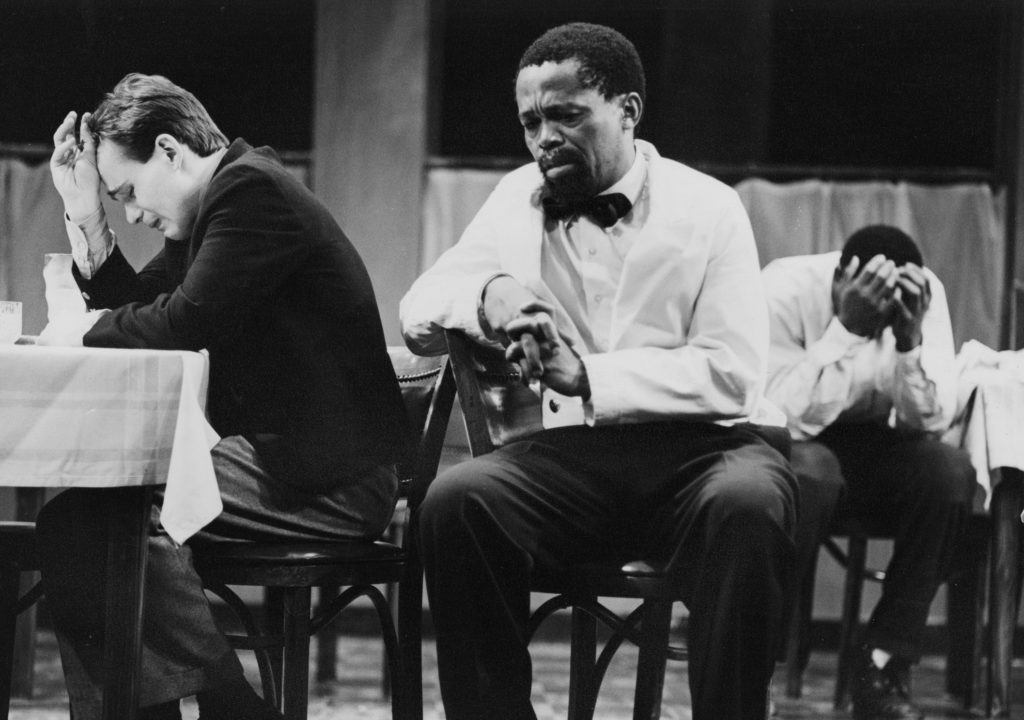
Željko Ivanek, Zakes Mokae and Danny Glover in the 1982 U.S. premiere of Athol Fugard’s “MASTER HAROLD …and the boys” at the Yale Repertory Theatre (photo by Gerry Goodstein)
After its US debut at Yale Repertory Theatre in March 1982, and before it opened on Broadway in early May of that year, Athol Fugard’s MASTER HAROLD…and the boys played a one-week engagement at the Annenberg Center in Philadelphia. During that brief run, one critic wrote of the play, in part:
Fugard, who also directed the Yale Repertory Theater production, has fashioned a play of compactness and clarity. Running without intermission for a rapid one-and-three-quarter hours, the play manages to develop and destroy this idyllic refuge for Hally while still taking time to comment on the human condition. To Fugard, life is a ballroom dance, but the humans who are on the floor are often tragically unaware of the steps.
The cast is exemplary. Danny Glover, with a minimum of dialogue, creates in Willie an admirable man whose emotions are obviously trapped by the racial system that restricts him. As Hally, Lonny Price captures the essence of a youth caught between two fathers and the pains of growing up. Price, who has replaced the explosive Željko Ivanek from the original Yale production, brings a gentle and more melancholy tone to the character of this young and misguided protagonist.
Dominating the show is Zakes Mokae as Sam. Mokae provides an ideal father figure for Hally, a man who painfully endures the insults of his “son” in an attempt to salvage the boy’s self-respect.
I recall this review distinctly because I wrote it. I also remember fighting angrily to insure that it appeared in The Daily Pennsylvanian, my college newspaper, because having seen the original run at Yale, I believed Master Harold to be a major work of theatre that students should know about. However, because my actual “beat” was writing theatre and film reviews of activities off-campus for the weekly entertainment magazine, 34th Street, shows at the on-campus Annenberg Center were the purview of others – though no one had asked to or been assigned to cover Master Harold. In some ways, it was a conflict of interest for me to write about Annenberg shows, because my work-study job was in the box office there, and in addition I had taken over running the Center’s post-show discussion series.
My fight to write about Master Harold was less because I was so eager to opine on it, but because I thought better me than no one. That’s not to say the play was struggling up from obscurity. On the same page where my review appeared there was an ad for the production, noting positive reviews by, among others, Frank Rich and Mel Gussow of The New York Times, Jack Kroll of Newsweek and Douglas Watt of the New York Daily News. But I doubt many Penn students at the time, even the theatre crowd, had read those.
I met Fugard that week in 1982 when he was on campus, albeit briefly, when I led a post-matinee discussion with him (two years earlier, also at Yale Rep, in a fleeting opportunity for me, he had signed my copy of A Lesson From Aloes). The event was to a degree derailed, first by the retirees in attendance, who used the opportunity to chastise the many high schoolers present for their inappropriate behavior during a pivotal moment in the play. Then more responsible students then took offense and spoke out to distance themselves from their less mature peers. Let’s just say I had no quality time with Athol on stage or off, as he disappeared immediately after the talk, which had squandered his presence.
It would be 28 years before I had the opportunity to speak with Fugard again, occasioned by my podcast “Downstage Center.” I had long wanted to talk with him, to revisit the Master Harold that I had seen both in New Haven and Philadelphia, and later on its national tour. Despite the fact that Fugard continued his relationship with Yale Rep into the latter part of the 80s, even as I began to work at Harford Stage, our paths never crossed, until October of 2010 for the podcast session.
Based upon what I had seen in 1982, I had been harboring a long unanswered question. However, what I wanted to discuss was so specific, that I didn’t bring it up during the 65 minute interview (which you can listen to here), because so few listeners might be interested. But once I turned off the recorder, I finally had my chance. I asked Fugard if he minded answering a very particular question almost three decades on, and he generously encouraged me.
As it was widely acknowledged, at the time and ever since, Ivanek could not stay with Master Harold because he was already committed to appear in a movie, The Sender, his first significant film role. Lonny Price, as he told me himself both back in 1982 at the Annenberg Center and again when we met as adults years later, had gone into the show with only 10 days preparation.
But as I intimated in my review, there was a shift in the play with the change from Ivanek to Price. Specifically (and if you don’t know the play, you may want to stop reading now), at its climax, Hally (as Harold is called throughout the play), spits on Sam, his surrogate father, and the two must confront the anger and shame that brought them to that moment and its aftermath. The play ends relatively quickly thereafter, with Hally making an emotional departure from the tea room where the play is set.
“When Željko played the role,” I related to Fugard in 2010, “it felt to me like there had been an irrevocable break. That Hally had become his father, embittered and racist, and that his friendship with Sam would never be repaired. With Lonny in the role, the moment seemed to be one that was more ambiguous, more confused, and even though he stormed off, you had a sense that they might work things out. Was that,” I then asked, “simply the result of the differing nature of the two actors, or was it a change in the intent of the moment and the play?”
“Well, the second way is truer to what really happened,” Fugard explained. As he had said previously in interviews over the years, he was Hally and there was a Sam. However the actual incident had taken place when Fugard was younger, a pre-teen, as opposed to the older teen as portrayed in the play. “We did become friends again,” he said.
“But,” he mused, “what you say is very interesting. Because what we ended up showing may have been the truth, but what you saw originally may have actually been the more dramatically interesting choice. I didn’t necessarily see it, because I knew what happened and that’s what I wanted to show. But perhaps I missed an opportunity.” And with that, since I had already kept Fugard past my allotted time, he was whisked off to some event where he was slated to put in an appearance.
I tell this story in part because while my question was birthed in 1982, it was with perseverance and luck that I was able to get an answer in 2010 – and because that’s an awfully long time to walk around with what was, in essence, a burning dramaturgical inquiry. But I also tell it because, for the first time in some 30 years, I’ll be seeing MASTER HAROLD…and the boys later this week at Signature, in a production once again directed by Fugard. Having seen it so often, and done so well, in the first half of the 1980s (including with James Earl Jones as Sam in the national tour), I have shied away from subsequent productions – and I wasn’t yet living in NYC when Lonny Price directed a revival for Roundabout in 2003. I’ve also never seen the TV version with Matthew Broderick, John Kani and Mokae from 1985 or the 2011 film (directed by Price) with Ving Rhames and Freddie Highmore.
It is now six years since I interviewed Athol, 34 years since I first saw Master Harold, and a few days before I see the play again. Perhaps Athol will be lurking at the back of the house, since I’m seeing a late preview; even if he is, I doubt he’ll remember me after our three brief meetings spread over so many years. I find myself wondering about what Hally I’ll see: the one who eventually reconciles with his friends or the one hardened into racism fueled by apartheid, or someone in between. But no matter what, I’m ready to spend an afternoon in the tea room with Willie, Hally and Sam, all of whom were theatrical mentors to me, teaching me how much one actor, and a shift in emphasis, can so change a play.
To be clear from the very start, two points. Judi Honoré, the owner of Shakespeare Books & Antiques in Ashland, Oregon, has every right to display anything she chooses in the window of, or for that matter anywhere in, her store. The Oregon Shakespeare Festival, also located in Ashland, Oregon, has every right as an organization to express its institutional opinion about events locally or nationally as it sees fit, and to align its business practices accordingly.
These rights, however, came into conflict this summer, when a window display of banned books at Shakespeare Books & Antiques, which has been in place (albeit with rotating inventory) for the past several years, was perceived by members of the OSF company as making a racial commentary about a current OSF production. Specifically, the origin of the dispute arose from the juxtaposition of an edition of Little Black Sambo to a collection of L. Frank Baum’s Oz books, while OSF was producing The Wiz, the retelling of The Wizard of Oz with an all-black cast.
The controversy has extended throughout the summer, and continues to simmer. OSF is still developing plans for a town hall meeting intended to allow members of the community to share their opinions of what has emerged from expressions of discomfort over the window display and its significant aftermath. But before that happens, on Monday October 31, Shakespeare Books & Antiques will close. So how did this come to pass, that ideals of social consciousness and free speech became seemingly oppositional positions?
* * *
For those unfamiliar with the children’s storyLittle Black Sambo, it recounts a simple, non-realistic tale of a child who is sequentially threatened by a group of tigers into parting with all of his clothes, then driven up a tree, after which the tigers fall to squabbling and end up chasing one another by their tails at the base of the tree until they somehow melt into butter, which is then brought home by the child and used by his mother to make pancakes for the family. The book, by Helen Bannerman, first appeared in 1899 in England, and has been republished and retold in numerous editions ever since.
While the original preface stated that it was written by “an English lady in India, where black children abound and tigers are everyday affairs,” some versions employ illustrations more evocative of Africa, while others conflate the two. The depiction of Bannerman’s little boy and his family has also varied widely, from relatively realistic to grossly stereotypical, with some editions employing iconography more akin to those often seen in the early 20th century American South, as also seen in a 1935 animated short based on the story.
Within decades of its appearance, LBS, while one of the relatively few children’s books with a black protagonist, was increasingly perceived as racist. Langston Hughes cited the book as being of the “pickanninny variety,” writing that the name “Sambo” was “amusing undoubtedly to the white child, but like an unkind word to one who has known too many hurts to enjoy the additional pain of being laughed at.” Even after LBS began to be removed (and banned) from schools and libraries, the name was taken up by a chain of US restaurants, started in California in 1957 as their brand, growing to more than 1,100 outlets by the 1970s before collapsing (after an attempted rebranding) in the 80s.
New editions of LBS have continued to emerge, with some making efforts to address the racial portrayals, particularly with regards to the illustrations, including some which have sought to more accurately bring accuracy to the setting of India. But the name remains a racial slur in the minds of many people, as it already was when the book was first published.
* * *
Portion of banned books display at Shakespeare Books & Antiques in Ashland, Oregon in September 2016
The context for the display in the Shakespeare Books & Antiques (SBA) window is provided by two signs. The first, shown within a frame in the display itself, reads:
BOOKS REFLECTING THE HISTORY OF RACISM IN THE UNITED STATES
Our position is that these books should still be available to read during these critical time [sic]. As Scott Parker-Anderson so eloquently wrote for the Library of Congress, “The truth about the past can make people uncomfortable, but it does not change the truth. There were slaves, they were treated horribly, and called horrible names. Those are the facts, that cannot be changed. REMEMBER, those that forget the past are doomed to repeat it.”
The second sign, affixed to the window, reads:
BANNED BY SOMEONE, SOMEWHERE, SOMETIME
We believe attempts to censor ideas to which we gave access, whether in books, magazines, plays, works of art, television, movies or songs are not simply isolated instances of harassment by diverse special interest groups. Rather, they are a part of a growing pattern of increasing intolerance which is changing the fabric of America. Censorship cannot eliminate evil, it can only kill freedom. We believe Americans have the right to buy, stores have the right to sell, and authors have the right to publish constitutionally protected material.
In a photo of the SBA window dating from the start of the dispute, two LBS books can be seen: one an edition of the original story, the second an apparent sequel by a wholly different author and illustrator, Little Black Sambo and the Monkey People. It is the former which is placed adjacent to the Oz books and a framed list of the many Oz titles. Also visible, but only by their spines, are Uncle Tom’s Cabin and a collection of the Uncle Remus stories.
Describing other parts of the display, Honoré, in an interview, said, “The Color Purple may have been there at the time, but I’m really not sure.” She went on to list the aforementioned books, as well as two copies of Huckleberry Finn and To Kill A Mockingbird.
The placement and proximity of LBS and the Oz books first came to light when four ASF company members, including actors from The Wiz company, which at the time was still in rehearsal, went to speak with Honoré in June. The accounts of the conversation given by Honoré and Ashley Kelley, one of the actors present, are fairly similar.
In Honoré’s description:
Middle of July, four actors were outside looking in my window. I didn’t know they were actors, they were just four black people. I went outside like I usually do and said, ‘Can I explain to you why any of these books are banned?’ and they said, ‘We’re actors in a play called The Wiz, which is playing here, and it’s an all-black cast and we object to the fact that you have Uncle Tom’s Cabin, Little Black Sambo, Huck Finn, To Kill a Mockingbird, these books right next to the Wizard of Oz book. Why do you have them that way? What kind of message are you trying to send?’
I said, ‘I’m not trying to send any message, they’re all just banned books. They said, ‘Well, we feel you’re trying to send some kind of a message,’ but I still don’t know to this day what kind of message I was supposed to be sending. I honestly don’t. But they saw me sending some horrible message by having them in that order. So I said, ‘Why don’t you come in and what we’ll do together is we’ll move them. If you’re that offended and you feel bad about it, we’ll move them together.’
Honoré notes that in moving the books, they were never removed from the window, but merely relocated away from the Oz books.
Via e-mail, Kelley described the encounter with Honoré as follows:
We went inside to talk to Ms. Honoré and we proceeded to have a peaceful conversation. We asked her what the inspiration was for the display and she began explaining the history of the books, not understanding what we meant. I told her specifically that I’m sure it wasn’t intentional but unfortunately the display as it stands is making negative commentary about the people in her community. Still not understanding, I explained to her that The Wiz was happening across the street which is the African American version of The Wizard of Oz.
She claimed she didn’t know there was such a version or that OSF was doing it. I told her that THAT was why we are offended by the display, the placement of these books that exploited African Americans next to the entire Wizard of Oz collection. I stressed again that I didn’t believe it was intentional but that unfortunately whether she knew or not it was making a statement. She kept defending why she had the black books to us and I in turn responded by telling her it wasn’t about the fact that she had those books and that I understand why she has them in the first place. My only issue was that they were next to all the Oz books…that’s all.
She finally understood and asked me what to do. Then SHE came up with an idea to move the books from the window and asked us if we would like to help. We said yes, walked inside with her and helped her move the books elsewhere. After that we stood with her for a while talking about her background and had a very pleasant conversation. We introduced ourselves. I thanked her for listening and for talking to us. We hugged and left her store.
After this, I sent an email to my cast to tell them about the positive experience I had with Ms. Honoré and that it was a very proud moment especially with all the horrible things happening with people of color all over the country and even in our town.”
* * *
Shakespeare Books & Antiques (from their website)
If that had been the end of the issue, with hugs, it would indeed stand as a positive moment for all concerned. But things quickly became complicated.
Ashley Kelley expressed surprise as to the fallout, writing:
It was brought to my attention weeks later that the display had been put back and that Ms. Honoré was upset with me for telling people what happened at OSF…which I didn’t understand because the email was a positive representation of her and the bookstore because we were able to peacefully talk and come to a solution. Then all of a sudden there were SO many people involved and the story seemed to shift to “we asked her to remove the books from the store.” which was NOT the conversation at ALL.
I was honestly very disappointed in how such a positive moment turned sour based off of lack of communication it seems. I was under the impression that everything was handled after my initial encounter with her. Little did I know there were more conversations, other emails, letters, etc. that I had no involvement in.
Claudia Alick, the community producer at OSF, who also chairs the company’s Diversity and Inclusion Planning Council, said in an interview that after learning of the encounter, she had discussed the conversation at the bookstore between the company members (three of whom were actors and one staff member, per OSF’s press office) and Honoré in a “healthy conversation” with Cynthia Rider, OSF’s executive director, who indicated that she wanted to speak with Honoré. Alick said she then went home to prepare an agenda for that conversation.
That same day, Rider called Honoré, asking to meet and discuss what had occurred. Honoré says that Rider said, “I’d like to discuss with you your banned book — she didn’t say banned book, she said your public window display — and protecting my staff. That was her exact language.” Honoré then describes her decision not to wait for a meeting with Rider at the store, and instead closing the shop and heading straight to OSF to ask for an immediate meeting with Rider. She ultimately met with Rider and with general manager Ted DeLong in an impromptu session. Alick had already left the OSF campus.
Julie Cortez, communications manager of OSF, relating Rider’s impression of the meeting, wrote that, “While Cynthia says Judi seemed upset when she arrived, by the end of the meeting their relationship seemed cordial.” Honoré describes the meeting as more problematic, saying, “I knew I was in deep trouble when Ted DeLong [OSF’s general manager, who also attended] said he thought Huck Finn was a horrible book.” Honoré says she was asked to remove the books from the window.
Further describing the meeting, Honoré recalled, “I said, ‘If you have a group of students and they’re really dumb and you keep telling them they’re really smart they will become smart. Vice versa if you have a group of students who are really smart, you keep telling them they’re dumb they will become dumb. If you have a sweet little town like Ashland and you keep calling us racist, it will become racist. I think the positions you guys have been taking have been incorrect.’ I don’t think they appreciated that much.”
* * *
Some may recall that Ashland and Oregon Shakespeare Festival were in the news this summer for another racially based incident, which was widely shared on social media and subsequently reported in mainstream media outlets. In that case, a man verbally attacked a black actor in the OSF company as she walked down the street, shouting, “It’s still an Oregon law. I could kill a black person and be out of jail in a day and a half. The KKK is still alive here.”
News reports indicated that the man who threatened the actress was likely a local homeless man who was known to the Ashland Police for other aggressive actions. The police determined, according to a report in the Mail Tribune, that “no crime had been committed,” even as they were “decrying this hateful speech.”
Asked about that incident, vis a vis the conversations over her window, Honoré was dismissive, saying, “One black actress was apparently yelled at by our town schizophrenic who said horrible things, but he yells at everybody, including me. If I don’t give him a dollar, he’ll say something like, ‘I’m going to kill you.’” She went on to volunteer, “They said the police officers were picking them up for no reason whatsoever, and they had to ride around in a car with a white person or they felt like they’d be targeted and get picked up. None of that is true. I mean I know our little sweet town and that doesn’t seem to happen here. And then they also said that if they go into a store and they’re asked more than once, ‘Can I help you,’ they’re being targeted for shoplifting.”
However, that incident happened in late June, subsequent to the meeting between Rider and Honoré, but before the dispute between SBA and OSF became widely known.
* * *
Immediately following the meeting between Honoré and Rider, Honoré says she went back to her store, upset at learning about the e-mail that was circulated and Rider’s original request to come to the bookstore and discuss the display. So she returned LBS to its original location in the window.
“Honestly, I felt like I was either sandbagged, slapped in the face or backstabbed, when they went back to OSF after I felt I had done something really nice for them. After I had temporarily moved it, then I put it back where it was. But that was for maybe a day, and then I thought better of it and I moved them way to the end again.”
Claudia Alick subsequently visited the store and had her own conversation with Honoré, who Alick says recounted her studies in college (Honoré attended UC Berkeley in the late 60s and early 70s, where she wrote her thesis on sexism and racism in textbooks) and repeatedly protested, “I am not a racist.”
Alick says that after listening to Honoré for ten minutes, she interjected, “I never said you were a racist. Nobody said you were a racist. Those words haven’t come out of anybody’s mouth. I just wanted to know what was the decision made, because I think that I might have a different understanding of that decision, because you put the display back and I’m confused by that. And so then there was another ten minutes where she finally admitted that she was pissed and those were her words. She was pissed at the actors for – and in her words it was for – ‘sending nasty e-mails about me.’”
In a separate interview, OSF artistic director Bill Rauch spoke to the issue of leveling charges of racism at anyone:
[LBS] is a much beloved story for many, many people, especially older people who either had it read to them by their parents or read it to their own children. That’s come up again and again and again. Some of the emotion people have felt has been that by OSF saying, ‘We do not support the juxtaposition of those original racial caricature drawings on the cover of that book being juxtaposed next to The Wizard of Oz,’ they felt that we were personally attacking a story that was a beloved part of their childhood and therefore somehow calling them racist for liking that story.
Alick says she informed Honoré that, “It’s interesting that you said those e-mails were nasty. I can share with you that it was just them sharing their own personal experience and they didn’t say anything that was negative or nasty about anyone. It was actually pretty generous and kind framing and language that was used to describe what happened.”
According to Alick, after further conversation with Honoré about how the display might prove troubling not just to artists but to any persons of color walking down the street, Honoré asked, “What do you want us to do?” Alick says she responded, “No, we’re not going to tell you what to do. I just wanted to get clarity about what you were doing. You get to decide what you’re going to do.”
Alick says she was aware of other OSF staff members having one-on-one discussions with Honoré, emphasizing that they were private, personal communications. But Alick says that, “[Honoré] started coming to the festival, and stopping people of color and – I’m going to use the word harassment – harassing them, saying ‘Aren’t you in The Wiz? Well this, this and this.’ She did the same thing to me, where she stopped me on the street and had just a really kind of gross exchange with me that wasn’t kind, that was so problematic. And so organizationally, people of color asked essentially, ‘Hey, would you please do something?’ We’re like, ‘Well, the only thing we can do is let her know privately we won’t be doing business with you. We won’t be investing in your services in the future because you’re treating our company members this way.’ It wasn’t a comment on her public display. It was a comment on her direct behavior with our company members.” She later added, “We didn’t do anything public.”
Honoré recounts writing a letter to Rider on July 18, in which she set out the events regarding the window display and all that had transpired much as described here, adding her account of a positive conversation with another OSF actor of color regarding the display, which had prompted her decision to once again shift the Sambo book away from the Oz books. She also expresses deep upset with all that has occurred, including being called a racist by someone she describes as an OSF actor. She concluded the letter by writing, “In my opinion, Ashland, and this includes our residents and our police department, are profoundly inclusive and make every effort to reach out to everyone, as are the merchants of this very special small town.”
* * *
On July 26, Rider sent the following letter to Honoré:
I am in receipt of your letter of July 18 describing your recent experiences with OSF staff and actors regarding your display window.
For myself, my colleagues in senior management, and those most deeply involved in the work of expanding diversity, equity, and inclusion here at OSF and in Ashland, the most important facts, which you allude to in your letter, are as follows:
You received feedback from various OSF staff members, who are by definition your fellow community members, that your window display that included blackface caricatures was hurtful and offensive due to their racist origins.
You removed the display.
You heard reports that emails were circulating at OSF regarding this chain of events, and decided to reinstall the display.
Through these events, you have demonstrated a distinct lack of empathy for the experiences of the people of color who brought this matter to your attention and their reactions to your display, and reinstating the display caused continued pain to those individuals and by extension to the Oregon Shakespeare Festival.
Because of this, I am by this letter informing you that Artistic Director Bill Rauch and I have given instruction to our staff not to patronize Shakespeare Books & Antiques for any Festival-related goods or services until further notice.
* * *
On August 4, the dispute between Honoré and OSF went fully public, in an article in the Daily Tidings (reprinted the following day in the Mail Tribune), resulting from Honoré sharing Rider’s letter with the paper. This marks the first time the word “boycott” appears to have been used in connection with the situation. The article also mischaracterizes Rider’s letter as a “ban on OSF staff purchasing items from the store,” instead of the actual language, which only proscribed staff from making purchases on behalf of OSF at the store. This occurred despite the article later quoting a letter to the editor from Rider and OSF artistic director Bill Rauch clarifying that they had not called for a boycott. But that became the prevalent narrative for the ensuing weeks.
While various letters to the editor played the dispute out in the local papers, as people took sides, the next major account of the situation came slightly less than four weeks later, when on August 30, the Daily Tidings reported that Honoré had decided to close her store, giving two months notice to her landlord for a closing on October 31. Honoré attributed the closing to a significant drop in business in the month of August, as well as the stress of responding to the conflict that had arisen with OSF. She said that in contrast to typical summer months, when her business averaged $20,000, her first 12 days of August yielded on $2,355 in sales and that on August 22, her total sales were $59.
In that article, the reporter John Darling included a statement from OSF, quoting it as follows,
If Judi is seeing a reduction in her business, that is either occurring for unrelated reasons or due to her decision to go public in the media and in her store windows,” the email said. “Given that OSF has only made one or two small purchases for Festival use at Shakespeare Books & Antiques over the years, the decision … was not about causing Judi financial hardship, but about communicating to our colleagues of color that we believe them and stand with them.
While Honoré in an interview described a seemingly dictatorial rule by the leadership of OSF over its staff (“She tells them what to do over there apparently and they do it,” Honoré said, referring to Rider), she was not able to provide any evidence that the OSF staff had been ordered away from her store for personal purchases. She affirmed that OSF had not revealed anything publicly about its communications with her, saying “They didn’t go public, I went public, and they’re calling the conversation I had with them a private conversation. Nobody told me that it was private.”
OSF shared with Arts Integrity a short memo they had given to “front line staff” to help answer questions from patrons about the situation, but the theatre’s first sustained public communication to the community, signed by Bill Rauch, headed, “A response to the ‘bookstore story,’” wasn’t issued until September 2.
It read, in part:
OSF has never sought publicity or media attention for its ongoing discussions with Judi about her window display. We intended privacy for all of our communications, written and verbal, prior to Judi reaching out to the Ashland Daily Tidings (a publication for which Judi’s husband is a columnist). I would like to emphasize that not once has anyone at OSF called for a public boycott of Judi’s bookstore. Our employees are, of course, always free to shop anywhere for their personal purchases, and before today we had never brought up this subject in any communications with our patrons or membership.
I stand by our decision not to do business with a person who has treated members of our company and community with disrespect. Since Judi went public about OSF’s decision, we’ve received numerous reports from staff and patrons about problematic and insensitive interactions in and outside of her store and on the OSF campus. Our attempts to continue the dialogue with her—with a mediator, if she would prefer—have gone unanswered.
Separately, Honoré said that she had asked Rider to visit the bookstore – Rider’s original intent in requesting a meeting with Honoré – but that Rider declined.
In the next to last paragraph of his community letter, Rauch wrote:
Free speech is necessary, but not all speech is neutral; all language, images and symbols are not equal. The fact that speech can be damaging must be acknowledged. As an institution and as individuals, how we use our right of free speech is a moral choice. It is not neutral to propound messages that deepen the isolation and oppression experienced by members of groups that have been historically marginalized. Propagating images that were historically stigmatizing to black people and that some people continue to experience as hurtful and stigmatizing is not a neutral act. In my view, we grow most when we listen with empathy and curiosity to all those who are different from us about their own life experiences.
* * *
It’s worth recalling Ashley Kelley’s comment about what has transpired in Ashland, “I was honestly very disappointed in how such a positive moment turned sour based off of lack of communication it seems.” In conversation and written material, both Honoré and the OSF leadership expressed the feeling that each “side” was not listening to or understanding the other. That is the very definition of a lack of communication.
The situation escalated not because of the conversation between the four company members and Honoré, but only when Rider asked to arrange to meet with Honoré, who then opted to precipitate an immediate conversation. Rider perceived that meeting as having begun in conflict but concluding well, however Honoré’s takeaway was both frustration with Rider (who she called “elitist”) and anger that the conversation about the window display had gone beyond herself and the four actors, causing her to reverse the results of that meeting.
While the original conversation between Honoré and the four company members, and the meeting between Honoré and Rider, occurred first, the late July exchange of letters between Honoré and Rider occurred after the incident in which a black actor at OSF was verbally abused. An atmosphere of concern over the treatment of people of color in Ashland had been heightened as the bookstore dispute played out over a number of weeks. As in all cases, a specific event shouldn’t be the pretext for diminishing the rights of others, but the bookstore situation was thrown into sharper relief by the intervening incident.
Bill Rauch noted, “I do think that for members of our community who feel Ashland is such a progressive community, that there can be no racism in our town, that if a person of color says they’ve experienced racism in our town that it’s the problem of the person of color, that they’re oversenstitive, that they’re being overly cautious and that the racism is not real. I think the juxtaposition of these things has triggered a lot in terms of the community response as well.”
Honoré cites Rider’s letter of July 26 as having prompted the precipitous drop in her business, claiming that other internal e-mails, which she could not produce, went beyond Rider’s instruction that staff should not do business with Shakespeare Books and Antiques. However, when she by her own admission went to the press for the story that first appeared on August 4, there was no mention of any impact on her business, only her unhappiness over what she characterized as a call to boycott her store.
Reading Rider’s letter carefully, one could argue that the language about ceasing to do business with SBA might have been somewhat differently structured. If one doesn’t read the entirety of this closing phrase – “I have given instruction to our staff not to patronize Shakespeare Books & Antiques for any Festival related goods or services until further notice” – one might only take away “given instruction to our staff not to patronize.” A statement affirming staff members’ own unfettered right to patronize the store would have been useful.
But regardless of how the letter was read, it was internal to OSF, yet Honoré says it resulted in a roughly 85% drop in business. If the staff of OSF was Honoré’s overwhelming customer base, then regardless of whether one agrees with the request to alter the display, Honoré’s choices influenced the purchasing decisions of her customers. In seeing the situation as one of social consciousness and sensitivity, OSF was well within its rights ito decide what vendors it chose to do business with, and that wasn’t a secret within the organization.
Honoré claims that in her one meeting with Rider, she was told, “Take the books out of your window or we’re going to boycott your store.” Rider denies having made such a statement. Asked whether her communication regarding OSF-related purchases wasn’t in fact an implicit message to the OSF community to not patronize the bookstore, Rider said, “That certainly wasn’t my intention.”
Was OSF advocating censorship, which presumably they would fight were such an effort directed at their own creative work? Given that they had no control over Honoré’s store, it’s hard to accept that they were, especially since the conversation only was about the placement of the books, not over whether Honoré should carry them at all. OSF was advocating to Honoré, according to their institutional imperatives and as a part of the Ashland community, sensitivity to members of the OSF company – both full time staff and guest artists – that escalated over a communications impasse. Rider observed, “Freedom of speech doesn’t mean you get to say whatever you want and nobody can tell you they’re upset about it.”
Because so many of the interactions within this dispute were person to person, it is difficult to pin down many absolutes, especially since the different parties offer differing impressions of the same event. In the fraught communications, it’s unfortunate that one possible rapprochement doesn’t appear to have been discussed. Might it have been possible for SBA and OSF to collaborate on further contextualizing the window display, so that it was clear the presence of LBS (and books like the Uncle Remus stories) was not to advance racially negative text or imagery? While Honoré absolutely has the right to display any books as she wishes, and there is no question that the books she displayed have all been officially censored at one time (or many times), a store window is not a museum or school, where history and education about featured items would usually be more fully explained.
While Shakespeare Books & Antiques will close on Monday, Honoré said that she does plan to reopen, after resting up from the stress of the past few months and getting a new business of hers, a furniture store, fully up and running. Saying that she has three times as many books warehoused as she was able to display in the shop that’s closing, she said she’d be back in a larger space. She felt some distance would put an end to the many people who were coming into her store to discuss the dispute with OSF, but not making purchases, noting that business only began to pick up when she announced she was closing.
As for further dialogue in Ashland through a town hall, which at one point was considered for Saturday, October 29, Julie Cortez of OSF said in an e-mail, “We are in discussion with the members of SOEDI (Southern Oregon Equity, Diversity and Inclusion Collaborative) about the best date to hold this community conversation, and we will keep people informed of what plans are made.” It’s too bad that the community still has to wait to process this situation together, openly, but hopefully they’ll get there soon in a way that helps everyone involved, directly or as observers, to fully appreciate and respect what’s being said and shown and read, on stage and off.
Long after I stopped acting in school productions (which was November 1981 at the University of Pennsylvania, to be precise), my mother would periodically say how much she wished that my shows had been preserved on video, so she could see them again. It’s important to understand that my performances were in the pre-home video era, before every parent had a video camera to capture every precious moment, let alone a pocket-sized phone with a digital video camera within it. The idea of YouTube was unimaginable.
I always said to my mom that I was grateful that there’s no video of me as Will Parker, as Colonel Pickering, as Juror Number 3. Why? Because it allowed me, my friends and indeed my mom to recall the performances, and the productions, as the magical experiences they were at the time. With a recording, my performances might have been revealed as subpar and amateurish, especially as my own highly self-critical faculties developed.
But as I’ve told people about this over the years, I have omitted a key piece of information – though I’ve never lied. For the past nine years, hidden in the dark recesses of YouTube, there has been footage of teen-aged me in performance, during my senior year of high school, if I recall correctly. It is not, however, of me in a school show, or community theatre, but rather as the top-billed “star” of a short film made by my friend Dan Karlok, the one true moviemaking buff I recall encountering as a teen. It should be noted that when I say moviemaking, I mean on film, that forgotten material that had to be sent off and processed, edited by hand, and so on.
To further set the scene, I must explain that in 1980 when the short film below was made, today’s zombie obsession among horror buffs was still very much a cult, built largely upon just two movies: George A. Romero’sNight of the Living Dead and Dawn of the Dead. There was no The Walking Dead regularly serving up horror on basic cable (there was barely basic cable for most people), let alone the final installment of Romero’s trilogy, Day of the Dead, which came out in 1985, the same year as The Return of the Living Dead, Dan O’Bannon’s riff on Romero’s universe.
So coming way out ahead of the trend, Dan Karlok rallied a significant number of my high school cohorts (mostly drama and band kids), as well as the distinctive figure of his burly and bearded older brother Andy, for the mini-epic which he wrote, scored, edited, shot, and pretty much everything else too: Dawn of the Night of the Dead: The Musical, almost 25% of which is credits. If you don’t recognize me, I’m the guy in the Boy Scout shirt and top hat.
Now I should mention that for people perhaps aged 45 and up, this film may prompt some distant memory. That’s because through circumstances entirely unknown to me, Dan sold the film to the USA Network in its very early days, to use as interstitial material on its “Up All Night” and “Night Flight” schlock movie fests that ran on the weekends in the very wee hours back in the latter half of the 1980s. It also appeared a few times on Connecticut Public Television. Yes, you may have seen me once upon a time, but I forgive you for not remembering the face or name.
Dan has gone on to a career in film and television, having spent several years in the lighting department in the early days of Law & Order; he most recently directed and executive produced the documentary Joan Rivers: Exit Laughing. I don’t see him much, but outside of his film work, he can be spotted around the northeast fronting The Eugene Chrysler Band, a rockabilly combo.
Some may wonder why I haven’t revealed this bit of my performing past until now, since it has been hiding in plain sight since 2007 according to YouTube. Well, I just never thought it the right time. But after shamelessly launching myself back on stage for the first time in 35 years earlier this month, and having a blast doing so, I thought I might as well show all. While I suspect you may get a chuckle out of how ridiculous I am in this, keep in mind that it’s also a time capsule for me of many friends from my youth, some with whom I’m still in touch, and at least one who passed away a number of years ago.
I shall now be adding this to my “reel,” along with my appearances on Cupcake Wars and Law & Order: Special Vctims Unit. Agents, casting directors, producers and directors: I await your call. In the meantime, happy Throwback Thursday and Happy Halloween!
P.S. True zombie buffs may note that in Romero’s Day of the Dead, the zombie named Bub is played by a very fine actor named…Howard Sherman. That is his real name, but he now uses Sherman Howard professionally. No relation. And I got to the zombie game first!
P.P.S. I did one other film with Dan, a stop-motion animated film, the name of which I simply can’t recall. I voiced two characters: a James Bond-esque villain and one head of a particularly dimwitted two-headed dragon.The plot was so convoluted, that Dan typically had to explain the premise, in detail, before showing the film. Only Dan would know whether it has been lost to time, is in the filmic equivalent of witness protection, or lurks somewhere in YouTube, just beyond my reach.















 We are more alike than we are unalike. On a cellular level, if you look at the earth as a giant cell, it always wants to divide – always, always, always. That’s how cells get to be two cells – you learned it in biology, mitosis. It pulls apart and it divides. The world is going to want you to divide, however you divide it up, that is what it’s going to want you to do. Your job as a citizen, as an artist, as a filmmaker, as playmaker, as an activist, as an actor, is to unite. Press against the thing that divides us.
 Theatre will never die because stories will never die. You can have film – and I love film, film is amazing – but it does not require your presence in order to be. Theatre requires participation.
 Time is the only thing we run out of, and I’m really aware of it now, just because of my age I’m super-aware of it. So I want to be aware when I look at a story and I think, why am I writing it, why should I write it, what do I have to give to it? What is the metaphor?

 A number of New York police officers attended the performance to insure that the sidewalk would not be blocked for passers-by. To achieve that objective, the NYPD cordoned off each performance group using the often-seen “bicycle rack” dividers. The three “church” representatives, who seemed to revel in their one-note portrayals, were spaciously accommodated with room to spare in their pen. The Juilliard/La Guardia contingent grew sufficiently large that the police obliged them by twice expanding their area, which was initially equal in dimension to that provided to the “church,” and still other students massed outside of it. At its peak, roughly five dozen people were in the Juilliard performance space.