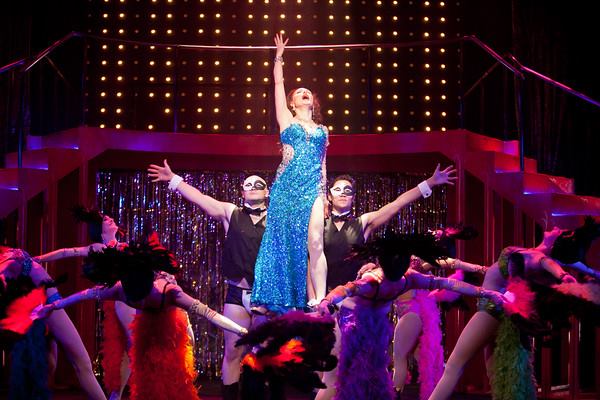
It is not my habit to offer my opinion about current productions, and I tend to even avoid doing so retrospectively. But I do want to briefly discuss the shows I’ve seen over the past week or so, because they’re never the same each night, because they’re exceptionally brief, and because they’re free. I’m referring to the “Ham4Ham Show,” the two to three minute bits of entertainment offered up outside the Richard Rodgers Theatre at the ticket lottery two hours before each preview of the new musical Hamilton.
For those who haven’t seen them or heard about them, the Ham4Ham shows can be anything – you have no idea what you’ll get – that the protean Lin-Manuel Miranda and the company choose to present. It could be a song, a dance, a Q & A with Lin in which he answers using only the lyrics of a favorite musical. But what it means is that those who’ve trekked to 46th Street in hope of snagging a pair of seats in the front row of the theatre for the performance two hours hence for only $10 a ticket may walk away empty handed, but they’ve gotten a little something more than suspense out of the experience.
Now it’s easy to look at this and be cynical, if you tend that way, thinking this is all about selling tickets. But while videos of the nightly event may spread out on social media (and the show’s official accounts do participate in that), the performance is first and foremost for people who haven’t bought seats, and very possibly can’t get or can’t afford tickets any other way. It is an act of generosity by Lin and the company, without a marketing message attached; indeed, it seems more an expression of gratitude to fans than anything else.
I say this as someone who has attended a dozen of these little shows, and viewed others online. I find the spirit of the crowd and of those who come out to perform to be enormously congenial and electric. I’ve seen no jostling for space, no rivalry among those competing for the same tickets, and I’ve watched the crowd spill into the street in blazing heat and humidity without complaint. I don’t attend to enter the lottery – I’ve been going to see, enjoy and record the shows for those without the proximity or time to attend in person. It just so happens that my office is on 46th Street and I simply have to cross Broadway to be there.
As theatres talk about how to engage audiences, there’s no question that Ham4Ham is a sterling example, if not necessarily a replicable model. To tick off just some the things that make this unique: 1) Lin-Manuel wrote and stars in Hamilton, so it’s truly his show, 2) no one is required to perform, they’re doing it entirely of their own accord, 3) lots of theatres don’t have the easy foot traffic that New York can generate to draw impromptu crowds, 4) not every show has the advance excitement (and sales) that Hamilton has generated off of its run at The Public – and so on. But it’s also worth noting that, my personal example aside, people would be there trying for the cheap tickets regardless – Ham4Ham is simply a bonus.
For all the reasons why Ham4Ham would be difficult to reproduce, there is something at its core that can perhaps provoke other models of engagement for other shows, for other theatres. If we can all learn from Lin-Manuel’s example and actively engage in giving something to audiences that they can’t get anywhere else, outside of the space that they need a ticket to enter, that may even stand alone and apart from what’s being offered on our stages, then perhaps we’ll find some new friends and new relationships that go far beyond just ‘how do we sell more tickets.’
Once Hamilton opens on Thursday, Ham4Ham may be less frequent, or perhaps change in format. So for everyone who has been out on 46th Street since the Ham4Ham shows began, thanks Lin, thanks Ariana, thanks Jon, thanks Renee, thanks Okieriete, thanks Karen, thanks Jon, thanks Philippa, thanks Alex – and thanks everyone I haven’t named too. The best show in town was the crowd, outside the R. Rodgers Theatre for A. Hamilton.
* * * *
The videos above were all shot by me (and let’s hear it for the iPhone), as was the photo at the top of the post, but here are a few more, shot by others in the crowd, that I think you’ll enjoy:
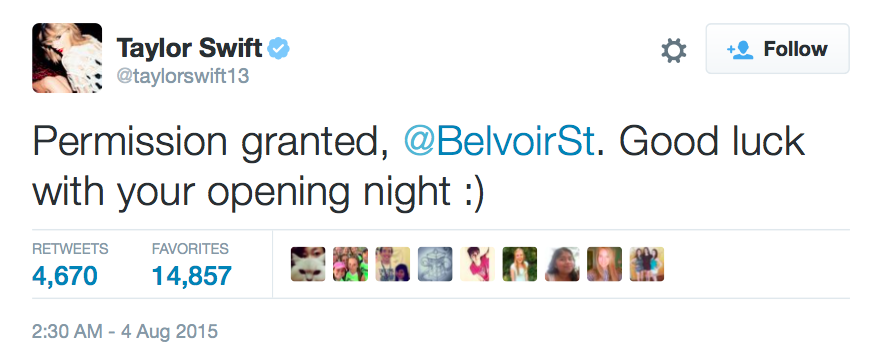
The fast story is this: Belvoir Street Theatre, a well-known and respected Australian theatre company is producing a play, Seventeen, in which a group of elderly (and acclaimed) actors play 17 year olds. The director of the show wanted to use “Shake It Off” as a choreographed number at the show’s climax. But going through normal channels, the music publisher had denied the company the rights, for reasons unknown.
Five days before opening, all conventional efforts exhausted, the company resorted to trying to reach Swift on social media and in what may be a first, she granted the rights via Twitter just hours ago. While I suspect there are some contractual details to be worked out beyond “Permission granted,” presumably the tweet from Swift gives Belvoir Street enough comfort that they can proceed. While news reports indicate that alternate music and staging was being prepared, now everything can continue according to the theatre’s and the production’s original plans.
It is, as I say, a happy ending, and having the reigning queen of pop music as your deus ex machina is quite the capper. But I would caution others who want to try this approach not to count on a recurrence: music licensing (or the licensing of any copyrighted material) via social media is not, in my estimation, going to become the new normal.
The fact is, Belvoir Street got lucky. To be sure, they waged a heck of a campaign, with people like Tim Minchin tweeting support and online pleas like “Please @taylorswift13 help these seventy-year-olds Shake It Off!” making the case on emotion, rather than business grounds. And, of course, Swift seems to be very personally involved in every single aspect of her career, including her social media feeds, so she and her team actually saw and considered the request, having undoubtedly known nothing of the original denial.
Just don’t try this at home with your show, whether it’s a fringe production or at a resident company like Belvoir Street. There are lots of artists who have people paid to monitor their social media (as I’m sure Swift does as well), but they’re not necessarily as shrewd or as generous as Taylor. They also have people paid to monitor unauthorized use of their words and music. Proceeding deep into rehearsals with material you don’t have rights to can easily bring heartache, and while that might merely be more song fodder for Swift, it can be unsettling to a production and possibly even expensive for a company when last minute changes need to be made.
There’s no question that pop music added to plays can enhance a production, without turning it into a jukebox musical. I vividly recall the Steppenwolf production of Balm in Gilead which interpolated now-vintage Bruce Springsteen recordings so brilliantly, and Trinity Rep’s All The King’s Men which made Randy Newman’s songs from his Good Old Boys album seem as if they’d been written expressly for the show. I can’t say whether the music was properly licensed in either of those cases – both are over 25 years old and my Playbills are in storage – but even if they weren’t then, I can’t imagine these shows getting away without the rights agreements now.
So the story here is not so much that Belvoir Street dodged a bullet, but that Taylor Swift deflected it. While she may seem to be omnipresent these days, she can’t actually be everywhere, and other artists and songwriters may not be quite as magnanimous. So when it comes to using existing songs, it may be like you’ve got this music in your mind, saying it’s gonna be alright, but that’s not necessarily the case. When it comes to copyright, you just can’t shake it off.
Howard Sherman is the director of the Arts Integrity Initiative at the New School for Drama.
The fast story is this: Belvoir Street Theatre, a well-known and respected Australian theatre company is producing a play, Seventeen, in which a group of elderly (and acclaimed) actors play 17 year olds. The director of the show wanted to use “Shake It Off” as a choreographed number at the show’s climax. But going through normal channels, the music publisher had denied the company the rights, for reasons unknown.
Five days before opening, all conventional efforts exhausted, the company resorted to trying to reach Swift on social media and in what may be a first, she granted the rights via Twitter just hours ago. While I suspect there are some contractual details to be worked out beyond “Permission granted,” presumably the tweet from Swift gives Belvoir Street enough comfort that they can proceed. While news reports indicate that alternate music and staging was being prepared, now everything can continue according to the theatre’s and the production’s original plans.
It is, as I say, a happy ending, and having the reigning queen of pop music as your deus ex machina is quite the capper. But I would caution others who want to try this approach not to count on a recurrence: music licensing (or the licensing of any copyrighted material) via social media is not, in my estimation, going to become the new normal.
The fact is, Belvoir Street got lucky. To be sure, they waged a heck of a campaign, with people like Tim Minchin tweeting support and online pleas like “Please @taylorswift13 help these seventy-year-olds Shake It Off!” making the case on emotion, rather than business grounds. And, of course, Swift seems to be very personally involved in every single aspect of her career, including her social media feeds, so she and her team actually saw and considered the request, having undoubtedly known nothing of the original denial.
Just don’t try this at home with your show, whether it’s a fringe production or at a resident company like Belvoir Street. There are lots of artists who have people paid to monitor their social media (as I’m sure Swift does as well), but they’re not necessarily as shrewd or as generous as Taylor. They also have people paid to monitor unauthorized use of their words and music. Proceeding deep into rehearsals with material you don’t have rights to can easily bring heartache, and while that might merely be more song fodder for Swift, it can be unsettling to a production and possibly even expensive for a company when last minute changes need to be made.
There’s no question that pop music added to plays can enhance a production, without turning it into a jukebox musical. I vividly recall the Steppenwolf production of Balm in Gilead which interpolated now-vintage Bruce Springsteen recordings so brilliantly, and Trinity Rep’s All The King’s Men which made Randy Newman’s songs from his Good Old Boys album seem as if they’d been written expressly for the show. I can’t say whether the music was properly licensed in either of those cases – both are over 25 years old and my Playbills are in storage – but even if they weren’t then, I can’t imagine these shows getting away without the rights agreements now.
So the story here is not so much that Belvoir Street dodged a bullet, but that Taylor Swift deflected it. While she may seem to be omnipresent these days, she can’t actually be everywhere, and other artists and songwriters may not be quite as magnanimous. So when it comes to using existing songs, it may be like you’ve got this music in your mind, saying it’s gonna be alright, but that’s not necessarily the case. When it comes to copyright, you just can’t shake it off.
Howard Sherman is the director of the Arts Integrity Initiative at the New School for Drama.
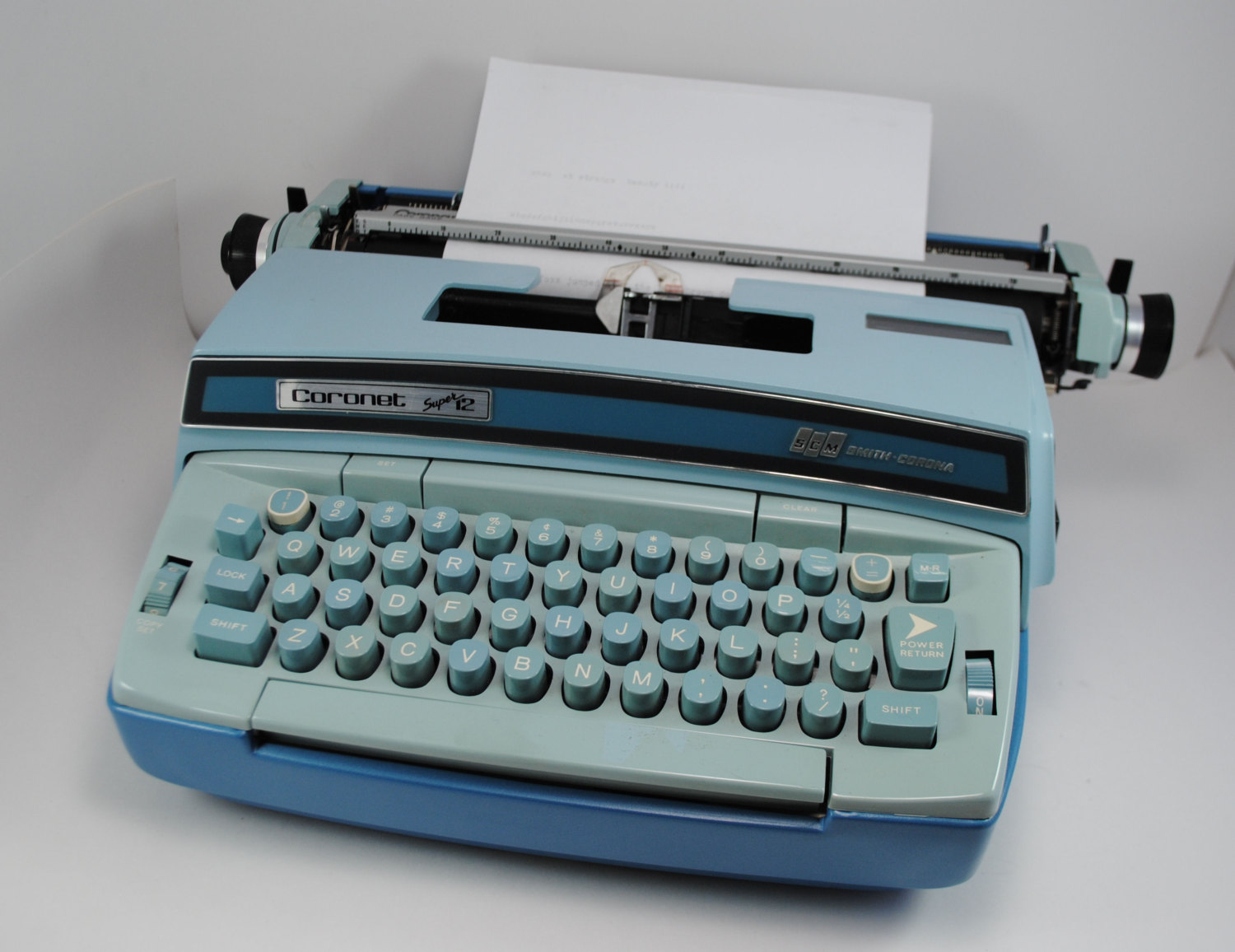
A close facsimile of the Smith Corona typewriter I used for over a decade.
Last weekend, I shared a story and wrote a blog post about Dylan Lawrence, a 13-year-old in Lincoln, Nebraska who staged what appeared to be a fairly impressive production of Shrek The Musical in a neighbor’s backyard. The story seemed to touch an awful lot of people, perhaps because they responded as I had, when introducing the article on Facebook.
Sometimes, those of us who work in the theatre need a quick reminder of the impulse that got us started, which can get lost amid the realities of having made the thing we love into our job. That’s why I think this story is so terrific, because, in one way or another, wherever we grew up or however we got started, to paraphrase Lin-Manuel’s Tony acceptance rap, we were that kid. Let’s share this – let’s make Dylan Lawrence a star, for every kid out there making theatre in a backyard, a basement, or on Broadway.
Frankly, I found myself jealous of Dylan’s energy and initiative, wishing I had been that creative and entrepreneurial at his age, to the degree one can be jealous of someone today over one’s own perceived deficiencies 40 years in the past.
A few days later, I happened on a news story from the UK, announcing that a small London pub theatre would be producing the world premiere of a play by Arthur Miller. Impressed by such a discovery, I read on, only to learn that the unstaged play in question had been written by Miller as a 20-year-old college sophomore. Frankly, while Miller’s reputation is secure, I had to wonder whether the play in question would add to the Miller canon, if it would contradict some aspect of it (a la Go Tell A Watchman), or would it simply be a novelty that goes back into the Miller archives after this run.
These two incidents began to work on me, as did a flip comment I made, entirely in jest, to a Twitter commenter about the Miller story. I said something to the effect that I doubted if anyone wanted to read my unproduced plays.
Shortly thereafter, it hit me. I actually have some unproduced plays. Or at least I had them. I’m not digging through old files and boxes for them, for me or anyone else, and I’m really hoping that no one else has copies. But I am willing to share with you what I recall of my efforts, which I haven’t thought about in quite some time.
It’s worth noting that I saw very little theatre as a child. I attended a children’s theatre show at Long Wharf Theatre in 1967 for the fifth birthday of a kindergarten classmate, of which I remember nothing but the seeming vast darkness of that actually intimate space. In second grade, my parents took my brother and me to see the national tour of Fiddler on the Roof at the Shubert Theatre in New Haven, and what I remember most is “Tevye’s Dream.” It stands out not because I liked the number, but because as a child I was very skittish about anything supernatural, and so my parents had spent a lot of time preparing me for the appearance of Frumah Sarah. The anticipation was so significant, and the event so anticlimactic, that it was my greatest takeaway. My first Broadway show, circa 1975, was Stephen Schwartz’s The Magic Show. My second was Beatlemania.
Despite a paucity of real world examples, I conceived of a passion for theatre, and my parents enrolled me in a Saturday morning drama program at the New Haven YMCA. I believe I was in fourth grade. I dimly recall the space in which we worked, that there were only a few other kids involved, perhaps three or four, and I have no memory of the class leader. But I do remember that the program concluded with some manner of performance – I don’t even recall any audience – of the play I wrote for the group, Love and Hate. The plot? No idea. But remarkably, I do think that even then I was aware of a book called War and Peace, and that it sounded pretty good, so I mimicked the wide scope of its title. I suspect I performed in Love and Hate as well, but that aspect is too indistinct. My older brother wouldn’t have attended out of disinterest, so I can’t ask him about it, and my sister would have been to young to sit through it. With my parents gone, these threads are all that is left of Love and Hate.
My next writing efforts, some time during fifth and sixth grade, were both done under the tutelage of my synagogue’s cantor, one Solomon Epstein, who was a young Jewish man from the south whose lasting gifts to me included several of my formative cultural experiences, notably my first art museum visits, as well as my lingering tendency, despite my New England upbringing, to say “y’all.”
It was Cantor Epstein who had our second grade Hebrew school class sing a short pop cantata called Joseph and the Amazing Technicolor Dreamcoat, years before it was expanded into a stage show (I managed to tell Lord Lloyd Webber this story years later). He staged several similar, but longer, works as multimedia events on the synagogue’s stage – after all, this was the early 70s. I remember learning how to synchronize three sets of dual slide projectors with a big electrical box called a crossfader, and asking him whether the rabbi would permit him to have an attractive young woman of 17 or 18 years of age dance in the synagogue in a body suit (it was fine, apparently).
But he also encouraged me to write, going so far as to loan me a portable Smith Corona electric typewriter, which was so much easier than the vintage manual typewriter that dated from my parents’ school days, and probably before; they later bought me my own electric, the same model as the one I’d borrowed. First, I undertook to do my own adaptation of the Peanuts comics for the stage (an avowed fan of the strip and quite aware of You’re A Good Man, Charlie Brown). I did little more than transcribe the various cartoons from the comics, which I had been cutting from the newspaper and pasting into scrapbooks for years, and arrange them in short scenes. My only innovation, not entirely surprising given my guide, was to invent a new character, a Jewish “Peanut” named “Tsvi,” which not so coincidentally is my Hebrew name. The title of this opus: Happiness is a Jewish Peanut. Clearly at that time I was seeking my cultural identity by placing myself among characters I loved.
Subsequently, I tackled a more significant project, adapting a novel, the name of which escapes me now. It was a wry Jewish fantasy about the lives of babies in heaven before they’re born and sent to earth, but it actually had a narrative, which ended with its main character being launched to meet its parents. I recall that in the book’s mythology, the philtrum, or “drip canal,” under our nose is where God snapped his fingers against us to bring us to mortal life send us to earth. Funny what stays with us, no? Again, I was probably transcribing more than writing, but as this was a several hundred page novel, I did have to assert some basic editing skills, if nothing else.
My last writing attempt never got beyond the outline phase, but it was a special high school project that proved too overwhelming. Looking back, it was utterly self-indulgent and also self-revelatory, a play in which I imagined a version of myself, to be played by me. This main character, a high school student in a school much like mine, was to look at the talents of other students I –I mean he – admired and then, in turn, he/I would demonstrate those very same talents, at least on a par with, if not better than, those I envied. It would have been great fodder for a therapist, but as drama, no doubt quite inert, albeit a showcase for whatever talents I actually had.
To be honest, I still have ideas for plays, and screenplays, from time to time, some of which have been turned over and over in my head for many years as the circumstances of the world, or of my life, have changed. I honestly believe one or two of them are pretty good, but I have found that my impulse to write is best served by the essay form, the blog form, because it allows me to pursue a single idea in a single writing session. It is the commitment of returning to the same story, over and over, day after day, tweaking, adjusting, and fixing endlessly that has staved off any real creative efforts. It is why I admire playwrights (and screenwriters, and novelists) so very much.
I unearth all of this now because of young Arthur Miller decades ago, because of young Dylan Lawrence today, and because of the countless youthful creative artists who may not yet realize that’s where they’re headed, who may not have the support and access that Dylan Lawrence, Arthur Miller and I all had. We know what happened with Miller, and I plan to follow and support Dylan in any way I can – as I will do as much as I’m able for any young person inspired by the arts, especially theatre, and I hope that holds true for those who read my blog.
As for me, I came to understand that I am not a dramatic storyteller, but an avid consumer of stories, who wants nothing more than to play some role in their getting told, and in supporting and knowing those who tell them. Just as there are undoubtedly countless young artists and administrators – and audiences – to be nurtured, I hope there are at least as many parents, mentors and teachers to pave the way, declining budgets and skittish authority figures be damned.
And check back with me in about 20 years. Maybe by then I’ll have enough material for a marginally entertaining one-man show. You never know.
I should say right up front that, until about two hours before I began writing, I didn’t know anything about the Words Players Theatre of Rochester, Minnesota or its parent organization, Northland Words. I only learned about them because the company had raised the online ire of people in the creative community. In particular, what caught my eye was a blog post by playwright Donna Hoke, “Dissecting The Most Disgusting Call For Plays I’ve Ever Seen,” in which she does exactly what she says she’s going to do in her title, line by line, word by word. I share her concern, but I’d like to take a macro view of the message that the company appears to be sending.
Throughout their call for plays for Words Players 2015 Original Short Play Festival, the company’s director Daved Driscoll says several things worthy of admiration: there’s a commitment to young performers, as well as a desire to find work which he feels will appeal to his local community. I don’t think anyone would argue with those goals.
But where his message gets into trouble is, first, in the margins, so to speak. “Our emphasis is perhaps less on the artist-centered goal of producing ‘great art’,” he writes; elsewhere he notes “our desire to give writers and directors first-hand experience of the vagaries of ‘marketability’ as much as the more arcane goals of ‘art’.” If Words Players’ primary goal is to sell tickets, that’s perfectly fine, but that intimates that their efforts are more commercial than not-for-profit, and Northland Words is a 501(c)(3) tax-exempt organization. Yet plenty of not-for-profits are accused of chasing sales over creative pursuits, so they’re not alone, but it’s awfully dissonant to be asking for plays from artists while dissing art itself. Why not focus affirmatively on what’s sought, rather than what’s not wanted? Instead, Words Players notes, “We prefer most of all plays that are significant and interesting, without off-putting superciliousness.”
Secondly, Driscoll states that, “We largely ignore considerations of age, race and gender in our casting decisions.” While that would be jarring in a professional setting, it’s perhaps somewhat less troubling in a company that’s focused on youth. After all, Lin-Manuel Miranda has noted that he doesn’t mind when schools without Latino students perform In The Heights, because once kids hit college, they’re going to be typed and should have a certain freedom to play any role while very young, though he does ask that they give respect to the culture they portray, and neither paint their skin nor adopt bad accents in doing so. However, Miranda doesn’t condone willfully altering the characters themselves, let alone the story, and neither do I. That choice should be the playwright’s, not the director’s or the artistic director’s.
I’d also suggest that in pointing out his youth emphasis, Driscoll could do better than, “The audience invariably includes a large percentage of young people. We will prefer scripts that appeal to them as well as to old, non-young people.” I believe most old, non-young people like myself wouldn’t mind at all that the work is for and by the young, were our decrepit state not reinforced redundantly. Honestly, young people play adults all the time in school theatre and community theatre where casts are young, so it’s not really an issue.
But what moves beyond poor communications and into the realm of unacceptable is how Driscoll speaks of how the theatre will handle the work of the very writers he’s soliciting. “Our production of the play is our only ‘compensation’ for its use,” he writes, later emphasizing the point by saying, “We don’t pay for the scripts.” Now if there are youthful writers in the local community who are the peers of the performers, who wish to write and be part of the program, that seems fair, provided no one else is getting paid either. But in a call for submissions that has clearly reached beyond the confines of Words Players and even Rochester. Minnesota, the idea that playwrights should give the company their scripts gratis devalues the work of writers – and if the youthful acting company knows of this, it suggests to them that writers’ words have no value.
Compounding this perspective, Driscoll writes, “While authors are welcome to confer with the directors, such conference is at the discretion of each director. Student directors will develop their autonomous interpretation and will maintain independent control of each production. They will in all probability modify settings and dialogue to fit our production situation and their own visions of the shows. Directors will, in particular, strive to make each play ‘entertaining’ to our audiences and may modify the scripts, accordingly.” This is the behavior of Hollywood studios towards writers, and they pay huge piles of money for that right; in the theatre, while a work is under copyright, the playwright has the final say about what words are spoken, unless they’re inveigled into giving away that right.
Finally, there’s a mission statement at the bottom of the call for plays which reads, in part, as follows: “Merely preserving ‘the way it was done’ is for mummies and pottery shards, not performance art.” I agree, but there’s a difference between fresh interpretations and wholesale vandalism, especially when a play is new and in no way trapped in amber.
Every theatre can set its play selection guidelines as it sees fit, but Words Players seems to be emphasizing the players over the words, and insulting playwrights in the process. The guidelines bother me for the same reason it bothers me when school administrators and professional directors and many others mess with copyrighted texts without permission: because not only is it in most cases legally and always ethically wrong (at least in the U.S.), it’s setting such a disastrous example for the young people who witness this disregard, bordering on contempt, for the writer’s art.
It’s unclear how many plays will be in the Words Players festival, how many people will attend and what they might be charged. But when it comes to compensation, royalties for amateur productions of short works are often little more than the price of a couple of movie tickets and a bag of popcorn, so they’re hardly onerous for any company. But no payment gives a licensee the right to have its way unilaterally with the text in theatre, unless the playwright inexplicably chooses to grant it.
Online, people wrote that they saw this same call last year and spoke out about it, but that it’s unchanged – they were ignored. Facebook and Twitter posts suggest that Words Players response has been, essentially, “if you don’t like it, then don’t submit.” They’ve been removing dissent from their social media. They’re trying to hide the efforts of those that might inform their community of reasonable standards and guide them towards more appropriate behavior.
I’m not writing just on behalf the playwrights – I’m writing on behalf of every single kid in that program. If those kids admire theatre and the arts, then regardless of whether they become professional artists or simply audience members in the future, any adults giving them training need to distinguish between creative rights and wrongs for them now, because they are the path to our future and to the health of the theatre.
In the call for plays by Words Players, Mr. Driscoll is teaching bad lessons (Donna Hoke has made some strong points on that as well). Either he should choose the plays he wants and treat them with respect, or he should write them himself and let the directors and performers have at them if he likes. The latter choice is his right if he is the author. But no one should be asking for plays if they’re not going to produce them with professional conduct and ethical standards, even for only one or two performances with a cast of young people in Rochester, Minnesota. Every play has meaning, as does every production, and Words Players will best serve its community by altering its practices to set the right example.
Update, August 5, 3:30 pm: Yesterday, Doug Wright, president of The Dramatists Guild, sent a letter to Daved Driscoll of Words Players outlining the reasons why playwrights and the Guild were so troubled by the theatre’s play submission guidelines. This morning, Driscoll responded in writing to the Guild, and subsequently did an interview with Playbill discussing their desire to conform to professional and ethical standards. Conversations between those parties will be ongoing, and if welcome, I hope to participate in them as well.
Update, August 7, 2 pm: The conversations online and offline surrounding this topic have, in some cases, metastasized far beyond my intent and perhaps the intent of others who drew attention to this situation. I hope you’ll read my followup post as well, “Writing A Different Script About Respect for Playwrights.”
Note: an earlier version of this post contained two photos of prior productions in the Words Players Original Short Plays Festival. While the photos were made available for download without restriction on the company’s website, I have removed them at the suggestion of several commenters.
Howard Sherman is director of the Arts Integrity Initiative at The New School for Drama.
Sundays tend to be slow days for theatre news, if you get most of your theatre news online. By the time I sit down to trawl through “the Sunday papers” for theatre stories to share, primarily through my Twitter account, I’ve seen most of what’s on offer already. The New York Times Arts stories start filtering out through Twitter and Facebook as early as Wednesday, the Sunday column of Chris Jones at The Chicago Tribune is usually available by Friday afternoon, and so on.
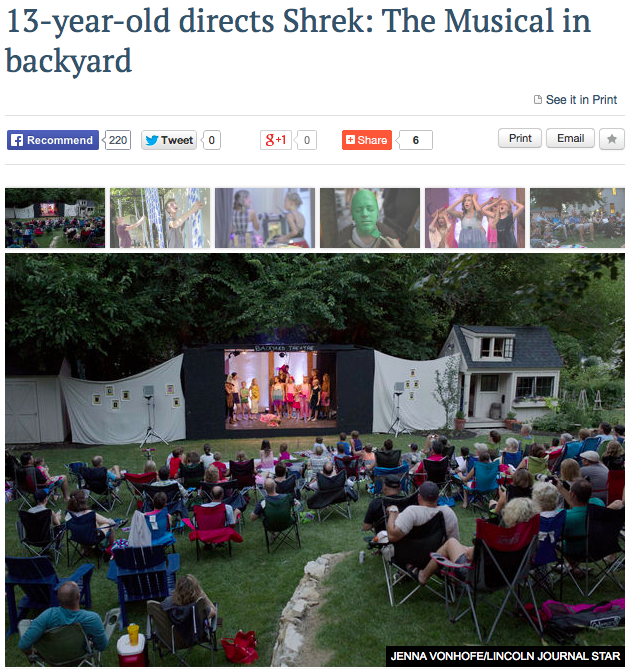
I look at my theatre news curation on Sundays as perfunctory (just as Saturdays tend to be particularly busy), knowing I’m unlikely to find much, which is why a story in the Lincoln, Nebraska Journal Star managed to catch my eye. It’s not, so far as I can tell, in the paper’s arts or entertainment section, but in local news, the sort of charming slice of life that columnists look for to illuminate their communities. However reporter Conor Dunn found out about impresario Dylan Lawrence’s production of Shrek: The Musical in a neighbor’s backyard, I’m awfully glad it came to the paper’s attention, and that I stumbled upon it. If you haven’t seen it yet, here’s a taste:
Now 13, Dylan pulled off his first major production this weekend — “Shrek: The Musical” — at The Backyard Theatre in southeast Lincoln, a venue literally carved out of a family’s backyard and completely run by kids.
This isn’t the first time Dylan has directed a play, however. It’s just in a new location. Last summer, he and 10 of his friends performed “The Wizard of Oz” in his Lincoln backyard. Dylan said the cast put the show together in just nine days and about 70 people attended.
* * *
While most theatrical productions have a set and a stage crew, Dylan took most of the roles on himself, alongside directing and performing as Lord Farquaad in the show.
He’s sewn the costumes, designed the props, rented a sound system and also created light cues using a software program on his laptop. He even created The Backyard Theatre’s website.
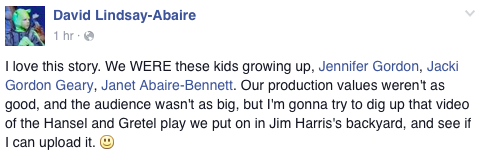
I have no doubt that there are other Dylan Lawrences out there, so I like to look at this story not as a wholly unique incident, but rather as emblematic of the grassroots love of theatre that inspires kids, and that in turn can inspire even those of us working at it professionally. I’m glad it’s finding resonance online – my post has been “liked” on Facebook 72 times in less than two hours and shared 37 times, including by David Lindsay-Abaire, who wrote the show’s book and lyrics. I suspect the number will climb much higher, because I believe that many more people will connect to it in the same way that I did.
There was one comment posted to me on Twitter, where I also shared the Journal Star story, saying “Hope he has the rights.” While I am adamant that authors should be compensated for their work, I wonder whether this ad hoc production by children 14 and under, with no institutional backing or adult leadership, reaches the level at which a license is required, and I intend to find out. However, if it turns out that a license should be paid, I don’t want my decision to share a local story that might have otherwise gone unnoticed to be visited upon Dylan and his company; consequently, I’ll pay for any rights required myself, to help Dylan practice what I preach, because it’s a small price to pay for encouraging the love of theatre and for a tale that reminds so many of us why we got into this crazy and thrilling business in the first place.
I performed on stage for the very first time as Charlie Brown at my day camp’s condensation of You’re A Good Man, Charlie Brown into about 20 minutes. I’m willing to bet it was unauthorized and unlicensed, and I don’t say that to encourage scofflaws, but merely as a fact. While it sounds like The Backyard Players of Lincoln, Nebraska are considerably more sophisticated than the rudimentary theatrics at Camp Jolly circa 1969, I feel a kinship to Dylan, even though he is obviously significantly more enterprising than I was. So I urge you to read his story and, perhaps, remember that very first time you made a stage in your backyard or your basement, or sang a show tune in elementary school before you’d even seen a play. Because we all started somewhere, and we need to always celebrate those taking their first theatrical steps whenever the opportunity presents itself.
Update, July 27, 7 a.m.: 18 hours after I first shared the Journal Star story via Facebook, my posting has been liked 107 times and shared 81 times. I have no way of knowing how it spread beyond there, but the original story on the Journal Star website has been “Facebook recommended” over 2700 times. We are that kid.
Seemingly out of nowhere, The Wall Street Journal published a column yesterday, “A Silenced Shakespeare in Washington: Shakespeare without puns is like French cooking without butter,” which slams the work of Washington D.C.’s Synetic Theater for their movement-based productions of Shakespeare, productions which have garnered critical and popular acclaim for more than a decade. What’s curious about this op-ed cum review, written by a contributor who is not a member of the paper’s arts staff, and certainly not their widely-traveled critic Terry Teachout, is that not only does it seek to demolish Synetic’s work, but to trash anyone who might enjoy or support that work. The author is James Bovard, identified as “the author of ‘Public Policy Hooligan’ and a member of the USA Today Editorial Page Board of Contributors.”
Here’s a few samples:
The latest Shakespeare fashion, at least in the Washington area, is to invite people to a feast of language and serve nothing but grunts, grimaces and grins—with a few gyrations thrown in for dessert…
The company has received numerous grants from the National Endowment for the Arts and its state affiliate, the Virginia Commission for the Arts. Synetic is known for high-energy performances relying on acrobatics, pantomime and special effects. But flips and twists cannot suffice for nouns and verbs….
Silent Shakespeare is akin to mental nouveau cuisine with more flourishes than calories. The fact that many Washingtonians consider Silent Shakespeare an improvement rather than an oxymoron reflects unkindly on the capital’s cultural pretensions. But perhaps we should not be surprised that the city that pioneered obfuscation is now exalting expunging English altogether.
Synetic responded to Bovard’s assault on a blog, but inevitably that will be seen by fewer people than those who read the Journal, one of the country’s largest newspapers in print and online. Here’s a bit of their riposte:
It is unclear to us from The Wall Street Journal’s latest opinion piece whether or not the writer James Bovard has seen a Synetic production, or whether his opinion has been formed from YouTube videos and editorial content from other publications….
Synetic’s wordless Shakespeare has never been recommended as improving upon or replacing his plays produced in the traditional way, focusing on and emphasizing the richness of the prose and poetry as it appears in English (however many a mewling schoolboy would contest that Shakespeare’s language is not English). At Synetic, his words are translated into physical language and visual poetry, just as they have been translated into countless other languages and art forms throughout history….
Perhaps the most contradictory paragraph involves Mr. Bovard’s comparison to Prokofiev’s Romeo and Juliet. He states, “…that presentation succeeds thanks to magnificent music and viewers’ familiarity with the characters and storyline.” None of those elements are absent from Synetic productions as audiences at Synetic are just as familiar with Shakespeare’s characters and story lines…
On reading Bovard’s piece, it was unclear to me as well as to whether he had actually seen the work itself (incidentally, I haven’t, which is why I offer no opinion of it). To that point, it’s worth noting that while Bovard took to his blog to write about the responses to his piece, and to take on certain points in Synetic’s response, he was mum on the issue of whether he has ever attended a show by the company.
Synetic Theater’s Much Ado About Nothing
As always, I believe critics are entitled to their opinion. However, if the editors at the Journal have given Bovard a platform to opine about the idea of Synetic’s work, rather than the work itself, they have abdicated basic journalism tenets, even for opinion pieces. That Bovard fails to understand that in decrying “wordless Shakespeare,” yet appreciating Shakespearean ballet, he’s really just taking issue with nomenclature, not art form, rather amuses me, as it should anyone taking him too seriously.
On his blog, Bovard even tries to take apart Synetic’s response, as if his broadside in the Journal was insufficient. I wonder, however, if in calling Synetic’s mention of their work’s accessibility to the Deaf and hard of hearing “patronizing,” he understands that while sign language interpretation has indeed been provided for theatrical productions for years, American Sign Language is not English, but its own language with its own unique syntax. This means that ASL has already shifted Shakespeare’s language into a new form, altered from the words that Bovard holds dear – and that ASL is in and of itself a visually based form, one with a particular beauty of its own, even to those who don’t know it.
If it is becoming the Journal’s policy to allow contributors to randomly allow contributors to slam the work of art, artists and companies they don’t like, I trust they will also begin publishing pieces on work that contributors particularly enjoy, even if both seem to supersede the purview of their own critics. That said, I suspect the WSJ critics and arts writers might have their own feeling about such usurpers, and the editors might reconsider such pieces in the future.
From this single essay, which serves as my introduction to Bovard’s writing and thinking, I make the assumption that he is a Shakespeare purist. He’s welcome to that view of works which I too enjoy enormously, though I happen to think they can be performed, interpreted, altered and reconstructed in countless worthwhile ways while never harming the original texts, remaining available to all who seek them or stage them. In fact, just last night I saw the Druid Theatre’s radically cut versions of Richard II and Henry IV, Part i, in which both Henry IV and Prince Hal were played by women, which might also make Bovard apoplectic.
In Bovard’s slash and burn approach to Synetic, I can only imagine that, metaphorically, the theater company somehow killed his father and married his mother, and after interminable dithering, he decided to seek revenge. As we all know, that doesn’t work out too well for all concerned.
If you are a musical theatre fan in general, and a Rent fan in particular, and you’re going to church in or around Tullahoma, Tennessee this Sunday, there’s a chance you may not like a bit of what you hear said from the pulpit. That’s because there’s an e-mail circulating among the area’s religious leaders alerting them about Jonathan Larson’s Rent, the Tony Award and Pulitzer Prize-winning musical about young lives in the East Village of New York City a few decades ago. Some of the clergy may want to talk about it.
A Tullahoma production of Rent is scheduled to open next Friday, presented by the community company PACT at the South Jackson Civic Center. It’s set for six performances over two weekends and it’s the third time that PACT, which is primarily focused on arts activities for youth (the acronym stands for “Performing Arts for Children and Teens”) has done a show which reaches beyond their usual age group, in this case working primarily with performers aged 18 to 20, but with one as old as 55. Only two performers are under 18, and the parents of both have signed permission slips approving of their children’s participation; those under 18 even needed permission slips just to audition. No one under 18 will be admitted to performances without a parent or guardian present.
Since preparations for the production got underway several months ago, those leading the company say that there have been some minor skirmishes around the show. During the winter, a member of the community circulated an e-mail speaking out against Rent and the leadership and artists of PACT in general, but I’m told it didn’t get much traction. Later, after the show was cast, the actor who was originally to play the character of Angel had to withdraw due to his father’s ire over his participation in the show. But of late, everything was proceeding smoothly for the show, including the recent decision to welcome the company of another Tennessee Rent production, which just closed last weekend in Johnson City, into the Tullahoma ensemble.
* * *
However, a few days ago, an e-mail was circulated to church leaders throughout the Tullahoma area. In a communication to his congregation, Pastor L. Wayne Wester of Highland Baptist Church quoted from that original e-mail, identifying the author as “a fellow Tullahoma Pastor”:
I want you to be aware that on July 10, 11, 12 and 17, 18, 19 a theater group in Tullahoma will be performing RENT. You can do your own research on RENT or visit the PACT site on Facebook for a brief description. In short it is a musical about a group of college age students who choose to live a “bohemian” (sexually, morally, and legally permissive lifestyle in New York City. The cast of characters include a stripper, transgender individuals, drug addicts, and many who are battling HIV due to their “bohemian” lifestyle. Several scenes take place in a strip club. While I have no objection to a theater group selecting and performing any musical or play they choose, this is our own (Tullahoma) theater group! What is worse is that this play was selected for PACT. The acronym stands for “Performing Arts for Children and Teens.”
Pastor Wayne, as he signed his communication, added his own thoughts after the quote:
Really? Do you agree with me and many of my fellow Pastors and concerned parents that this is inappropriate for such a group? If you do…speak up about it! If you don’t…shame on you. Jesus should be our moral compass, especially for our young people to see from adults. I would like to know your opinion…one way or the other. Really!
At the top of the message, in red ink, was the phrase “Bus Ministry Possibility – vote on Sunday in PM Service.”
Dr. Wester did not name the pastor who wrote the original e-mail. However, I spoke with Zac Collins, the stage manager for Rent, whose uncle and grandfather are also pastors in the community, who told him that they had both received the original e-mail and said that other pastor friends had received it as well. They told him that it was sent by Jim Zidan, Senior Pastor of Christ Community Church in Tullahoma.
Coleen Saunders and Melissa Shuran, the President and Vice-President, respectively, of the South Jackson Civic Center and co-founders of PACT, told me that while Pastor Zidan had twice visited the civic center seeking e-mail addresses for the leadership, no e-mail or letter expressing concern about or opposition to Rent had ever been received.
* * *
I wrote to Pastor Zidan with questions about Rent and his e-mail. Here’s part of his response, verbatim:
I don’t believe or community has an interest or appetite for such fare; particularly for our children. Our previous PACT productions have been Oliver, Big River, Pinnochio, and Peter Pan. This is a pretty big deviation from those family friendly productions. I have attempted to speak to all the leaders of our theater community, including the current leaders of PACT. I even offered to speak on our local community television show to express my concerns and inform the public. No one seems interested in having this discussion so I have decided to sit and wait. I may write an editorial for our local paper, but I think I well wait until after the production. It is not my desire to sabotage this performance. I think it will fail financially. We’re it not for PACT money and the accompanying grants (for children’s theater) I don’t think they could even have produced this show. Ultimately it is up to our parents and local theater leadership; and apparently they are all asleep at the wheel.
I had asked Pastor Zidan whether he had ever seen or read Rent, but nothing in his response to me answered that question. He also did not respond to my question about what he hoped to achieve with his e-mail to his colleagues, or directly acknowledge it.
* * *
It’s impossible to know how pastors in the Tullahoma area are responding to Pastor Zidan’s message. Some may choose to speak against the show at services this weekend (or vote about it, in Pastor Wester’s case); others may wish to speak in support of Rent. It’s impossible to know whether any of them are personally familiar with the show itself. Consequently, in the hope that this essay might find its way into the Tullahoma community and beyond, a few words in support of Rent, PACT and the cast and team behind the upcoming production – or any production, for that matter – seem warranted.
Rent is a modern classicRent premiered in New York in 1996 at the Off-Broadway New York Theatre Workshop, where it was such an immediate sensation that it moved to Broadway only a few months later, where it won, as mentioned above, the Tony Award and the Pulitzer Prize, the highest honors in American theatre. It’s notable that the Pulitzer is rarely awarded to musicals; it occurs roughly once every 10 years. Rent ran for over 11 years on Broadway, playing to an audience of over 5 million people, and untold millions more on tour and in regional, amateur and school productions since then. It was made into a film and its final Broadway performance was recorded widely sold on DVD.
Rent is universal The reason Rent is still being performed almost 20 years after it was first produced is because while it is set very specifically at a moment in time and a particular place among a small group of young people in New York, it speaks to people from around the world. Every community is a mix of different races, ethnicities, sexualities, religions, strengths and weaknesses; Rent’s success is because so many people can find themselves or their own families and friends on that stage. It can simply be embraced for what it is, exuberant and moving entertainment, or it can be used as a point of departure for conversations about ambition, family, illness, acceptance and loss.
Rent was born amidst tragedyRent was the breakthrough work by the talented young writer Jonathan Larson – who didn’t live to see its success. Jonathan died suddenly of a rare heart condition just after seeing the final dress rehearsal of the show. He never saw it with an audience and was never able to experience its success. Rent was Jonathan’s gift to a world he left prematurely, at the age of 35.
Rent is about loveRent is the story of people who gather together to create, to share and to form their own family born of love and care for one another. Musician or stripper, performance artist or filmmaker, they travel the journey that so many young people travel, as they find themselves and their place in the world. Some are lost along the way, and we never know what happens to others after the play stops, but it is a show about seeing people lovingly for who they are, not judging them for their choices or even failings.
Creative artists deserve the opportunity to growWhile PACT was begun with a focus on those under 18, it’s not unusual to find artists wanting to spread their wings beyond a previously defined mission, which most recently at PACT included a version of Robin Hood this spring. With the majority of the current cast between 18 and 20, PACT is giving young adults an opportunity to stay involved in the arts, and the leadership of the group the opportunity to explore even more of the theatrical canon. They have made it very clear that this is not their typical fare, so no one is surprised, with their intentions reinforced in the local press. As an independent organization, they have they right to determine their creative direction, with the ultimate arbiters of their work being their audience.
There are no scenes set in a strip club Just FYI.
* * *
That the message from Pastor Zidan came out only this week would seem rather late in the game, with the show starting performances next week. In any event, I think it’s important to say that of course the pastors in Tullahoma have the right to communicate with one another and to preach as they see fit. I hope and trust that their messages are of love, acceptance, and understanding, not just for their parishioners, but for all people, including those who might mirror the characters in Rent, as well as those who want to see it or participate in it.
I also hope that those who might hear or read pastoral messages against Rent will take the time to read more about it, to listen to its songs, to consider its words as well, should they be pressed to judge it in advance. Most importantly, I hope everyone will remember that they have the absolute right to speak their minds, but that should the situation rise to the level of trying to stop Rent, which Pastor Zidan says is not his intent, they might keep in mind that those creating and participating in the show have the right to tell that story and to sing those songs for those who wish to experience it. Before any of us begin thinking to try to silence any voices, we must think about how we would feel if someone attempted to silence our own.
Rent may have, to some, a squalid setting, but is about struggle, friendship, community, equality, love, sacrifice, life and death, and even redemption. Those seem like themes worth exploring and embracing in every city and town, every day, in places of worship, in theatres and beyond.
* * *
Disclosure: as I have noted in my writing in the past, I did not know Jonathan Larson, but came to know his parents and sister through my work at the American Theatre Wing and its assumption of the grant programs originally undertaken by the Jonathan Larson Foundation.
Note: I welcome respectful dialogue about this in the comments section of this site, however I will remove any personal attacks or rude remarks. This is not censorship; it is my right as the author of this post and the operator of this website to insure that dialogue remains constructive.
Howard Sherman is director of the Arts Integrity Initiative at the New School for Drama.
“You can’t draw sweet water from a foul well,” critic Brooks Atkinson wrote of his initial reaction to the musical Pal Joey. I don’t know whether Christopher Hart of The Sunday Times in London knows this famous quote, but it certainly seems to summarize his approach to reviewing the London premiere of Stephen Adly Guirgis’s The Motherfucker With The Hat, which one can safely say is light years more profane than the Rodgers and Hart musical.
Alec Newman, Ricardo Chavira & Yul Vázquez in The Motherfucker With The Hat at the National Theatre
“A desperately boring play,” “an absolute stinker of a play,” “untrammelled by such boring bourgeois virtues as self-restraint or good manners,” “turgid tripe,” and “a pile of steaming offal,” are among the phrases Hart deploys about Guirgis’s Hat. While I happen to not agree with him (and admittedly I saw the Broadway production, not the one on at the National Theatre), he is entitled to these opinions. It may not be particularly nuanced criticism, but it’s his reaction. There are other British critics with opposing views (The Guardian and The Independent), and some who agree (Daily Mail), so there’s no consensus among his colleagues. But within his flaying of the play, Hart reveals classist, racist and nationalist sentiments that, however honestly he may be expressing them, prove why he is unable to assess the play on its own terms, empathizing with its flawed characters, as any good critic should endeavor to do.
Take this example: “Like the white working class in this country, the PRs in America have picked up a lot of black patois.” Even allowing for differences in language between England and the U.S., referring to residents of Puerto Rico and “the PRs” is patently offensive, and also hopelessly out of date, all at once. The statement also suggests that Puerto Ricans are in some way foreign, when the island itself has been part of America for more than a century; it’s perhaps akin to saying “the Welsh in Great Britain” as if they’re alien. When he parses “black patois” as the difference between saying “ax instead of ask,” Hart presents himself as Henry Higgins of American pronunciations, which I strongly suspect he picked up from watching American television and film, without any real understanding of racial culture or linguistics here – and he generalizes condescendingly about a huge swath of the British populace for good measure.
Hart also refers to the “very brief entertainment to be had in trying to work out” the ethnic background of the character Veronica, first musing that she might be “mixed race African American” but acknowledging her as Puerto Rican “when her boyfriend calls her his ‘little taino mamacita’.” I don’t know why he was fixated on this issue, presumably based on a parsing of the skin color of the actress in the role, especially since the play provided him with the answer (though the same problem has afflicted U.S. critics encountering Puerto Rican characters as well). Would that he were more focused on the character and story. He briefly describes the plot as being about “one Veronica, who lives in a scuzzy apartment off Times Square, snorts coke and sleeps around. Oh, and she shouts a lot.” In point of the fact, the play is an ensemble piece, and if any one character dominates, it’s Jackie, the ex-con struggling to fight his addictions and set his life straight.
After going off on a tear about the play’s profanity, Hart makes a comment about the play’s dialogue, saying, “A lot of it is ass-centred, in that distinctive American way.” As an American, I have to say that I’m unfamiliar with our bum-centric obsession, outside of certain pop and rap songs, even if Meghan Trainor is all about that bass. But hey, I’ve only lived here my whole life, and spent 13 of those years living and working in New York, a melting pot of culture and idiom. What do I know?
I don’t happen to read Hart with any regularity, but my colleague at The Stage, Mark Shenton, has noted his tendency to antagonistic hyperbole in the past, having called Hart out for separate reviews of Cabaret and Bent which both seem puritanical and, in the latter case, homophobic. While I peruse a number of UK papers online, both via subscription and free access, even my limited exposure to Hart’s rhetoric suggests that The Sunday Times is an outlet whose paywall I shall happily leave unbreached.
I was actually going to shrug off the ugliness of the Hat review, but only about an hour after I read it, I came across some letters to the editor in The Boston Globe, responding to a review of A. Rey Pamatmat’s Edith Can Shoot Things and Hit Them at Company One Theatre. While I don’t think the critic in this case, Jeffrey Gantz, was trying to be inflammatory (as I’m fairly certain Hart was), he revealed his own biases in seemingly casual remarks. Noting that two of the characters are Filipino-American, he wrote:
They make the occasional reference to their favorite Filipino dishes, but I wish more of their culture was on display, and it seems odd that they have no racial problems at school.
Maria Jan Carreon and Gideon Bautista in Edith Can Shoot Things and Hit Them at Company One Theatre
Not every character with a specific racial or ethnic origin need demonstrate it for our consumption on stage; it may not be germane to the play or perhaps the characters created by Pamatmat are more steeped in American culture than Filipino. The statement is the equivalent of saying about me, were I a character, that though I mention matzoh ball soup and pastrami, it would be nice if I spoke more Yiddish, wore a yarmulke, or waxed rhapsodic about my bar mitzvah. My grandparents were all immigrants to the U.S., so I’m only second generation American, not so far removed from another culture and schooled at length in my religion, but I don’t constantly remind people of those facts.
As for not experiencing intolerance at school, Gantz must have a singular idea of what every young person who is not white experiences on a daily basis. That’s not to say that there isn’t ugliness and ignorance directed at people of color far too regularly at every level of American life, but perhaps that isn’t germane to the story Pamatmat wants to tell or part of the personal experience he draws upon (he’s from Michigan, incidentally). It’s not as if “racial problems” for students of color are an absolute rule of dramaturgy that must be obeyed.
That said, it’s ironic that Gantz criticizes the play for taking on “easy targets, notably bigotry and bad parents.” The fraught relationship between parents and children has been the fodder of drama since the Greeks, and it seems an endlessly revelatory subject; as for bigotry, if it is perceived as an “easy” subject, then perhaps Gantz, despite wishing “racial problems” on the characters, has no real understanding of the complexity of race in America and the many forms bigotry can take, enough to fuel 1,000 plays and playwrights or more. But he’s complaining that Pamatmat hasn’t written the play that Gantz wants to see, rather than assessing the one that was written.
I can’t speak to the general editorial slant of The Sunday Times, so while Hart’s recent rant may be in keeping with the paper’s character, I don’t think the implicit racial commentary of Gantz’s review is consistent with the social perspective of The Boston Globe. That leads me to wonder, as I have before, what role editors play when racial bias appears in reviews, such as in a Chicago Sun-Times review that appeared to endorse racial profiling. Yes, these reviews are each expressions of one person’s opinion, but they are also, by default, opinions which are tacitly endorsed by the paper itself. Reading these reviews just after following reports from the Americans in the Arts and Theatre Communications Group conferences, which demonstrated a genuine desire on the part of arts institutions to address diversity and inclusion, I worry that if the arbiters of art continue to judge work based on retrograde social views, it will only slow progress in the field that, as it is, has already been too long in coming.
Howard Sherman is director of the Arts Integrity Initiative at The New School College of Performing Arts School of Drama and senior strategy consultant at the Alliance for Inclusion in the Arts.
If you’re like me, someone deeply committed to the arts – in practice, in education, in media coverage, in every aspect of life – you’ve probably had the same fantasy I’ve had over the years. What, I often wonder, would the scenario for the arts be like if they had the same attention and resources as those afforded to sports, especially in high schools and colleges?
That scenario can be played out with serious thought, especially as we watch school arts programs being cut – just last week the Atlanta school system cut music teachers at the elementary level. But it can also lead to some laugh-worthy imaginings – performance enhancing drugs for actors, anyone?
In the most sustained flight of fantasy I’ve seen surrounding this daydream, comedian Owen Weber has just released a video imagining The “thESPiaN” Network, covering theatre as if it was sports television. It’s executed with striking verisimilitude and real professionalism. That’s right, guys in suits at a desk saying things like, “You can’t blow opening night – the critics don’t give redos,” mentioning that a drama program gave up a “sixth round Fortinbras,” and declaring, “We’re getting wild now – Oscar Wilde!” I’m very amused.
Remarkably, Weber has released the video in four and eight minute version, and the it’s the long version that has my favorite sight gag, regarding a production of the Scottish play.
There are a couple of small things that bothered me as I watched the videos. Now I don’t know Weber’s other work (though clearly I’ll be checking it out), so I have no idea whether these are characteristic or anomalies. One is very likely intentional, and it’s a moment when an actress being discussed is briefly, fleetingly objectified not for her talent but for her looks. It’s very likely that this was meant to emphasize the “bro” culture of sports, even though, let’s face it, even ESPN has female sportscasters who would be very quick to shut down that sort of conversation about a female athlete.
My second observation is that the video is completely cast with Caucasians, and while everyone may have worked for nothing and Weber’s friends who were available for the shoot on any given day may have left him few options, I do wish that a video that will surely be making the rounds of theatre programs and theatre offices everywhere – and I’m contributing to that dissemination – better represented the diversity and inclusiveness of the arts. Quoting Jeanine Tesori at the Tony Awards, though she was speaking specifically to women at that moment, “You have to see it to be it.” Look, I know: comedy is no fun when it’s picked apart, but I can’t share these without mentioning that.
I wouldn’t be sharing these videos if they weren’t well-executed, consistently clever and at a few moments, laugh out loud funny. And the bottom line is, if there was a “Stage Center” on TV every night, I’d be watching it. And maybe some new ways of talking about the arts wouldn’t be such a bad idea at all.

 It is not my habit to offer my opinion about current productions, and I tend to even avoid doing so retrospectively. But I do want to briefly discuss the shows I’ve seen over the past week or so, because they’re never the same each night, because they’re exceptionally brief, and because they’re free. I’m referring to the “Ham4Ham Show,” the two to three minute bits of entertainment offered up outside the Richard Rodgers Theatre at the ticket lottery two hours before each preview of the new musical Hamilton.