The achievements of Lin-Manuel’s Hamilton are significant and expansive, so much so that I need not add to the proliferation of reviews, essays, parodies, think pieces and so on engendered by his landmark work. However, I feel that, in light of my increasingly senior status and the years of theatre history stashed in my head, I must point out that Lin was not the first to merge rap and American politics on the New York stage.
Travel back with me over 30 years, to an Off-Broadway venue in Greenwich Village known as The Village Gate. A cabaret theatre, it was home a number of acclaimed revues in its day including Jacques Brel is Alive and Well and Living in Paris in the 1960s, National Lampoon’s Lemmings (with Chevy Chase and John Belushi) in the 1970s and Tomfoolery in the 1980s. Closed in 1994, today the building that housed The Village Gate is, last I noticed, a CVS pharmacy.*
“Rap Master Ronnie” on vinyl
But for a very short time in 1984, thanks to composer Elizabeth Swados and lyricist Garry Trudeau (yes, of Doonesbury fame) then-President Ronald Reagan could be found on stage rapping away, while he was simultaneously in residence at 1600 Pennsylvania Avenue. The opus that provided this platform? An hour-long revue called Rap Master Ronnie, with actor Reathel Bean in the title role.
An off-shoot of the Broadway Doonesbury musical that Trudeau and Swados had created just the year before, in truth Rap Master Ronnie had only a single rap number, the title tune (which then-Times critic Frank Rich cited as a high point). But while its musical styling wasn’t really beatbox-based overall, the show did interrogate Reagan’s presidency pointedly and musically in the weeks leading up to the 1984 election (which would ultimately see Reagan win a second term).
”I don’t know if there’s anything artistic being done about this election – it is either being ignored or given up on,” Mr. Trudeau observed. ”It didn’t seem right to me to let it go without trying to say something. The piece is enormously challenging because, as everybody knows, Reagan has proven unusually resistant to frontal assault. That’s a very difficult target to take aim at.”
It’s an interesting statement to read in an election year 32 years later, no?
I digress. I also admit to making the Hamilton link in perhaps my BuzzFeed-iest ploy for attention, just to lure you in to learn of largely forgotten bit of theatrical agitprop, that has nevertheless left one wonderful artifact: the music video version of the title track of Rap Master Ronnie. So I apologize for making you wade through everything up until now, and invite you to see a rapping political figure from days gone by – when everyone’s friend and role model Lin-Manuel was but two years old.
More trivia: Rap Master Ronnie’s limited run at The Village Gate was succeeded by another musical about a politican, Mayor, which portrayed then-NYC mayor Ed Koch in a decidedly more lighthearted lampoon. It was created by composer and lyricist Charles Strouse and marked the first significant credit for a young writer named Warren Leight, who would go on to win a Tony for Side Man and has been steering the Law and Order: Special Victims Unit franchise for several years. But again, I digress.
* Update: I am informed by reader Rafael Gallegos that the one-time Village Gate is now the nightclub Le Poisson Rouge. I swear it was a pharmacy for a time, but this shows you the last time I sought either medication or entertainment on Bleecker Street.
Avenue Q at Warsaw Federal Incline Theater (Photo by Jennifer Perrino)
“In America, where we have diverse populations, even if you’re in a community theatre, I think it’s better to not do the show rather than do it in yellowface or blackface.”
“The show” in question is Avenue Q, the 2004 Tony Award winning send-up of Sesame Street. The speaker is Robert Lopez, the co-conceiver, co-composer and co-lyricist (with Jeff Marx) of the musical; Lopez is also an award recipient for his work on Broadway’s The Book of Mormon and Disney’s film Frozen. Lopez was responding to questions provoked by a recent article in the Cincinnati Enquirer by David Lyman, a freelance writer covering arts and culture for the paper, entitled “Yellowface: The New Blackface?” Lyman’s article was instigated by the casting of the role of Japanese immigrant Christmas Eve in the Warsaw Federal Incline Theater production of Avenue Q, which closed this past weekend.
In the piece, Lyman wrote, “It probably shouldn’t have surprised me when I saw the Warsaw Federal Incline Theater’s production of Avenue Q and found the character of Christmas Eve – “I am Japanese,” she declares at one point – played by an actress who looked white. (More on this later.) Showbiz Players did the same thing when it produced the show in 2012.” Lyman went on to write, “While casting an ethnically appropriate Asian actor may be more difficult in Greater Cincinnati than in Seattle, it is not impossible.”
Lyman was prompted to examine Avenue Q due to a Facebook colloquy begun by Cincinnati actress Elizabeth Molloy on February 7, ten days before the production began its run. It began:
How is it 2016, and I still have to explain to people that yellowface is wrong?
I mean, everyone knows that blackface is a no-no, right? (RIGHT?!). So why is it so difficult to extend that same logic to other races? Do I really have to point out that yellowface is just as terrible, just as insulting, just as disrespectful, and just as mean as blackface?
In an interview, Lyman said he did not know Molloy well, but saw her remarks because mutual friends shared them on Facebook. Lyman said that as a freelancer, he does not review every show in the area. “This [Avenue Q] was one I probably was not going to see,” he notes, but as a result of Molloy’s post, “I thought, ‘Well OK, I need to change my plans and I did.” Lyman notes that he paid for his seat.
In his article, Lyman wrote:
So is it essential that an actor look Asian? Or is it enough that a person’s heritage somehow reflect an Asian heritage? [The actress] doesn’t look particularly Asian. But according to Rodger Pille, director of communications and development for Cincinnati Landmark Productions, the Incline’s parent organization, [the actress] said that her great-great-great-grandmother was Ma’ohi, from the island of Tahiti.
“Once we knew that she did have some of that descent, we felt we could move forward with the casting,” says Pille. “That was enough for us. We didn’t want to be the arbiter of what percentage Asian she was.”
He has a point. Theaters shouldn’t have to check genetic code before they allow a person to audition for a particular role. But they should be sensitive and use common sense.
Please note that the name of the actor has been omitted above, and will not figure in this article. The responsibility for the casting lies with the theatre and production’s director. The goal here is to explore the ramifications of the casting in Cincinnati, not to in any way shame a performer who had a chance for paid work in what is surely a limited range of opportunities in the city. Warsaw Federal Incline Theater is a professional non-Equity company, described by several people as the top non-Equity theatre in the area, with sufficient influence that several individuals contacted for this article declined to be interviewed out of concern for alienating the leadership of the company.
As Lyman’s article spread nationally, it reached Erin Quill, a staunch advocate for authenticity in racial casting and, as it happens, the original understudy for the role of Christmas Eve in the Broadway company of Avenue Q. She has written her own commentary about the situation on her blog, “The Fairy Princess Diaries,” but also responded to questions resulting from Lyman’s article via e-mail. She wrote:
CE [Christmas Eve] is an immigrant from Japan. First generation. There is an obligation to showcase the character in such a way that honors the writers’ intentions. CE is Japanese. It is in the script.
I think it is fair to say that in this particular case, with a reviewer being so distracted by concerns of ‘whitewashing’ while he viewed the show in Cincinnati that he felt he had to write extensively about it – I think the Creative/Production Team did not do their job. They may be good people, but good people make bad decisions all the time.
Actors don’t cast themselves. As Ann Harada tweeted me the other day ‘Sometimes people need time for learning’ – and this is really what it is –learning where the line is drawn for an audience to buy into the show. According to that review –this casting is problematic. I for one, am glad that diversity is being discussed in Cincinnati theater, I hope it continues.
Quill went on to write,:
I believe that as we are now 15 years (gulp) down the road- you can always find a person to play the role that would be appropriate. You cannot sell me on the idea that ‘no one came in’ – and if that IS the rare instance – make a phone call and see who is out there that is available.
Saying ‘we could not find any’ is laziness.
Ann Harada, referred to by Quill, originated the role of Christmas Eve, in workshop, Off-Broadway at The Vineyard Theatre and on Broadway. Regarding the Warsaw Federal Incline production she wrote via e-mail:
I do understand the limitations of casting certain roles, but then, why do the play? I have a hard time believing they’d use a White Othello instead of just not doing Othello. That being said, I always wish I’d seen the international productions of Q like in Denmark, God knows who played Christmas Eve and Gary [Coleman] in that one.
I’ve met a few white Christmas Eves in my time, mostly adorable young girls who played her in high school. Whatever. Which is why we can’t get upset at the actress who was cast, it’s not her fault. It’s interesting and a little hurtful that her heritage was deemed “exotic” enough to pass for Japanese but ultimately it is a decision we have to lay at the feet of the producers and creative team.
In response to whether the character of Christmas Eve, with her heavily accented English, could be perceived as a stereotype, Harada wrote:
I was concerned that the role would be viewed as a stereotype but I felt it was integral to the points made in the show that the character have an accent. I know several people who expressed their dismay to me about the accent and my response was ” you don’t get it”. If I felt Christmas Eve was a stereotypical character (submissive, shy lotus blossom, good at math, that sort of thing) it might be one thing but she was so obviously tough, smart, educated and aggressive that I felt she was a fully rounded person. People do have accents. It doesn’t make them less smart or interesting or valid than people who don’t have accents.
Except for a few specific lines, the script of Avenue Q does not write in an accent or dialect for Christmas Eve. While it does drop articles and reverse pluralization of words, lines like “Ev’lyone’s a ritter bit lacist” are the exception in the text, rather than the rule. That was very intentional, said Lopez, though he warned of overdoing it. Lopez, incidentally, describes himself as “half Filipino, half a medley of Irish, English, Canadian, Latvian and other stuff.”
“I think that’s the way the performer would prefer to read the script, so that’s how we presented it,” Lopez explained. “I think there’s a description that says she speaks with a heavy accent and that’s not something that we’re trying to micromanage exactly. It’s on a performer by performer basis. I’ve seen it done even by professionals and it’s made me uncomfortable and I always give a note about it. Because there’s a line – and it’s not just a racial sensitivity thing, it’s a comedy sensitivity thing. If you play something cheap, if you play it for cheap laughs, instead of playing the truth behind it, it will always be offensive. Bad comedy always offends me in all forms. Avenue Q has that pitfall because it’s puppets. In many ways it’s cartoony, but on the other hand it’s also real, it’s also about real life. Unless the actors play the truth of the characters, the show is just a shadow of itself.”
It’s worth noting that among its various transgressive elements, which includes a gender switch in casting which calls for a actress to play the role of Gary Coleman, early workshop iterations, including its five performances at the O’Neill Theater Center in Connecticut, saw a white actress in that role. Lopez said that the original intent was meant to be merely another example of the show’s irreverence. He credits the show’s commercial producers with prompting Lopez, Whitty, Marx and director Jason Moore to cast a black actress when the show moved to full production. Lopez said he would not support a return to the casting of a white actress in that role. [In full disclosure, at the time of the 2002 workshop, I was executive director of The O’Neill Center, and while I found the casting choice very strange when I learned of it, I did not make any objection to it. In the same situation today, I would let my voice be heard speaking against the choice.]
This past Sunday, during a Democratic presidential debate, CNN moderator Don Lemon cited the Avenue Q song “Everyone’s A Little Bit Racist,” which indicated that 13 years after its Broadway debut, the show’s messages remain current.
“Sometimes I wondered about that song and sometimes I think that people don’t get the spirit in which it’s meant,” said Lopez. “It’s certainly not intended for us to relax our standards as far as the way we treat other people. The only way we can move forward is if we acknowledge where we are. So the song in that sense is relevant.”
In the wake of his article about the Warsaw Federal Incline production, David Lyman said that while he was surprised to see few responses in the article’s comments section, he had gotten “dozens of communications” in its wake via e-mail and on social media.
Describing the response as “uniformly supportive,” Lyman characterized the messages as saying, “I’m glad you brought this up. It’s about time somebody wrote something like this. I’m impressed. I’m proud of the paper for doing that.” He contrasted this with the responses he received several years ago when he called out a University of Cincinnati College-Conservatory of Music production for using the original script of the musical Peter Pan, complete with archaic representations of Native Americans and still featuring the song “Ugg-a-Wugg.” He said that in his review, he expressed the opinion, “’Well shame on them. They shouldn’t be doing that. This is the wrong century for that.’ That did not go down well. I got a fair amount of negative feedback on that one.”
Lyman also noted that he had not heard anything from the Warsaw Federal Incline Theatre itself since his article came out. For this article, multiple attempts were made, via phone and e-mail, to contact executive and artistic director Tim Perrino as well as communications/development director Rodger Pille, of Cincinnati Landmark Productions, the parent organization behind Warsaw Federal Incline. Neither responded to any of the inquiries. That gives Lopez, Harada, Quill, Lyman and even Elizabeth Molloy, who began the conversation, the final words on the subject, namely that when casting roles where race is specified, the roles should be filled by actors of that race.
But Lopez, in considering the subject of the show’s continued relevance, struck a conciliatory note while making clear what the lessons should be from and for Cincinnati, as well as any future productions of Avenue Q.
“I think that the dialogue has widened,” observed Lopez. “I think people are more comfortable sharing their opinions. I think as the conversation widens to include to everybody’s point of view, we all benefit from learning what offends people and learning what in fact their point of view is. I think we all learn from that, but unless we all talk about it, you don’t learn. In some ways, unless you cast a white Christmas Eve, you don’t learn that that’s wrong, you don’t learn that that’s not OK with people.”
Even though Avenue Q is closed, David Lyman notes that the issue of authenticity in racial casting retains great currency, not only in Cincinnati, but at this particular theatre. “Warsaw Federal incline Theatre is doing Anything Goes in June,” notes Lyman. “What are we going to see there? We’ve got these two Chinese guys. Are they going to make any effort to find Asians? I don’t know. We’re going to find out.”
“In America, where we have diverse populations, even if you’re in a community theatre, I think it’s better to not do the show rather than do it in yellowface or blackface.”
“The show” in question is Avenue Q, the 2004 Tony Award winning send-up of Sesame Street. The speaker is Robert Lopez, the co-conceiver, co-composer and co-lyricist (with Jeff Marx) of the musical; Lopez is also an award recipient for his work on Broadway’s The Book of Mormon and Disney’s film Frozen. Lopez was responding to questions provoked by a recent article in the Cincinnati Enquirer by David Lyman, a freelance writer covering arts and culture for the paper, entitled “Yellowface: The New Blackface?” Lyman’s article was instigated by the casting of the role of Japanese immigrant Christmas Eve in the Warsaw Federal Incline Theater production of Avenue Q, which closed this past weekend.
In the piece, Lyman wrote, “It probably shouldn’t have surprised me when I saw the Warsaw Federal Incline Theater’s production of Avenue Q and found the character of Christmas Eve – “I am Japanese,” she declares at one point – played by an actress who looked white. (More on this later.) Showbiz Players did the same thing when it produced the show in 2012.” Lyman went on to write, “While casting an ethnically appropriate Asian actor may be more difficult in Greater Cincinnati than in Seattle, it is not impossible.”
Lyman was prompted to examine Avenue Q due to a Facebook colloquy begun by Cincinnati actress Elizabeth Molloy on February 7, ten days before the production began its run. It began:
How is it 2016, and I still have to explain to people that yellowface is wrong?
I mean, everyone knows that blackface is a no-no, right? (RIGHT?!). So why is it so difficult to extend that same logic to other races? Do I really have to point out that yellowface is just as terrible, just as insulting, just as disrespectful, and just as mean as blackface?
In an interview, Lyman said he did not know Molloy well, but saw her remarks because mutual friends shared them on Facebook. Lyman said that as a freelancer, he does not review every show in the area. “This [Avenue Q] was one I probably was not going to see,” he notes, but as a result of Molloy’s post, “I thought, ‘Well OK, I need to change my plans and I did.” Lyman notes that he paid for his seat.
In his article, Lyman wrote:
So is it essential that an actor look Asian? Or is it enough that a person’s heritage somehow reflect an Asian heritage? [The actress] doesn’t look particularly Asian. But according to Rodger Pille, director of communications and development for Cincinnati Landmark Productions, the Incline’s parent organization, [the actress] said that her great-great-great-grandmother was Ma’ohi, from the island of Tahiti.
“Once we knew that she did have some of that descent, we felt we could move forward with the casting,” says Pille. “That was enough for us. We didn’t want to be the arbiter of what percentage Asian she was.”
He has a point. Theaters shouldn’t have to check genetic code before they allow a person to audition for a particular role. But they should be sensitive and use common sense.
Please note that the name of the actor has been omitted above, and will not figure in this article. The responsibility for the casting lies with the theatre and production’s director. The goal here is to explore the ramifications of the casting in Cincinnati, not to in any way shame a performer who had a chance for paid work in what is surely a limited range of opportunities in the city. Warsaw Federal Incline Theater is a professional non-Equity company, described by several people as the top non-Equity theatre in the area, with sufficient influence that several individuals contacted for this article declined to be interviewed out of concern for alienating the leadership of the company.
As Lyman’s article spread nationally, it reached Erin Quill, a staunch advocate for authenticity in racial casting and, as it happens, the original understudy for the role of Christmas Eve in the Broadway company of Avenue Q. She has written her own commentary about the situation on her blog, “The Fairy Princess Diaries,” but also responded to questions resulting from Lyman’s article via e-mail. She wrote:
CE [Christmas Eve] is an immigrant from Japan. First generation. There is an obligation to showcase the character in such a way that honors the writers’ intentions. CE is Japanese. It is in the script.
I think it is fair to say that in this particular case, with a reviewer being so distracted by concerns of ‘whitewashing’ while he viewed the show in Cincinnati that he felt he had to write extensively about it – I think the Creative/Production Team did not do their job. They may be good people, but good people make bad decisions all the time.
Actors don’t cast themselves. As Ann Harada tweeted me the other day ‘Sometimes people need time for learning’ – and this is really what it is –learning where the line is drawn for an audience to buy into the show. According to that review –this casting is problematic. I for one, am glad that diversity is being discussed in Cincinnati theater, I hope it continues.
Quill went on to write,:
I believe that as we are now 15 years (gulp) down the road- you can always find a person to play the role that would be appropriate. You cannot sell me on the idea that ‘no one came in’ – and if that IS the rare instance – make a phone call and see who is out there that is available.
Saying ‘we could not find any’ is laziness.
Ann Harada, referred to by Quill, originated the role of Christmas Eve, in workshop, Off-Broadway at The Vineyard Theatre and on Broadway. Regarding the Warsaw Federal Incline production she wrote via e-mail:
I do understand the limitations of casting certain roles, but then, why do the play? I have a hard time believing they’d use a White Othello instead of just not doing Othello. That being said, I always wish I’d seen the international productions of Q like in Denmark, God knows who played Christmas Eve and Gary [Coleman] in that one.
I’ve met a few white Christmas Eves in my time, mostly adorable young girls who played her in high school. Whatever. Which is why we can’t get upset at the actress who was cast, it’s not her fault. It’s interesting and a little hurtful that her heritage was deemed “exotic” enough to pass for Japanese but ultimately it is a decision we have to lay at the feet of the producers and creative team.
In response to whether the character of Christmas Eve, with her heavily accented English, could be perceived as a stereotype, Harada wrote:
I was concerned that the role would be viewed as a stereotype but I felt it was integral to the points made in the show that the character have an accent. I know several people who expressed their dismay to me about the accent and my response was ” you don’t get it”. If I felt Christmas Eve was a stereotypical character (submissive, shy lotus blossom, good at math, that sort of thing) it might be one thing but she was so obviously tough, smart, educated and aggressive that I felt she was a fully rounded person. People do have accents. It doesn’t make them less smart or interesting or valid than people who don’t have accents.
Except for a few specific lines, the script of Avenue Q does not write in an accent or dialect for Christmas Eve. While it does drop articles and reverse pluralization of words, lines like “Ev’lyone’s a ritter bit lacist” are the exception in the text, rather than the rule. That was very intentional, said Lopez, though he warned of overdoing it. Lopez, incidentally, describes himself as “half Filipino, half a medley of Irish, English, Canadian, Latvian and other stuff.”
“I think that’s the way the performer would prefer to read the script, so that’s how we presented it,” Lopez explained. “I think there’s a description that says she speaks with a heavy accent and that’s not something that we’re trying to micromanage exactly. It’s on a performer by performer basis. I’ve seen it done even by professionals and it’s made me uncomfortable and I always give a note about it. Because there’s a line – and it’s not just a racial sensitivity thing, it’s a comedy sensitivity thing. If you play something cheap, if you play it for cheap laughs, instead of playing the truth behind it, it will always be offensive. Bad comedy always offends me in all forms. Avenue Q has that pitfall because it’s puppets. In many ways it’s cartoony, but on the other hand it’s also real, it’s also about real life. Unless the actors play the truth of the characters, the show is just a shadow of itself.”
It’s worth noting that among its various transgressive elements, which includes a gender switch in casting which calls for a actress to play the role of Gary Coleman, early workshop iterations, including its five performances at the O’Neill Theater Center in Connecticut, saw a white actress in that role. Lopez said that the original intent was meant to be merely another example of the show’s irreverence. He credits the show’s commercial producers with prompting Lopez, Whitty, Marx and director Jason Moore to cast a black actress when the show moved to full production. Lopez said he would not support a return to the casting of a white actress in that role. [In full disclosure, at the time of the 2002 workshop, I was executive director of The O’Neill Center, and while I found the casting choice very strange when I learned of it, I did not make any objection to it. In the same situation today, I would let my voice be heard speaking against the choice.]
This past Sunday, during a Democratic presidential debate, CNN moderator Don Lemon cited the Avenue Q song “Everyone’s A Little Bit Racist,” which indicated that 13 years after its Broadway debut, the show’s messages remain current.
“Sometimes I wondered about that song and sometimes I think that people don’t get the spirit in which it’s meant,” said Lopez. “It’s certainly not intended for us to relax our standards as far as the way we treat other people. The only way we can move forward is if we acknowledge where we are. So the song in that sense is relevant.”
In the wake of his article about the Warsaw Federal Incline production, David Lyman said that while he was surprised to see few responses in the article’s comments section, he had gotten “dozens of communications” in its wake via e-mail and on social media.
Describing the response as “uniformly supportive,” Lyman characterized the messages as saying, “I’m glad you brought this up. It’s about time somebody wrote something like this. I’m impressed. I’m proud of the paper for doing that.” He contrasted this with the responses he received several years ago when he called out a University of Cincinnati College-Conservatory of Music production for using the original script of the musical Peter Pan, complete with archaic representations of Native Americans and still featuring the song “Ugg-a-Wugg.” He said that in his review, he expressed the opinion, “’Well shame on them. They shouldn’t be doing that. This is the wrong century for that.’ That did not go down well. I got a fair amount of negative feedback on that one.”
Lyman also noted that he had not heard anything from the Warsaw Federal Incline Theatre itself since his article came out. For this article, multiple attempts were made, via phone and e-mail, to contact executive and artistic director Tim Perrino as well as communications/development director Rodger Pille, of Cincinnati Landmark Productions, the parent organization behind Warsaw Federal Incline. Neither responded to any of the inquiries. That gives Lopez, Harada, Quill, Lyman and even Elizabeth Molloy, who began the conversation, the final words on the subject, namely that when casting roles where race is specified, the roles should be filled by actors of that race.
But Lopez, in considering the subject of the show’s continued relevance, struck a conciliatory note while making clear what the lessons should be from and for Cincinnati, as well as any future productions of Avenue Q.
“I think that the dialogue has widened,” observed Lopez. “I think people are more comfortable sharing their opinions. I think as the conversation widens to include to everybody’s point of view, we all benefit from learning what offends people and learning what in fact their point of view is. I think we all learn from that, but unless we all talk about it, you don’t learn. In some ways, unless you cast a white Christmas Eve, you don’t learn that that’s wrong, you don’t learn that that’s not OK with people.”
Even though Avenue Q is closed, David Lyman notes that the issue of authenticity in racial casting retains great currency, not only in Cincinnati, but at this particular theatre. “Warsaw Federal incline Theatre is doing Anything Goes in June,” notes Lyman. “What are we going to see there? We’ve got these two Chinese guys. Are they going to make any effort to find Asians? I don’t know. We’re going to find out.”
Howard Sherman is interim director of the Alliance for Inclusion in the Arts and director of the Arts Integrity Initiative at The New School College of Performing Arts.
When a student-devised piece of theatre begins as The Politics of Dancing, an examination of relationships springing from Ibsen’s A Doll’s House, and is ultimately produced as This Title Has Been Censored, something is amiss. When a student production scheduled for multiple performances in a college theatre department’s mainstage season ends up as a single workshop performance with rudimentary tech given during a final exam period, something is strange. When an original work of theatre begins to address gender roles and is immediately downsized, something is troubling. When these actions were prompted because an inchoate project was judged by departmental leadership based solely on a few preliminary scenes reviewed four months before the work was to be finished, something seems wrong.
But those are all aspects of what transpired over the past several months in the theatre department of Oklahoma State University. The Politics of Dancing, which had been announced as part of the school’s 2015-16 mainstage season in the Vivia Locke Theatre, which seats some 500 patrons, was to have been presented in February; the rest of the season included A.R. Gurney’s What I Did Last Summer, and The 25th Annual Putnam County Spelling Bee. Instead of The Politics of Dancing, the school produced John Cariani’s Almost, Maine.
So what exactly happened to The Politics of Dancing? In October, Professor Jodi Jinks, who holds the school’s Mary Lou Lemon Endowed Professorship for Underrepresented Voices, shared a few short scenes from the work the students had begun to create with the head of the department, which both she and the students say weren’t necessarily representative of what the finished work would be like, given the evolving nature of any devised theatre.
“Professor Jinks allowed us as an ensemble to explore what we wanted. It kind of naturally flowed in that direction,” said student Jessica Smoot via e-mail. “Honestly I think it just came from the fact that you can’t properly explore romantic relationships without understanding gender, and since it is such a hot topic these days it became a much more fascinating subject to explore.”
Student Joshua Arbaugh said, also via e-mail, “The focus of the show never switched from ‘general relationships.’ Gender was only one subject that the show was going to touch on. There was never a time that we as a group decided that the show would be about gender. However, gender and gender roles play a big part in relationships so we devoted a healthy amount of time early in our devising process to explore the many facets of gender in our research and our work. We had no idea that this would displease anyone and did not believe that it was a divergence in our declared ‘focus’.”
Prof. Jinks says that she shared some very early drafts of Dancing on October 19 and two days later department chair Andrew Kimbrough met with the students involved in the production and, in Jinks’s words, “dropped the bomb, or gave the option.”
“We could change the direction we were heading in and create something for our [mainstage] audience, or the students could say what they wanted to say and move to the studio,” explained Jinks.
The audience, as described by students in their meeting with Kimbrough, was “over 50, white and Republican,” according to Jinks in an interview with the campus newspaper The O’Colly. Kimbrough told The O’Colly, “I believed the students’ assessment of the audience was accurate.” From The O’Colly:
The theater department advertised the play as a production that “examines the mating rituals of our planet’s most advanced and complicated species,” according to a department brochure.
“I was seeing an evolution of work that was, one, not on the topic that was proposed, (and) two, that tended to be one-sided in its address of transgender issues,” Kimbrough said.
Kimbrough said he visited the class and requested that if the students continued with “The Politics of Dancing,” they keep in mind the type of audience they would be performing for.
“Even though they were moving in a new direction, they were never asked to abandon the topic but simply to proceed from the vantage of mid-October with our current audience in mind,” Kimbrough said. “And I believe when you’re running a business, this is the No. 1 rule. You must create work that has your audience in mind.”
After a weekend of consideration, according to Jinks, the students decided to move the production to the smaller studio. “Ultimately,” said Jinks, “they decided to perform the play they originally wanted to write.”
But that plan hit a snag when Jinks and the students were later informed that their production in the studio would have no production support, because the technical departments, in her description, “could not do two things that close together or at the same time,” with the substituted mainstage show cited as a conflict.
“They were offered the studio and thought they could do that,” said Jinks. “That was the option they were presented, and slowly, bit by bit, it was removed.”
Regarding Kimbrough’s position on the project, Arbaugh wrote, “The idea of him bullying our work until he was ‘comfortable’ with it was too great a cost. However, none of us would have chosen to lose departmental support and our spot in the season. We were all blindsided by the decision and I would say it’s because we gave the ‘wrong answer’.”
Arbaugh continued, saying, “The Politics of Dancing was supposed to be a true test of all our talents. We, as students of the theater, were to use everything we had learned in this in this endeavor. When it was cancelled, it was like a big door was slammed in all of our faces saying, ‘who you are is inappropriate and what you have to contribute has no value.’ So self-esteems suffered and even now there is anxiety in the department.”
So why did the show become This Title Has Been Censored?
“As a class,’ wrote Smoot, “we found that using the source materials we were initially assigned (A Doll’s House and the “Politics Of Dancing” song) were becoming more of a hindrance to our creativity, so we scrapped them from the show. This, along with the struggles we had faced through the process, made the show look completely different from what it was initially intended to be – but that can be expected with devised theatre! We wanted to rename the show in a way that acknowledged the struggles in the process. The final product still discussed gender, but in a much more personal way that drew from many of our personal experiences and life moments interspersed with current events revolving around gender.”
At the show’s single performance, Jinks wrote the following in the program:
During the first few weeks of this current semester the Devised Theatre class was developing a different play than the one you will see today. It was called the The Politics of Dancing and it was to be performed in the Vivia Locke in February of 2016. The devised class would build it and perform it, with me serving as facilitator and director. Over a year ago I made preliminary choices to jump start the process with the class. We were to deconstruct Ibsen’s play A Doll’s House and build a new piece by looking at Ibsen’s work through the lens of gender identification, transgenderism and gender politics – subjects which are omnipresent in the media of late. However other lessons (struggles) interrupted that process.
Jinks believes that some of the problems that arose came from many in the theatre department being unfamiliar with company-created theatre.
“I was working with faculty who have no experience with devising, but I thought we were addressing those needs, “ she said, noting that there was “some rigidity, some pushback even before it was canceled.” Jinks said she discounted that response, calling it “irrelevant.”
“It was so early in the process, the play could have gone in any direction. We had four months. They canceled it because the idea was threatening.”
Jinks described a series of meetings with the dean, the provost, the faculty council and the Office of Equal Opportunity between November and early February.”
“I was met with a wall of silence and denial,” she said, “I’d like them to tell me why it isn’t a denial of academic freedom of speech.”
In February, Jinks met with Kimbrough and the provost.
“I gave both men my action requests, “ she said. “One, Andrew was to acknowledge that an error was made in canceling The Politics of Dancing. Two, Andrew would apologize to the department – faculty, staff and students. Three, the department would write policy so that this doesn’t happen again. Four, there would be a recusal from professional advancement discussion by Andrew over me.”
“Andrew said no to one and two,” she continued. “He did say he would apologize for not having everyone in the same room at the same time to discuss the issue.”
Jinks has been at Oklahoma State University for five years, four of those on a tenure track. She will be up for tenure review in two years.
* * *
Dr. Andrew Kimbrough was contacted by e-mail and asked for an on the record interview regarding this situation. His entire reply was as follows
I’ll be happy to speak to you once our challenge is fully resolved and behind us. I’m learning a lot, and would appreciate more professional response. Thanks.
A second request, noting that his replies to The O’Colly would be the only opportunity for his voice to be heard in this article, received no reply.
Since Dr. Kimbrough asked for more professional response, it seems only appropriate to provide him with some.
My first thought is to say that if indeed you are not already well-versed, Dr. Kimbrough, you should become familiar with the process of devised theatre as an evolutionary process that cannot necessarily be given a label more than half a year in advance and be expected to stick to exactly the original premise. That said, devised theatre must have a place in the OSU theatre department with the full resources of the department, because devised theatre is important both academically and creatively; it is essential that theatre students of today learn about and experience devised, collaborative works to prepare them forprofessional careers.
Please reconsider your statements and overall perspective, Dr. Kimbrough, about the audience being the most important arbiter of what students perform at OSU. Your assertion in The O’Colly, “When you’re running a business, this is the No. 1 rule,” seems profoundly misplaced within an academic theatre program. Students should not be educated according to the perceived preferences of the local consumer marketplace, but rather taught in order to develop their talent, their skills, and their knowledge so that they themselves are competitive in the marketplace of theatre. Indeed, if your position on why we make theatre were voiced by the artistic director of most of America’s not-for-profit theatres, that individual would be questioned by many in the field for abdicating the role of an artistic leader and kowtowing to lowest common denominator sentiments. Yes, there are financial demands on all theatres, and theatre cannot survive without an audience, but those concerns need to operate in balance with the creative impulse. To visit those concerns on students who have paid for a complete theatrical education, with audience satisfaction superseding the education imperative, seems a corruption of the role of academics.
Dr. Kimbrough, your students have the same sentiments as I do.
Jessica Smoot wrote, “He sees this department as a business, and while that has been very beneficial when building the department, it can become dangerous for the creative integrity of the department, which I think is very detrimental to our department. There are ways to warn people to not come if you’re easily offended – add ratings, label shows as avant garde or fringe – but don’t take freedom of speech from the students. We will spend the rest of our lives having to worry about where the money to support our art will come from. Let us have some freedom while we still have the ability to not worry about finance, so that when producing our work becomes harder, we will be creating better quality work from the start because we have already had a chance to practice.”
Joshua Arbaugh wrote, “How could we possibly predict what every audience member came to see and how do we know whether or not there is a completely different audience that has simply been alienated by these ‘choices’ in the past. When someone says, “We need to cater to our audience.” That person is really saying, ‘what’s going to be the most digestible to the kinds of people I personally want to come to these shows.’ My answer is no, the theater season should not be selected to impress Andrew’s hetero-normative white friends.”
Finally Dr. Kimbrough, while one would hope you would do so in all things, it’s particularly incumbent upon you when your department has an endowed chair for underrepresented voices to always demonstrate genuine concern and respect for the students who embody those voices and the professor directly charged with serving them. When you offered the students the opportunity to pursue their vision in a smaller space due to your concerns over the marketability of a piece which appeared to be leaning towards a consideration of gender, and they were subsequently informed that they would receive no technical support and no promotion, you were effectively suppressing art on that subject, regardless of your intent.
I am very fond of Almost Maine (and its author, John Cariani) and I’ve seen Cabaret numerous times, but I don’t think those are shows which deeply explore gender issues and represent efforts at diversity, as you suggested to The O’Colly. You need to redress the impression you have instilled in your students as quickly as possible, by planning for work which explicitly examines that topic, either on the mainstage or for a sustained run in the studio. In addition, you would do well to endorse a new student devised work on the subject of gender in modern society that you will stand behind as firmly as you do The 39 Steps or As You Like It (which does have a bit of gender bending of its own, rendered safe by being 400 years old).
On top of all of this, Dr. Kimbrough, to speak your language for a moment, if money is an important consideration, your actions may be alienating a presumably important donor. To cite an article in The Gayly:
“Literally, the name of this endowed professorship is ‘The Mary Lou Lemon Endowed Professorship for underrepresented voices,’” said Robyn Lemon, daughter of the late Mary Lou Lemon. “Not allowing these students to perform this play contradicts the very reason this entire professorship was set up.”
The bottom line here is that the education of students must come first at a university, and that education must not be simply current but forward-thinking in its philosophy, its pedagogy and its practice. The Politics of Dancing isn’t likely to be resurrected; its moment has passed. But if Oklahoma State University theatre wishes to stand for excellence, if it wants to both compete for students and for the students it graduates to be competitive, it must make very clear that it embraces students no matter their gender identity, their race, their ability or disability – in short, it must be genuinely and consistently inclusive – and it should use its stages to make that clear to the entire university, the local community and beyond.
* * *
One last word: as The O’Colly researched its story on this subject, Kimbrough acknowledged that he attempted to have the story quashed. He was quoted saying, “I think it would be in the best interest of the department if there was no negative publicity of this incident.” When there are charges of censoring a piece of theatre by reducing its potential audience significantly and withdrawing support from it, that’s not a very good time to also try to keep the story from being told. As is so often the case, efforts to avoid negative stories only lead to yet more inquiry and more concern. That holds true for decisions to cease answering questions about a subject in the public eye. Theatre is about telling stories and very often, about revealing truths. The story of The Politics of Dancing is incomplete. It is up to Oklahoma State Theatre to bring it to an honest, open, inclusive and satisfying ending for all concerned.
Howard Sherman is director of the Arts Integrity Initiative at The New School College of Performing Arts. This post originally appeared at artsintegrity.org.
When a student-devised piece of theatre begins as The Politics of Dancing, an examination of relationships springing from Ibsen’s A Doll’s House, and is ultimately produced as This Title Has Been Censored, something is amiss. When a student production scheduled for multiple performances in a college theatre department’s mainstage season ends up as a single workshop performance with rudimentary tech given during a final exam period, something is strange. When an original work of theatre begins to address gender roles and is immediately downsized, something is troubling. When these actions were prompted because an inchoate project was judged by departmental leadership based solely on a few preliminary scenes reviewed four months before the work was to be finished, something seems wrong.
But those are all aspects of what transpired over the past several months in the theatre department of Oklahoma State University. The Politics of Dancing, which had been announced as part of the school’s 2015-16 mainstage season in the Vivia Locke Theatre, which seats some 500 patrons, was to have been presented in February; the rest of the season included A.R. Gurney’s What I Did Last Summer, and The 25th Annual Putnam County Spelling Bee. Instead of The Politics of Dancing, the school produced John Cariani’s Almost, Maine.
So what exactly happened to The Politics of Dancing? In October, Professor Jodi Jinks, who holds the school’s Mary Lou Lemon Endowed Professorship for Underrepresented Voices, shared a few short scenes from the work the students had begun to create with the head of the department, which both she and the students say weren’t necessarily representative of what the finished work would be like, given the evolving nature of any devised theatre.
“Professor Jinks allowed us as an ensemble to explore what we wanted. It kind of naturally flowed in that direction,” said student Jessica Smoot via e-mail. “Honestly I think it just came from the fact that you can’t properly explore romantic relationships without understanding gender, and since it is such a hot topic these days it became a much more fascinating subject to explore.”
Student Joshua Arbaugh said, also via e-mail, “The focus of the show never switched from ‘general relationships.’ Gender was only one subject that the show was going to touch on. There was never a time that we as a group decided that the show would be about gender. However, gender and gender roles play a big part in relationships so we devoted a healthy amount of time early in our devising process to explore the many facets of gender in our research and our work. We had no idea that this would displease anyone and did not believe that it was a divergence in our declared ‘focus’.”
Prof. Jinks says that she shared some very early drafts of Dancing on October 19 and two days later department chair Andrew Kimbrough met with the students involved in the production and, in Jinks’s words, “dropped the bomb, or gave the option.”
“We could change the direction we were heading in and create something for our [mainstage] audience, or the students could say what they wanted to say and move to the studio,” explained Jinks.
The audience, as described by students in their meeting with Kimbrough, was “over 50, white and Republican,” according to Jinks in an interview with the campus newspaper The O’Colly. Kimbrough told The O’Colly, “I believed the students’ assessment of the audience was accurate.” From The O’Colly:
The theater department advertised the play as a production that “examines the mating rituals of our planet’s most advanced and complicated species,” according to a department brochure.
“I was seeing an evolution of work that was, one, not on the topic that was proposed, (and) two, that tended to be one-sided in its address of transgender issues,” Kimbrough said.
Kimbrough said he visited the class and requested that if the students continued with “The Politics of Dancing,” they keep in mind the type of audience they would be performing for.
“Even though they were moving in a new direction, they were never asked to abandon the topic but simply to proceed from the vantage of mid-October with our current audience in mind,” Kimbrough said. “And I believe when you’re running a business, this is the No. 1 rule. You must create work that has your audience in mind.”
After a weekend of consideration, according to Jinks, the students decided to move the production to the smaller studio. “Ultimately,” said Jinks, “they decided to perform the play they originally wanted to write.”
But that plan hit a snag when Jinks and the students were later informed that their production in the studio would have no production support, because the technical departments, in her description, “could not do two things that close together or at the same time,” with the substituted mainstage show cited as a conflict.
“They were offered the studio and thought they could do that,” said Jinks. “That was the option they were presented, and slowly, bit by bit, it was removed.”
Regarding Kimbrough’s position on the project, Arbaugh wrote, “The idea of him bullying our work until he was ‘comfortable’ with it was too great a cost. However, none of us would have chosen to lose departmental support and our spot in the season. We were all blindsided by the decision and I would say it’s because we gave the “wrong answer.”
Arbaugh continued, saying, “The Politics of Dancing was supposed to be a true test of all our talents. We, as students of the theater, were to use everything we had learned in this in this endeavor. When it was cancelled, it was like a big door was slammed in all of our faces saying, ‘who you are is inappropriate and what you have to contribute has no value.’ So self-esteems suffered and even now there is anxiety in the department.”
So why did the show become This Title Has Been Censored?
“As a class,’ wrote Smoot, “we found that using the source materials we were initially assigned (A Doll’s House and the “Politics Of Dancing” song) were becoming more of a hindrance to our creativity, so we scrapped them from the show. This, along with the struggles we had faced through the process, made the show look completely different from what it was initially intended to be – but that can be expected with devised theatre! We wanted to rename the show in a way that acknowledged the struggles in the process. The final product still discussed gender, but in a much more personal way that drew from many of our personal experiences and life moments interspersed with current events revolving around gender.”
At the show’s single performance, Jinks wrote the following in the program:
During the first few weeks of this current semester the Devised Theatre class was developing a different play than the one you will see today. It was called the The Politics of Dancing and it was to be performed in the Vivia Locke in February of 2016. The devised class would build it and perform it, with me serving as facilitator and director. Over a year ago I made preliminary choices to jump start the process with the class. We were to deconstruct Ibsen’s play A Doll’s House and build a new piece by looking at Ibsen’s work through the lens of gender identification, transgenderism and gender politics – subjects which are omnipresent in the media of late. However other lessons (struggles) interrupted that process.
Jinks believes that some of the problems that arose came from many in the theatre department being unfamiliar with company-created theatre.
“I was working with faculty who have no experience with devising, but I thought we were addressing those needs, “ she said, noting that there was “some rigidity, some pushback even before it was canceled.” Jinks said she discounted that response, calling it “irrelevant.”
“It was so early in the process, the play could have gone in any direction. We had four months. They canceled it because the idea was threatening.”
Jinks described a series of meetings with the dean, the provost, the faculty council and the Office of Equal Opportunity between November and early February.”
“I was met with a wall of silence and denial,” she said, “I’d like them to tell me why it isn’t a denial of academic freedom of speech.”
In February, Jinks met with Kimbrough and the provost.
“I gave both men by action requests, “ she said. “One, Andrew was to acknowledge that an error was made in canceling The Politics of Dancing. Two, Andrew would apologize to the department – faculty, staff and students. Three, the department would write policy so that this doesn’t happen again. Four, there would be a recusal from professional advancement discussion by Andrew over me.”
“Andrew said no to one and two,” she continued. “He did say he would apologize for not having everyone in the same room at the same time to discuss the issue.”
Jinks has been at Oklahoma State University for five years, four of those on a tenure track. She will be up for tenure review in two years.
* * *
Dr. Andrew Kimbrough was contacted by e-mail and asked for an on the record interview regarding this situation. His entire reply was as follows
I’ll be happy to speak to you once our challenge is fully resolved and behind us. I’m learning a lot, and would appreciate more professional response. Thanks.
A second request, noting that his replies to The O’Colly would be the only opportunity for his voice to be heard in this article, received no reply.
Since Dr. Kimbrough asked for more professional response, it seems only appropriate to provide him with some.
My first thought is to say that if indeed you are not already well-versed, Dr. Kimbrough, you should become familiar with the process of devised theatre as an evolutionary process that cannot necessarily be given a label more than half a year in advance and be expected to stick to exactly the original premise. That said, devised theatre must have a place in the OSU theatre department with the full resources of the department, because devised theatre is important both academically and creatively; it is essential that theatre students of today learn about and experience devised, collaborative works to prepare them forprofessional careers.
Please reconsider your statements and overall perspective, Dr. Kimbrough, about the audience being the most important arbiter of what students perform at OSU. Your assertion in The O’Colly, “When you’re running a business, this is the No. 1 rule,” seems profoundly misplaced within an academic theatre program. Students should not be educated according to the perceived preferences of the local consumer marketplace, but rather taught in order to develop their talent, their skills, and their knowledge so that they themselves are competitive in the marketplace of theatre. Indeed, if your position on why we make theatre were voiced by the artistic director of most of America’s not-for-profit theatres, that individual would be questioned by many in the field for abdicating the role of an artistic leader and kowtowing to lowest common denominator sentiments. Yes, there are financial demands on all theatres, and theatre cannot survive without an audience, but those concerns need to operate in balance with the creative impulse. To visit those concerns on students who have paid for a complete theatrical education, with audience satisfaction superseding the education imperative, seems a corruption of the role of academics.
Dr. Kimbrough, your students have the same sentiments as I do.
Jessica Smoot wrote, “He sees this department as a business, and while that has been very beneficial when building the department, it can become dangerous for the creative integrity of the department, which I think is very detrimental to our department. There are ways to warn people to not come if you’re easily offended – add ratings, label shows as avant garde or fringe – but don’t take freedom of speech from the students. We will spend the rest of our lives having to worry about where the money to support our art will come from. Let us have some freedom while we still have the ability to not worry about finance, so that when producing our work becomes harder, we will be creating better quality work from the start because we have already had a chance to practice.”
Joshua Arbaugh wrote, “How could we possibly predict what every audience member came to see and how do we know whether or not there is a completely different audience that has simply been alienated by these ‘choices’ in the past. When someone says, “We need to cater to our audience.” That person is really saying, ‘what’s going to be the most digestible to the kinds of people I personally want to come to these shows.’ My answer is no, the theater season should not be selected to impress Andrew’s hetero-normative white friends.”
Finally Dr. Kimbrough, while one would hope you would do so in all things, it’s particularly incumbent upon you when your department has an endowed chair for underrepresented voices to always demonstrate genuine concern and respect for the students who embody those voices and the professor directly charged with serving them. When you offered the students the opportunity to pursue their vision in a smaller space due to your concerns over the marketability of a piece which appeared to be leaning towards a consideration of gender, and they were subsequently informed that they would receive no technical support and no promotion, you were effectively suppressing art on that subject, regardless of your intent.
I am very fond of Almost Maine (and its author, John Cariani) and I’ve seen Cabaret numerous times, but I don’t think those are shows which deeply explore gender issues and represent efforts at diversity, as you suggested to The O’Colly. You need to redress the impression you have instilled in your students as quickly as possible, by planning for work which explicitly examines that topic, either on the mainstage or for a sustained run in the studio. In addition, you would do well to endorse a new student devised work on the subject of gender in modern society that you will stand behind as firmly as you do The 39 Steps or As You Like It (which does have a bit of gender bending of its own, rendered safe by being 400 years old).
On top of all of this, Dr. Kimbrough, to speak your language for a moment, if money is an important consideration, your actions may be alienating a presumably important donor. To cite an article in The Gayly:
“Literally, the name of this endowed professorship is ‘The Mary Lou Lemon Endowed Professorship for underrepresented voices,’” said Robyn Lemon, daughter of the late Mary Lou Lemon. “Not allowing these students to perform this play contradicts the very reason this entire professorship was set up.”
The bottom line here is that the education of students must come first at a university, and that education must not be simply current but forward-thinking in its philosophy, its pedagogy and its practice. The Politics of Dancing isn’t likely to be resurrected; its moment has passed. But if Oklahoma State University theatre wishes to stand for excellence, if it wants to both compete for students and for the students it graduates to be competitive, it must make very clear that it embraces students no matter their gender identity, their race, the ability or disability – in short, it must be genuinely and consistently inclusive – and it should use its stages to make that clear to the entire university, the local community and beyond.
* * *
One last word: as The O’Colly researched its story on this subject, Kimbrough acknowledged that he attempted to have the story quashed. He was quoted saying, “I think it would be in the best interest of the department if there was no negative publicity of this incident.” When there are charges of censoring a piece of theatre by reducing its potential audience significantly and withdrawing support from it, that’s not a very good time to also try to keep the story from being told. As is so often the case, efforts to avoid negative stories only lead to yet more inquiry and more concern. That holds true for decisions to cease answering questions about a subject in the public eye. Theatre is about telling stories and very often, about revealing truths. The story of The Politics of Dancing is incomplete. It is up to Oklahoma State Theatre to bring it to an honest, open, inclusive and satisfying ending for all concerned.
Hearing the word ‘vagina’ aloud before 1996, outside of a medical setting, was a bit startling. Encountering it in an article was likely to cause many readers more than a bit of surprise. Seeing it in newspaper ads, on posters or even on the sides of buses was seen as downright shocking. I remember it well.
Thanks to Eve Ensler’s groundbreaking The Vagina Monologues in 1996, the perfectly accurate, non-slang term for women’s genitalia became part of widely accepted conversation. The play had a long Off-Broadway run, has had countless professional and amateur productions around the world, and through Ensler’s V-Day initiative, The Vagina Monologues has generated more than $100 million for women’s charities internationally. Oh, and the word vagina has been demystified to the extent that you can hear it mentioned fairly regularly on network television comedies, where it clearly comports with network and FCC standards and practices.
But if you happen to be at the city council meeting this coming Tuesday afternoon in Ocala, Florida, you might think the word vagina, and monologues about vaginas, are something to be ashamed of and indeed silenced, attitudes from the pre-1996 era, if not even earlier. That’s because a local businessman named Brad Dinkins has asked and been scheduled to appear before the council to discuss, in the words of his request, “The respective leases between the city (landlord) and The Reilly Arts Center and the Marion Theatre (tenants) … and possible ‘use’ violations per the lease with the tenants. The issues at hand are in regards to questionable performances at each location, scheduled during March, 2016.”
Mr. Dinkins goes on to cite the performances that he believes breach the lease by being “questionable,” specifically a single performance of The Vagina Monologues at the city-owned Reilly Arts Center, which is leased to and operated by the Ocala Symphony, and The Marion at Midnight, a burlesque performance at another city owned and subleased venue, The Marion Theatre. In his request to speak at the council, Mr. Dinkins has lined up a whole team, which he describes as follows in his correspondence with the Ocala city manager:
“Besides myself there will be other local citizen participants, some of which will include Father Don Curran, Rector of Christ The King Church; Mike Sullivan, former PGA tournament golf champion, and Dennis Camp, attorney, who may or may not speak.”
Clearly Mr. Dinkins’s attempt is at least to have the city remedy what he sees as a breach by canceling the performances. In his request to be heard at the city council, he quoted from the lease agreements for the venues, which he asserts are virtually identical.
6.7. The following guidelines shall govern the performance and other entertainment that may be shown at, or viewed by the public on, the Premises:
6.7.1 Tenant shall not use the Building (by, without limitation, presenting performances or other entertainment), or permit others to use the Building, in a manner that City, in its reasonable discretion, deems inappropriate or objectionable.
6.7.2 Prior to claiming a default under paragraph 6.7.1, City shall notify tenant that it claims a performance, or other entertainment, or use is inappropriate or objectionable, and, if Tenant no longer presents such performance or other entertainment, or permits such use, no default shall have occurred.
If they don’t immediately agree to fold their tents over this action and cancel these events which Mr. Dinkins finds “questionable,” his next step may well be to assert that the Symphony is acting as a poor steward of the Reilly, and that Carmen and Cesar Soto, who have a five-year lease of the Marion through November 2017, are also remiss, and seek to have both operators’ contracts revoked. It’s hard to say. After all, what does a former golf champion have to do with any of this? Who knows what Mr. Dinkins will want next beyond silencing these particular shows?
Based solely on the above, you might be tempted to brand Ocala a hick backwater town that is simply out of step with the times. But in point of fact, this year’s presentation of The Vagina Monologues would be the show’s fourth run in the city, albeit the first at the city-owned O’Reilly. But clearly its prior presentations by the Insomniac Theatre Company at their own venue in 2012 and 2013 and at the The Brick City Center for the Arts in 2014 apparently didn’t violate any community standards of decency. In fact they sold out, raising money for the Ocala Domestic Violence/Sexual Assault Center and the V-Day charity. This year’s presentation is raising funds for the PACE Center for Girls.
As for the burlesque performances, they’ve been taking place at the Marion about three times a year for the past couple of years. Burlesque, of course, has become once again popular and even hip; it’s meant to evoke the tawdry era of burlesque’s heyday, but with a healthy dose of empowerment in performances that are welcoming to all body types and races, and beyond the binary definition of gender. The performances in Ocala are sponsored by, among others, a hair salon, an architecture firm, and a fitness club.
Let’s face it: what on earth does “questionable” mean? How about “inappropriate” or “objectionable”? If no one can agree on exactly what constitutes obscenity, these words are so vague as to very likely be unenforceable. After all, I find a number of the current presidential candidates questionable, but that doesn’t actually say anything about my perception of them. I also find Brussels sprouts objectionable, and the notion that are appealing to be questionable, but so what? Does that mean if I were an Ocala resident I could attempt to prevent them from ever being served in these venues?
* * *
How did this incipient censorship effort reach up to New York? That’s because Chad Taylor, who produced Ocala’s prior productions of The Vagina Monologues and is directing it this year at the Reilly, posted his concerns on Facebook and it spread quickly. In his plea for support (and signatures on a petition), he wrote:
On March 1st at 4 PM at City Hall, this “offended” individual will be speaking before the City Council to get us shut down. He is bringing some “friends” who share his point of view. I don’t ask a lot of out you guys, but I cannot stand by and watch two female-centric shows that empower women be stopped because someone out there has an issue with the word Vagina. We must be heard. For every person who speaks against these shows we must have three voices for them. Let’s pack the place with people who aren’t afraid of giving women a voice OR adults a choice in how they want to be entertained.
It’s worth noting that a new member of the city council, elected in 2015, is Matthew Wardell, the music director and conductor of the Ocala Symphony, which as operator of The Reilly Arts Center is the producer of The Vagina Monologues. While one might make the assumption that he has a conflict of interest in this case, Wardell says he consulted with the city attorney and given that all proceeds are going to charity, he’s in the clear. “I can’t recuse myself,” said Wardell, “because there’s no financial interest.”
Wardell says that he believes the people speaking against The Vagina Monologues haven’t actually read or seen the play. “I don’t think they understand the impact of the piece on women – and men,” said Wardell. “Great art stretches us and and brings us back to a place where we can talk about it together.”
“I just don’t agree that the play is in any way immoral,” he said. “There’s nothing here that’s against the law,” he added, while saying that he didn’t believe anything was going to change the opponents’ minds.
“I err on the side of the First Amendment,” Wardell explained. “When I took the oath to serve on city council, I swore to uphold the Constitution of the United States and you just don’t skip over the First Amendment.”
Wardell cited an event in the past year where the city council agreed to close down an entire city block for a movie promotion: a 50 Shades of Grey “Naught Or Nice” Party. He noted a similar sanctioned event for Magic Mike XXL.
Explaining that he’s not allowed to discuss business with fellow council members outside of actual council meetings, Wardell said that in light of other approved events, “I’d find it objectionable if my fellow council members had any objections.”
* * *
In his request to speak, Mr. Dinkins outlines the “meeting intent hoped for”
Following the interaction among the Council members and local citizens, it is hoped the City Council, acting as Landlord of both locations, will take action to investigate and determine if the upcoming events violate the “use” guidelines per their respective leases.
I can only hope that the city council of Ocala will have the good sense to let Mr. Dinkins and his team be heard in accordance with their standard practices regarding time allotted, scheduling and so on, even though Mr. Dinkins has asked to be scheduled early in the meeting for no apparent reason whatsoever other than his own preference. I hope the council insures that the conversation is civil, respectful and entirely fact-based, including recognition of the separation of church and state in all matters. I also hope that equal time will be given to any Ocala citizens who appear and wish to make the case on behalf of these performances, their producers and the venues in which they take place. I hope lots of people appear to speak on behalf of The Vagina Monologues and The Marion at Midnight.
Then I hope the city council will thank all parties and simply go on with the essential business of running Ocala without voicing any opinion one way or another or calling for any vote. They will have already spent far too much time on a retrograde, reactionary effort to deny members of the community access to legal and creative pursuits that they’ve previously enjoyed. I hope the council won’t use some wholly subjective, undefinable words in two lease agreements to dignify a call for censorship. Because that’s what I call, at the very least, questionable indeed.
Update, February 25, 2016, 9 am: Mekaella Lord, also known as Lady Mekaella DeMure, the producer of The Marion at Midnight and other Ocala burlesque events, has posted a Facebook notice of a peaceful protest against the censorious effort that will be brought before the Ocala city council on Tuesday. It reads in part:
This man & his co-speakers will present their case before council that day on our “unwholesome,” “unchristian” and “inappropriate” productions. Myself & others will also be allowed to comment and speak in our defense after his public comment. If you would like to attend, please do. Please keep it civil and polite as we represent an elegant & professional art, let’s keep it that way!
This man seeks to take away something from Ocala. The right to do any art uncensored and to have a voice as women, as artists. This single person is trying to redefine what art is and isn’t and what should or shouldn’t be allowed due to his personal preferences.
Will you allow that?
We are defending a LOT here. Not only our own production & right to work as performers in our own venues that we rented and hometown for our audience, but so much more.
All provocative art is objectionable to someone.
The fact that a person who has not even seen the show has decided to object does not make the show objectionable.
A free society is based on the principle that each and every individual has the right to decide what art or entertainment he or she wants — or does not want — to create & share. We are defending the right for females & artists to have a voice, to exercise their voice/art.
Update, February 25, 6:30 pm: Playwright Eve Ensler sent the following message to the organizers of the Ocala production of The Vagina Monologues, through her V-Day organization, via the Arts Integrity Initiative:
I stand with all of you who are standing for freedom, for theater, for women, for liberation.
The vagina is out of the bottle and she won’t be put back in!
In deepest solidarity,
Eve
This post will be updated as events warrant.
Howard Sherman is the director of the Arts Integrity Initiative. This post originally appeared on ArtsIntegrity.org.
Hearing the word ‘vagina’ aloud before 1996, outside of a medical setting, was a bit startling. Encountering it in an article was likely to cause many readers more than a bit of surprise. Seeing it in newspaper ads, on posters or even on the sides of buses was seen as downright shocking. I remember it well.
Thanks to Eve Ensler’s groundbreaking The Vagina Monologues in 1996, the perfectly accurate, non-slang term for women’s genitalia became part of widely accepted conversation. The play had a long Off-Broadway run, has had countless professional and amateur productions around the world, and through Ensler’s V-Day initiative, The Vagina Monologues has generated more than $100 million for women’s charities internationally. Oh, and the word vagina has been demystified to the extent that you can hear it mentioned fairly regularly on network television comedies, where it clearly comports with network and FCC standards and practices.
But if you happen to be at the city council meeting this coming Tuesday afternoon in Ocala, Florida, you might think the word vagina, and monologues about vaginas, are something to be ashamed of and indeed silenced, attitudes from the pre-1996 era, if not even earlier. That’s because a local businessman named Brad Dinkins has asked and been scheduled to appear before the council to discuss, in the words of his request, “The respective leases between the city (landlord) and The Reilly Arts Center and the Marion Theatre (tenants) … and possible ‘use’ violations per the lease with the tenants. The issues at hand are in regards to questionable performances at each location, scheduled during March, 2016.”
Mr. Dinkins goes on to cite the performances that he believes breach the lease by being “questionable,” specifically a single performance of The Vagina Monologues at the city-owned Reilly Arts Center, which is leased to and operated by the Ocala Symphony, and The Marion at Midnight, a burlesque performance at another city owned and subleased venue, The Marion Theatre. In his request to speak at the council, Mr. Dinkins has lined up a whole team, which he describes as follows in his correspondence with the Ocala city manager:
“Besides myself there will be other local citizen participants, some of which will include Father Don Curran, Rector of Christ The King Church; Mike Sullivan, former PGA tournament golf champion, and Dennis Camp, attorney, who may or may not speak.”
Clearly Mr. Dinkins’s attempt is at least to have the city remedy what he sees as a breach by canceling the performances. In his request to be heard at the city council, he quoted from the lease agreements for the venues, which he asserts are virtually identical.
6.7. The following guidelines shall govern the performance and other entertainment that may be shown at, or viewed by the public on, the Premises:
6.7.1 Tenant shall not use the Building (by, without limitation, presenting performances or other entertainment), or permit others to use the Building, in a manner that City, in its reasonable discretion, deems inappropriate or objectionable.
6.7.2 Prior to claiming a default under paragraph 6.7.1, City shall notify tenant that it claims a performance, or other entertainment, or use is inappropriate or objectionable, and, if Tenant no longer presents such performance or other entertainment, or permits such use, no default shall have occurred.
If they don’t immediately agree to fold their tents over this action and cancel these events which Mr. Dinkins finds “questionable,” his next step may well be to assert that the Symphony is acting as a poor steward of the Reilly, and that Carmen and Cesar Soto, who have a five-year lease of the Marion through November 2017, are also remiss, and seek to have both operators’ contracts revoked. It’s hard to say. After all, what does a former golf champion have to do with any of this? Who knows what Mr. Dinkins will want next beyond silencing these particular shows?
Based solely on the above, you might be tempted to brand Ocala a hick backwater town that is simply out of step with the times. But in point of fact, this year’s presentation of The Vagina Monologues would be the show’s fourth run in the city, albeit the first at the city-owned O’Reilly. But clearly its prior presentations by the Insomniac Theatre Company at their own venue in 2012 and 2013 and at the The Brick City Center for the Arts in 2014 apparently didn’t violate any community standards of decency. In fact they sold out, raising money for the Ocala Domestic Violence/Sexual Assault Center and the V-Day charity. This year’s presentation is raising funds for the PACE Center for Girls.
As for the burlesque performances, they’ve been taking place at the Marion about three times a year for the past couple of years. Burlesque, of course, has become once again popular and even hip; it’s meant to evoke the tawdry era of burlesque’s heyday, but with a healthy dose of empowerment in performances that are welcoming to all body types and races, and beyond the binary definition of gender. The performances in Ocala are sponsored by, among others, a hair salon, an architecture firm, and a fitness club.
Let’s face it: what on earth does “questionable” mean? How about “inappropriate” or “objectionable”? If no one can agree on exactly what constitutes obscenity, these words are so vague as to very likely be unenforceable. After all, I find a number of the current presidential candidates questionable, but that doesn’t actually say anything about my perception of them. I also find Brussels sprouts objectionable, and the notion that they are appealing to be questionable, but so what? Does that mean if I were an Ocala resident I could attempt to prevent them from ever being served in these venues?
* * *
How did this incipient censorship effort reach up to New York? That’s because Chad Taylor, who produced Ocala’s prior productions of The Vagina Monologues and is directing it this year at the Reilly, posted his concerns on Facebook and it spread quickly. In his plea for support (and signatures on a petition), he wrote:
On March 1st at 4 PM at City Hall, this “offended” individual will be speaking before the City Council to get us shut down. He is bringing some “friends” who share his point of view. I don’t ask a lot of out you guys, but I cannot stand by and watch two female-centric shows that empower women be stopped because someone out there has an issue with the word Vagina. We must be heard. For every person who speaks against these shows we must have three voices for them. Let’s pack the place with people who aren’t afraid of giving women a voice OR adults a choice in how they want to be entertained.
It’s worth noting that a new member of the city council, elected in 2015, is Matthew Wardell, the music director and conductor of the Ocala Symphony, which as operator of The Reilly Arts center is the producer of The Vagina Monologues. While one might make the assumption that he has a conflict of interest in this case, Wardell says he consulted with the city attorney and given that all proceeds are going to charity, he’s in the clear. “I can’t recuse myself,” said Wardell, “because there’s no financial interest.”
Wardell says that he believes the people speaking against The Vagina Monologues haven’t actually read or seen the play. “I don’t think they understand the impact of the piece on women – and men,” said Wardell. “Great art stretches us and and brings us back to a place where we can talk about it together.”
“I just don’t agree that the play is in any way immoral,” he said. “There’s nothing here that’s against the law,” he added, while saying that he didn’t believe anything was going to change the opponents’ minds.
“I err on the side of the First Amendment,” Wardell explained. “When I took the oath to serve on city council, I swore to uphold the Constitution of the United States and you just don’t skip over the First Amendment.”
Wardell cited an event in the past year where the city council agreed to close down an entire city block for a movie promotion: a 50 Shades of Grey “Naught Or Nice” Party. He noted a similar sanctioned event for Magic Mike XXL.
Explaining that he’s not allowed to discuss business with fellow council members outside of actual council meetings, Wardell said that in light of other approved events, “I’d find it objectionable if my fellow council members had any objections.”
* * *
In his request to speak, Mr. Dinkins outlines the “meeting intent hoped for”
Following the interaction among the Council members and local citizens, it is hoped the City Council, acting as Landlord of both locations, will take action to investigate and determine if the upcoming events violate the “use” guidelines per their respective leases.
I can only hope that the city council of Ocala will have the good sense to let Mr. Dinkins and his team be heard in accordance with their standard practices regarding time allotted, scheduling and so on, even though Mr. Dinkins has asked to be scheduled early in the meeting for no apparent reason whatsoever other than his own preference. I hope the council insures that the conversation is civil, respectful and entirely fact-based, including recognition of the separation of church and state in all matters. I also hope that equal time will be given to any Ocala citizens who appear and wish to make the case on behalf of these performances, their producers and the venues in which they take place. I hope lots of people appear to speak on behalf of The Vagina Monologues and The Marion at Midnight.
Then I hope the city council will thank all parties and simply go on with the essential business of running Ocala without voicing any opinion one way or another or calling for any vote. They will have already spent far too much time on a retrograde, reactionary effort to deny members of the community access to legal and creative pursuits that they’ve previously enjoyed. I hope the council won’t use some wholly subjective, undefinable words in two lease agreements to dignify a call for censorship. Because that’s what I call, at the very least, questionable indeed.
Update, February 25, 2016, 9 am: Mekaella Lord, also known as Lady Mekaella DeMure, the producer of The Marion at Midnight and other Ocala burlesque events, has posted a Facebook notice of a peaceful protest against the censorious effort that will be brought before the Ocala city council on Tuesday. It reads in part:
This man & his co-speakers will present their case before council that day on our “unwholesome,” “unchristian” and “inappropriate” productions. Myself & others will also be allowed to comment and speak in our defense after his public comment. If you would like to attend, please do. Please keep it civil and polite as we represent an elegant & professional art, let’s keep it that way!
This man seeks to take away something from Ocala. The right to do any art uncensored and to have a voice as women, as artists. This single person is trying to redefine what art is and isn’t and what should or shouldn’t be allowed due to his personal preferences.
Will you allow that?
We are defending a LOT here. Not only our own production & right to work as performers in our own venues that we rented and hometown for our audience, but so much more.
All provocative art is objectionable to someone.
The fact that a person who has not even seen the show has decided to object does not make the show objectionable.
A free society is based on the principle that each and every individual has the right to decide what art or entertainment he or she wants — or does not want — to create & share. We are defending the right for females & artists to have a voice, to exercise their voice/art.
Update, February 25, 6:30 pm: Playwright Eve Ensler sent the following message to the organizers of the Ocala production of The Vagina Monologues, through her V-Day organization, via the Arts Integrity Initiative:
I stand with all of you who are standing for freedom, for theater, for women, for liberation.
The vagina is out of the bottle and she won’t be put back in!
In deepest solidarity,
Eve
Update, March 2, 10:30 am: At the City Council meeting, both sides of the content debate shared their thoughts, with opponents of content restrictions outnumbering Brad Dinkins and his supporters. After hearing all concerned, the City Council took no action, other than asking the city’s attorney to review the legality of the pertinent clauses in the city’s venue leases. “We don’t feel (we want) to ban this,” said Council Chairman Jim Hilty, according to a report on Ocala.com. “We’re definitely not looking to ban anyone’s free speech. I believe at this point we have to allow the shows to go on.”
This post will be updated as events warrant.
Howard Sherman is the director of the Arts Integrity Initiative.
If you’re not familiar with Julia Pascal’s 2003 play Crossing Jerusalem, that’s because the play has only had two productions in the U.S. Or perhaps it is more correct to say that it has had one and a half productions, because the play’s second U.S. run, by J-CAT, the Cultural Arts Theatre at the Michael-Ann Russell Jewish Community Center in North Miami, a community theatre, was shut down by the JCC after giving only half of its scheduled performances.
* * *
The play takes place during the intifada of 2002, and focuses on an Israeli family that chooses to take the risk of crossing Jerusalem to dine at a favorite restaurant to mark a family birthday celebration, a restaurant owned by a Christian Arab (in the script’s description) and staffed by two Palestinian Muslims. The characters represent a microcosm of the Israeli-Palestinian conflict as interpreted by Pascal. In 2015, on the occasion of the play’s first London revival, Pascal spoke about her intention in writing Crossing Jerusalem with The Jewish Chronicle Online.
“I think that it’s the playwright’s duty not to take a simplistic line,” says Pascal. “I’ve been examining what plays have been done on Israel [in Britain] over the past 50 years, and almost all of them have been from an anti-Zionist point of view. So, because of who is allowed to write about Israel and who is commissioned to write about Israel, you only get the simplistic Israel-bad/Palestinian-good point of view through the plays we have seen. I fee it’s my duty to show all sides. Whether that’s comfortable or not is another question. It’s the kaleidoscope that’s important.”
Speaking just this week from London, after the J-CAT production was canceled, Pascal said, “Jews told me, ‘You’re very tough on us.’ Palestinians said, ‘You portray us all as terrorists.’ People tend to bring their own attitudes to the play.”
“I see right and wrong on both sides,” Pascal explained, “and I get it in the neck from both sides.”
As to her Jewish perspective, Pascal says, “I think it’s painful to be a Jew, but we have to deal with it. The way the state of Israel was built up was painful and in the long continuum of history, it’s no one group’s fault.” However, she described the media conversation around Israel in England by saying, “The British press is very anti-Israel. That is the default position.”
Ultimately, Pascal says, she wrote Crossing Jerusalem because, “There was no play in England that represented Israel in all its complexity.”
* * *
J-CAT’s production of Julia Pascal’s Crossing Jerusalem
It seems clear that J-CAT and the JCC were fully aware of the potential for controversy in producing the play. Program statements from Paul Kruss and Gary Bomzer, the Chairman of the Board and the President and CEO respectively, began as follows:
“Throughout our history of community theatre, it is not unusual to periodically present a play whose content may be viewed as controversial and be a catalyst to stimulate audience discussion after the performance. For us at the MAR-JCC, it shows an openness to present theatre which may not reflect the views or opinions of the MAR-JCC’s lay leadership and staff, but has the potential to serve as an educational opportunity to delve into social, and even political questions and issues that the production raises. Crossing Jerusalem certainly falls into this category…from family dynamics to the Arab-Israeli conflict, Crossing Jerusalem touches upon subject matters that are heavily discussed in Israel’s open and democratic society. And for you, the audience, we invite you to participate in some of this discussion as part of a talk-back at the end of the show.”
The program also carried a statement from Michael Andron, the head of J-CAT, an employee of the JCC and director of Crossing Jerusalem:
“This is a challenging play. Its setting is in one of the most complex places on the planet. If it were easy to ‘show’ all the history and the political problems clearly, perhaps it might be easier to find solutions to them. Clearly, it is not so easy.”
Later in his program note, Andron continued:
Those in our audience who might care to argue that one actor’s statement, or another’s line or stated idea, is inaccurate (or, as in Politifact’s lingo: true, mostly true, mostly false, pants on fire), or that some clear insight or additional point of view is lacking in the play, would miss the point somewhat, I think. We will try, after the show, to add a layer of factual education on some of those issues.
The company’s website noted that the show contained “mature themes and language.”
* * *
With all of that understanding up front, how did it lead Bomzer, the JCC president and CEO, to terminate the run after only four of nine performances had been given? On February 16, he wrote to the JCC community:
We have heard the voices of many in our community advocating passionately to put an end to the show because they feel the message is inappropriate and troublesome. Please know that our intentions in presenting Crossing Jerusalem are good ones, and yet we realize that we have unintentionally caused pain to many in the audience; for this we are sincerely sorry.
The vision of the JCAT leadership was to engage meaningfully with each other on Israel, across lines of difference and to build a culture in which complicated questions are ones we can openly discuss. While we were aware that the play deals with some very controversial issues, the last thing we wanted was to alienate members of our community or damage relationships…
We must together devise constructive and participatory ways forward to get at our differences, even when they remain dramatic. Meanwhile, our leadership has made the decision to suspend performances of Crossing Jerusalem in order to avoid any further pain and to engage in rigorous, vibrant conversation that advances our community.
From being aware of potential controversy in his program note to apologizing for that controversy and accepting and advancing the idea that the play was causing pain, Bomzer’s shift in position and tone is significant. Instead of publicly defending the play, JCAT and his own role in seeing Crossing Jerusalem produced, with the intention of starting valuable discussion, Bomzer quickly disowns it, even though his letter acknowledges receiving many communications from people both in support of and against the play.
Michael Andron issued a statement via his Facebook page regarding the cancelation. It reads, in its entirety:
I want to share two thoughts about the cancellation of JCAT’s “Crossing Jerusalem”. (If you haven’t followed it, search it). Ten months ago, JCC CEO Gary Bomzer and I agreed that we would produce Crossing Jerusalem at JCAT as both a gripping drama and as an educational learning opportunity about the Middle East. We determined this should include my playbill director’s notes to the audience, a few brief remarks before the show about the complexity of a play set in a complicated part of the world, Israel, one that we both love and support, and an opportunity for a talkback with the cast and creative team after the show. I proceeded to direct an incredible cast and honored all the plans Gary and I agreed to.
As far as the cancellation is concerned: Personally, of course I would have preferred to continue the show to the end and let the audience decide for themselves. I directed this powerful play to portray all sides and stimulate discussion, education and insights. But insights shouldn’t incite (as I wrote in the playbill) and I feel horrible that they did. I’m saddened for the actors and crew who worked so hard on this production, as well as for those in the community who didn’t get to see the piece and decide for themselves what they felt and thought about it. This my opinion and I am not speaking on behalf of the JCC. But JCAT is part of the JCC and I understand and accept the difficult decision that the organization had to make.
When contacted, Andron declined to answer any questions regarding the cancelation beyond his Facebook post.
* * *
I wrote to Gary Bomzer on Sunday asking for an interview, saying that I planned to write about this situation within two days, and he responded just a few hours later, writing, “Thank you for your email. Please send me your questions and I will respond as best as I can.” I sent him eight questions at 8 pm Sunday evening and as I write on Tuesday morning, I have not heard from him again, even having re-sent the questions at 8 am this morning.
Some of my unanswered questions were:
4. The Miami Herald article cites Avi Goldwasser and Charles Jacobs expressing opposition to the play, with Goldwasser having participated in at least some of the post-performance discussions. How did Mr. Goldwasser and Mr. Jacobs, who as I understand it are based in New York and Boston respectively, come to be involved in speaking at and in connection with your production from the moment it began performances? Did members of your community reach out to them and include them in the dialogue before performances had even begun?
5. Corollary to number 4, I have a copy of a document prepared by Mr. Goldwasser which seems to be framed as a rebuttal to sentiments and statements expressed by the characters. Was this document inserted into programs or otherwise distributed at performances? If so, who made the decision to make this material available? Was any other historical or dramaturgical material available in the program or as handouts?
8. Are you concerned that by canceling the remaining performances in this play’s run, you may face situations in the future where members of the JCC community seek to have other cultural offerings canceled because they differ from their own personal viewpoints? Will this potentially limit the range of the JCC’s cultural offerings in the future?
In the various articles that have come out thus far about the cancelation of Crossing Jerusalem at the JCC, all reporters seem to be relying, as I am, on the same documents, statements and Facebook posts. Very little is being spoken aloud. The Miami Herald’s feature on the cancelation contextualized it by citing other conflicts over politics and culture in South Florida, notably over Cuban artists, but that article also mentions the controversy over The Death of Klinghoffer at the Metropolitan Opera in 2014.
In regards to the portrayal of Israelis, Palestinians and Jews (since not all Jews are Israeli), the Klinghoffer example is certainly pertinent. I would add the controversy over the New York Theatre Workshop’s planned production of My Name Is Rachel Corrie in 2006, which was canceled and ultimately produced else where in New York as a commercial production, and the clashes between Ari Roth during his tenure at Theater J, the resident company at the Washington DC JCC, over the content of his artistic choices which included a range of viewpoints about the social and political situation in Israel, which ultimately led to Roth forming his own company Mosaic Theater. A production of Rachel Corrie was also canceled in 2009 at the Mosaic Theatre Company in Plantation FL (no connection to Ari Roth’s new company), a professional company in residence at the American Heritage School prior to production.
Crossing Jerusalem at the MAR-JCC once again raises the question of whether complex, messy portrayals of the Israeli-Palestinian conflict and the human stories within it can successfully be produced within the context of Jewish Community Centers, or for that matter by artistic institutions in areas with significant Jewish populations. It seems quite possible that based on past examples, JCCs will shy away from this kind of work in the future, lest they be subject to the kind of criticism that has been levied upon the organizations cited above.
Will there be only one kind of approved narrative in the US for exploring this seemingly intractable situation through art? As someone with significant religious training in my youth, I was taught that Judaism is a non-dogmatic religion that values discussion and debate. I do not see those principles being sustained in the censorious actions of the MAR-JCC; I am one of the signatories to a letter developed by the National Coalition Against Censorship urging the JCC to reinstate the canceled performances.
Having read Crossing Jerusalem, I can see why people with strong viewpoints might object to some of the statements and opinions within it, though in my reading every statement is counterweighted by another conflicting one. I have certainly seen plays with which I do not agree, some of which even made me quite angry, but I support their right to be heard and seen by those who choose to attend them. I fear an ever-increasing artistic orthodoxy when it comes to portrayals of Israel in the U.S.
The first step in avoiding a singular viewpoint is for Crossing Jerusalem to be seen and heard once again at the North Miami JCC. If people choose not to attend? That’s OK. If there are protests? Also fine. Based upon my scanning of Facebook commentary, there are plenty of people in North Miami who want to see Crossing Jerusalem, perhaps even more now that it has become a cause celebre. They should have the opportunity to do so, or not, according to their own artistic, political and religious compass. If the play was sufficiently worthy for the JCC to produce in the first place, knowing its potential for controversy, Bomzer shouldn’t be going back on his word now, and should let audiences decide for themselves.
If you’re not familiar with Julia Pascal’s 2003 play Crossing Jerusalem, that’s because the play has only had two productions in the U.S. Or perhaps it is more correct to say that it has had one and a half productions, because the play’s second U.S. run, by J-CAT, the Cultural Arts Theatre at the Michael-Ann Russell Jewish Community Center in North Miami, a community theatre, was shut down by the JCC after giving only half of its scheduled performances.
* * *
The play takes place during the intifada of 2002, and focuses on an Israeli family that chooses to take the risk of crossing Jerusalem to dine at a favorite restaurant to mark a family birthday celebration, a restaurant owned by a Christian Arab (in the script’s description) and staffed by two Palestinian Muslims. The characters represent a microcosm of the Israeli-Palestinian conflict as interpreted by Pascal. In 2015, on the occasion of the play’s first London revival, Pascal spoke about her intention in writing Crossing Jerusalem with The Jewish Chronicle Online.
“I think that it’s the playwright’s duty not to take a simplistic line,” says Pascal. “I’ve been examining what plays have been done on Israel [in Britain] over the past 50 years, and almost all of them have been from an anti-Zionist point of view. So, because of who is allowed to write about Israel and who is commissioned to write about Israel, you only get the simplistic Israel-bad/Palestinian-good point of view through the plays we have seen. I fee it’s my duty to show all sides. Whether that’s comfortable or not is another question. It’s the kaleidoscope that’s important.”
Speaking just this week from London, after the J-CAT production was canceled, Pascal said, “Jews told me, ‘You’re very tough on us.’ Palestinians said, ‘You portray us all as terrorists.’ People tend to bring their own attitudes to the play.”
“I see right and wrong on both sides,” Pascal explained, “and I get it in the neck from both sides.”
As to her Jewish perspective, Pascal says, “I think it’s painful to be a Jew, but we have to deal with it. The way the state of Israel was built up was painful and in the long continuum of history, it’s no one group’s fault.” However, she described the media conversation around Israel in England by saying, “The British press is very anti-Israel. That is the default position.”
Ultimately, Pascal says, she wrote Crossing Jerusalem because, “There was no play in England that represented Israel in all its complexity.”
* * *
J-CAT’s production of Julia Pascal’s Crossing Jerusalem
It seems clear that J-CAT and the JCC were fully aware of the potential for controversy in producing the play. Program statements from Paul Kruss and Gary Bomzer, the Chairman of the Board and the President and CEO respectively, began as follows:
“Throughout our history of community theatre, it is not unusual to periodically present a play whose content may be viewed as controversial and be a catalyst to stimulate audience discussion after the performance. For us at the MAR-JCC, it shows an openness to present theatre which may not reflect the views or opinions of the MAR-JCC’s lay leadership and staff, but has the potential to serve as an educational opportunity to delve into social, and even political questions and issues that the production raises. Crossing Jerusalem certainly falls into this category…from family dynamics to the Arab-Israeli conflict, Crossing Jerusalem touches upon subject matters that are heavily discussed in Israel’s open and democratic society. And for you, the audience, we invite you to participate in some of this discussion as part of a talk-back at the end of the show.”
The program also carried a statement from Michael Andron, the head of J-CAT, an employee of the JCC and director of Crossing Jerusalem:
“This is a challenging play. Its setting is in one of the most complex places on the planet. If it were easy to ‘show’ all the history and the political problems clearly, perhaps it might be easier to find solutions to them. Clearly, it is not so easy.”
Later in his program note, Andron continued:
Those in our audience who might care to argue that one actor’s statement, or another’s line or stated idea, is inaccurate (or, as in Politifact’s lingo: true, mostly true, mostly false, pants on fire), or that some clear insight or additional point of view is lacking in the play, would miss the point somewhat, I think. We will try, after the show, to add a layer of factual education on some of those issues.
The company’s website noted that the show contained “mature themes and language.”
* * *
With all of that understanding up front, how did it lead Bomzer, the JCC president and CEO, to terminate the run after only four of nine performances had been given? On February 16, he wrote to the JCC community:
We have heard the voices of many in our community advocating passionately to put an end to the show because they feel the message is inappropriate and troublesome. Please know that our intentions in presenting Crossing Jerusalem are good ones, and yet we realize that we have unintentionally caused pain to many in the audience; for this we are sincerely sorry.
The vision of the JCAT leadership was to engage meaningfully with each other on Israel, across lines of difference and to build a culture in which complicated questions are ones we can openly discuss. While we were aware that the play deals with some very controversial issues, the last thing we wanted was to alienate members of our community or damage relationships…
We must together devise constructive and participatory ways forward to get at our differences, even when they remain dramatic. Meanwhile, our leadership has made the decision to suspend performances of Crossing Jerusalem in order to avoid any further pain and to engage in rigorous, vibrant conversation that advances our community.
From being aware of potential controversy in his program note to apologizing for that controversy and accepting and advancing the idea that the play was causing pain, Bomzer’s shift in position and tone is significant. Instead of publicly defending the play, JCAT and his own role in seeing Crossing Jerusalem produced, with the intention of starting valuable discussion, Bomzer quickly disowns it, even though his letter acknowledges receiving many communications from people both in support of and against the play.
Michael Andron issued a statement via his Facebook page regarding the cancelation. It reads, in its entirety:
I want to share two thoughts about the cancellation of JCAT’s “Crossing Jerusalem”. (If you haven’t followed it, search it). Ten months ago, JCC CEO Gary Bomzer and I agreed that we would produce Crossing Jerusalem at JCAT as both a gripping drama and as an educational learning opportunity about the Middle East. We determined this should include my playbill director’s notes to the audience, a few brief remarks before the show about the complexity of a play set in a complicated part of the world, Israel, one that we both love and support, and an opportunity for a talkback with the cast and creative team after the show. I proceeded to direct an incredible cast and honored all the plans Gary and I agreed to.
As far as the cancellation is concerned: Personally, of course I would have preferred to continue the show to the end and let the audience decide for themselves. I directed this powerful play to portray all sides and stimulate discussion, education and insights. But insights shouldn’t incite (as I wrote in the playbill) and I feel horrible that they did. I’m saddened for the actors and crew who worked so hard on this production, as well as for those in the community who didn’t get to see the piece and decide for themselves what they felt and thought about it. This my opinion and I am not speaking on behalf of the JCC. But JCAT is part of the JCC and I understand and accept the difficult decision that the organization had to make.
When contacted, Andron declined to answer any questions regarding the cancelation beyond his Facebook post.
* * *
I wrote to Gary Bomzer on Sunday asking for an interview, saying that I planned to write about this situation within two days, and he responded just a few hours later, writing, “Thank you for your email. Please send me your questions and I will respond as best as I can.” I sent him eight questions at 8 pm Sunday evening and as I write on Tuesday morning, I have not heard from him again, even having re-sent the questions at 8 am this morning.
Some of my unanswered questions were:
4. The Miami Herald article cites Avi Goldwasser and Charles Jacobs expressing opposition to the play, with Goldwasser having participated in at least some of the post-performance discussions. How did Mr. Goldwasser and Mr. Jacobs, who as I understand it are based in New York and Boston respectively, come to be involved in speaking at and in connection with your production from the moment it began performances? Did members of your community reach out to them and include them in the dialogue before performances had even begun?
5. Corollary to number 4, I have a copy of a document prepared by Mr. Goldwasser which seems to be framed as a rebuttal to sentiments and statements expressed by the characters. Was this document inserted into programs or otherwise distributed at performances? If so, who made the decision to make this material available? Was any other historical or dramaturgical material available in the program or as handouts?
8. Are you concerned that by canceling the remaining performances in this play’s run, you may face situations in the future where members of the JCC community seek to have other cultural offerings canceled because they differ from their own personal viewpoints? Will this potentially limit the range of the JCC’s cultural offerings in the future?
In the various articles that have come out thus far about the cancelation of Crossing Jerusalem at the JCC, all reporters seem to be relying, as I am, on the same documents, statements and Facebook posts. Very little is being spoken aloud. The Miami Herald’s feature on the cancelation contextualized it by citing other conflicts over politics and culture in South Florida, notably over Cuban artists, but that article also mentions the controversy over The Death of Klinghoffer at the Metropolitan Opera in 2014.
In regards to the portrayal of Israelis, Palestinians and Jews (since not all Jews are Israeli), the Klinghoffer example is certainly pertinent. I would add the controversy over the New York Theatre Workshop’s planned production of My Name Is Rachel Corrie in 2006, which was canceled and ultimately produced else where in New York as a commercial production, and the clashes between Ari Roth during his tenure at Theater J, the resident company at the Washington DC JCC, over the content of his artistic choices which included a range of viewpoints about the social and political situation in Israel, which ultimately led to Roth forming his own company Mosaic Theater. A production of Rachel Corrie was also canceled in 2009 at the Mosaic Theatre Company in Plantation FL (no connection to Ari Roth’s new company), a professional company in residence at the American Heritage School prior to production.
Crossing Jerusalem at the MAR-JCC once again raises the question of whether complex, messy portrayals of the Israeli-Palestinian conflict and the human stories within it can successfully be produced within the context of Jewish Community Centers, or for that matter by artistic institutions in areas with significant Jewish populations. It seems quite possible that based on past examples, JCCs will shy away from this kind of work in the future, lest they be subject to the kind of criticism that has been levied upon the organizations cited above.
Will there be only one kind of approved narrative in the US for exploring this seemingly intractable situation through art? As someone with significant religious training in my youth, I was taught that Judaism is a non-dogmatic religion that values discussion and debate. I do not see those principles being sustained in the censorious actions of the MAR-JCC; I am one of the signatories to a letter developed by the National Coalition Against Censorship urging the JCC to reinstate the canceled performances.
Having read Crossing Jerusalem, I can see why people with strong viewpoints might object to some of the statements and opinions within it, though in my reading every statement is counterweighted by another conflicting one. I have certainly seen plays with which I do not agree, some of which even made me quite angry, but I support their right to be heard and seen by those who choose to attend them. I fear an ever-increasing artistic orthodoxy when it comes to portrayals of Israel in the U.S.
The first step in avoiding a singular viewpoint is for Crossing Jerusalem to be seen and heard once again at the North Miami JCC. If people choose not to attend? That’s OK. If there are protests? Also fine. Based upon my scanning of Facebook commentary, there are plenty of people in North Miami who want to see Crossing Jerusalem, perhaps even more now that it has become a cause celebre. They should have the opportunity to do so, or not, according to their own artistic, political and religious compass. If the play was sufficiently worthy for the JCC to produce in the first place, knowing its potential for controversy, Bomzer shouldn’t be going back on his word now, and should let audiences decide for themselves.
Howard Sherman is director of the Arts Integrity Initiative at The New School College of Performing Arts.
Respectful debate on all aspects of this column are welcomed, however comments are moderated.
My so-called sprint was occasioned by my attendance at Monday night’s live broadcast of the opening number from the musical Hamilton, which was being performed at its home at the Richard Rodgers Theatre in New York as part of the recording industry’s annual Grammy Awards. My seating shift was in response to a request for someone to fill an empty front row seat. I was happy to help out, and I received a round of applause for my selflessness.
Online, my efforts prompted a number of Twitter followers and Facebook friends to call me a “fanboy”, and while it’s not a term I’d apply to myself in middle age, there are worse things that could be said of me. Since I have always maintained that I am not a critic, seeing myself as someone of the theatre who sometimes writes about the theatre, I’m actually a bit reassured to find that my fandom is showing. Thirty-six years after I first went to work in a box office, there’s something rejuvenating about finding that I am indeed still an enthusiastic fan of theatre, although a long way from starstruck.
Hamilton has certainly been the most public expression of my fandom, as evidenced by the 48 Ham4Ham videos that I’ve shot on the street outside the Rodgers, having begun them simply as material for a blog post I wrote in August, and never stopped. Just this week, my cover story on the musical’s protean creator and star, Lin-Manuel Miranda, comes out in Dramatics magazine, the only national US publication for high school theatre students. But I am not without self-control: I’ve seen Hamilton only twice, and I’ve never entered the ticket lottery for day-of-show seats.
By the standards of die-hards, I am an amateur. I have not committed the Hamilton cast recording to memory, like many fans who have yet to even see the show. While I would like to see it again at some point, I am not given to seeing shows numerous times; barring professional commitments, I rarely see any show more than twice, unlike fans I know and read of who happily see the same show dozens of times. My theatre fandom drives me to predominantly see that which I have not seen before. So little time, and so many shows.
As it happens, my front row experience, which also included witnessing Hamilton win the Grammy for best cast recording and a rapped acceptance by Lin-Manuel, came only four days after my latest opportunity to see perhaps my favourite stage performer work his magic once again. Bill Irwin, a gifted actor, clown, mime and so many other things, has returned to New York’s Signature Theatre with his sometime partner David Shiner for a second run of Old Hats, perhaps the 10th or 11th time I’ve seen Bill in a show of his own singular creation. I have been an unabashed fan of Bill’s since I first saw him in the mid-1980s; his particular gifts have the effect of making me grin the moment he walks on a stage (save for his career-changing turns in Albee’s The Goat and Virginia Woolf). Privileged to have first met him 15 years ago, when I greeted him excitedly by ticking off the litany of his work that I’d seen, like Kathy Bates in Misery, I take unbridled joy in seeing him at work – and now going backstage to see him along with an always intriguing mix of acting and circus royalty. I have long been a proselytiser to the cult of Bill, and I’m not in the least ashamed of it or subtle about it.
I think there’s something to be said for maintaining the enthusiasm of a fan even as the realities of raising money, balancing budgets, serving and collaborating with artists and staff, and so on, can abstract and distract from the very reason that drew us to work in the theatre in the first place. Given my career, I’m no longer the teen who stood in awe as James Earl Jones signed a programme for me, but I am also far from a jaded aesthete who deploys 35 years of theatregoing to decry the theatre of today. If you spot me by a stage door awaiting an audience with Laura Benanti or Audra McDonald, or at an event with camera phone at the ready (the better to feed my social media activity), don’t think less of me. After all, I’m still in touch with the kid who fell hard for theatre and never wanted to do anything else, and can still be thrilled by it and the people who make it.
Theatre needs fans not just in the seats, but in its offices, its rehearsal rooms and on its stages as well. After all, it’s not as if we’re in it for the money.



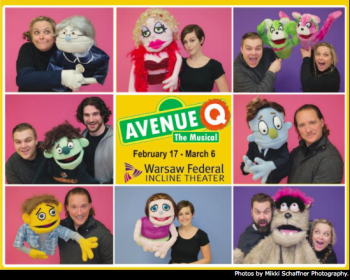 “The show” in question is Avenue Q, the 2004 Tony Award winning send-up of Sesame Street. The speaker is Robert Lopez, the co-conceiver, co-composer and co-lyricist (with Jeff Marx) of the musical; Lopez is also an award recipient for his work on Broadway’s The Book of Mormon and Disney’s film Frozen. Lopez was responding to questions provoked by a recent article in the Cincinnati Enquirer by David Lyman, a freelance writer covering arts and culture for the paper, entitled


 If you’re not familiar with Julia Pascal’s 2003 play Crossing Jerusalem, that’s because the play has only had two productions in the U.S. Or perhaps it is more correct to say that it has had one and a half productions, because the play’s second U.S. run, by J-CAT, the Cultural Arts Theatre at the Michael-Ann Russell Jewish Community Center in North Miami, a community theatre, was shut down by the JCC after giving only half of its scheduled performances.


